
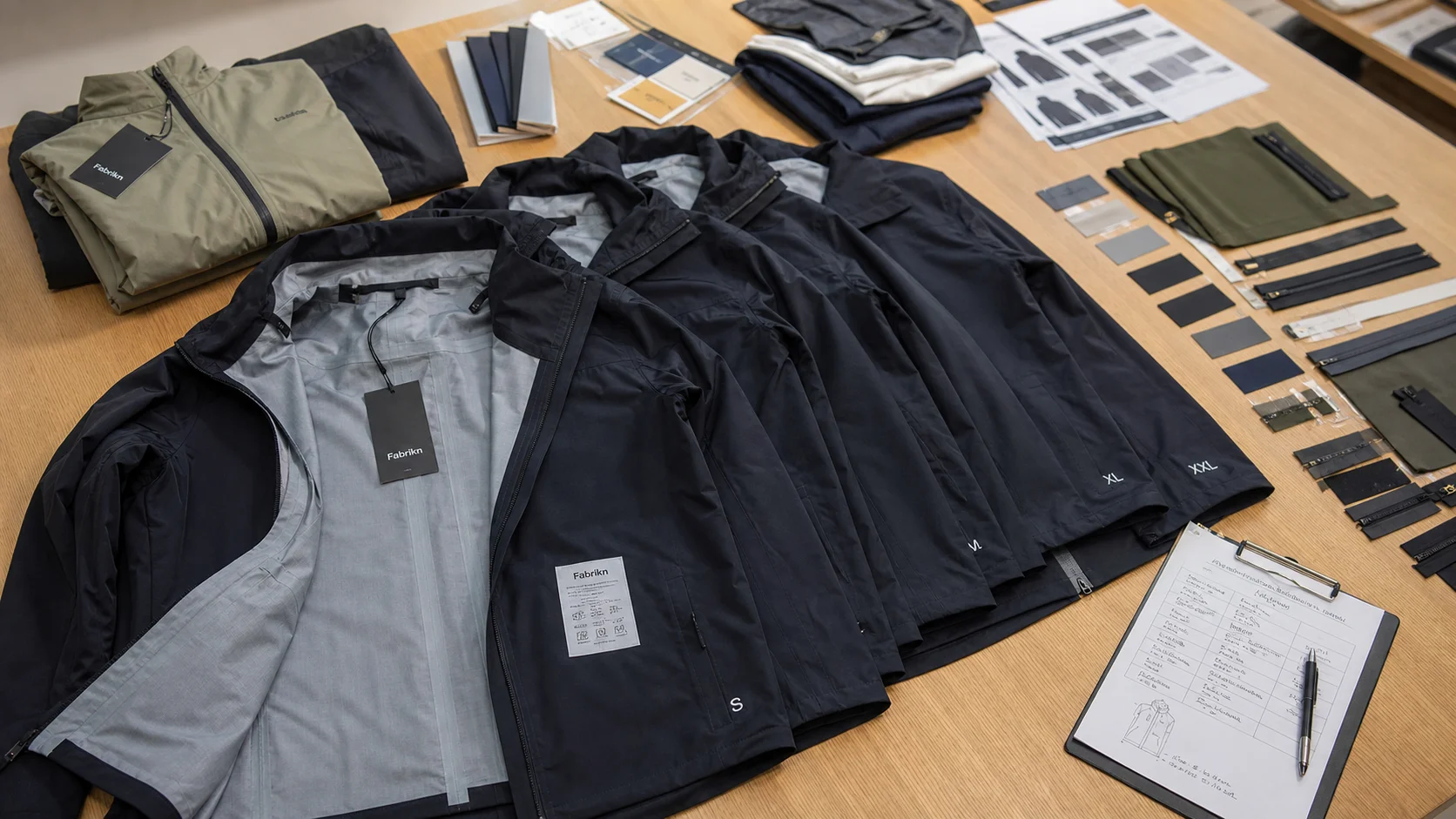
Manage Minimum Order Quantity Negotiations with checks for samples, fit, MOQ, QC evidence, pricing terms, and delivery risk.
Fast answer: Manage Minimum Order Quantity Negotiations: Samples, Cost Lines, QC, and Delivery Risk should be judged by production evidence, not by a generic sourcing promise. The buyer needs sample proof, cost breakdowns, QC checkpoints, and delivery buffers in writing.
Ask for recent sample photos, measurement tolerances, fabric or print test assumptions, decoration test notes, packing examples, and a named inspection checkpoint. These details show whether the team can repeat an approved sample at bulk volume.
Separate garment cost, decoration, labels, packaging, sampling, testing, freight, and rush charges. When every cost line is visible, it becomes easier to reduce colorways, adjust size depth, or reserve more time for sampling.
Negotiating minimum order quantity, or MOQ, is one of the most important steps in sourcing clothing and apparel products. Whether you are a startup launching your first collection, an established brand testing a new line, or a procurement team managing production risk, MOQ negotiations can shape your cash flow, inventory exposure, product margins, and supplier relationships.
The challenge is that MOQ is not just a number. It reflects production efficiency, material sourcing, machine setup, labor planning, and a manufacturer’s risk tolerance. Buyers often want to keep quantities low to reduce risk, while manufacturers need enough volume to make production viable. Managing this conversation well can mean the difference between a sustainable partnership and a deal that fails before production begins.
This practical guide explains how to manage MOQ negotiations strategically. You will learn how to prepare, how to communicate your needs clearly, which tactics actually work, and how to build agreements that benefit both sides. If you are looking for a reliable manufacturing partner, you can also explore Fabrikn’s services page or reach out through our contact us page for a tailored discussion.
MOQ is the smallest quantity a manufacturer is willing to produce for a specific item, fabric, color, design, or style. In apparel manufacturing, MOQ can apply at several levels:
Manufacturers set MOQs for practical reasons. Cutting and sewing lines require setup time. Fabric mills often have minimum dye lots. Printing or embroidery processes involve configuration costs. Packaging suppliers may also have thresholds. In other words, MOQ is usually a reflection of production economics rather than a random rule.
For buyers, especially smaller brands, the issue is that high MOQ can increase financial risk. Ordering too much inventory can tie up capital, create storage challenges, and lead to markdowns if demand is lower than expected. That is why effective MOQ negotiation is essential in the apparel business.
To negotiate well, it helps to understand the motivations on both sides. Buyers want flexibility, lower upfront costs, and the ability to test products before committing to large production runs. Manufacturers want efficient operations, predictable demand, and sufficient margins to justify the production slot.
MOQ affects business in several ways:
Understanding these trade-offs helps you approach negotiation with realistic expectations. If you ask for a very low MOQ, the supplier may agree, but only if you are willing to pay more, simplify the design, or accept longer lead times. The key is not to force the lowest number possible; it is to find a commercial structure that works for both parties.
Good MOQ negotiations begin long before you speak to a supplier. Preparation helps you make smarter decisions, avoid unrealistic demands, and identify where you can compromise without hurting your business goals.
Start by clarifying what you want from the order. Are you launching a new product and need a test run? Are you trying to reduce financial risk? Are you aiming for a long-term supply contract? Your goals will determine how much leverage you have and what trade-offs are acceptable.
MOQ negotiations are closely linked to pricing. If you reduce quantity, unit price may rise. Before approaching a manufacturer, know your acceptable landed cost, target wholesale price, and minimum margin. This prevents you from agreeing to an MOQ that looks manageable but undermines profitability.
Some items are easier to produce in small batches than others. A simple T-shirt with standard fabric and a basic print may have a lower MOQ than a multi-panel jacket with custom trims and multiple colors. Knowing which elements drive MOQ gives you negotiation leverage.
Use market research, historical sales, pre-orders, and sample feedback to forecast demand. If you can demonstrate likely volume growth, suppliers are more likely to be flexible on initial MOQ because they see future upside.
You may not be able to lower every requirement. Decide what matters most to you:
Once you know your priorities, you can negotiate from a position of clarity rather than pressure.
MOQ negotiation is most effective when you treat it as a business problem to solve, not a battle to win. The following tactics can help you reduce barriers while maintaining a healthy supplier relationship.
Instead of asking only, “Can you lower the MOQ?” ask why the minimum exists. Is it driven by fabric sourcing, machine setup, printing constraints, or color matching? Once you understand the source of the MOQ, you can often find a workaround.
For example, if the MOQ is high because of multiple colors, you may reduce the number of colorways. If the MOQ comes from custom fabric, you may switch to an in-stock textile. If trim minimums are the issue, you may simplify the design.
In many cases, a supplier will accept a lower MOQ if the unit price is higher. This can be a useful trade-off for startup brands or test orders. While the per-piece cost rises, your total exposure stays manageable.
This approach works best when you have limited budget and need to validate market demand before scaling.
The more complex your product, the more likely the MOQ will be high. Reducing complexity can lead to a lower minimum. Consider simplifying:
Simplifying the product can reduce setup costs and improve manufacturability, making it easier for the factory to accept a smaller run.
Instead of placing many small orders, consider combining your demand into fewer styles or colorways. A supplier may be willing to produce a smaller MOQ per style if the overall order value is high enough.
This tactic is especially useful for capsule collections or seasonal launches where volume can be concentrated into a few core products.
If you cannot meet the MOQ immediately, offer a phased production relationship. You might start with a smaller initial order in exchange for a forecasted repeat order, or agree to a structured replenishment plan.
Factories value predictability. A clear commitment to future orders can make them more flexible on the first run.
If a manufacturer is hesitant to lower MOQ, ask for a sampling or pilot production phase. This allows you to test the product, validate quality, and build trust before larger volumes are discussed.
A sample-to-production pathway is often one of the most effective ways to secure favorable terms later.
Factories do not only look at unit count. They also consider the overall business value. If you can offer:
you may have more leverage than you think. A supplier may accept a lower MOQ if the relationship looks stable and scalable.
Clear communication builds trust. Explain your business stage, expected growth, and reason for seeking a lower MOQ. Avoid unrealistic pressure tactics or vague promises. Manufacturers are more likely to help buyers who are honest, organized, and easy to work with.
The best MOQ negotiations are not about forcing the supplier to lose. They are about finding a structure where both sides can succeed. That means your offer should address the manufacturer’s concerns while protecting your business.
A win-win agreement may include one or more of the following:
When you think in terms of partnership rather than transaction, suppliers are often more willing to collaborate. A manufacturer who trusts that your brand is serious and well-managed is more likely to make room for you, especially if they see growth potential.
If you want to learn more about Fabrikn’s approach to production partnerships, visit our about us page to understand how we work with businesses of different sizes.
Many businesses weaken their position by making avoidable mistakes. Here are the most common ones.
If you do not understand what drives the MOQ, you may ask for unrealistic changes. This can make you appear unprepared and reduce the supplier’s willingness to be flexible.
A low MOQ is not always the best outcome. Sometimes a slightly larger order comes with much better pricing, quality consistency, or delivery reliability. Always evaluate the total business impact.
Lower MOQ can lead to higher setup costs, shipping inefficiencies, or higher packaging fees. Make sure you calculate the full landed cost before agreeing to a smaller run.
If you want a highly customized product at a tiny quantity, the economics may not work. Be prepared to adjust your design if you want the supplier to meet you halfway.
Too much pressure, excessive back-and-forth, or unrealistic demands can make a supplier less willing to cooperate. Professionalism matters. A respectful negotiation can create long-term value that a hard bargain cannot.
MOQ negotiations become easier when suppliers see you as a reliable long-term partner. Many of the best deals are available not to the buyer who pushes hardest, but to the buyer who communicates clearly, pays on time, and grows consistently.
To build that relationship:
Suppliers are more open to negotiation when they believe the partnership will continue. Over time, your MOQ may decrease naturally as trust increases and order history grows.
For brands seeking a dependable manufacturing partner, Fabrikn offers support across product development and production. You can explore our services or contact our team through the contact us page to discuss your requirements.
At Fabrikn, we understand that MOQ is one of the biggest challenges for growing brands. As a B2B clothing manufacturer, we work with businesses that need practical solutions, transparent communication, and production terms that support growth.
Our team helps clients navigate product development, sampling, production planning, and order structuring with an eye toward commercial realism. Whether you need guidance on fabric selection, simplified construction, or phased ordering, we aim to create a process that balances quality, cost, and flexibility.
If you are preparing for your first order or trying to improve your sourcing strategy, working with a manufacturer that understands business constraints can save time and reduce risk. Visit our services page to learn more about what we offer, or get in touch directly via contact us.
Managing minimum order quantity negotiations is about more than asking for a smaller number. It requires preparation, clarity, and a practical understanding of manufacturing economics. The most successful buyers know how to balance their own needs with the supplier’s operational realities.
By defining your goals, simplifying your product where possible, understanding the reasons behind MOQ, and negotiating on total value instead of just quantity, you can create agreements that support growth without excessive risk. Over time, strong supplier relationships can lead to better terms, smoother production, and more scalable business results.
If you are ready to discuss your next apparel project, Fabrikn is here to help you move from negotiation to production with confidence.
Get a free quote from Fabrikn — your trusted B2B clothing manufacturer with 10+ years of experience. MOQ as low as 200 pieces.
Get a Free Quote →A good MOQ depends on the product type, material, customization level, and supplier capabilities. Simple garments may have lower MOQs, while complex or highly customized products often require larger minimums. The right MOQ is one that keeps your business profitable and manageable.
Yes, MOQ can often be negotiated. Common ways to lower it include simplifying the design, accepting a higher unit price, reducing color variations, committing to future orders, or switching to in-stock materials.
Manufacturers require MOQ to cover setup costs, material sourcing minimums, production efficiency, and labor planning. MOQ helps them make production economically viable.
Sometimes yes, especially if you are testing a new product, preserving cash flow, or reducing inventory risk. However, you should always compare the total cost and expected margins before agreeing.
Be transparent, respectful, and realistic. Explain your business stage, offer trade-offs, simplify the product, and show willingness to build a long-term relationship. Professional communication goes a long way.
Prepare product specifications, demand estimates, target pricing, acceptable margins, and clear priorities. The more informed you are, the stronger your negotiation position will be.