
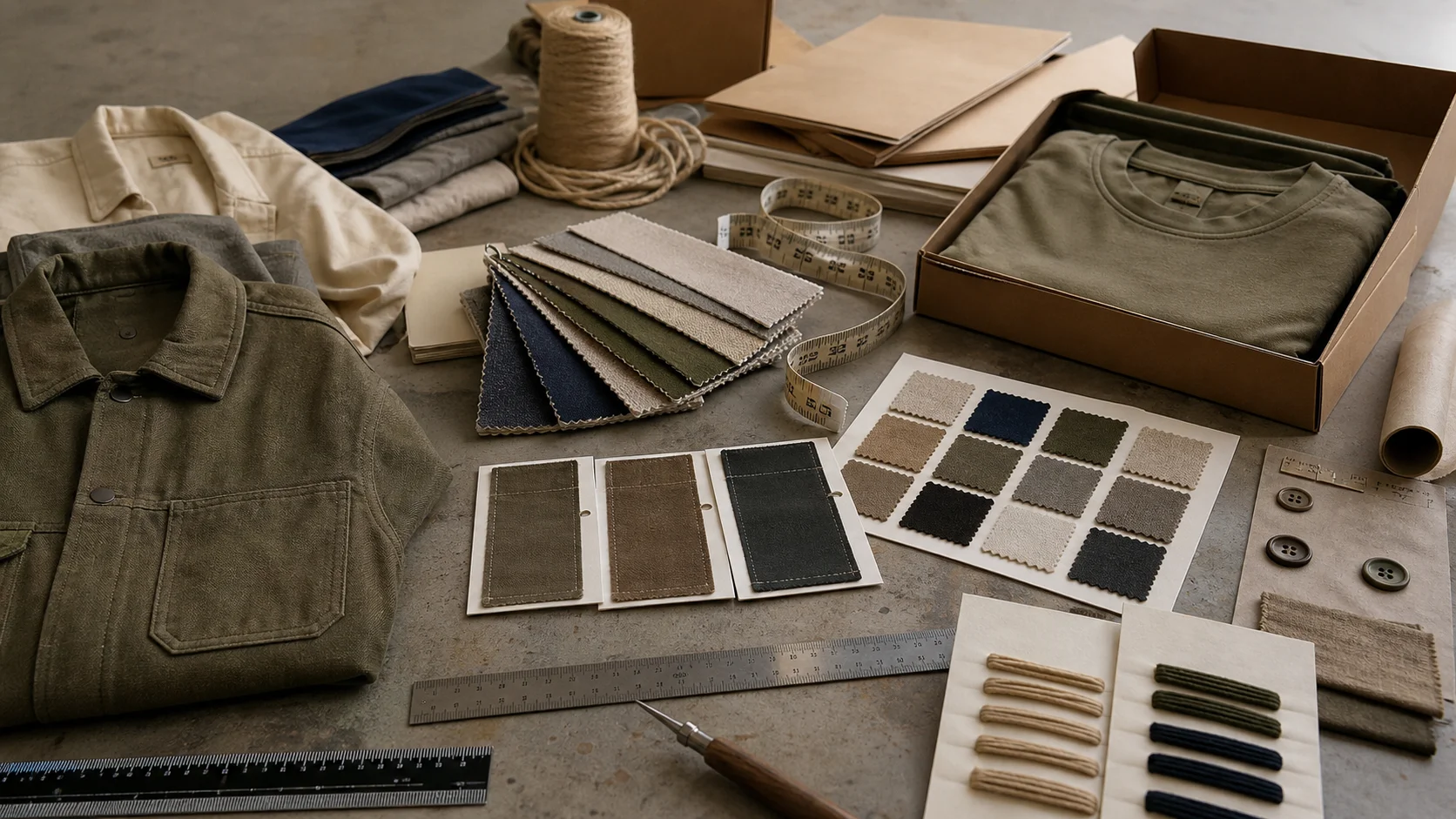
Manage Quality Disputes with Clothing Manufacturers compared by sample evidence, fabric or trim specs, MOQ, AQL terms, cost lines, delivery timing, and...
Fast answer: Manage Quality Disputes with Clothing Manufacturers: Sample Evidence, MOQ, Capacity, and Rework Terms should be judged by production evidence, not by a generic sourcing promise. The buyer needs sample proof, cost breakdowns, QC checkpoints, and delivery buffers in writing.
Ask for recent sample photos, measurement tolerances, fabric or print test assumptions, decoration test notes, packing examples, and a named inspection checkpoint. These details show whether the team can repeat an approved sample at bulk volume.
Separate garment cost, decoration, labels, packaging, sampling, testing, freight, and rush charges. Clear cost lines make it easier to reduce colorways, adjust size depth, or reserve more time for sampling.
Quality disputes are one of the most stressful challenges in apparel sourcing. Whether you are a startup launching your first collection or an established brand scaling production, problems like stitching defects, incorrect sizing, fabric inconsistencies, or poor finishing can quickly affect delivery timelines, customer satisfaction, and profit margins. The good news is that most disputes can be managed effectively when they are handled with a clear process, strong documentation, and a professional communication strategy.
This guide explains how to manage quality disputes with clothing manufacturers in a way that protects your business relationship while still holding suppliers accountable. We will cover common causes of disputes, how to prevent them, how to document issues, how to communicate with manufacturers, and what to do when the problem cannot be resolved quickly. If you work with a production partner like Fabrikn, having a structured dispute process can make the entire manufacturing relationship smoother and more predictable.
Quality disputes usually happen when expectations are not aligned. In apparel manufacturing, even small misunderstandings can lead to large production problems because garments depend on precise measurements, materials, finishing standards, and consistent workmanship. A small 0.5 cm seam allowance error on a knit tee can become a 1.5-2.0 cm fit issue after washing, while a 10 mm shade variation between dye lots can be enough to trigger a rejection at retail.
Some disputes start because the brand’s tech pack is incomplete or unclear. Others happen because the manufacturer interprets specifications differently or substitutes materials without approval. In some cases, the issue is not with the factory at all but with unrealistic expectations from the buyer. For example, if the approved sample was never finalized properly, there may be no reliable benchmark for production quality. In real production hubs like Guangzhou, Dhaka, Ho Chi Minh City, and Istanbul, factories may run multiple buyers on the same line, so even a small omission in a purchase order can result in the wrong 180 GSM jersey, a different rib knit, or an unapproved thread count.
The most common root causes include:
Understanding the cause of the problem is the first step toward resolving it fairly. A dispute that is handled without identifying the root cause is likely to repeat in the next production run. In many sourcing programs, lead times of 18-22 business days for repeat styles and 30-45 business days for first runs are realistic, but only if approvals, fabric booking, and inline checks stay on schedule.
Before discussing resolution strategies, it helps to understand the most frequent quality disputes in clothing manufacturing. These issues vary depending on the product category, but many brands encounter the same patterns repeatedly. For example, a 100% combed cotton jersey tee, a 95/5 cotton-spandex legging, and a recycled polyester fleece hoodie each fail in different ways depending on fabric, machine setup, and finishing process.
This includes broken seams, skipped stitches, uneven hems, loose threads, and poor reinforcement at stress points. These are usually easy to spot but can indicate deeper process problems in the factory. On a typical production line using Juki single-needle lockstitch machines, overlock/serger machines, coverstitch machines, and bartack machines, poor tension settings or dull needles can cause seam failure at the armhole, crotch, or side seam.
Garments may be too large, too small, or inconsistent across sizes. This becomes a major issue when production does not match the approved size spec or graded pattern. A common dispute is a tee body length being 2-3 cm shorter than spec, or a denim waistband sitting 1 cm tighter than the sealed sample.
Common fabric issues include holes, color variation, pilling, shrinkage, twisting, uneven dye lots, and wrong fabric composition. Fabric-related disputes can be expensive because they affect the entire production run. A supplier may promise 220 GSM French terry but deliver 200 GSM, or substitute a lower-cost polyester blend for an approved organic cotton, bamboo viscose, or recycled nylon without permission.
Graphic alignment issues, poor print durability, incorrect colors, or misplaced embroidery can all lead to rejected garments. Screen printing, heat transfer, DTG, and embroidery each have different tolerance risks; for example, a logo placed 8-10 mm off-center or a puff print that cracks after washing can be enough to fail inspection.
Color mismatch between samples and bulk production often leads to disputes, especially when approval standards are not clearly defined. This is common when reactive dyes, pigment dyes, or piece dyeing are used across multiple dye lots, or when garments from Guangzhou and Ho Chi Minh City are matched against the same Pantone reference without lab-dip approval.
Incorrect labels, missing size tags, wrong care labels, or damaged packaging may seem minor, but they can affect compliance and retailer acceptance. A missing OEKO-TEX Standard 100 hangtag, incorrect fiber content label, or wrong carton quantity can delay shipment and trigger chargebacks.
Knowing which defects are most common in your product category helps you create better inspection criteria and respond faster when a dispute arises. If you sell sustainable apparel, you may also want suppliers with real certifications such as GOTS for organic cotton, OEKO-TEX Standard 100 for chemical safety, GRS for recycled materials, WRAP for socially responsible production, or BSCI for ethical compliance audits.
The best way to manage quality disputes is to prevent them before they happen. Prevention starts long before bulk production begins. Brands that invest time in preparation usually experience fewer disputes and solve them more easily when they do occur. In practical terms, that means approving fabric quality, fit, trims, and packaging before any bulk cutting begins, whether the order is for 500 MOQ or 10,000 units.
Your tech pack should include accurate measurements, construction details, fabric composition, trims, labels, stitching requirements, packaging instructions, and approved artwork. The more specific your documentation is, the less room there is for disagreement later. For example, specify whether the body fabric is 180 GSM 100% cotton single jersey, 320 GSM brushed fleece, 400 GSM French terry, or 14 oz denim; whether seams should be overlocked and topstitched; and whether trims must be YKK zippers, nickel-free snaps, or OEKO-TEX certified elastics.
Never move into bulk production without a clearly approved pre-production sample. This sample should serve as the quality benchmark for the entire order. Ideally, both you and the manufacturer should confirm in writing that the sample is the reference point for bulk production. In many factories, a PP sample approval before cutting and a sealed lab dip before dyeing are standard checkpoints.
Every garment has acceptable tolerances for measurements, shade variation, and other minor differences. Define these tolerances upfront so the manufacturer knows what is acceptable and what is not. A common standard might allow +/- 1 cm on chest width for knit tops, +/- 1.5 cm on length for woven shirts, and one shade lot per colorway, unless otherwise agreed.
When possible, include quality standards, inspection checkpoints, defect thresholds, and dispute procedures in your purchase order or manufacturing agreement. A written framework helps avoid confusion if a disagreement occurs. Many brands also add AQL standards, such as AQL 2.5 for major defects and AQL 4.0 for minor defects, plus a clear rework or replacement policy.
Not every factory is the right fit for every product. A reliable partner with experience in your category will understand the quality expectations better and reduce the likelihood of disputes. If you are still evaluating suppliers, you can learn more about a manufacturing partner’s capabilities on Fabrikn’s About Us page and explore available support through Fabrikn’s Services page. Depending on the style, a basic tee might be quoted at $2.50-4.00 per unit at 500 MOQ, while a more complex hoodie with embroidery, rib trim, and garment washing could be significantly higher.
When a quality problem appears, the way you document it matters just as much as the defect itself. Poor documentation weakens your case and makes resolution harder. Strong documentation creates a clear factual record that both sides can review. In practice, the best evidence includes a packing list, carton count, inspection report, defect photos, measurements taken with a tape or digital caliper, and a comparison against the approved sealed sample.
Do not rely on a quick visual check. Inspect a representative sample of the shipment using a consistent method. Focus on construction, measurements, fabric, finishing, labels, and packaging. A common workflow is to inspect cartons from the top, middle, and bottom of the pallet, then check 20-80 pieces depending on order size and risk level.
Separate defects into categories such as critical, major, and minor. Critical defects may make products unsellable or non-compliant. Major defects may affect appearance or function. Minor defects may be cosmetic but still worth recording. A broken seam in the crotch, a reversed care label, or a missing size sticker is usually treated more seriously than a loose thread of under 2 cm.
Visual evidence is one of the most powerful tools in a dispute. Photograph the defect with good lighting and include close-ups, wide shots, and measurement references where needed. If the issue involves fit or movement, video can be helpful. For color claims, take photos under daylight-balanced lighting and, if possible, include a Pantone reference card or swatch.
Always note how many pieces are affected, how many are defective in each size or color, and whether the issue appears isolated or widespread. A dispute becomes much easier to assess when the scale of the problem is clear. For example, if 37 out of 500 units have misaligned prints, the problem is more serious than a single random defect.
Use the approved sample, spec sheet, and color references to show exactly where the production deviated from expectations. This is especially useful when the manufacturer argues that the product meets their interpretation of the order. If the factory works with GOTS-certified organic cotton, GRS recycled polyester, or OEKO-TEX Standard 100 trims, the approved reference should also include the exact supplier and certification scope.
Organizing this evidence into a simple report saves time during negotiations and helps both sides focus on facts rather than assumptions.
Communication is often the difference between a dispute that gets resolved quickly and one that escalates into a damaging conflict. The goal is to be firm, specific, and professional. Start by describing the issue in factual terms, attach the evidence, and ask for the manufacturer’s response within a clear deadline, such as 24-48 hours for acknowledgment and 3-5 business days for a corrective action plan.
Use language that is direct but not emotional. Instead of saying the garments are unacceptable, explain exactly what is wrong and what you need next. For example, “The side seam measurements are 2 cm short against the sealed sample on 46 of 200 pieces, and the print placement is 9 mm low on the front chest logo. Please confirm whether you can rework these units or replace them within 7 business days.”
It also helps to keep communication in writing. Email, shared inspection reports, and annotated photos create a paper trail that is useful if the issue later needs escalation. If the factory is in Guangzhou, Dhaka, Ho Chi Minh City, or Istanbul, written communication is especially important when working across time zones and multiple production teams.
Once the issue is acknowledged, the next step is to negotiate a practical solution. In many cases, manufacturers are willing to rework defective goods, replace affected units, discount future orders, or refund part of the invoice. The right resolution depends on the type of defect, the size of the order, and the timing of the shipment.
Common resolution options include:
When negotiating, focus on restoring value rather than winning the argument. If 12% of a shipment has minor stitching issues, it may be more efficient to rework those units locally than to demand a full remake. If the problem is a wrong fabric composition, however, replacement may be the only acceptable solution.
For larger programs, some brands also negotiate corrective actions such as extra inline inspections, pre-shipment 100% checks, needle detection for certain products, or revised machine settings on the lockstitch, overlock, coverstitch, or bar tack stations.
If the manufacturer does not respond, delays the conversation, or refuses to address the issue, escalate in stages. First, resend the report with a clear deadline and summary of the problem. Then request a meeting with a production manager, sales manager, or ownership contact. If there is still no movement, formally state the remedy you expect and the timeline for response.
In severe cases, you may need to withhold the remaining payment until the issue is addressed, provided your contract supports that approach. You may also need to involve a third-party inspection company, sourcing agent, or legal advisor if the value at risk is significant. The key is to stay organized and avoid making threats you cannot enforce.
A good quality dispute process turns a stressful event into a repeatable business system. Your process should define how defects are reported, who reviews them, what evidence is required, how quickly the manufacturer must respond, and what remedies are available. Even a simple one-page SOP can prevent confusion.
A practical dispute process usually includes:
You can also include supplier qualification criteria in the process, such as minimum experience with knitwear, woven shirts, denim, activewear, or children’s clothing, plus audit standards like WRAP, BSCI, GOTS, OEKO-TEX Standard 100, or GRS depending on your product and compliance needs.
Not every dispute can or should be repaired. If the manufacturer repeatedly misses specs, refuses to take responsibility, or delivers inconsistent quality across multiple orders, it may be time to escalate or switch suppliers. Repeated failures often cost more than moving to a better factory.
Consider switching if:
Before switching, calculate the true cost of staying versus leaving. A lower unit price is not a good deal if it leads to 8% returns, delayed launches, or frequent chargebacks. A factory in Dhaka may offer strong sewing capacity at a lower labor cost, while a facility in Istanbul might deliver faster turnaround for certain European programs; the best choice depends on product type, lead time, and quality control discipline.
The strongest manufacturer relationships are built on transparency and consistency. When both sides understand the rules, disputes become less frequent and easier to solve. Share forecasts early, confirm materials before ordering, and visit the factory when possible to review cutting, stitching, washing, finishing, and packing processes.
It also helps to review performance after each order. Track defect rate, on-time delivery, sample approval speed, communication quality, and correction turnaround. Over time, these metrics reveal whether a supplier is improving or becoming more difficult to manage.
If sustainability or compliance matters to your brand, ask for current certificates and scope documents rather than relying on logos alone. A real certificate number and valid audit date matter more than a general claim of certification.
Quality disputes are a normal part of clothing manufacturing, but they do not have to damage your business. With clear specifications, approved samples, strong documentation, and professional communication, most issues can be resolved fairly and efficiently. The most successful brands treat dispute handling as part of their sourcing system, not as an emergency response.
If you want fewer surprises in production, build your process around prevention, documentation, and structured follow-up. A reliable manufacturing partner can make that much easier, especially when they have experience with the materials, machines, certifications, and quality controls your product requires.
Document it immediately with photos, measurements, and a count of affected units, then compare it against the approved sample and spec sheet.
For most disputes, ask for acknowledgment within 24-48 hours and a proposed solution within 3-5 business days.
Check your written tolerances, approved sample, and measurement records. If the issue was not clearly defined in advance, negotiate a practical remedy and update the spec for future orders.
Depending on your product and market, common real certifications include GOTS, OEKO-TEX Standard 100, WRAP, BSCI, and GRS.
Yes. Even at 500 MOQ, a low-cost order can still face issues with fabric shrinkage, seam quality, print placement, or finishing consistency if the process is not controlled.