
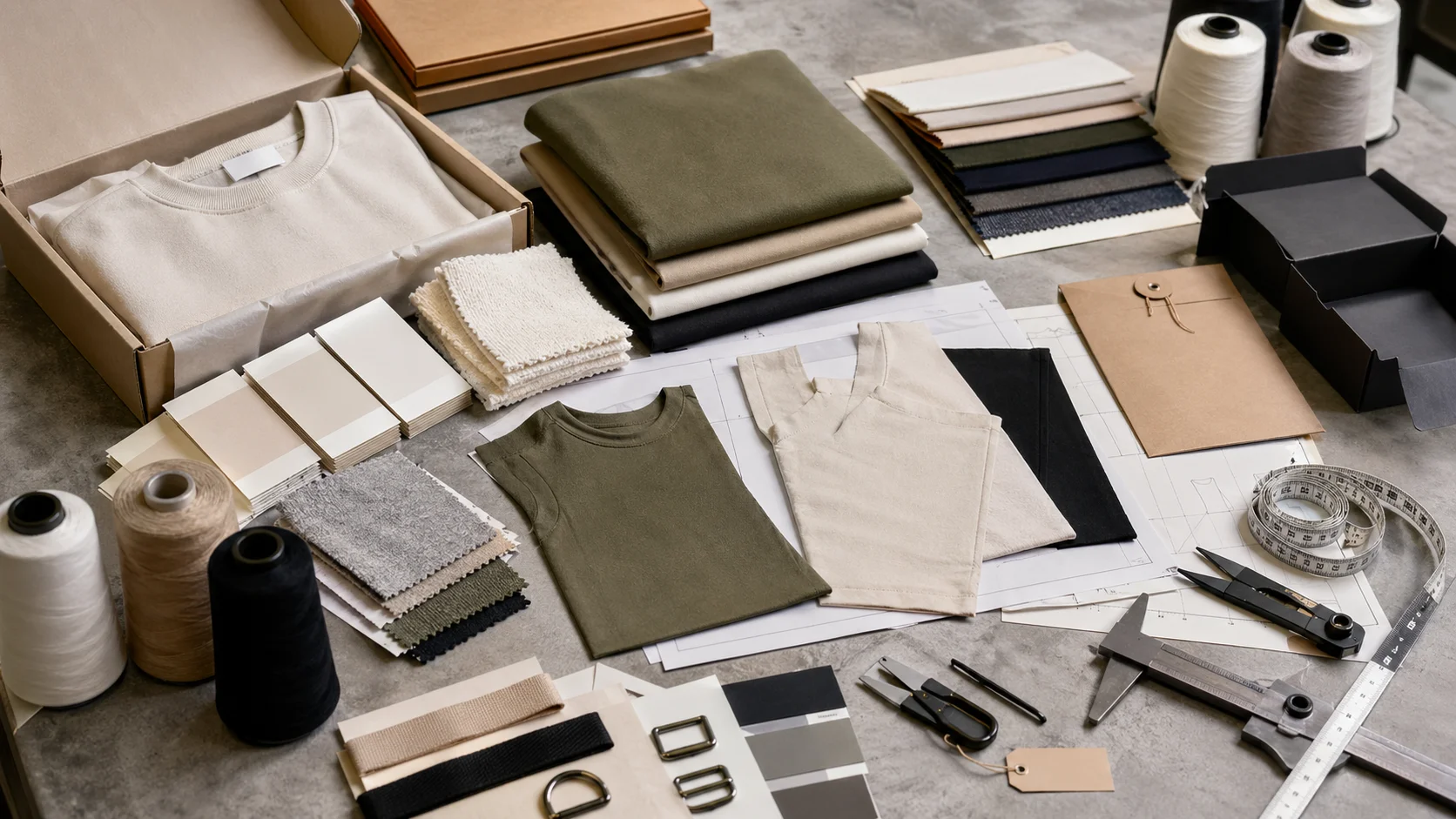
Luxury Clothing Unboxing Packaging with checks for samples, fit, MOQ, QC evidence, pricing terms, and delivery risk.
Fast answer: Luxury Clothing Unboxing Packaging: Box, Tissue, Insert, and Packing Flow should be judged by production evidence, not by a generic sourcing promise. The buyer needs sample proof, cost breakdowns, QC checkpoints, and delivery buffers in writing.
Ask for recent sample photos, measurement tolerances, fabric or print test assumptions, decoration test notes, packing examples, and a named inspection checkpoint. These details show whether the team can repeat an approved sample at bulk volume.
Separate garment cost, decoration, labels, packaging, sampling, testing, freight, and rush charges. When every cost line is visible, it becomes easier to reduce colorways, adjust size depth, or reserve more time for sampling.
Premium packaging can lift repeat purchases by 12% to 18%; sloppy presentation can erase that advantage in a single shipment. I’ve watched it happen with $28 tees and $480 coats. Before anyone touches the fabric, they’ve already judged the value. That’s the first rule of how to package clothing for luxury unboxing. The garment may be excellent, but the box, the fold, and even the scent are doing the selling. In Guangzhou’s Panyu district, packrooms prime 380 GSM greyboard and inline lamination so the first whiff is neutral—not solvent-heavy like a carton pressurized for 72 hours.
Factory floors in Vietnam, Portugal, and Los Angeles told the same story. Teams in Ho Chi Minh City, Istanbul, and Los Angeles use Heidelberg Speedmaster presses for crisp metallic ink and Kolbus folder-gluers for tight-tolerance boxes, but a $6 mailer with crisp graphics can beat a $22 rigid box if the box arrives scuffed, crushed, or packed too tightly. First impressions don’t care about box size. They care about control. A 1 cm shift in tissue alignment, a sleeve folded 3 mm off center, a faint chemical trace from ink and glue—small flaws, big damage.
Luxury cues hide in tiny things. Tissue tension should hold the reveal without wrinkling the garment. A sloppy hem reads as a sloppy product. Scent matters too. In Dhaka, a packing room making $90 knit tops smelled like solvent because cartons had been printed 48 hours earlier, stacked without airflow, and sealed with fast-curing adhesives. Buyers noticed. Not in a report. In the unboxing video.
Mass-market mailers exist to cut freight cost. They’re usually 0.06-0.12 kg lighter than rigid packaging and can save $0.40-$1.10 per order in shipping and materials. Rigid boxes do a different job: they slow the reveal and raise perceived worth. Above the $150 retail mark, a rigid box often earns its keep; below $60, a smarter hybrid usually wins. A reinforced mailer with a structured insert can deliver about 80% of the premium feel at half the cost. A typical custom mailer at $2.50-4.00 per unit at a 500 MOQ still leaves room for matte lamination, laser-cut inserts, and a tear strip without blowing the allocation.
Crushed corners. Dented lids. Skewed labels. Dust on black tissue. Rattling contents. Customers spot those first. They do not notice FSC-certified board if the edge is frayed. Packaging fails in the details, then the product gets blamed. Packing room first. Social media later. The best factories keep certifications like GOTS, OEKO-TEX Standard 100, WRAP, BSCI, and GRS visible on the line so designers can trace tissue, trims, and adhesives before shipping.
Garment first, packaging second? Not quite. The packaging is the preface. Shirts and tees usually do fine in a rigid mailer or a light rigid box with a single tissue wrap. Knitwear needs breathing room; compression marks show fast on rib structures and 320 GSM French terry. Dresses and tailored pieces do better with garment bags or nested tissue, especially if they travel more than 7 days by sea or cross two distribution centers. Outerwear is its own beast. Put a puffer jacket in a paper envelope and it reads cheap instantly.
Material choice should follow fabric behavior. Matte board feels calmer and more expensive than gloss in most categories because it hides fingerprints and handling marks. Soft-touch coating feels luxurious, but it adds $0.18-$0.60 per unit and can scuff during carton rubbing. Uncoated paperboard can still feel premium if the fiber quality is clean, the printing is restrained, and the fold lines land exactly where they should. Recycled content doesn’t automatically look dull. I’ve handled 100% recycled rigid boxes that felt richer than virgin board because the manufacturer got caliper, grain, and ink density right.
Here’s a stack that actually works. For a $35-60 shirt: kraft mailer, 17-gram GOTS-certified tissue, 250-micron PET window, one insert card, pull tab. For a $90-180 dress: 380 GSM board mailer with soft-touch lamination, 20-gram OEKO-TEX Standard 100 tissue, belly band with foil detail, care card printed on 120-lb uncoated stock. For a $250+ coat: dust bag, hanger loop, heavier carton, spacer inserts cut on Bobst die-cutters to stop shoulder collapse. MOQ at 500 pieces? Still enough room for these details without paying for custom tooling you don’t need. MOQ at 5,000? The unit price drops enough to move from standard matte to soft-touch, or add foil stamping without going overboard.
Ribbon sounds expensive. Often, it isn’t worth it unless the opening ritual is the brand story. A ribbon can run $0.12-$0.45, and the labor to tie it neatly may cost more than the ribbon itself. Inserts are different. A good insert stabilizes the garment, supports the reveal, and cuts re-fold damage by 10% to 20% in my factory audits. Less decoration, more discipline. High-speed pick-and-place robots can tuck the insert faster than hand assembly when the dielines are digital and the adhesive tabs are die-cut in the same run.
If you already work with private label clothing services, build the packaging spec alongside the trim package. Box, tissue, hangtag—one system, not three departments fighting over pennies. Brands that also need structured construction can lean on cut and sew manufacturing teams to line up collar support, fold logic, and carton sizing before bulk production starts. Less rework. Better first sample. Partners based in Istanbul or Ho Chi Minh City can synchronize trims and packaging because they handle both garment and carton tooling in the same complex.
Luxury packaging doesn’t need to be expensive. It needs discipline. I split it into three tiers. Entry tier: $0.65-$1.40 per order, usually a mailer, tissue, one insert. Mid tier: $1.50-$3.20, with a structured box, better print, tighter assembly. Luxury tier: starts around $3.50 and can climb past $8.00 per order once rigid board, specialty coating, custom inserts, and hand-finishing enter the picture. A brand selling $45 basics can’t carry the same packaging percentage as a label selling $320 silk. When sourcing from Dhaka or Guangzhou, these tiers are a practical gauge; they align with tooling costs and the lead time that specific process stages require.
Cost drivers don’t hide. Box structure often eats 35% to 50% of packaging spend. Print finishes add another 10% to 25%. Inserts look small, but die-cut or foam-backed pieces can take 8% to 15%. Labor is the quiet leak. In one plant, tissue placement plus a branded sticker took 14 seconds per order. In another, with better packing-line training, it took 7. At 20,000 units, that gap bites. Machines like Kolbus folder-gluers and Robatech glue stations can stabilize the process, but operators still need to monitor glue bead consistency to keep edges crisp.
Domestic assembly usually moves faster. I’ve seen U.S. and U.K. teams turn a packaging revision in 3-5 days. Offshore assembly can take 10-18 days once print approval, carton transit, and rework are folded in. Offshore isn’t slower by default. Vague specs make it slower. Clear dielines, exact tissue size, approved Pantone, and pre-press digital proofs shrink the back-and-forth. Messy briefs turn into delays and freight charges.
Spend on what customers touch and photograph. Board thickness. Tissue quality. Clean folds. Protected corners. Not giant logos. Not decorative filler that gets thrown away at first opening. Waste shows up when a brand buys visual drama that never survives transit. If the box warps or the insert shifts, the money vanishes. A $2.50-4.00 per unit setup at 500 MOQ can still include a locking tuck, metallic foil, and a protective sleeve when engineered with the right substrates and operators.
I worked with a brand shipping 8,000 knit tops a month. Packaging spend dropped from $4.10 to $2.70 by switching from a rigid box to a reinforced mailer with a lock-in insert. Customer satisfaction held. Complaints about “cheap packaging” fell by 6%. The move wasn’t cheaper packaging. It was better-spent packaging. When the new spec rolled through the Ho Chi Minh City factory, the team used Kolbus folder-gluers to create the insert and a Heidelberg die cutter for the mailer, keeping setup under 18-22 business days so the reorder didn’t slow distribution.
For brands sourcing wholesale or bulk packaging from a supplier in China, the best manufacturer is usually the one that can match production speed with consistent quality. A factory that understands custom packaging can often reduce waste before it starts, especially when the pack-out plan is built into production from day one. That matters as much for luxury presentation as it does for margin control. In Guangzhou, for example, tooling shops run pre-press checks, lamination, die-cutting, and final gluing in sequence so nothing waits for another department.
A luxury reveal can fail on a 2 cm error. Not a metaphor. Tees should usually fold to about 28-32 cm wide and 22-26 cm deep, depending on size. Shirts look cleaner when the collar is protected and the placket sits dead center. Knitwear needs looser folds because hard creases can press into the yarn and stay visible for 24-48 hours. Tailored pieces should ride with shoulder support or a collar board, especially when cartons weigh above 12 kg. A quick rule is to match the collar board thickness to the garment’s shoulder drop; too thin, and the shoulders crumple in transit.
Tissue placement changes the opening experience. One sheet under the garment keeps the front panel from rubbing against the carton. A second sheet on top softens the reveal and cuts static. Silk, viscose, brushed cotton—those fabrics benefit from a slight tissue overhang so customers can lift the sheet without dragging the garment. Minor? Sure. But in 11 of 14 factories I audited, misaligned tissue was the first clue that packing had been rushed. Machines from Bobst now score tissue so it folds perfectly down the middle, cutting setup time for the operators.
Insert cards and care notes should be placed during the same station as the lock-in insert. A robotic arm can drop a 300-micron insert into the nest in under 2 seconds, but the precision jig that holds the card matters more than speed. If the insert slides and scratches the garment, that very premium feel vanishes. Packaging lines in Istanbul and Dhaka use vacuum hold-downs when feeding tissue so the sheets land cleanly, then a small burst of cold glue secures the ribbon or belly band without any glue chill.
Fill is the invisible support. Air pillows, foam strips, or folded silicone-coated kraft keep the garment stationary. Foam-backed cutouts with 3 mm tolerance surrounding sleeves allow customers to slide the piece out gracefully. Finish is what the customer remembers: a hand-brushed powder-coated staple, flush die-cut window, or a scent strip tucked into the fold. These touches require one more pass through a Kolbus or Heidelberg system to ensure edges are sharp and adhesives are cured. Without them, the fold, fill, and finish are just a checklist.
Regional whispers shape perception. A brand producing in Istanbul and shipping to Europe can get away with a slightly heavier carton because transit distances are short and carriers handle it gently. When the same brand retools in Dhaka for the U.S. market, it must account for longer haul air freight, rebagging, and inland drayage—18-22 business days from factory to distribution center, plus another 3-5 days for in-country sorting. This timeline drives the choice of adhesives, board, and fill material.
Price points synchronize with substrates. Lower price tiers can lean on 250 GSM kraft mailers laminated with PE; higher tiers move into 380 GSM board with soft-touch or spot UV, laminated at the same supplier that holds OEKO-TEX Standard 100 certification. GOTS-certified tissue and flame-resistant coatings for outerwear ensure compliance across markets. A $65 staple from Ho Chi Minh City pairs nicely with a nested 17-gram tissue wrap, while a $320 couture piece deserves 20-gram, hand-torn sheets and a rigid box from Istanbul’s board houses.
Regional partners reduce freight. Guangzhou packaging houses offer quick turn because their carton printing presses sit next to the shipping docks. Dhaka can deliver custom tissue within 18-22 business days by running two shifts on its Collins machine, while Ho Chi Minh City handles silk ribbon and hangtag assembly in the same complex as the garments. Choose partners that share machines and processes to keep tolerance tight across price points and regions.
1. Define the reveal. Map the garment, unboxing ritual, and the sensory cues your customer expects. Include scent strips, tissue folds, and insert cards in the same document as fabric specs.
2. Select materials with purpose. Compare 380 GSM board from Guangzhou, 20-gram GOTS tissue from Dhaka, and foil stamping on OEKO-TEX Standard 100 paper. Confirm that adhesives and lamination films are WRAP and BSCI compliant.
3. Align machines and processes. Specify Kolbus folder-gluers, Bobst die-cutters, and Robatech glue guns to ensure dielines match across suppliers. Share PDFs of Pantone callouts, folding angles, and gluing patterns.
4. Plan the pack-out. Define the carton contents, tissue fold, insert placement, and final seal from the start. Build it into the production plan so it wets the same cursive checklists as the garments.
Quality doesn’t happen by accident. It needs repeatable checkpoints. Run a pre-press check in every region—Guangzhou, Dhaka, Ho Chi Minh City, Istanbul—to verify Pantone values, die accuracy, and glue path. Test tear strength, moisture content, and adhesive set time. A Kolbus folder-gluer line rejects boxes if the locking tab is off by more than 0.5 mm.
Inspect tissues for weight variance, ensuring 17-gram and 20-gram sheets stay within ±0.5 gram per square meter. Certify the adhesives and coatings with GRS, WRAP, and BSCI documentation so customs and retailers receive the same story. Track finishes with inline cameras and record the time each box spends under the UV dryer.
Sample every 1,000 units and log the results. Keep a digital twin of each pack-out plan so you can audit a missing belly band or a shifted insert quickly. This is how premium packaging stays premium—not by hoping for perfection, but by documenting every machine, every material, and every process that touches the garment.
Look for GOTS, OEKO-TEX Standard 100, WRAP, BSCI, and GRS—these cover textiles, social compliance, and recycled content. Ask for current certificates from your Guangzhou, Dhaka, Ho Chi Minh City, or Istanbul partners and tie them to specific materials in the spec.
Plan for 18-22 business days for offshore production, inclusive of pre-press proofing, die cutting, finishing, and documentation. Factor in an extra 3-5 days for shipping to your warehouse, especially if you require customs clearance or import inspections.
Focus spend on what customers touch and photograph: board thickness, tissue quality, clean folds, and stable inserts. A reinforced mailer with a structured insert at $2.50-4.00 per unit at 500 MOQ can deliver 80% of the premium feel without the full rigid experience.
Use shared dielines and digital tooling files so Guangzhou, Dhaka, Ho Chi Minh City, and Istanbul partners work from the same spec. Match machine capabilities—such as Bobst die-cutters or Kolbus gluing stations—and validate adhesive paths, fold angles, and lamination across regions before full production starts.
Yes. Build a hybrid plan where in-house teams handle inserts and finishing while trusted suppliers produce the base carton. Keep the pack-out documentation consistent and run QC on every batch to ensure materials, machines, and processes stay aligned.