
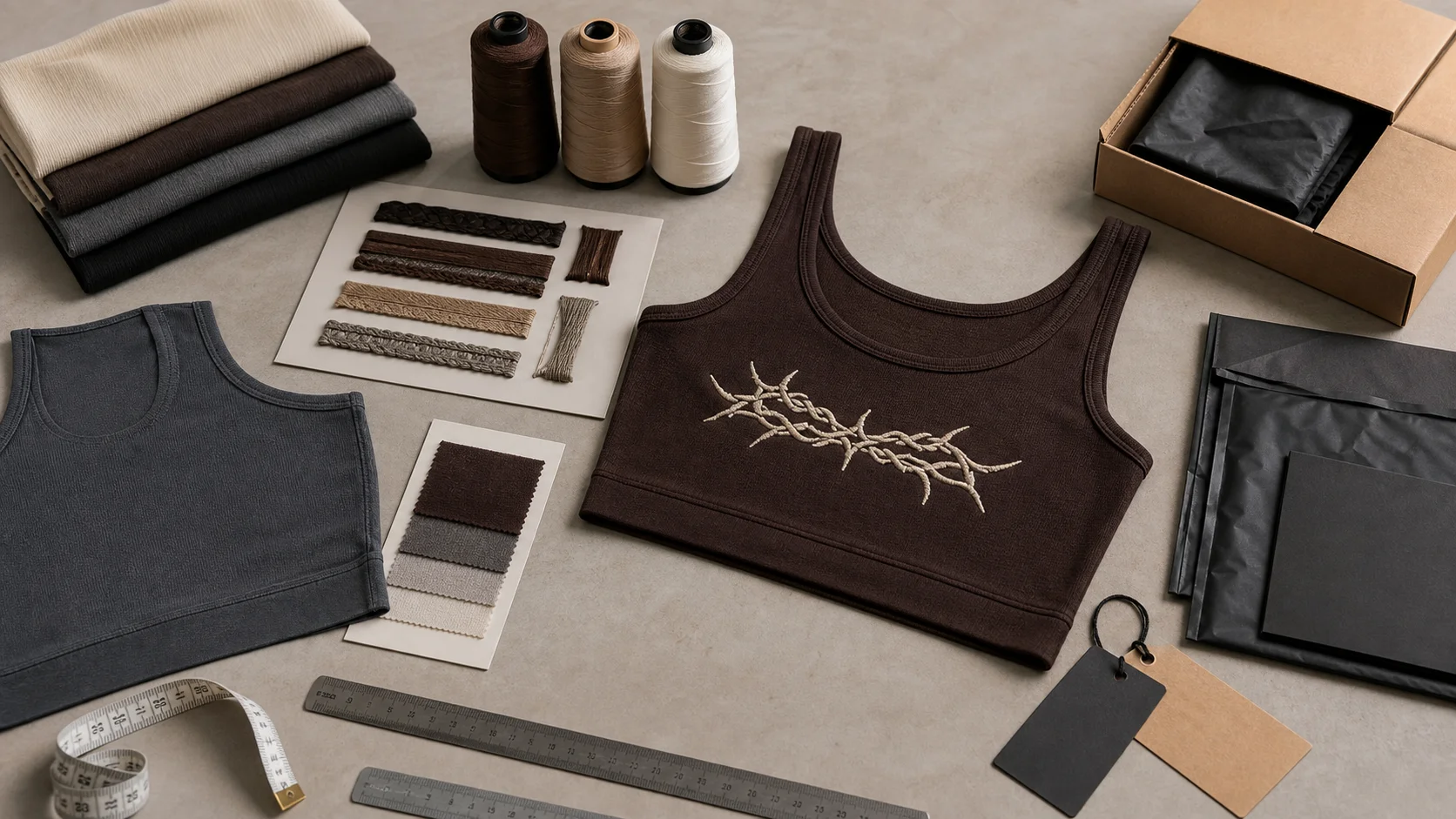
Ecommerce Clothing Packing with checks for samples, fit, MOQ, QC evidence, pricing terms, and delivery risk.
Fast answer: Ecommerce Clothing Packing: Fold, Bag, Box, Label, and Cost should be judged by production evidence, not by a generic sourcing promise. The buyer needs sample proof, cost breakdowns, QC checkpoints, and delivery buffers in writing.
Ask for recent sample photos, measurement tolerances, fabric or print test assumptions, decoration test notes, packing examples, and a named inspection checkpoint. These details show whether the team can repeat an approved sample at bulk volume.
Separate garment cost, decoration, labels, packaging, sampling, testing, freight, and rush charges. When every cost line is visible, it becomes easier to reduce colorways, adjust size depth, or reserve more time for sampling.
One crushed hem can wipe out the profit on an order faster than any discount ever could. If you are figuring out how to package clothes for ecommerce store orders, start here: packaging is a margin decision dressed up as logistics. In apparel audits, poor packing choices have pushed return rates up 7-12%, and the real cost only shows up once re-ship fees, customer service time, and lost repeat purchases are counted.
Lightweight garments are not safe just because they weigh little. A 180 GSM cotton tee can still pick up moisture in a humid last-mile van, scuff against rough carton edges, or arrive with a sleeve crease that photographs badly on the customer’s doorstep. I’ve watched brands lose money on items that survived transit physically but failed visually. Presentation damage is still damage.
By price point, the pattern shifts. Budget basics sold at $12-$18 usually ship in thin poly mailers, and customers tolerate small imperfections because the price feels disposable. Premium fashion, often $80-$250 per order, gets overpacked with tissue, inserts, rigid boxes, and double wrapping. Sounds safer. Not always. More layers create more handling steps, more compression points, and more chances for a packer to make a mistake.
At factories in Vietnam and Turkey, one counterintuitive result showed up again and again: overpackaging can raise damage rates by trapping humidity and adding pressure points around seams, collars, and embellishments. A velvet dress sealed inside a decorative box with three inserts and a plastic garment sleeve may look luxurious. Left in a hot container for 10-14 days, it can arrive with odor retention or crush marks. Luxury isn’t the problem. Airflow and load distribution are.
Packaging waste rarely comes from one dramatic failure. It comes from tiny leaks in the system: a mailer that splits, a label that scans twice, a box that is 20 mm too large, or a fold method that forces a return because the garment wrinkles badly. Across regions, those leaks multiply. A parcel that is fine in Los Angeles may be punished by wet weather in Manchester or dense courier sorting in Seoul.
I built my own packing audits around garment type, because a hoodie does not pack like a silk blouse. When you decide how to package clothes for ecommerce store fulfillment, start by sorting inventory by fabric weight, silhouette, and fragility. Tees, denim, knitwear, dresses, and accessories should never share the same default pack method. If your team packs all five the same way, you are paying for inconsistency with returns.
For tees and basics, fold to a fixed width — usually 25-30 cm, depending on carton or mailer size — then add a single sheet of tissue if the print is delicate. Denim wants a tighter fold along the side seam to prevent knee creasing, especially on 12 oz and 14 oz jeans. Knitwear needs space. A heavy 320 GSM French terry hoodie should be folded once, then once again, not compressed into a tiny mailer that leaves permanent ridge marks. Dresses need more protection around straps and embellishment zones; a garment bag or inner sleeve keeps friction down.
Accessories are a separate line item. Belts, caps, socks, and small leather goods often disappear into oversized cartons, which is why I insist on barcode placement facing the opening edge. A packer should scan the SKU, verify color and size, then place the barcode where a warehouse checker can see it without unwrapping the item. Ten to fifteen seconds saved per order sounds small. On 3,000 monthly orders, those seconds turn into real labor.
Use desiccant only where moisture risk justifies it. In humid climates, one 5-10 gram silica packet can protect a garment bagged item; in dry regions, it may be unnecessary and only adds waste. Poly mailers are usually the right choice for tees, leggings, and flat-folded cotton items because they are light, cheap, and hard to beat on freight cost. Cartons belong where structure matters, like premium dresses, embellished items, or gift sets that should not bend in transit.
Quality control is where many brands fail. I’ve seen beautiful packaging specs collapse because nobody checked the seal strength, label scan, or final carton dimensions. Your checklist should include four things: seal integrity, a successful scan test, a basic drop test from waist height, and size verification against the order slip. If the item is meant to ship in a 30 x 22 x 4 cm box, do not accept a 34 cm substitute just because it was nearby. That extra space raises dimensional weight and can add $0.80-$2.40 per shipment on common lanes.
Last year I worked with a brand that was struggling with returns on knit dresses. The fix was not expensive: replace a bulky insert with a single folded tissue layer, move from a glossy box to a recycled mailer with a stiffener, and train packers on one fold standard. Returns tied to “arrived wrinkled” fell by 18% over six weeks. If you want product structure plus brand control, private label clothing services are only useful when the package standard matches the garment standard.
Material choice should follow function, not habit. A good mailer blocks moisture, resists tears, and survives sloppy handling while staying light enough that your shipping rate does not jump for no reason. In my audits, the winning materials are rarely the fanciest ones. They are the ones with the fewest failure points.
Poly mailers usually cost $0.08-$0.22 per unit depending on thickness, print, and recycled content. They work well for flat garments and small accessories. Recycled mailers often run $0.12-$0.28, and the premium is worth it if you sell enough volume to care about customer perception. Corrugated boxes start around $0.35 and can climb to $1.20 or more for rigid or printed styles. Garment bags, used as inner protection, sit around $0.05-$0.18. Compostable mailers can be attractive at $0.18-$0.40, but they need testing because not every compostable film survives rough courier handling.
Inserts, tapes, and seals matter more than brand owners admit. A $0.12 upgrade from a weak adhesive strip to a better seal can prevent a $7.50 return if the parcel opens, gets wet, or arrives visibly damaged. I have measured the same jacket shipped in two materials and seen the cheaper mailer lose every time on puncture resistance, even though the unit cost was lower by only a few cents.
Regional sourcing changes the equation. In Portugal and Mexico, I saw recycled board perform well when carton compression was controlled and boxes were stacked no more than 8-10 high. In parts of South Asia, low-cost board looked fine on paper but collapsed under humid warehouse conditions unless outer cartons were reinforced. That is why a low-cost material can perform better only in the right compression environment. Cheap is never just cheap.
According to ASTM packaging test methods, material strength should be validated under realistic handling conditions, not showroom conditions. I prefer to match material choice to the garment’s fail point: abrasion for knits, moisture barrier for cotton basics, structure for premium tailoring, and presentation for giftable apparel. If you need a range of packaging-compatible product builds, it helps to browse our product catalog before locking dimensions.
A stronger outer layer does nothing if the inner fold shifts during a 6-hour sort line. That is why I favor a balanced system. One layer protects, one layer stabilizes, and nothing extra sits there pretending to be insurance. For brands comparing factory output, asking the manufacturer, supplier, or factory for pack-out samples is part of production planning, especially when MOQ, custom branding, wholesale programs, and bulk orders all affect quality.
Packaging standards should change with the brand tier. Basics and athleticwear can survive in plain recycled mailers, provided the fold is clean and the label is readable. Mid-market brands usually need a printed mailer or slim carton to signal care without blowing up cost. Luxury and giftable apparel need better structure, but not necessarily more layers.
In North America, buyers accept plain mailers more easily if the product is priced at $20-$40 and the return policy is clear. In Europe, there is slightly more tolerance for minimal packaging when recycled content is visible on pack. In parts of Asia, branded boxes and dust sleeves still carry more weight for premium perception, especially on gifts. The same shirt can travel well in all three regions, but customer expectation changes the unboxing standard.
I usually treat packaging spend as a share of SKU value. Basics should land around 1-2% of product value. Mid-market apparel often sits at 2-3%. Premium goods can justify 3-5% if packaging reduces wrinkles, claims, and store-level returns. Go beyond that and you are paying for ceremony rather than protection.
The cleaner package often wins the review, not the loudest one. I saw a premium jersey brand switch from a heavy embossed box to a stiff recycled mailer with a branded belly band. Unboxing became less theatrical, yet customer satisfaction improved because the dresses arrived flatter and cleaner. Fancy does not win if the garment looks tired.
For fast fashion, speed and cost beat ceremony. For slow fashion, shape retention, traceability, and lower waste matter more. That is why the correct answer to how to package clothes for ecommerce store is not one package. It is a tiered system tied to category, margin, and market. If your production partner in China offers custom packaging during wholesale sourcing, make sure the supplier matches the same quality standard you expect from the finished garment.
Three common setups show the tradeoff clearly. A basic mailer with tissue and label costs about $0.15-$0.35 in materials and takes 20-30 seconds to pack. A branded mailer with a fold insert and sticker seal usually lands at $0.30-$0.65 and needs 30-45 seconds. A rigid box with tissue, insert card, and garment sleeve can cost $0.70-$1.80 and often takes 45-70 seconds, especially when the team has to align brand panels and check presentation.
Cost does not stop at materials. A box can raise dimensional weight, which is painful on air and express lanes. On a common cross-border shipment, that extra carton volume can add $1.50-$4.00 in freight, even before labor is counted. Mailers compress better and usually ship at lower volumetric cost, which is why many apparel brands quietly move to them after launch.
I map packaging decisions against order volume, average order value, and return sensitivity. Low AOV, high volume, low return sensitivity: use a basic mailer. Medium AOV, moderate volume, moderate return sensitivity: use a branded mailer or slim carton. High AOV, giftable, high return sensitivity: use a rigid box only if the product truly needs structure. A $120 dress is not automatically a box product if a reinforced mailer keeps it flatter and costs $2.10 less per order.
Timing matters as much as spend. A packing line that saves 15 seconds per order can free nearly 7 hours over 1,600 orders. That is one extra worker shift saved every few days. If you are choosing between a premium setup and a simpler setup, measure labor first, then damage rate, then freight. Shiny packaging hides a slow workflow.
For brands scaling private-label SKUs, I often recommend a packaging spec review alongside cut and sew manufacturing decisions, because the seam construction, hangtag placement, and fold logic affect the packout. If your MOQ is 500 pieces and your lead time is 3-4 weeks, you can still standardize before inventory lands. If you need help defining the costs, get a free quote and compare the packout scenarios side by side.
Lower impact packaging is not a slogan. It is a set of measurable choices: recycled content, mono-material design, right-sized packs, and fewer components. If a package uses 80% recycled content but mixes plastic, foil, and laminated paper into one impossible-to-separate unit, the claim is weaker than it looks.
Paper mailers are often easier to recycle than mixed-material boxes, but only if the inks and adhesives stay within local acceptance rules. Poly mailers can be recyclable in some systems, yet many curbside programs reject them unless a store drop-off exists. Mixed materials are the worst offenders because one shiny coating or a thick adhesive strip can push the whole item out of the recycling stream.
Data from Textile Exchange continues to show that material choice matters, but packaging only counts if the supplier can back it with certificates and spec sheets. I ask for recycled content declarations, resin identification, paper fiber proof, and printed ink details. Marketing copy is not evidence. A supplier certificate with batch references is. For compliance and environmental labeling standards, OEKO-TEX is another useful reference point, and the U.S. Commercial Service can help brands assess sourcing and export considerations.
Regional access changes the story. A mailer that is technically recyclable in Germany may not be accepted in parts of the United States, where sorting rules differ by municipality. The same logic applies in Australia and Canada, where local collection capacity varies. If your brand sells across borders, do not assume one “eco” pack will behave the same way everywhere.
My bias is simple. Use less material first. Then choose the material your customers can actually dispose of correctly. Sustainability claims fail when the pack looks green but lands in landfill because nobody checked local rules. That is not environmental progress. That is expensive theater.
Start with an audit of the current pack process. Measure damage rate, packing time, dimensional weight, and return reasons for 30 days. Then define rules by SKU group: tees, knits, denim, dresses, and accessories. Train packers on one fold standard per group, one approved mailer or box size, and one label placement rule.
Run a simple implementation checklist. Set inspection thresholds for seal quality, scan success, and size tolerance. Test two packaging setups over 500-1,000 orders before you scale. Compare return reason codes, not just total returns, because “wrinkled,” “damaged,” and “not as expected” tell different stories.
Monthly revision is enough for most brands. Faster than that, and you risk chasing noise. Slower than that, and small failures become expensive habits. The best system is the one that reduces cost, keeps garments clean, and travels well across borders. If you are refining how to package clothes for ecommerce store fulfillment, document the standard in a one-page SOP and keep it visible on the packing line.
Most apparel orders cost $0.15-$0.65 to package in basic or branded mailers. Boxed premium orders can reach $0.70-$1.80 in materials before labor and freight. If dimensional weight increases, shipping can rise another $1.50-$4.00 per parcel.
Use a fixed fold method by garment type, keep knitwear looser, and place tissue only where fabric friction matters. Tees usually need one clean fold, while dresses and premium items benefit from a garment sleeve or slim carton. Avoid overfilling the pack.
The best return-friendly option is usually a resealable poly mailer or a slim box with enough structure to be reused. For items under $40, a mailer is often enough. For higher-value pieces, use a box only if it protects shape and reduces complaint risk.
A basic rollout usually takes 2-4 weeks if materials are already sourced. Training packers and testing labels can happen in days, while A/B testing over 500-1,000 orders gives cleaner data before full adoption. Cross-border brands may need longer for compliance checks.
Start with right-sizing, fewer components, and recycled-content mailers. A switch from a multi-part box setup to a mono-material mailer can save $0.10-$0.40 per order. The biggest savings usually come from reducing empty space and lowering freight weight.