
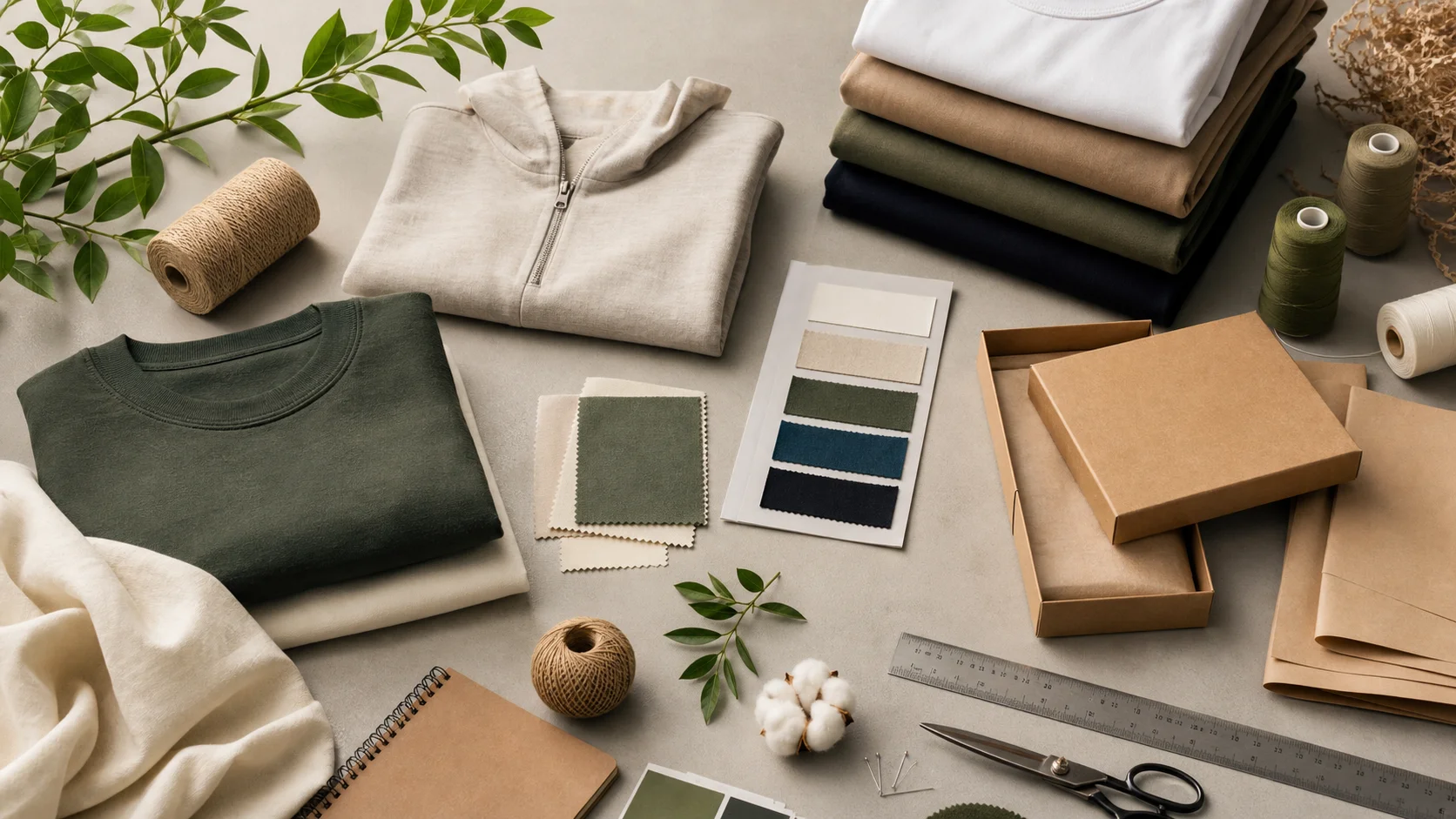
Print Logos on Apparel Mailer Bags compared by sample evidence, fabric or trim specs, MOQ, AQL terms, cost lines, delivery timing, and rework responsibility.
Fast answer: Print Logos on Apparel Mailer Bags: Material, Print, MOQ, and QC Terms should be judged by production evidence, not by a generic sourcing promise. The buyer needs sample proof, cost breakdowns, QC checkpoints, and delivery buffers in writing.
Ask for recent sample photos, measurement tolerances, fabric or print test assumptions, decoration test notes, packing examples, and a named inspection checkpoint. These details show whether the team can repeat an approved sample at bulk volume.
Separate garment cost, decoration, labels, packaging, sampling, testing, freight, and rush charges. Clear cost lines make it easier to reduce colorways, adjust size depth, or reserve more time for sampling.
A mailer bag can make a brand feel considered or careless before the customer has even touched the garment. If you are researching how to print logos on apparel mailer bags, start with the surface, not the artwork. I’ve watched a $38 hoodie land in a $0.28 bag with blurry text, and the whole order felt downgraded. It hammered the point home: tiny slips on the surface scream louder than any logo.
Eight countries. More than 200 factory visits. The pattern is always the same: print durability, ink adhesion, and bag material have to survive shipping stress, abrasion, and temperature swings together. A bag that looks perfect at dispatch can scuff after three courier hubs, two sorting drops, and one cold warehouse night. Heat warps films. Recycled fibers absorb ink unevenly. And that surface matters as much as the logo.
Retail tiers use mailer graphics as a signal. Fast-fashion brands often accept 1-color prints on LDPE at 20,000-unit volumes because speed beats finesse. Premium DTC labels spend more on matte finishes, cleaner registration, and restrained branding, sometimes on 500 to 1,000 bags for a seasonal drop. But sustainability claims enter the picture too. A crisp recycled bag with visible fiber speckle can read as honest; a fake-eco print on glossy plastic can feel careless.
The most expensive bag is not always the best-printed bag. I saw that in one factory outside Ho Chi Minh City, where a $0.41 co-extruded mailer had sharper type than a $0.62 recycled-content bag because the cheaper option had better press discipline, tighter plate setup, and fewer last-minute artwork changes. Setup quality matters more than raw substrate cost. A disciplined press crew can save a flawed design. A sloppy one can ruin an expensive material.
The real question isn't just “what looks good.” It's which method fits the material, the order size, and the brand standard. I usually ask for the intended print area, the expected carton compression, and the delivery window before I talk about inks. If the mailer bag manufacturer cannot answer those three things cleanly, the quote is premature.
There are five common ways to print logos on apparel mailer bags, and each one behaves differently once you move from sample to shipment. Flexographic printing suits volumes of 5,000 to 50,000+ units because plate costs are spread thin. Digital printing feels better at 500 to 2,000 units when artwork changes fast and lead time is short. Screen printing still has a place for bold 1- or 2-color marks, especially on kraft, though it struggles with fine gradients and tiny type. Hot stamping, embossing, and adhesive labels help signal premium cues or limited editions, but they add time and a little drama to the quote.
Flexo is the workhorse. Setup can run $150 to $600 per color depending on plates and tooling, but unit cost falls sharply once the run hits 10,000 bags or more. It handles LDPE and co-extruded film well, and it can deliver clean edges on simple logos. Digital avoids plates entirely, which is why some brands use it for 500-unit influencer drops or same-week replenishment. On a coated kraft mailer, digital can hold detail nicely, though heavy saturation may sit differently than on film.
Screen printing creates a strong hand-feel and opaque color, especially on darker substrates, but registration needs discipline. A 3-color logo on a 250-micron recycled mailer can drift if the film stretches during curing. Hot stamping gives metallic or foil effects, yet it usually increases setup time by one to two weeks and can add $0.08 to $0.25 per bag. Embossing is quieter and more tactile, but it demands heavier stock and very clean die alignment.
To keep things practical, I break the choices down like this: 500 units lean toward digital or label application. Around 5,000 units, the decision often lands in flexo or screen, depending on colors. Above 50,000 units, flexo is the default unless the artwork varies by SKU or region. Some brands mix methods, pairing a printed base bag with a separate adhesive label for holiday editions, athlete collabs, or retailer-specific barcodes. I have also seen teams pair packaging with sublimation printing services for apparel decoration so the bag and garment branding speak the same visual language.
Comparing print sharpness across materials is where the quote can mislead. LDPE gives the cleanest edge control. Co-extruded film is close behind. Kraft is beautiful but porous. Recycled surfaces often show more fiber break-up, so fine lines need to be thicker by 10 to 20 percent. That small design adjustment can matter more than choosing the “premium” method. For sourcing and export planning, the U.S. Commercial Service at trade.gov can also be a useful reference for buyers working with overseas suppliers.
The same logo can look razor-sharp on a gloss poly bag and muddy on recycled kraft because surface texture changes ink holdout, drying speed, and edge spread. Poly mailers are less forgiving of poor file prep, but they reward clean artwork with bright color and strong definition. Kraft mailers absorb more, which softens the image; that can look artisanal, or simply underpowered, depending on the brand.
Matte finishes hide scuffs better than gloss, especially after two to four days in transit. Gloss gives stronger contrast but shows fingerprinting and courier abrasion faster. Recycled-content bags can need different inks or coatings to keep adhesion stable, and not every eco claim survives real handling. I’ve seen “post-consumer recycled” bags that looked great on press and then failed rub tests after 25 to 30 passes. Sustainability is a material choice, not a marketing suffix.
Artwork needs to be vector-based whenever possible. Minimum line thickness should usually stay above 0.25 mm for flexo and closer to 0.35 mm on kraft, with a safe zone of at least 3 to 5 mm from trim edges. Pantone matching is useful when brand color consistency matters across two factories or three continents. CMYK can work for digital, but it should be approved under the same light source, not under a laptop screen at 11 p.m.
Fine text is a trap. Anything under 6 pt can blur after folding, stacking, and courier compression, especially on smaller mailer fronts. I ask brands to enlarge tiny legal copy or URL text by 15 to 20 percent when it sits near the print edge. That tiny adjustment saves reprints. It also avoids the awkward moment when the website is technically there but impossible to read.
If the bag will be paired with custom cut and sew manufacturing, I often push teams to align packaging graphics with the garment program rather than treat them separately. In brands that use a dedicated factory workflow, the packaging file should echo the garment’s trim palette, not fight it. That coordination is one reason buyers get cleaner shelf stories and fewer abandoned SKUs.
Printing costs are rarely just the printing cost. On small orders, setup charges, plates or screens, proofing, shipping, and rework can exceed the actual ink application. I have seen a 500-bag order quoted at $0.36 per unit for the bag, then another $180 in setup, $65 in proofing, and $40 in carton shipping, turning the landed cost into something closer to $0.82 each.
By contrast, a well-planned 10,000-bag run on a Guangzhou line featuring a Mitsubishi servo flexo press with inline corona treatment might drop to $0.08 to $0.14 for ink application, depending on color count and coverage. The base co-extruded LDPE film from the same plant keeps the material cost in the low teens per bag, so the total stays reasonable.
A strong brief makes the supplier's job narrower and the quote more reliable. For print logos on apparel mailer bags, include the target customer, sales channel, expected order quantity, size range, decoration needs, packaging requirements, and delivery market. Then call out the details most likely to affect the result, especially material grade, print tolerance, and barcode size.
The brief should also explain what cannot change. Some brands care most about hand feel, some about price, some about launch timing, and some about retail compliance. When those priorities are not written down, suppliers tend to optimize for whatever is easiest to quote. Clear priorities help the factory make better tradeoffs before the first sample is cut or printed.
Ask the supplier to respond with assumptions, not just a price. A useful reply states MOQ, sample route, production capacity, inspection plan, packing method, and freight handoff. If the answer is vague, the project may still work, but it needs a tighter pre-production stage before money and calendar pressure build up.
The best time to catch problems is before the pre-production sample is approved. Check measurements, color, placement, material behavior, shrinkage, construction, labels, and packaging in the same review instead of approving each item in isolation. Many bulk issues are not caused by one dramatic mistake; they come from several small unchecked assumptions.
For print logos on apparel mailer bags, pay special attention to folding method, pack-out sequence, and retail compliance. These details often look minor in an email but become expensive once cutting, printing, sewing, packing, or shipping begins. A simple checklist with owner, due date, and approval status keeps the brand team and factory aligned.
Bulk production should not start until the supplier can explain how the approved sample becomes a repeatable production standard. That means reference sample storage, line instructions, inline checks, final inspection, and defect handling. A factory that can describe this process clearly is usually safer than one that only promises speed.
Price differences are useful only when the quotes cover the same work. Compare sample cost, material source, trims, decoration, packaging, testing, inspection, and freight assumptions. A low unit price can become expensive if it excludes items the brand needs before launch.
Timeline promises deserve the same scrutiny. Ask what happens if the first sample needs revision, whether materials are in stock, when the production slot is reserved, and how export packing is handled. The most reliable supplier is often the one that gives a realistic calendar instead of the fastest optimistic answer.
Before making the final decision, write down the specification, approval owner, delivery expectation, and the one or two risks that would cause the most trouble if missed. For print logos on apparel mailer bags, this usually means checking material grade, print tolerance, barcode size, and the support process after the order is placed.
This last review does not need to be complicated. It simply makes the decision easier to repeat, easier to explain, and easier to verify when the finished product or jewelry arrives.
One useful way to pressure-test the decision is to ask what would happen if the order had to be repeated in six months. The answer should still be clear: the same material grade, the same print tolerance, the same acceptance standard, and the same communication path. If a second order would depend on memory or guesswork, the first order is not documented well enough yet.
Another useful check is to separate preference from requirement. Preference is the look, wording, or finish the brand likes. Requirement is the measurement, tolerance, certificate, material, or delivery condition that cannot fail. Good buying decisions keep both visible, so the final choice is not pushed around by the last email, the cheapest quote, or the prettiest sample photo.
Finally, ask who owns each approval. A project with one accountable owner for sample review, one owner for final content or artwork, and one owner for delivery sign-off usually moves faster than a project where every decision is shared loosely across a team. Clear ownership reduces delays and makes the finished result easier to judge.