
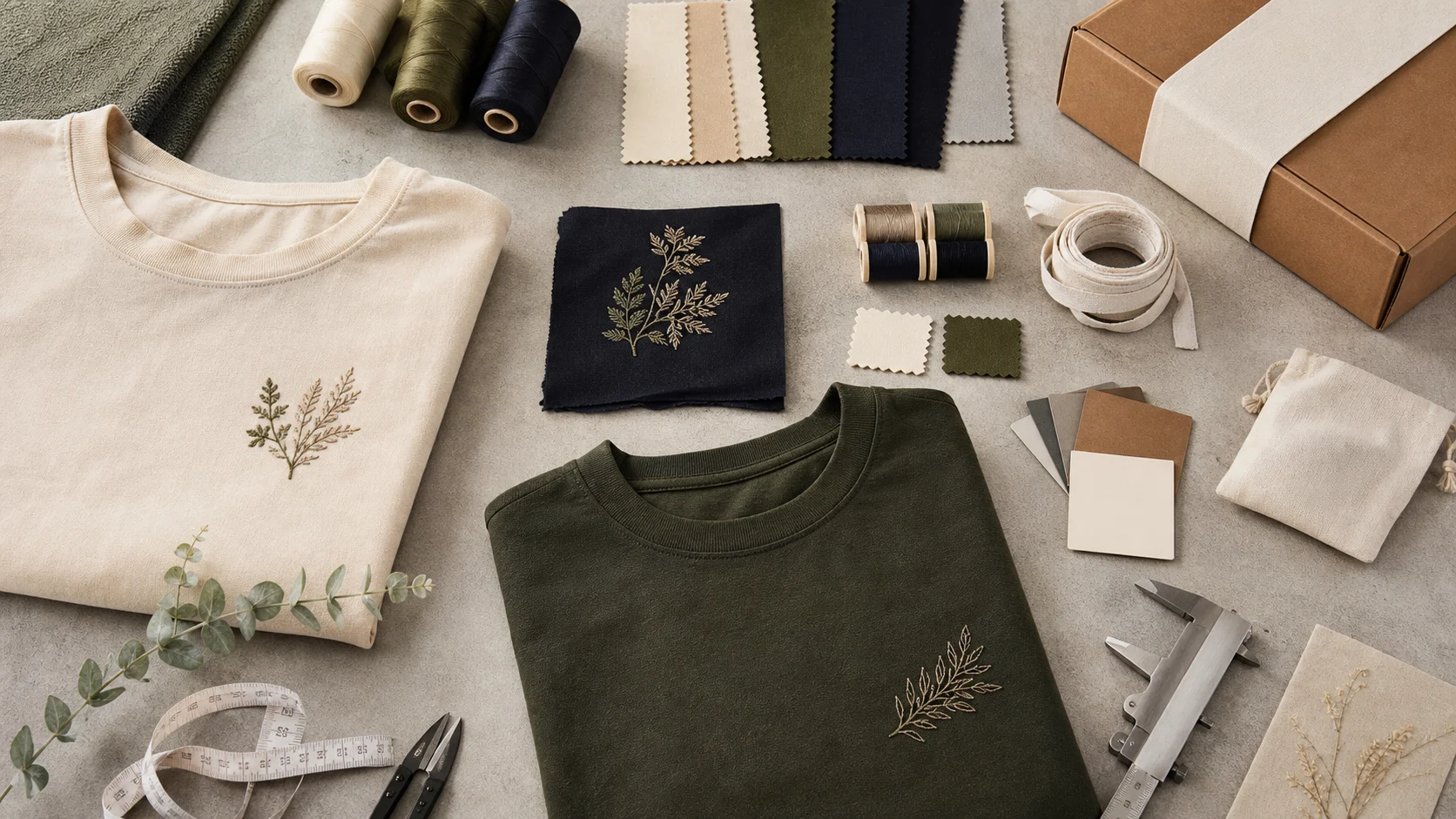
Set Wholesale Minimums for A Clothing Brand compared by sample evidence, fabric or trim specs, MOQ, AQL terms, cost lines, delivery timing, and rework...
Fast answer: Set Wholesale Minimums for A Clothing Brand: Tech Pack, Sample Gate, MOQ, and QC Terms should be judged by production evidence, not by a generic sourcing promise. The buyer needs sample proof, cost breakdowns, QC checkpoints, and delivery buffers in writing.
Ask for recent sample photos, measurement tolerances, fabric or print test assumptions, decoration test notes, packing examples, and a named inspection checkpoint. These details show whether the team can repeat an approved sample at bulk volume.
Separate garment cost, decoration, labels, packaging, sampling, testing, freight, and rush charges. Clear cost lines make it easier to reduce colorways, adjust size depth, or reserve more time for sampling.
Setting wholesale minimums is one of the most important decisions a clothing brand can make when entering B2B sales. The right minimum order quantity, minimum spend, or assortment requirement can protect your margins, streamline production, and attract the right retail partners. The wrong one can lead to unprofitable orders, operational headaches, and a brand image that feels either too exclusive or too easy to ignore.
If you are building a fashion brand and want to scale through wholesale, your minimums are more than a pricing rule. They are part of your business strategy. They shape who buys from you, how efficiently you produce, and how your brand is perceived in the market. Whether you are working with independent boutiques, regional chains, or online retailers, a well-designed wholesale policy helps you grow with confidence.
In this guide, we will break down how to set wholesale minimums for a clothing brand, what factors matter most, and how to choose a structure that supports both your financial goals and your brand positioning. If you are also refining your production and wholesale process, you can explore Fabrikn’s services to see how a manufacturing partner can support your growth.
Wholesale minimums are the smallest order requirements you set for retailers or stockists who want to purchase your products at wholesale pricing. They can be structured in several ways depending on your brand model:
For clothing brands, minimums usually reflect the realities of manufacturing. Producing apparel involves fabric sourcing, sampling, grading, cutting, sewing, labeling, packing, and shipping. Smaller orders can quickly become unprofitable if the production setup costs are too high relative to the order size.
That is why wholesale minimums are not simply about saying “yes” or “no” to customers. They are about ensuring each order makes financial sense for your business.
Wholesale minimums serve several important purposes. First, they protect your profitability. Apparel production often involves fixed costs that do not change much whether you make 100 units or 1,000 units. If a wholesale account orders too little, your margins can disappear quickly.
Second, minimums help you manage production efficiency. When you encourage larger, more predictable orders, you reduce setup changes, improve material planning, and make your supply chain easier to manage. This is especially important for brands that work with overseas or domestic factories with specific capacity constraints.
Third, minimums help define your brand’s market position. A boutique-friendly minimum sends a different message than a premium, higher-volume minimum. Your policy tells potential buyers whether you are designed for emerging shops, established retailers, or high-volume distributors.
Finally, wholesale minimums save time. A clear policy filters out buyers who are not a fit for your business and makes it easier for serious retail partners to understand how to work with you. If you are developing your brand structure from the ground up, learning more about Fabrikn’s about us page can give you a sense of how an experienced manufacturing partner supports brand growth.
Before choosing a number, you need to understand the business variables behind it. The best wholesale minimums are based on your actual cost structure, not just what competitors are doing.
Start with the real cost of making your garments. This includes raw materials, trims, labor, sampling, quality control, packaging, and freight. If your costs are high because you use premium fabric, custom hardware, or specialized construction, your minimums will need to reflect that.
Wholesale pricing must allow room for healthy margins. If your retail price is $80 and your wholesale price is $40, your business still needs enough margin after manufacturing and overhead to remain profitable. A minimum order should ensure each account contributes meaningfully to your bottom line.
Some apparel products require significant setup work. Screen printing, embroidery digitizing, pattern adjustments, grading, and custom dyeing all add upfront costs. If those fees are not spread across enough units, even a wholesale order can become a loss.
Brands that produce in stock need minimums that align with available inventory. Brands that produce on demand or in small batches may need minimums high enough to justify a new production run. Your inventory model directly affects the right threshold.
The size and purchasing habits of your target retailers matter. Independent boutiques may prefer lower minimums, while department stores or multi-location retailers may expect larger commitments. If your ideal customers are smaller specialty shops, your minimums should not be so high that you exclude them.
Low-value, high-touch orders can create fulfillment inefficiencies. If your team spends too much time handling small wholesale accounts, you may need to raise your minimums to keep operations sustainable.
Think about whether your wholesale channel is meant to drive brand awareness, generate cash flow, or scale volume quickly. If your goal is fast expansion, you might set more accessible minimums. If you want premium positioning, a higher threshold can help maintain exclusivity.
There is no universal formula for wholesale minimums, but there is a practical process you can use to find the right number.
Calculate the full landed cost of each item, including manufacturing, labeling, packaging, and freight to your warehouse. For example, if a sweatshirt costs $18 to produce and ship to you, that is your base cost.
Most clothing brands sell at wholesale for roughly 2x to 2.5x landed cost, depending on the category, market, and brand position. If your sweatshirt costs $18 landed and wholesale is $36, you have a 50% gross margin before overhead and sales costs.
Estimate the smallest order that covers your administrative time, fulfillment labor, and sales expense while still leaving profit. This is not just about manufacturing costs. You must also account for customer service, invoicing, shipping coordination, and account management.
Some brands set a minimum dollar amount, such as $500 or $1,000 per order. Others use unit-based minimums, such as 24 units per style. Many successful brands use a hybrid approach: for example, a minimum order value plus a per-style minimum.
Run sample wholesale orders through your pricing model. Ask yourself: if a retailer orders this amount, will the account be profitable? Will production be efficient? Does it support the kind of client relationship you want? This stress test helps you avoid setting a minimum that looks good on paper but fails in practice.
Let’s say your average wholesale top has the following structure:
If you want at least $400 in gross profit from a wholesale account after costs, you may need an order of around 30 units. At $28 per unit, that equals $840 in wholesale revenue. If the retailer cannot commit to that amount, the account may not be worth servicing at this stage.
Different brands use different minimum structures depending on their product mix and growth stage. Here are the most common models in clothing wholesale.
This is one of the simplest and most popular approaches. You set a minimum dollar amount, such as $500, $1,000, or $2,500 per order. It works well when your product line includes multiple styles and price points.
Best for: Brands with diverse collections, easy ordering, and balanced unit pricing.
In this model, buyers must order a set number of units per style, color, or SKU. For example, a retailer may need to order 12 units per style in a size curve. This is common in apparel because it supports production efficiency.
Best for: Brands with size runs, seasonal collections, or custom production requirements.
A hybrid minimum combines a dollar threshold with style-level requirements. For example, a retailer might need to order at least $800 total, with a minimum of 6 units per style.
Best for: Brands that want control over both profitability and assortment structure.
Some brands require wholesale buyers to purchase from a full seasonal line rather than picking only a few bestsellers. This can improve brand presentation and create stronger merchandising stories in-store.
Best for: Fashion-forward brands, premium labels, and curated retail environments.
You can also set different minimums for first-time buyers and repeat accounts. Opening orders may require a higher minimum to justify onboarding, while reorders can be lower because the relationship is already established.
Best for: Brands that want to make onboarding worthwhile without discouraging loyalty.
Your wholesale minimums influence how buyers perceive your brand. A higher minimum often signals a more premium, exclusive, or operationally mature brand. A lower minimum can make your products more accessible to smaller boutiques that are testing new vendors.
The right approach depends on who you want to attract.
If your brand is new, a very high minimum may block promising retail partners who are willing to try your line but are not ready for a large commitment. On the other hand, a minimum that is too low may lead to low-quality accounts, too many small orders, and limited profit.
Think of your minimum as a filter. It should attract retailers who align with your brand values, price point, and merchandising strategy. If your brand is positioned for premium boutiques, a higher threshold can reinforce that message. If your brand is designed for broad distribution, your minimum should support easier access while still protecting your business.
For brands still refining their wholesale strategy, having a reliable manufacturing partner can make a major difference. You can learn more about product development and production support through Fabrikn’s services.
Once you have set your wholesale minimums, communicate them clearly across all buyer touchpoints. Confusion at this stage can slow down sales and create unnecessary back-and-forth.
Your line sheet should state your minimums clearly, along with your wholesale terms, lead times, and ordering process. Keep the language straightforward and easy to scan.
If you have a B2B portal, make sure the minimums appear before buyers begin the ordering process. This avoids wasted time and helps retailers self-qualify.
Anyone representing your brand should be able to explain the minimums confidently and consistently. They should also understand when exceptions are appropriate and when they are not.
Some brands are firm on order minimums. Others allow exceptions for strategic partners or first-time buyers. If you do allow flexibility, define the boundaries so that your policy still protects your margins.
A simple wholesale FAQ or contact page can help buyers understand the process before reaching out. If you want to discuss custom production or a tailored wholesale setup, you can direct potential partners to contact us.
Many clothing brands make avoidable mistakes when setting wholesale minimums. Avoiding these issues can save you time, money, and frustration.
Low minimums may seem customer-friendly, but they can create too much work for too little return. If you spend the same amount of time processing a $300 order as a $3,000 order, your business will feel the strain quickly.
Competitor benchmarking is useful, but your cost structure is unique. Never copy another brand’s minimum without checking whether it fits your margins and operations.
Different categories may need different minimums. For example, premium outerwear, basic tees, and accessories do not have the same economics. One blanket rule may not work across your entire line.
As your brand grows, your costs, capacities, and customer expectations will change. Minimums should evolve with your business.
If you occasionally make exceptions, document the rules. Otherwise, your team may create inconsistent pricing behavior that confuses buyers and weakens your wholesale policy.
Wholesale minimums are not permanent. Review them regularly to ensure they still support your business goals.
You should revisit your minimums when:
A good review cycle is every six to twelve months, or after any major operational change. Look at real wholesale order data, not just assumptions. Which orders are most profitable? Which accounts require the most support? Which minimum structures drive the best business outcomes?
As you refine your pricing and wholesale policies, keep your manufacturing partner in the loop. Brands that work closely with production teams can adjust minimums with more confidence because they understand how order size affects cost and lead time.
Learning how to set wholesale minimums for a clothing brand is really about balancing three things: profitability, operational efficiency, and brand positioning. Your minimum should be high enough to make wholesale worthwhile, but not so high that it shuts out the retailers you want to work with.
The best minimums are based on actual costs, aligned with your brand strategy, and easy for buyers to understand. Start with your numbers, test different scenarios, and revisit your policy as your business evolves. With the right wholesale structure in place, you can build stronger retail relationships and scale more sustainably.
If you are ready to develop your wholesale program with a reliable apparel manufacturing partner, Fabrikn can help you move from concept to production with greater confidence.
Get a free quote from Fabrikn — your trusted B2B clothing manufacturer with 10+ years of experience. MOQ as low as 200 pieces.
Get a Free Quote →A good wholesale minimum depends on your costs, margins, and target customers. Many brands set minimum order values between $500 and $2,500, but the right number should be based on your actual profitability requirements.
Both can work. Minimum order quantity is useful for production efficiency, while minimum order value is easier for buyers to understand. Many apparel brands use both together for better control.
Yes. Some brands use different minimums for first-time buyers, key accounts, or strategic partners. If you do this, create clear rules so your policy stays consistent.
Wholesale minimums help ensure that each order covers production costs, overhead, and sales effort. Without them, small orders can reduce profitability and create unnecessary operational burden.
Review them every six to twelve months or whenever your costs, production capacity, or business model changes. Adjust them when needed to keep your wholesale program sustainable.