
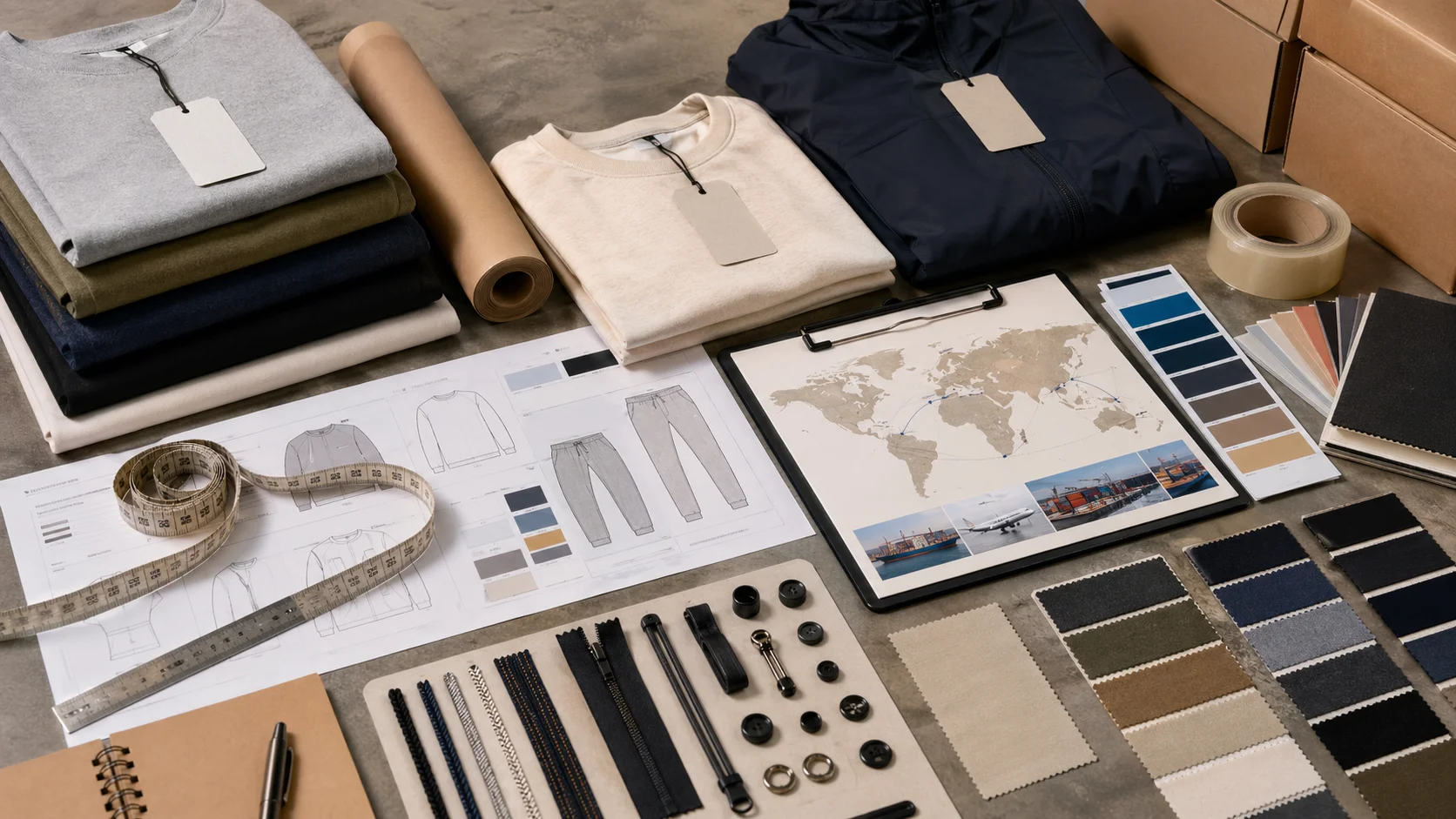
Test Demand for A Clothing Line compared by sample evidence, fabric or trim specs, MOQ, AQL terms, cost lines, delivery timing, and rework responsibility.
Fast answer: Test Demand for A Clothing Line: Tech Pack, Sample Gate, MOQ, and QC Terms should be judged by production evidence, not by a generic sourcing promise. The buyer needs sample proof, cost breakdowns, QC checkpoints, and delivery buffers in writing.
Ask for recent sample photos, measurement tolerances, fabric or print test assumptions, decoration test notes, packing examples, and a named inspection checkpoint. These details show whether the team can repeat an approved sample at bulk volume.
Separate garment cost, decoration, labels, packaging, sampling, testing, freight, and rush charges. Clear cost lines make it easier to reduce colorways, adjust size depth, or reserve more time for sampling.
One of the biggest mistakes new fashion brands make is assuming that a great design automatically means strong sales. In reality, the clothing market is competitive, fast-moving, and full of brands that look good on paper but fail because they never validated whether customers actually wanted the product. If you are trying to figure out how to test demand for clothing line ideas, the goal is simple: reduce risk before you commit to a full production run.
Testing demand helps you avoid wasted inventory, improves your chances of profitability, and gives you a clearer path to launch. Instead of guessing, you collect real signals from potential customers. Those signals can include clicks, sign-ups, pre-orders, comments, shares, DMs, and purchases. For a new fashion brand, even a small amount of proof can make a major difference.
At Fabrikn, we work with brands at different stages of growth, and we often see that the most successful launches start with a test, not a large order. If you want support with production planning after you validate your idea, you can learn more about our services.
You cannot test demand effectively if you do not know who you are testing it with. A clothing line is not for everyone. It performs best when it solves a style, fit, function, or identity need for a very specific audience.
Start by asking questions like:
For example, “women ages 25 to 34” is too broad. “Urban professional women who want elevated basics for work and travel” is much more useful. The clearer your target customer, the more accurate your demand testing will be.
Create a simple customer profile that includes their preferred price range, style preferences, and buying habits. This will help you design tests that speak directly to their needs instead of appealing to a vague audience.
Before you produce samples or launch ads, you need to validate the actual product idea. Ask yourself whether your clothing line has a strong reason to exist. Is it offering a new style, better fit, improved comfort, more sustainable materials, or a stronger identity than what is already available?
Validation does not require a finished product. You can test with:
Share these concepts with potential customers and observe the response. Ask which version they prefer, what they would change, and whether they would actually buy it. The more honest the feedback, the better. Try to avoid asking leading questions like “Do you love this?” Instead, ask “Would you buy this? Why or why not?”
This step is especially useful for new brands that want to minimize upfront costs. If a concept does not generate interest at the idea stage, it is better to learn that early rather than after you have ordered inventory.
Competitive research is one of the most effective ways to test demand for clothing line ideas. If similar brands are growing, selling out, or building engaged communities, that is a strong sign the market exists. Your goal is not to copy competitors, but to identify where demand already lives and where there may be a gap.
Look at brands in your category and examine:
Read customer reviews carefully. Reviews often reveal what shoppers love, what they hate, and what is missing. If people consistently complain about fit, quality, sizing, or delivery times, your brand may be able to win by solving those pain points.
You should also look for saturation. If the market is crowded with nearly identical products, demand may still exist, but you will need a stronger point of difference. A new fashion brand must understand both opportunity and competition before investing in production.
Demand is easier to test when your idea feels real. That does not mean you need a full collection or a finished e-commerce site. It means you need a simple, clear presentation of the brand concept.
This could include:
Your brand concept should explain why the line exists and who it is for. If you are testing premium loungewear, for example, your concept should make it obvious that the line is designed for comfort, quality, and style. If you are testing streetwear, your concept should communicate culture, exclusivity, or design edge.
Keep the presentation clean and professional. Even a basic landing page can help you measure interest far better than a vague social post. If you are still shaping your brand identity, you may also want to learn more about our background on the About Us page.
Social media is one of the fastest ways to test demand for a clothing line because it gives you immediate feedback from real people. You can post mockups, behind-the-scenes content, design polls, and concept videos to see what resonates.
Useful social media testing methods include:
Pay attention to more than likes. Comments, saves, shares, and direct messages are better indicators of interest. A small audience that responds strongly can be more valuable than a large audience that scrolls past without engaging.
You can also test different messages. One audience may respond to sustainability, while another may care more about fit or versatility. By testing multiple angles, you can learn what sells before you launch.
For best results, post consistently and use the same visual style across your content. That makes it easier to see patterns in audience response.
A landing page is one of the strongest tools for testing demand for clothing line ideas because it captures intent. Instead of guessing whether people are interested, you ask them to take a specific action, such as joining a waitlist or placing a pre-order.
A good landing page should include:
If people are willing to give you their email, that is a strong signal. If they are willing to pay, that is even better. Pre-orders are especially useful because they test demand while helping fund production.
Be transparent about timelines if you offer pre-orders. Customers should know when the product will ship. Honesty builds trust and protects your brand reputation from the beginning.
If you are ready to move from validation to production, you can use our contact us page to discuss next steps with a manufacturing partner.
Paid advertising can help you test demand quickly, even with a small budget. Instead of running a full launch campaign, use ads to test which concept gets the most attention and clicks.
Start small and focus on one product, one audience, and one offer. This makes it easier to interpret results. For example, run ads promoting a single hoodie design to a specific age group, then compare performance across different images, headlines, or value propositions.
Important metrics to watch include:
If an ad generates strong clicks but poor conversions, the product or landing page may need improvement. If both clicks and conversions are strong, you may have found a real demand signal.
Keep in mind that ads can reveal interest, but they do not guarantee long-term success. Use them as one part of a broader validation strategy.
Direct feedback is essential because it gives you context behind the numbers. A product may appear popular online but fail in real life if customers dislike the fabric, fit, or price.
You can gather feedback through:
Ask practical questions such as:
The best feedback often comes from people who are not trying to be polite. You need honest reactions, not just encouragement. If multiple people mention the same issue, that is a clear sign to adjust the product before scaling.
Once initial interest looks promising, move into physical testing. Samples let you evaluate real fabric feel, construction, fit, sizing, and finishing. This stage is crucial because demand can disappear if the final product does not meet expectations.
Start with a sample or small batch rather than a full production order. Test the product internally and with a small group of target customers. This gives you insights into:
If customers love the sample, that is a stronger demand signal than a mockup ever could be. Real fabric and real construction details can either confirm or weaken your market potential.
At this point, a reliable manufacturing partner becomes valuable. Careful sampling, quality control, and production guidance can help new brands move from concept to a market-ready product without unnecessary mistakes.
When testing demand for clothing line ideas, you need to track the right data. Vanity metrics alone will not tell you whether the brand is viable.
Focus on these indicators:
It is also helpful to compare metrics across different versions of your concept. For example, test one product in black and another in cream, or compare two price points. Small changes can reveal what customers value most.
Do not rely on one metric alone. A high number of likes may look encouraging, but it is not as strong as a steady stream of email sign-ups or actual purchases.
Real demand usually shows up in multiple places at once. It is not just one social post performing well. It is when people engage, ask questions, sign up, and buy.
Strong signs of demand include:
You may also notice that people are willing to wait for the product. That is often a sign of brand desire, especially in fashion, where identity and exclusivity matter. If customers are excited enough to join a waitlist or preorder, you have stronger evidence of demand than a simple interest check.
The goal is not to find perfect certainty. It is to collect enough proof to move forward with confidence.
Many new brands misread demand because they make avoidable mistakes during testing. Here are a few to watch out for:
Another common mistake is changing too many variables at once. If you alter the design, price, audience, and marketing message all at once, you will not know what actually worked. Keep your tests simple and focused.
It is also important not to overreact to one weak result. Sometimes a good product fails because the messaging was unclear or the audience was wrong. Testing should help you diagnose the issue, not end the process prematurely.
Once you have tested demand and seen positive signals, the next step is turning your idea into a product people can actually buy. That is where the right manufacturer matters. You need a partner who understands sampling, quality control, production timelines, and the needs of a growing brand.
At Fabrikn, we help clothing brands move from concept to production with a practical, scalable approach. If you are in the early stage of testing, our team can help you prepare for the next phase of development, whether you need guidance on sampling, product planning, or full production support.
If you are ready to discuss your clothing line project, visit our contact us page.
Get a free quote from Fabrikn — your trusted B2B clothing manufacturer with 10+ years of experience. MOQ as low as 200 pieces.
Get a Free Quote →Start with free methods such as social media polls, direct outreach, mockups, and conversations with your target audience. You can also create a simple landing page using low-cost tools to collect emails before spending on production.
The best approach is to combine several methods: audience research, social media engagement, landing pages, pre-orders, and sample testing. Using multiple signals gives you a more accurate picture than relying on just one tactic.
There is no fixed number, but you should collect feedback from enough people in your target audience to identify patterns. If the same comments or purchase concerns come up repeatedly, that is more useful than feedback from a large but unqualified audience.
Yes. Pre-orders are one of the strongest demand signals because they show that customers are willing to commit money before production is complete. Just make sure your timelines are clear and realistic.
That usually means interest exists, but something is blocking the purchase. Common issues include weak pricing, poor positioning, unclear product benefits, or an unconvincing landing page. Review your offer and test again with a clearer message.
Yes. It is usually better to validate the idea first using mockups or simple concepts before paying for samples. Once the idea shows promise, you can invest in physical development with more confidence.
Yes. Fabrikn supports clothing brands through the manufacturing process, from early planning to production. If you are ready to move forward, explore our services or reach out through our contact us page.