
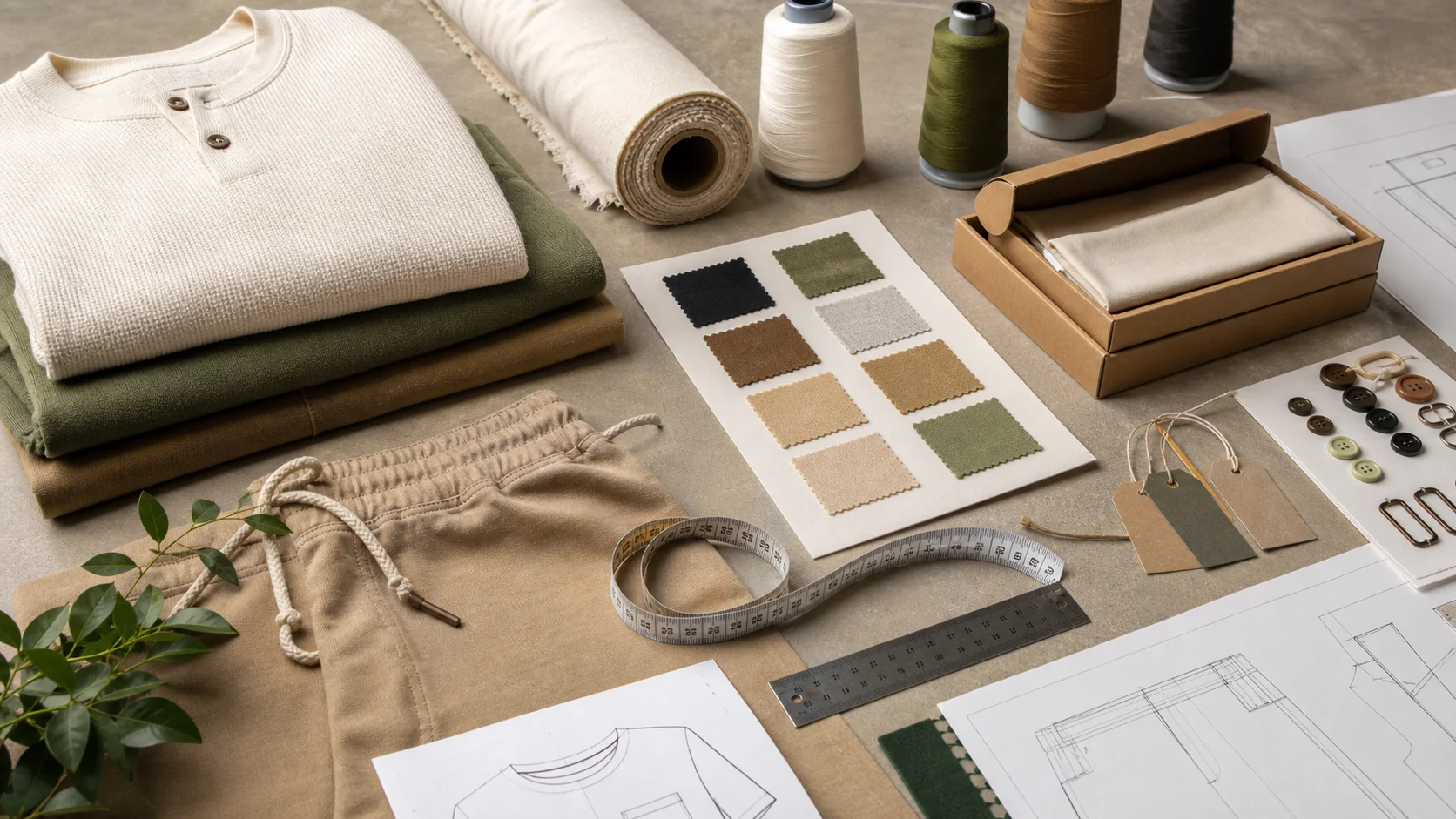
Verify Clothing Production Vendor Legitimacy Before You Place An Order compared by sample evidence, fabric or trim specs, MOQ, AQL terms, cost lines,...
Fast answer: Verify Clothing Production Vendor Legitimacy Before You Place An Order: Sample Evidence, MOQ, Capacity, and Rework should be judged by production evidence, not by a generic sourcing promise. The buyer needs sample proof, cost breakdowns, QC checkpoints, and delivery buffers in writing.
Ask for recent sample photos, measurement tolerances, fabric or print test assumptions, decoration test notes, packing examples, and a named inspection checkpoint. These details show whether the team can repeat an approved sample at bulk volume.
Separate garment cost, decoration, labels, packaging, sampling, testing, freight, and rush charges. Clear cost lines make it easier to reduce colorways, adjust size depth, or reserve more time for sampling.
If you are sourcing apparel for your brand, one of the biggest risks is choosing a clothing factory that looks professional online but is not actually legitimate. A polished website, attractive product photos, and fast email replies are not enough to confirm that a manufacturer can deliver quality garments on time and at scale. Before you place an order, you need a structured way to verify clothing factory legitimacy so you can protect your budget, timeline, and brand reputation.
This guide explains exactly how to evaluate a clothing factory before you commit to production. Whether you are launching a new label or expanding an existing line, these steps will help you avoid scams, reduce quality issues, and build stronger supplier relationships. If you are also comparing partners, you can learn more about our capabilities on the Fabrikn services page or get in touch through our contact page.
Clothing manufacturing requires trust. You are sharing your designs, specifications, timeline, and often a significant upfront payment with a third party. If the factory is fake, underqualified, or financially unstable, the consequences can be severe. You may lose money, miss a launch date, receive unusable garments, or even expose your designs to unauthorized production elsewhere.
Verifying legitimacy is not just about avoiding fraud. It is also about confirming that the factory has the right equipment, skilled labor, quality systems, and business structure to support your product. A legitimate factory should be able to prove who they are, what they make, and how they operate.
In B2B apparel sourcing, the best results come from factories that are transparent and responsive. If a supplier avoids basic questions, refuses documentation, or gives inconsistent answers, treat that as a warning sign.
The first step in how to verify clothing factory legitimacy is to look for the most obvious signs of a real operating business. These checks are quick, but they can eliminate many unreliable suppliers early in the process.
A real factory website should include clear information about the company, location, services, product categories, and contact details. Look for a physical address, company history, production photos, and a professional domain name. Be cautious if the website is vague, full of generic stock images, or lacks meaningful details about facilities and capabilities.
Compare the company name, domain, and contact details across all channels. A legitimate manufacturer usually uses branded email addresses rather than free personal accounts. The website, invoice headers, and email signatures should all match or at least align closely.
Use search engines, B2B platforms, business directories, and social media to see whether the factory has a real footprint. Look for mentions in trade shows, client testimonials, factory videos, or industry listings. A lack of any online presence is not always suspicious, but it should prompt additional verification.
One of the most important parts of verifying clothing factory legitimacy is checking that the company is legally registered. A real manufacturer should be able to provide business registration documents, tax identification numbers, and, where relevant, export licenses or manufacturing permits.
Request the legal business name, registration number, and a copy of the certificate of incorporation or equivalent business license. Compare the registration information with the company name used on the website, invoices, and bank account details.
Verify that the address listed is a genuine manufacturing or office location. You can use map services, satellite images, or local business directories to confirm the site exists. Be careful if the company claims to be a factory but only lists a residential apartment, co-working space, or unrelated office building.
If you are importing internationally, ask whether the factory regularly handles export orders and understands customs documentation, incoterms, labeling requirements, and shipping procedures. A legitimate export-ready clothing manufacturer should know how to manage these steps or coordinate with freight partners.
To better understand our company background and production approach, you can also review the About Us page on Fabrikn.
A genuine clothing factory should not only exist on paper. It must also have the right machinery, trained workers, and production systems to make the products you need. Many problems happen when brands choose a supplier that says yes to everything but actually specializes in something very different.
Some clothing factories focus on knitwear, while others specialize in woven garments, denim, activewear, outerwear, children’s wear, or private-label basics. Ask what categories they produce most often and whether they have experience with your fabric type, construction method, and finishing requirements.
A reliable factory should be able to explain its production process from pattern making to cutting, sewing, finishing, inspection, and packing. Ask what machines they use, how many production lines they operate, and whether key steps are done in-house or outsourced. A transparent answer suggests real operational experience.
Legitimate factories usually have structured minimum order quantities and realistic production schedules. If a supplier promises very low minimums, extremely fast turnaround, and premium quality all at once, be cautious. While flexibility is possible, unrealistic promises often indicate inexperience or deception.
One of the strongest ways to verify clothing factory legitimacy is to request samples. Samples reveal much more than sales emails ever will. They show whether the factory can actually produce the level of quality it claims.
Request samples of similar garments the factory has produced. These can help you assess stitching, fabric quality, fit, finishing, labeling, and packaging. If they can only show random examples that do not match your category, that may indicate weak specialization.
If you have custom designs, ask the factory to make a sample based on your tech pack or reference images. A legitimate clothing manufacturer should be able to interpret measurements, construction details, and material requirements accurately.
Do not judge based on one garment alone. Ask for more than one sample if needed, and compare them carefully. A legitimate factory should be able to maintain consistency across repeated samples and revisions.
How a factory communicates tells you a great deal about how it will manage production. Reliable manufacturers are usually clear, patient, and specific. They ask questions, confirm details in writing, and set expectations honestly.
When you ask technical questions about fabric shrinkage, color matching, print placement, seam construction, or packaging, a legitimate factory should answer with confidence and detail. Vague answers, copied text, or constant deflection can be warning signs.
Fast replies are helpful, but speed alone does not equal credibility. More important is whether the factory remains consistent over time. Do they give the same answers across emails, calls, and quotations? Do they follow up professionally? Do they keep records of your discussions?
A trustworthy supplier is willing to discuss limitations as well as strengths. For example, they may explain that a certain fabric needs a longer lead time or that a complex garment requires a higher MOQ. Honest limitations are usually a good sign. Overpromising is not.
Before placing an order, try to learn how the factory performs with other clients. References and third-party feedback can help you verify whether the supplier delivers what they promise.
A legitimate clothing factory should be able to provide references from previous customers, especially for similar product categories. When speaking with references, ask about product quality, communication, delivery performance, problem resolution, and whether they would reorder.
Testimonials on a website can be useful, but they should not be your only source. Look for details. Real feedback often includes specific products, timelines, or outcomes. Generic praise without context is less convincing.
Factories that attend trade shows, participate in exhibitions, or maintain active industry profiles are often easier to verify. While not mandatory, these signals suggest that the business is established and visible in the market.
If your order is large enough, visiting the factory is one of the best ways to verify clothing factory legitimacy. If travel is not possible, a live video tour is the next best option.
Observe whether the facility matches the supplier’s claims. Look for active production lines, organized material storage, quality control areas, labeling systems, and finished goods inventory. A real factory should look operational, not staged.
A live video call can reveal a lot. Ask the factory to show the entrance, office area, sample room, sewing lines, cutting tables, warehouse, and quality inspection section. If they hesitate or keep the camera fixed in one spot, that may be a concern.
Seeing the team can help verify that the company is staffed by actual managers, technicians, and production workers. It also helps you understand who will handle sampling, production, and communication after the order is placed.
A legitimate clothing factory will protect both parties with clear terms. Before paying, review the quotation, purchase order, contract, and payment structure carefully.
All critical details should be documented in writing: product specifications, materials, colors, sizes, quantities, pricing, lead times, inspection standards, and shipping terms. Verbal promises should never replace a formal agreement.
Most factories require a deposit before production. That is normal. However, be cautious if they request unusually high advance payments, prefer untraceable payment methods, or refuse to issue an invoice. Always make sure the bank account name matches the legal company name as closely as possible.
Some warning signs should immediately slow you down:
For larger orders, consider hiring a third-party inspection service before shipment. This adds another layer of protection and helps confirm that the goods match your order specifications before they leave the factory.
When you are close to making a decision, run through a final verification checklist. A legitimate clothing factory should be able to satisfy most or all of the following:
If several of these items are missing, take more time before committing. In clothing manufacturing, patience at the verification stage can save significant time and money later.
At Fabrikn, we understand that legitimacy, transparency, and communication matter just as much as product quality. B2B apparel buyers need a manufacturing partner that can support development, production, and delivery with clarity at every stage. That is why we focus on professional processes and responsive service.
If you are still evaluating suppliers and want to see how a manufacturer should present itself, explore our services, read more about us, or reach out through our contact page to discuss your project.
Get a free quote from Fabrikn — your trusted B2B clothing manufacturer with 10+ years of experience. MOQ as low as 200 pieces.
Get a Free Quote →Start by checking the company registration, physical address, website credibility, contact details, samples, and references. A real factory can usually prove its legal status and show evidence of active production.
At minimum, ask for business registration documents, a company license, tax details, a detailed quotation, and banking information that matches the legal business name. Export documents may also be needed for international orders.
Not always, but extremely low pricing can indicate poor materials, hidden fees, or an unreliable supplier. Compare quotes from multiple factories and evaluate whether the pricing matches the product complexity.
If your order value is significant or your product is highly customized, a factory visit is strongly recommended. If travel is not possible, request a live video tour and additional documentation.
One of the biggest warning signs is inconsistency. If the company name, address, payment account, documents, and communication do not match, stop and investigate further before sending money.
At least one development sample is recommended, and more if your product has complex construction, fit, or material requirements. Multiple samples help you judge consistency and production capability.
Yes. You can verify many details remotely through registration documents, video calls, third-party inspections, references, samples, and online business checks. Remote verification is common in global apparel sourcing.
Verifying clothing factory legitimacy is one of the most important steps in successful apparel sourcing. With the right checks, you can reduce risk, improve product quality, and choose a partner that supports your brand growth with confidence.