
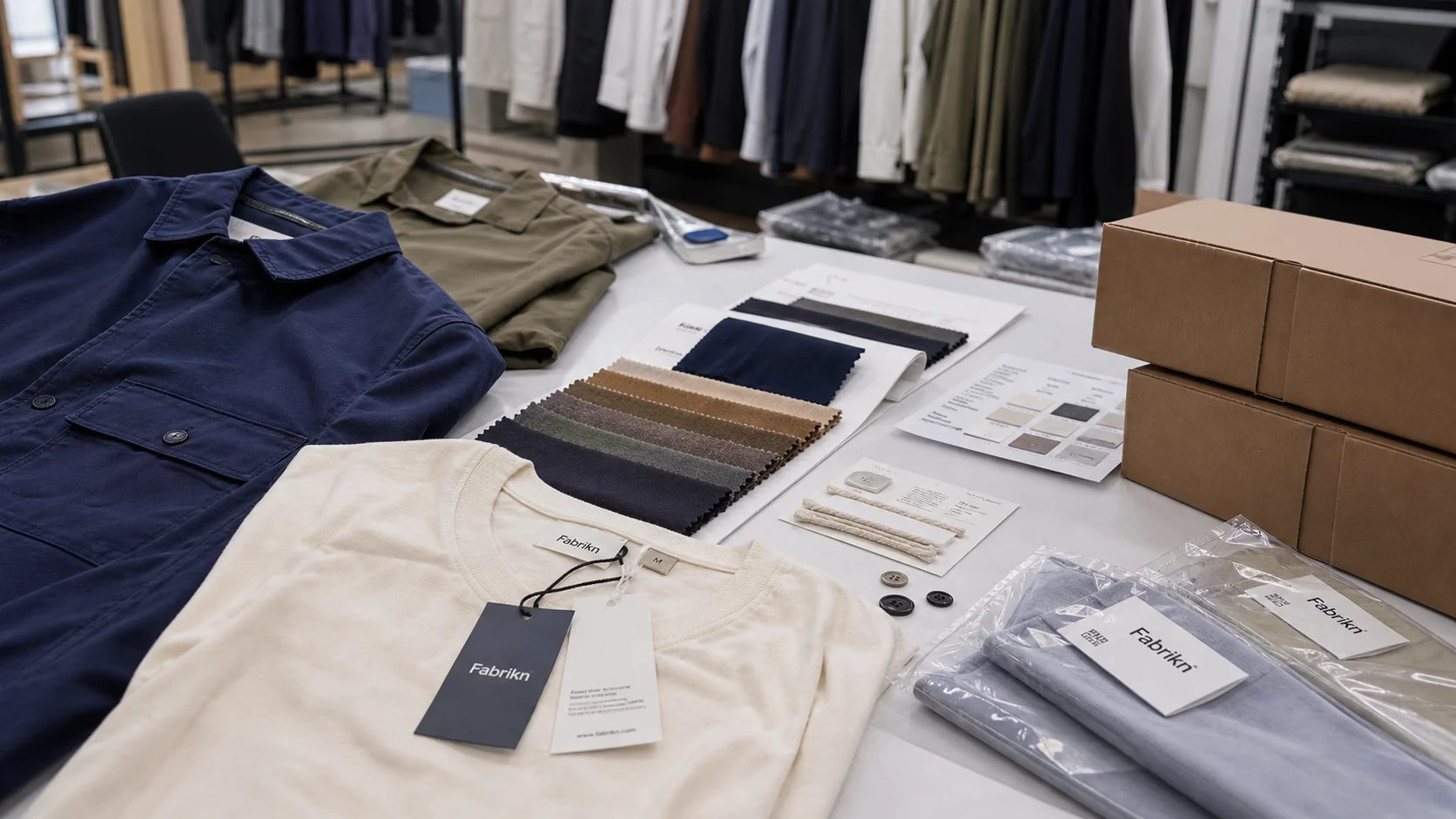
Verify Garment Factory Compliance and Certifications compared by sample evidence, fabric or trim specs, MOQ, AQL terms, cost lines, delivery timing, and...
Fast answer: Verify Garment Factory Compliance and Certifications: Tech Pack, Sample Gate, MOQ, and QC Terms should be judged by production evidence, not by a generic sourcing promise. The buyer needs sample proof, cost breakdowns, QC checkpoints, and delivery buffers in writing.
Ask for recent sample photos, measurement tolerances, fabric or print test assumptions, decoration test notes, packing examples, and a named inspection checkpoint. These details show whether the team can repeat an approved sample at bulk volume.
Separate garment cost, decoration, labels, packaging, sampling, testing, freight, and rush charges. Clear cost lines make it easier to reduce colorways, adjust size depth, or reserve more time for sampling.
How to Verify Garment Factory Compliance and CertificationsIf you are sourcing apparel for your brand, one of the most important steps is verifying that your garment factory is truly compliant and properly certified. Factory claims can sound impressive on a website or sales sheet, but due diligence is what protects your business from quality issues, shipment delays, legal risks, and reputational damage. In the garment industry, compliance is not just a box to tick. It affects worker safety, product integrity, ethical sourcing, import readiness, and your brand’s long-term credibility.
This guide explains how to verify garment factory compliance and certifications in a practical, step-by-step way. Whether you are working with a new supplier or reviewing an existing manufacturing partner, you will learn what documents to request, which certifications matter, how to spot red flags, and how to build a reliable supplier verification process.
Compliance means a factory meets applicable legal, ethical, environmental, and quality standards. For apparel brands, that can include labor laws, health and safety requirements, environmental management, chemical restrictions, product labeling, and social responsibility standards. Depending on your market, compliance may also affect customs clearance, retailer approval, and consumer trust.
When a factory is not compliant, the risks can be costly:
Verifying compliance early helps you avoid surprises later. It also gives you a better understanding of whether a factory can support your brand’s standards as you scale.
Not every garment factory needs every certification, and the right ones depend on your products, market, and sourcing goals. Still, several certifications and standards are commonly reviewed during supplier verification.
These focus on labor practices, worker rights, wages, working hours, and workplace conditions. They are especially important if your brand sells to retailers or operates under a strict ethical sourcing policy.
These show that the factory has structured processes for maintaining consistency, traceability, and corrective action.
If sustainability matters to your brand, environmental certifications can help confirm responsible factory operations and lower-impact production practices.
These are critical if you are producing garments for sensitive markets, children’s wear, or products that must meet restricted-substance requirements.
Some compliance checks are not “certifications” in the traditional sense, but they are equally important. These may include fire safety inspections, business registration, export licenses, wastewater treatment records, and building permits.
For more information about production support and supplier capabilities, visit our services page.
Factory verification should be a structured process, not a one-time question during sales discussions. The goal is to confirm that a factory’s claims are current, valid, and relevant to your specific product category.
Before you ask a factory for proof, determine what compliance means for your business. Your requirements may vary depending on your product type and sales channels.
A clear checklist helps you evaluate factories consistently and avoid requesting unnecessary documents.
Ask the factory to send full copies, not just logos or summary claims. The document should show the certificate number, issue date, expiration date, certification body, and scope of coverage. A valid certificate for one facility or product line does not automatically apply to another site or category.
Be careful with “in progress” claims. A factory may say it is certified, but the certificate may have expired, or the audit may only cover a different business entity.
Once you have a document, check who issued it. Not all certificates are equal. Some are issued by reputable third-party organizations, while others may come from less reliable entities or self-declared programs.
If the factory cannot provide verifiable issuing information, treat the claim with caution.
One of the most common mistakes buyers make is assuming a certification covers more than it actually does. The scope may be limited to a single production facility, a specific process, or a particular product group.
For example, a factory may have ISO 9001 for cutting and sewing operations but not for washing, printing, or embroidery. Or an OEKO-TEX certificate may apply to fabric processing, but not to the finished garment assembly line.
Always confirm:
Many credible certification systems allow buyers to verify records online. Use the official database or the issuer’s verification tool whenever possible. This reduces the chance of forged, expired, or altered documents.
If the database does not match the factory’s claims, ask for clarification immediately. It may be an innocent administrative issue, or it may indicate a deeper problem.
Certificates are important, but a good factory should also have internal systems that support ongoing compliance. Ask questions about how the factory manages:
A factory that understands and documents its processes is usually easier to work with than one that only shows certificates.
If the order value is significant, an audit is one of the strongest ways to verify compliance. Depending on your budget and timeline, this may be a third-party audit, a supplier visit, or a virtual factory inspection.
An audit helps you see whether the documents match real working conditions. It also reveals how the factory handles issues, whether safety procedures are visible, and whether management is transparent under review.
If an audit identifies noncompliance, do not immediately reject the factory unless the issue is severe. Instead, review the corrective action plan. A professional factory should be able to explain what happened, how it will be fixed, and when the changes will be verified.
Factories that respond quickly, honestly, and with evidence are often more reliable than factories that simply claim perfection.
A strong verification process relies on evidence. Here are the main documents you should request from a garment factory before placing an order.
You do not always need every document for every order, but the more complete the record, the more confidence you can have in the supplier.
Some warning signs should prompt extra caution. If you notice several of these at once, consider slowing down before committing to production.
One red flag does not always mean a factory is untrustworthy. However, repeated inconsistencies should be treated seriously.
Audits are designed to confirm whether a factory’s operations match its claims. They may be conducted by a buyer, an independent audit firm, or a certification body. While the format varies, most audits review several core areas.
If you are evaluating a factory through an audit report, review both the findings and the corrective actions. Pay attention to:
A factory with a transparent audit history and steady improvement is often a stronger partner than one with no history at all.
At Fabrikn, we understand that brands need more than production capacity. They need manufacturing partners who can support quality, transparency, and long-term reliability. Verifying compliance is part of building a healthier supply chain, and the right factory relationship makes that process much easier.
If you are comparing suppliers or planning a new apparel project, our team can help you evaluate requirements and align production with your sourcing goals. Learn more about us or get in touch through our contact page.
Working with a manufacturer that is open about documentation, processes, and quality standards gives you a better foundation for scaling. Compliance is not only about passing audits. It is about reducing risk and creating products your customers can trust.
Verification should not end once the first order is placed. Compliance can change over time, especially if a factory adds new equipment, new lines, new subcontractors, or a new ownership structure. Keep reviewing documents regularly.
By making verification part of your sourcing workflow, you reduce risk and improve supplier accountability.
Learning how to verify garment factory compliance and certifications is one of the smartest investments a brand can make. It protects your business from operational setbacks, supports ethical sourcing, and helps you work with factories that are prepared for long-term partnerships. The process starts with knowing what you need, then requesting documents, checking certification scopes, validating records, and reviewing audit results. Most importantly, it requires consistency. A factory that is truly compliant should be able to prove it clearly and repeatedly.
When you take verification seriously, you are not just reducing risk. You are building a stronger supply chain, a more reliable product line, and a more trustworthy brand.
Get a free quote from Fabrikn — your trusted B2B clothing manufacturer with 10+ years of experience. MOQ as low as 200 pieces.
Get a Free Quote →Check the issuing body, certificate number, expiration date, and scope. Then verify the record in the official database if available. A real certificate should match the factory name and address exactly.
There is no single most important certification for every buyer. For many brands, ISO 9001, WRAP, SEDEX SMETA, or OEKO-TEX are among the most useful depending on quality, labor, and product safety goals.
No. Certifications are helpful, but they should be combined with document review, communication checks, audit reports, and on-site or virtual inspections. A strong compliance system is broader than a certificate.
At minimum, verify before onboarding a new factory and then regularly during the relationship. Many brands recheck documents annually or before each major production run.
That is a significant red flag. A reputable factory should be willing to share at least basic compliance documents and explain any limits on disclosure. If they refuse, consider working with another supplier.
Yes, but certifications provide independent evidence that makes verification easier. A factory without certifications may still be compliant, but you should look more closely at audits, records, and internal procedures.