
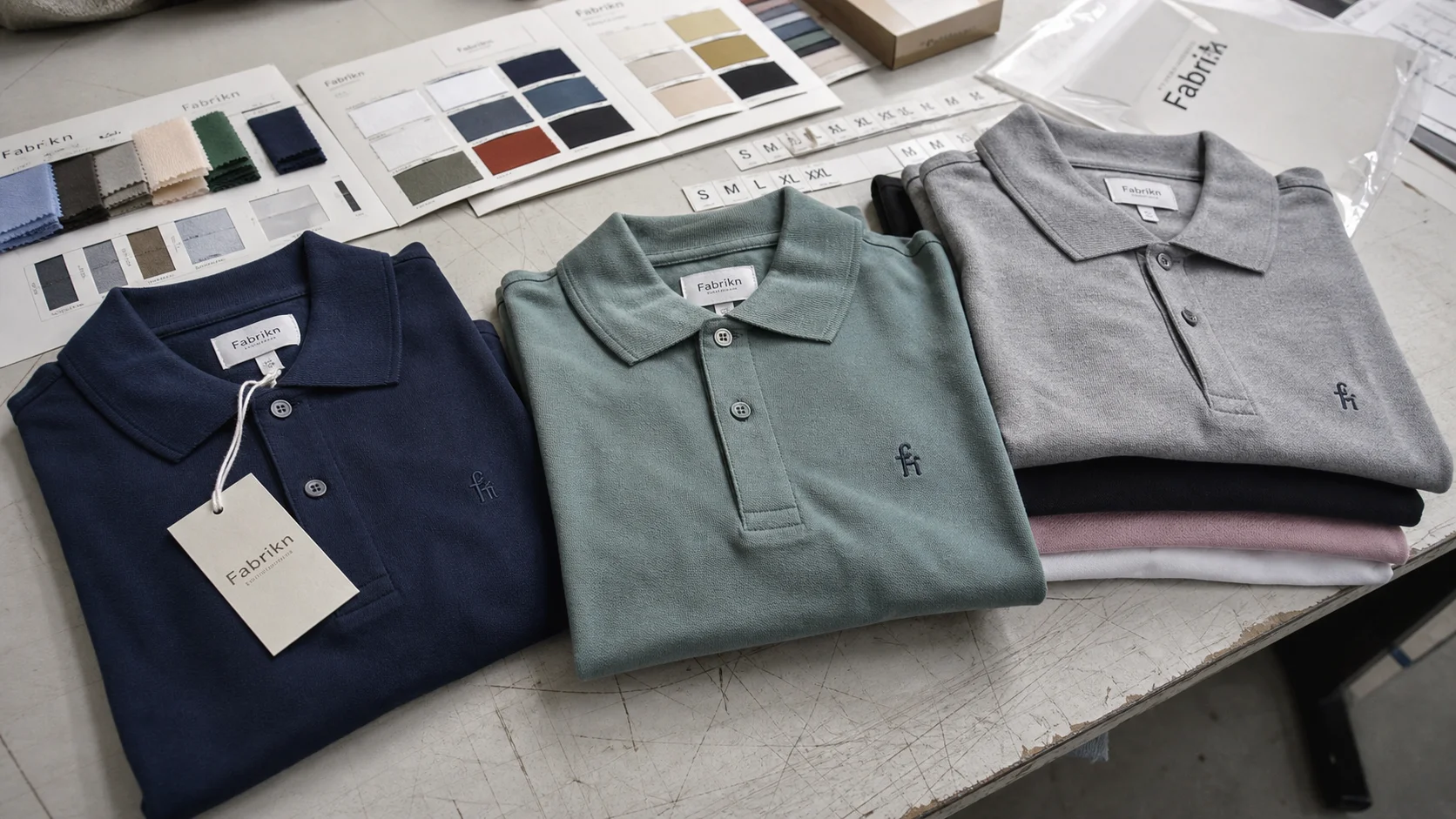
Verify Sustainable Clothing Manufacturer Certifications compared by sample evidence, fabric or trim specs, MOQ, AQL terms, cost lines, delivery timing, and...
Fast answer: Verify Sustainable Clothing Manufacturer Certifications: Sample Evidence, MOQ, Capacity, and Rework Terms should be judged by production evidence, not by a generic sourcing promise. The buyer needs sample proof, cost breakdowns, QC checkpoints, and delivery buffers in writing.
Ask for recent sample photos, measurement tolerances, fabric or print test assumptions, decoration test notes, packing examples, and a named inspection checkpoint. These details show whether the team can repeat an approved sample at bulk volume.
Separate garment cost, decoration, labels, packaging, sampling, testing, freight, and rush charges. Clear cost lines make it easier to reduce colorways, adjust size depth, or reserve more time for sampling.
As sustainability becomes a central priority in the apparel industry, more brands are looking for clothing manufacturers that can prove their environmental and social claims. Certifications are often the first sign that a factory takes sustainability seriously. But not all certificates are equally meaningful, and not every logo on a website tells the full story.
If you are sourcing from a sustainable clothing manufacturer, you need more than a polished website or a claim of “eco-friendly production.” You need to know whether the certifications are valid, current, and relevant to the products you want to make. Verifying these credentials helps reduce reputational risk, prevents greenwashing, and gives you confidence that your supply chain aligns with your brand values.
In this guide, we will explain how to verify sustainable clothing manufacturer certifications, what to look for in common standards, and how to build a practical verification process before choosing a production partner.
In the fashion industry, sustainability claims carry real weight. Customers, retailers, and regulators increasingly expect proof that products are made responsibly. However, certification fraud, expired licenses, and misleading references are more common than many brands realize.
Verification matters for several reasons:
It protects your brand reputation. If your supplier’s certifications are false or outdated, your own sustainability claims may be challenged.
It reduces compliance risk. Many retailers and marketplaces require valid documentation before approving products.
It supports traceability. Verified certifications help you understand where materials come from and how they are processed.
It filters out greenwashing. Some factories use sustainability language without meeting recognized third-party standards.
It improves long-term supplier quality. Factories that maintain valid certifications often have stronger operational systems and documentation discipline.
For brands seeking a dependable partner, certification verification should be part of the sourcing process, not an afterthought. If you want to explore production support from a manufacturer with a structured service approach, visit our services page.
Before you can verify a certification, you need to know what the certification actually covers. Not every sustainability certificate applies to every part of the supply chain. Some focus on raw materials, some on chemical safety, some on labor practices, and others on facility management.
GOTS is one of the most recognized certifications for organic textiles. It covers the processing, manufacturing, packaging, labeling, trading, and distribution of textiles made from organic fibers. A manufacturer claiming GOTS certification should be able to prove that its processes meet strict environmental and social criteria.
OEKO-TEX Standard 100 tests textiles for harmful substances. While it is not a full sustainability certification, it is an important indicator of product safety and chemical control. It is widely used for apparel, babywear, and home textiles.
This label combines product safety with supply chain traceability and more responsible production. It indicates that the item was tested for harmful substances and manufactured in environmentally friendly, socially responsible facilities.
GRS applies to products containing recycled content. It verifies recycled materials, chain of custody, social requirements, and environmental practices. For brands using recycled polyester, recycled cotton blends, or recycled trims, GRS can be especially important.
RCS is similar to GRS but focuses specifically on verifying the recycled content in products. It is often used when a brand needs proof that a textile includes recycled fibers without the broader social and environmental requirements of GRS.
ISO 14001 is an environmental management systems standard. It does not certify a specific product but shows that a manufacturer has a structured system for managing environmental impact.
SA8000 is a social accountability standard that focuses on labor conditions, worker rights, and fair treatment. It is relevant when a brand wants assurance that manufacturing practices align with human rights expectations.
amfori BSCI is a widely used supply chain audit framework for social performance. It is not a traditional certification in the same way as GOTS or OEKO-TEX, but many brands use it as part of supplier due diligence.
Understanding the scope of each credential helps you verify the right documents and ask better questions. A manufacturer may have one valid certificate for fabric processing and a different one for factory operations. Do not assume one certification covers the entire supply chain.
The best way to verify sustainable clothing manufacturer certifications is to use a structured process. Here is a practical step-by-step approach.
Many factories display certification logos on websites, catalogs, or product pages. That is not enough. Ask for the complete certificate document, including the certificate number, issuing body, scope, product categories, and expiration date.
A legitimate certificate should clearly show:
The certified company name
The certification body or issuing organization
The certificate number
The certification scope
The issue and expiry dates
The applicable standard version
One of the most common problems is a mismatch between the legal company name on the certificate and the name used in marketing materials. A factory may operate under a brand name, but the certificate must correspond to the legal entity that actually holds it.
Compare the certificate with the supplier’s business registration documents and website details. If the names do not match closely, ask for clarification.
Most reputable certification schemes have a public database or certificate lookup tool. This is one of the most reliable ways to confirm authenticity. Search the certificate number, company name, or scope in the official system.
Check whether the certificate is:
Currently active
Assigned to the same legal entity
Within its valid date range
Covering the relevant products or processes
If the certificate does not appear in the database, that does not always mean it is fake, but it does mean you should investigate further. Contact the issuing body directly if needed.
Scope is critical. A certificate may apply only to one facility, one production line, one product type, or one stage of processing. For example, a factory could be certified for organic fabric dyeing but not for garment cutting and sewing. If your product requires end-to-end certification, make sure every relevant stage is covered.
Ask these questions:
Does the certificate cover the exact facility where my order will be produced?
Does it cover the full process or only part of it?
Does it apply to the materials I plan to use?
Are subcontractors included or excluded?
Many brands overlook this simple but essential step. Certifications expire. If a supplier’s certificate is outdated, the claim is no longer valid. Even if the manufacturer says renewal is “in process,” you should ask for current proof.
Be especially careful with annual audits and multi-year validity periods. The certificate may still look professional, but if the expiration date has passed, it cannot be used as current verification.
Not every organization issuing certificates has the same level of authority. A valid sustainability certification should come from a recognized third-party body with clear standards, audit procedures, and traceability.
Look for signs that the issuer is legitimate:
Clear standards and methodology
Publicly searchable certificate records
Accreditation or recognition where applicable
Transparent audit processes
If you have never heard of the issuer, treat the certificate carefully and do more research before relying on it.
In some cases, the certificate alone may not tell you enough. Ask for supporting documents such as audit summaries, chain-of-custody evidence, transaction certificates, or test reports. This is especially important for materials that claim organic or recycled content.
For example, a GRS claim may be supported by transaction certificates or purchase records that show the flow of recycled materials through the supply chain. Similarly, OEKO-TEX claims may be supported by product test reports.
A valid certificate should make sense in the context of the factory’s actual operations. If a manufacturer claims broad sustainability capabilities but cannot explain its production process, sourcing model, or quality controls, that is a warning sign.
Ask how the certification integrates into daily operations. A credible manufacturer should be able to explain:
Where certified materials are sourced
How certified items are separated from non-certified items
How records are maintained
How compliance is monitored over time
If you are placing a large order, entering a long-term agreement, or launching a sustainability-focused brand, it may be worth involving an external compliance consultant or sourcing expert. They can help review documents, interpret standards, and assess whether the certificate truly supports your claim.
Verification is not just about confirming what is true. It is also about spotting warning signs that something may be wrong.
Watch for these red flags:
No certificate number: Legitimate certificates usually include a unique reference number.
Missing expiry date: A document without a valid date range is suspect.
Only a logo, no document: Logos are easy to copy; documents are harder to fake.
Vague wording: Claims like “eco-certified” or “fully sustainable” without a specific standard are not enough.
Scope mismatch: The certificate covers a different product, process, or facility than the one you plan to use.
Unverifiable issuer: The organization cannot be found or has no official lookup tool.
Pressure to move quickly: A supplier who discourages verification may not be acting transparently.
These red flags do not always mean fraud, but they should trigger deeper review. When sustainability claims are central to your brand, even a small documentation gap can become a major problem later.
Once you have reviewed the certificate, the next step is to ask targeted questions. These questions help you determine whether the manufacturer truly understands and maintains its sustainable practices.
Can you provide the full certificate and current verification link?
Which facility is certified, and is that the facility that will handle my order?
What products or processes are included in the certification scope?
When was the last audit completed?
Are there any subcontractors involved in production?
How do you maintain chain-of-custody documentation?
Do you have additional certifications for labor, chemical safety, or environmental management?
What happens if the certification is suspended or renewed late?
The answers should be clear, specific, and consistent with the documents you received. If the responses are vague or contradictory, pause and investigate further.
Verification is most effective when it is built into your sourcing workflow. Rather than checking certificates only once, create a repeatable process for every supplier.
Use a standard checklist to review each manufacturer’s certifications, including certificate number, issuer, scope, expiry, and database verification. This makes comparison easier across suppliers.
Store all certificates, audit reports, and correspondence in one secure location. This helps with future audits, retailer requests, and internal compliance reviews.
Do not assume a certificate remains valid forever. Re-check certificates at least once a year, or sooner if the supplier is making a new claim or changing production sites.
Not every certification is necessary for every brand. Choose the standards that match your materials, target market, and sustainability claims. If your collection uses organic cotton, GOTS may be more relevant than a general environmental management system. If you rely on recycled polyester, GRS or RCS may be more appropriate.
Certification is important, but it should not be your only assessment tool. Also evaluate sampling quality, communication, production capacity, lead times, ethical practices, and quality control. A sustainable supplier should perform well across multiple dimensions, not just on paper.
At Fabrikn, we understand that brand owners need more than a promise. They need clarity, documentation, and dependable manufacturing support. Our approach is built to help clients evaluate production partners with confidence and move from sourcing to production with fewer unknowns.
If you are exploring sustainable manufacturing or looking for a production partner that values transparency, our team can help guide the process. Learn more about our company on the about us page, or reach out directly through our contact us page to discuss your project requirements.
We also support clients who need help navigating product development, sourcing, and manufacturing requirements across different apparel categories. A thoughtful supplier review process helps brands make better decisions, reduce risk, and build more credible sustainability claims.
Learning how to verify sustainable clothing manufacturer certifications is essential for any brand that wants to build trust in the modern fashion market. A certificate is only valuable if it is current, authentic, and relevant to the exact products and processes involved. By reviewing the full document, checking official databases, confirming scope, and asking the right questions, you can separate genuine sustainability commitments from superficial marketing claims.
Strong verification protects your brand, supports responsible sourcing, and helps ensure that your products meet the expectations of today’s conscious customers. In sustainable fashion, diligence is not optional. It is part of building a resilient and credible business.
Get a free quote from Fabrikn — your trusted B2B clothing manufacturer with 10+ years of experience. MOQ as low as 200 pieces.
Get a Free Quote →Ask for the full certificate, including the certificate number, issuing body, scope, and expiration date. Then verify it in the official database of the certifying organization or contact the issuer directly.
The most important details are the certificate scope, the legal company name, and the expiration date. These show whether the certificate applies to the exact facility and product you plan to use.
No. Logos can be copied easily. Always request the full certificate and verify it through an official source before relying on the claim.
No. Some certifications cover organic content, some cover recycled materials, some focus on chemical safety, and others address labor or environmental management. Each has a different purpose.
At minimum, verify certifications once a year and whenever the supplier changes facility, product scope, or certification claims.
Yes. Many manufacturers hold several certifications covering different aspects of production, such as organic content, recycled materials, chemical safety, or social compliance.
Request clarification from the manufacturer and contact the issuing body. Do not assume the certificate is valid until you receive confirmation.