
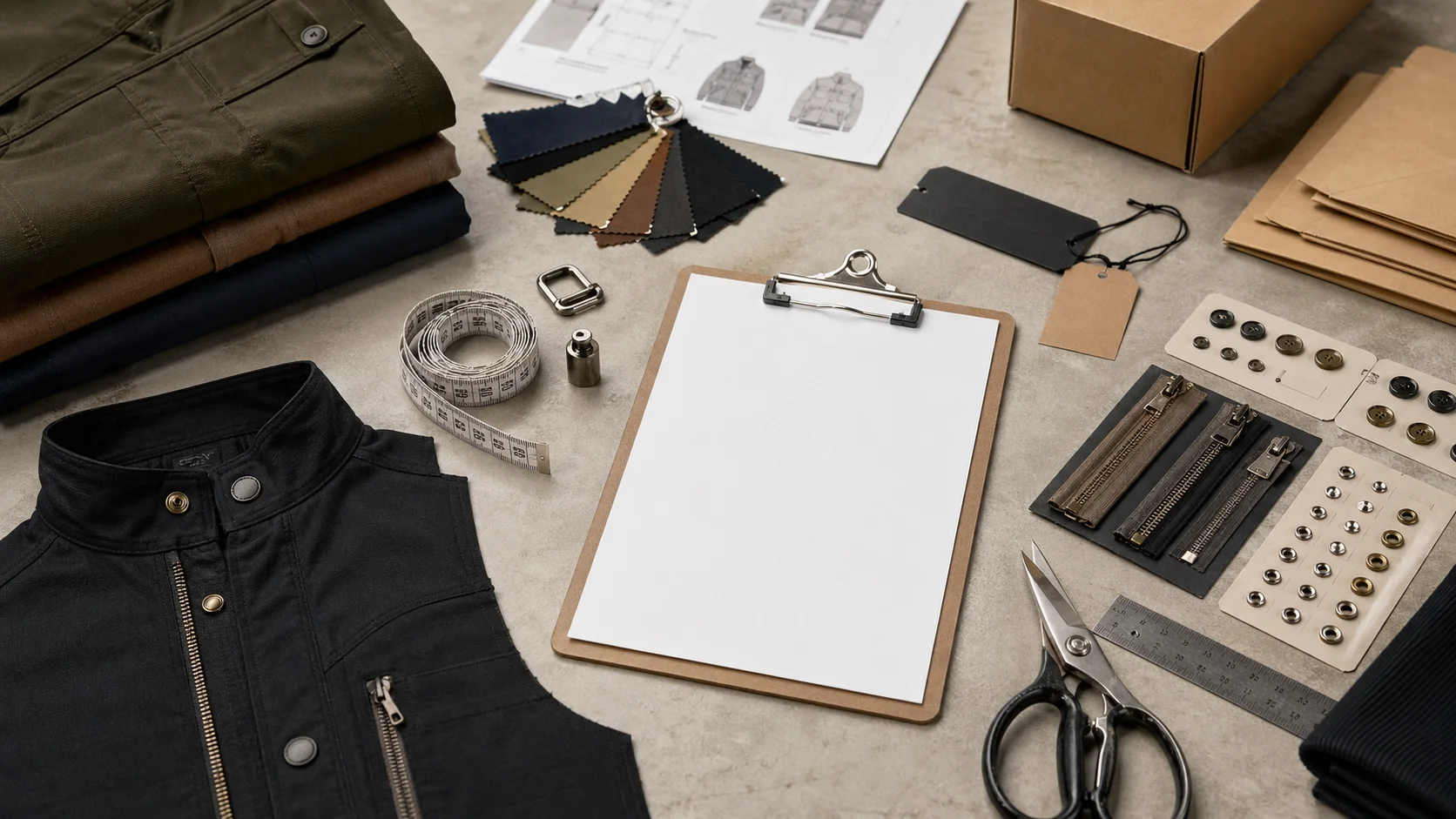
Jacket Quality Control Checklist for Clothing Manufacturers with checks for samples, fit, MOQ, QC evidence, pricing terms, and delivery risk.
Fast answer: Jacket Quality Control Checklist for Clothing Manufacturers should be judged by production evidence, not by a generic sourcing promise. The buyer needs sample proof, cost breakdowns, QC checkpoints, and delivery buffers in writing.
Ask for recent sample photos, measurement tolerances, fabric or print test assumptions, decoration test notes, packing examples, and a named inspection checkpoint. These details show whether the team can repeat an approved sample at bulk volume.
Separate garment cost, decoration, labels, packaging, sampling, testing, freight, and rush charges. When every cost line is visible, it becomes easier to reduce colorways, adjust size depth, or reserve more time for sampling.
Jacket Quality Control Checklist for Clothing Manufacturers - Clothing Manufacturer manufacturing guide
If you make jackets for retail brands, private label labels, or wholesale programs, quality control is not a final step. It is the backbone of the whole order. I have seen good jacket factories lose money on a single sloppy seam, a weak zipper lot, or a shade variation that should have been caught on day one. Jackets are unforgiving. They carry structure, hardware, lining, padding, and fit expectations all at once. That is exactly why a clothing manufacturer quality control checklist service for jackets needs to be specific, stage-based, and consistent. In a typical outerwear line, one bad zipper run or a 2-3 mm placket shift can create a full carton hold, even when the rest of the garment looks fine.
This guide breaks down a practical jacket QC checklist used in real production environments, from fabric inspection through final packing. It is written for manufacturers, sourcing teams, and brand owners who want fewer defects, cleaner audit results, and fewer painful returns after delivery. If you need broader support beyond jackets, you can review our services, learn more on our about-us page, or reach out through contact-us. In a normal production cycle, a repeat jacket order is often scheduled in 18-22 business days after lab dip approval and bulk trim sign-off, while a first run with sampling and revisions usually takes 30-45 days.
A T-shirt can tolerate a little more forgiveness. A jacket cannot. The construction is more complex, and the customer can see and feel that complexity immediately. Zippers must run smoothly. Snap buttons must align. Lining must not twist. Quilting must stay even. Sleeve balance must look right when the garment is hanging on a rack. One small fault can make the whole jacket feel cheap. On a lined bomber or puffer, a 5 mm shift in the lining bag can create a pull line that only shows after steaming and final pressing, which is why outerwear needs its own QC standard.
In my experience, the most expensive jacket problems are not always the obvious ones. A torn seam is easy to spot. A misaligned pocket, slightly off-center placket, or mismatched topstitch thread can slip through an inexperienced inspection team and still create a customer complaint. That is why a jacket-specific checklist matters. It keeps the team focused on what makes outerwear different from basic apparel. Factories in Guangzhou, Dhaka, and Ho Chi Minh City all run high-volume jacket lines, but the best ones still separate shell inspection, trim approval, and final packing into distinct checkpoints instead of treating them as one pass.
"A jacket can pass a casual glance and still fail in the customer’s hands. The best QC teams check the parts that normal eyes ignore."
For factories, a dedicated checklist also improves consistency between inspectors. If one person checks collar roll and another ignores it, the results become unreliable. A good clothing manufacturer quality control checklist service for jackets creates a shared standard. It makes training easier, dispute resolution faster, and final quality more predictable. In practice, most outerwear buyers expect an AQL 2.5 standard for major defects, with minor defects tracked separately at 4.0, especially on styles with visible hardware or printed linings.
Quality control starts before the first cut. That is where many jacket issues are planted. If the wrong fabric batch enters production, no amount of sewing skill will fix the final result. Pre-production is the cheapest place to catch problems, and yet many factories rush through it. A 4-point fabric inspection on every incoming roll and a 10-yard shade band check by lot can prevent the most common color and surface complaints before cutting begins.
Check the bulk fabric against the approved swatch for color, hand feel, weight, shrinkage behavior, and surface defects. For jacket shells, I like to verify fabric width and GSM again at incoming inspection, not just rely on supplier paperwork. A common winter jacket shell may require 180-260 GSM polyester or nylon, while a heavier workwear style can sit much higher. For technical shells, I would also confirm hydrostatic head and DWR performance on 40D or 70D nylon taslan, and check whether the lining is 210T polyester taffeta, brushed tricot, or recycled poly mesh.
Trims need equal attention. Zippers, snaps, drawcords, toggles, labels, elastic, and interlinings must match the approved sample. If the zipper brand changes after sign-off, the garment can feel different even when the size is correct. That is the kind of detail buyers remember. In practice, outerwear teams often lock in YKK coil, YKK Vislon, or YKK Aquaguard for shell jackets, then separate the trims by color lot and slider type so the packing line does not mix a matte black slider with a gunmetal finish.
Before bulk cutting, verify the pattern against the tech pack and size spec. Check critical points such as chest width, body length, sleeve length, shoulder slope, hood depth, collar height, and cuff opening. Jackets often lose shape when grading is too aggressive, especially across sizes XL and above. A 1 cm grade jump that works on a tee can look wrong on a jacket sleeve cap or a stand collar.
I strongly recommend a pre-production fit sample review on the actual target size range. A sample that fits a medium well can still expose poor proportion in large sizes. That is especially true for puffers, bomber jackets, and tailored outerwear. A serious factory will often make a first proto, a size-set sample, and a pre-production sample before bulk approval, with sleeve pitch and collar roll checked on a live fit model rather than flat only.
Confirm stitch type, seam allowance, bonding method, seam sealing, quilting spacing, and reinforcement points before bulk sewing begins. For technical jackets, the wrong seam tape or bad bonding temperature can create waterproofing failures later. A factory may save a few minutes per piece by skipping a process check, but that shortcut usually costs far more in rework. For example, seam sealing on a PU-coated shell typically needs the tape width, dwell time, and roller pressure confirmed on the exact machine setting before production starts.
A jacket QC service should also approve the order of operations. Pocket bags, linings, insulation, and hardware installation all affect the final shape. Once production starts, changing sequence can create puckering, drag lines, or misaligned layers. On a quilted style, the stitch order around the baffle often matters more than the seam type itself because one wrong pass can shift the fill and create a cold spot.
In-line inspection is where the factory catches drift before it becomes a pile of defects. The aim is not to inspect every single piece like a bottleneck. The aim is to monitor the line at the right moments and stop recurring issues early. A good line auditor will usually sample the first 5-10 pieces after each operation change, then recheck every 20-30 pieces if the defect rate stays low.
Cutting errors travel fast. A miscut sleeve or left-right asymmetry can ruin fit across the whole size run. If the factory uses automated cutting, I still like a manual spot check at lay-up and bundling. Machines are excellent. People catch the weird things machines miss. On larger programs, a Gerber AccuMark or Lectra Vector cutter can speed output, but the bundle table still needs a human to confirm drill holes, notch depth, and one-way pile direction before sewing starts.
For outerwear, topstitching is not just decoration. It is part of the visual standard. On a $28 FOB basic jacket, a crooked visible stitch line can be enough for a buyer to reject a shipment. On a premium $65 to $120 retail jacket, the tolerance is even tighter because customers are paying for finish. A straight lockstitch on a JUKI DDL-8700-7 or a reinforced chainstitch at the armhole is often the difference between a clean rack appearance and a returned carton.
Zippers, buttons, snaps, rivets, and buckles need repeatable placement. A zipper that is 3 mm off center on one piece and 5 mm off on another will look sloppy in photos and feel uneven in use. I have seen jacket lines waste hours fixing a zipper alignment issue that should have been caught when the first ten pieces came off the line. Snap placement on plackets and storm flaps is especially sensitive because even a 2 mm offset will make the overlap twist under tension.
Hardware also needs function testing. Run the zipper up and down. Test snap engagement. Check slider smoothness and stop resistance. A pretty jacket that fails at the zipper is still a failed jacket. For a YKK Vislon or metal coil zipper, a quick pull test on the first 3-5 garments can expose a bad lot before the line finishes the batch.
Lining must hang cleanly without twisting. Insulation must be distributed evenly, especially in quilted jackets and puffers. Thin spots are easy to miss under shop lighting, which is why in-line handlers should flatten and visually compare both sides of the garment. If the filling shifts during sewing, the jacket may pass measurement but still look cheap on a hanger. For synthetic fill, a 120-160 gsm wadding layer is common in light cold-weather jackets, while recycled polyester fill in a puffer can need chamber-by-chamber control to avoid clumping.
Final inspection is where the jacket is judged as a product, not a pile of parts. A complete clothing manufacturer quality control checklist service for jackets should cover appearance, measurement, function, packaging, and labeling. Most factories use a final audit table with AQL 2.5 for major defects, then flag zipper failures, open seams, and wrong labels as automatic rejects.
Look at the jacket as a customer would. Hang it. Fold it. Zip it. Put your hand in the pocket. If a jacket feels awkward in your hand, it will probably feel awkward in a store or at home. That is a hard truth, and one of the reasons I am not a fan of factories that rely only on paperwork inspections. You need eyes and hands on the garment. On coated fabrics and bonded fleece, the press cloth and steam setting matter as much as the inspection itself because a hot platen can leave a permanent shine mark in seconds.
Measure the critical points from the approved spec sheet. Common checkpoints include chest, hem sweep, front length, back length, sleeve length, cuff opening, shoulder width, hood opening, and collar height. Use a clear tolerance standard, such as +/- 1 cm for core measurements on regular jackets, or tighter where the buyer requires it. On premium outerwear, some brands ask for +/- 0.5 cm on front length and sleeve length because even a small variation changes the drape.
For technical outerwear, check whether insulation or quilting has affected the final dimensions after pressing. I have seen jackets pass sewing control and still fail final measurement because the padding compressed unevenly during finishing. That is especially common after tunnel drying or heavy steam pressing, when one panel relaxes more than the other.
Function testing should also include stress points that buyers often forget. Try the hood adjusters, pocket bags, and sleeve tabs. On a shell jacket, make sure the zipper garage does not block the slider. On a puffer, make sure the fill does not catch inside the chain when the zipper is closed at the bottom stop. These are the issues that show up after shipping if they are not caught on the line.
Confirm size labels, care labels, country of origin, fiber content, and brand labels are correct and readable. Check polybag warnings, carton marks, hangtags, and barcodes. If the order is destined for a chain retailer, the packing insert and carton weight may need to match the buyer routing guide exactly. I have seen shipments delayed because the barcode on the hangtag was 2 mm too low for the scanner window, which is a painful but very real outerwear mistake.
Jacket defects often repeat by style category, which is why the QC team should know the failure patterns for each construction. A puffer behaves differently from a bomber, and a softshell behaves differently from a tailored blazer-style jacket. The best factories keep a defect log by style and seam operation, then use that data to adjust machine settings, operator training, and in-line checkpoints.
Cause: Tape stretch, bad zipper alignment, or inconsistent feeding on the sewing machine.
Prevention: Use a zipper foot, check tape tension before attaching, and verify with a 10-piece first-off audit. On shell jackets, a pre-shrunk zipper tape is often worth the extra cost because it reduces wave after steaming.
Cause: Misaligned baffles, fill migration, or poor guide marking.
Prevention: Mark stitch lines with consistent spacing and keep quilting tension even across the panel set. For sewn-through puffers, a 4 cm or 5 cm baffle spacing is common, and it should be checked after the first sample run, not after bulk output.
Cause: Asymmetrical cutting, poor joining, or different seam shrinkage on the two sides.
Prevention: Check left-right pattern balance during cutting and confirm collar stand height before final stitching. A collar that is off by even 3 mm can twist after topstitching.
Cause: Wrong turn-in sequence or incorrect lining bag size.
Prevention: Approve the assembly order before sewing and confirm the lining dimension at pre-production. Polyester taffeta linings can slip more than brushed tricot, so the turn-of-cloth needs a different allowance.
Cause: Needle size mismatch, dull needle point, or poor thread quality.
Prevention: Match needle system and size to fabric weight, and change needles regularly. Many outerwear lines use Schmetz or Groz-Beckert needles, with the needle changed after every 8-10 hours on heavy shell fabrics.
Outerwear production is usually slower and more labor-heavy than basic knitwear. In Guangzhou, a well-run factory making light bomber jackets can often quote $2.50-4.00 per unit at 500 MOQ for a simple unlined style, while a quilted or technical jacket is typically much higher because of extra operations, seam sealing, and hardware. In Dhaka, prices can be more competitive for large-volume cut-and-sew programs, especially when the factory is WRAP or BSCI audited. In Ho Chi Minh City, many factories are strong on cleaner finishing and smaller MOQs, particularly for brands that need OEKO-TEX Standard 100 materials or recycled polyester programs.
For timing, a basic sample-to-bulk jacket order usually needs 18-22 business days after approval if trims are in stock and no lab dips are pending. If the style includes bonded seams, waterproof tape, or special quilting, add 5-7 business days for process validation and line setup. A realistic staffing ratio is one dedicated inline QC for every 25-35 sewing operators, plus one final inspector for every 150-200 finished pieces per shift. That ratio matters because jacket lines accumulate defects quickly when inspection is too thin.
Certification also affects factory choice. GOTS is relevant when the lining or pocketing uses organic cotton. OEKO-TEX Standard 100 is common for fabric and trim safety claims. WRAP and BSCI audits matter for social compliance, especially for export programs into the US and EU. A factory can have all four certifications and still fail jacket quality if the sewing standard is weak, so the audit badge should never replace a live production check.
One of the simplest ways to keep a jacket program under control is to map each operation to one concrete check. Many factories post this at the line end so operators, line leaders, and auditors all use the same reference. This is especially useful on a mixed line sewing nylon shell jackets, bonded fleece bombers, and insulated parkas in the same week.
Stage What to Check Typical Tool or Method Useful Detail Incoming fabric Shade, GSM, width, surface flaws 4-point inspection, GSM cutter Check every roll lot and keep shade bands by dye lot Cutting Grain, symmetry, notches, nap direction Lectra or Gerber cutter, bundle audit Confirm one-way pile before lay-up on brushed fabrics Stitching Seam width, skipped stitches, puckering JUKI lockstitch, Brother bartack Check first 5-10 pieces after each operation change Hardware Zipper alignment, snap function, rivet placement Functional pull test, visual gauge Measure center-to-center spacing in millimeters, not by eye Finishing Press marks, shine, loose threads, lint Steam press, lint roller, final visual audit Keep hot pressing off coated shells and matte finishes Packing Label accuracy, barcode, polybag, carton mark Carton checklist, scan test Match buyer routing guide before sealing the cartonIf you want jacket quality control to work every season, it needs to run like a system, not a one-time inspection. The best services create a master checklist by style family, then layer in buyer-specific requirements for measurements, labeling, and packaging. A softshell should not use the same exact checklist as a puffer or a workwear parka, even if the factory line is the same.
Start with three documents: the tech pack, the approved sample set, and the defect standard. Then train the line using real garment examples, not only photos. In a factory that produces for multiple markets, you may need one checklist for EU buyers who want OEKO-TEX documentation and another for US buyers who focus more on carton counts, fiber content, and size consistency. This is where a disciplined QC lead saves real money.
The service should also define escalation rules. If a defect repeats on 3 consecutive bundles, stop the line and correct the operation. If a hardware lot fails the first 10 pull tests, quarantine the carton and recheck the full shipment. If the buyer needs a final seal on a waterproof jacket, make sure the seam sealing machine temperature and tape feed are logged, not just assumed. That kind of discipline is what separates an average jacket program from a reliable one.
Get a free quote from Fabrikn — your trusted B2B clothing manufacturer with 10+ years of experience. MOQ as low as 200 pieces.
Get a Free Quote →The most common mistake is checking appearance without checking function. A jacket can look perfect on the table and still fail because the zipper tracks crooked, the hood is too shallow, or the lining twists after the first zip. On many lines, that happens because the team inspects the final garment before testing the hardware.
Most factories use AQL sampling instead of 100 percent inspection. For outerwear, AQL 2.5 is a common target for major defects, with lot size and sample count set by the buyer. On a 3,200-piece shipment, the sample plan is usually much smaller than full inspection, so the first-off and in-line checks matter just as much as the final audit.
Typical shell materials include 100 percent nylon taslan, polyester twill, polyester pongee, and cotton canvas. Linings are often 210T polyester taffeta, brushed tricot, or mesh. Fill can be polyester wadding, recycled polyester insulation, or down, depending on the target price and warmth level.
No. GOTS, OEKO-TEX Standard 100, WRAP, and BSCI help with material safety and social compliance, but they do not replace a strong in-line and final QC program. A certified factory can still make a bad seam if the operator training or machine setup is poor.
For most jacket programs, the essentials are a stable lockstitch machine like a JUKI DDL-8700-7, a bartack machine for stress points, an overlock machine for lining and internal seams, and a steam press for final shape. Technical jackets may also need a seam sealing machine and a bond tester for taped seams.
For brands and manufacturers alike, a strong jacket QC checklist is the difference between a clean shipment and a warehouse full of claims. Jackets are too complex to leave to chance, and too visible to hide small problems. If you build the checklist around fabric data, machine control, buyer standards, and real production behavior, you get fewer defects and a much smoother order every season.