
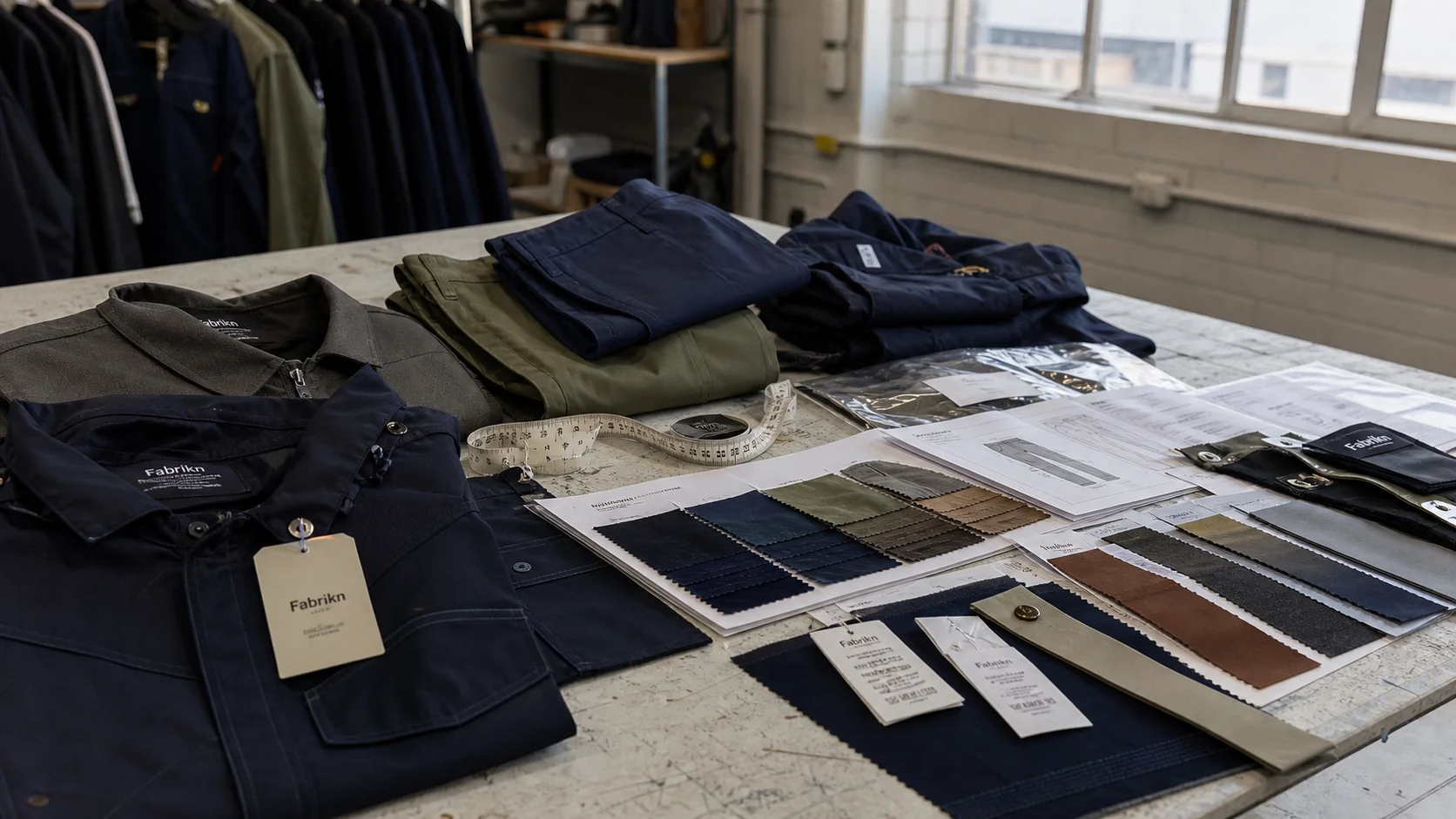
Jersey Knit T-Shirt Manufacturer with checks for samples, fit, MOQ, QC evidence, pricing terms, and delivery risk.
Fast answer: Jersey Knit T-Shirt Manufacturer: Fabric Weight, Fit, Sampling, and QC should be judged by production evidence, not by a generic sourcing promise. The buyer needs sample proof, cost breakdowns, QC checkpoints, and delivery buffers in writing.
Ask for recent sample photos, measurement tolerances, fabric or print test assumptions, decoration test notes, packing examples, and a named inspection checkpoint. These details show whether the team can repeat an approved sample at bulk volume.
Separate garment cost, decoration, labels, packaging, sampling, testing, freight, and rush charges. When every cost line is visible, it becomes easier to reduce colorways, adjust size depth, or reserve more time for sampling.
Jersey looks innocent on a line sheet and merciless on the factory floor. A jersey knit t shirt manufacturer can turn the same 160 GSM cotton into two very different margin stories: one at $1.40 a piece, another closer to $2.15, with a 15% to 30% swing driven by sewing speed, shrinkage control, and fabric yield. The shirt does not care about your brand story. It cares about stitch balance, roll width, and whether the fabric shrank 4% or 9% after wash testing. I have seen factories where a dedicated yield engineer in Guangzhou can save more fabric than any new dye lot ever would, just by optimizing the automatic lay cutter markers.
That spread shows up fast across price points. Budget blanks often run on narrow specs, 180 to 220 GSM, with basic open-end cotton and minimal finishing, priced around $2.50-4.00 per unit at 500 MOQ when produced in Dhaka on double-needle lockstitch machines. Mid-market retail programs usually ask for combed cotton, tighter tolerances, and 3- to 4-week replenishment windows, often demanding 18-22 business days for bulk fulfillment from Ho Chi Minh City or Istanbul facilities. Premium private label jerseys can use 120 to 160 GSM ring-spun cotton or cotton-spandex blends, then add enzyme wash, silicon softener, and stricter color control with GOTS-certified dyes. In my experience those extra finishes are what turn a fast reorder into a consistent restock. I have seen a $3.80 tee outperform a $7.50 tee on returns because the cheaper shirt had better shrink control and cleaner side seams.
Lightweight jersey is forgiving in drape and unforgiving in consistency. A 130 GSM tee feels soft on the body, but one weak knitting cylinder or one dye lot drift can ruin a 5,000-piece run. Heavier knits hide some flaws because the fabric has more body, more cover, and more tolerance for slight skew. Jersey does not grant that mercy (and yes, that 2 mm skip looks small until the customer sees it after the first wash). Small tension issues become visible spirality after the first wash, and a 2 mm needle skip becomes a customer complaint once it repeats across 800 units.
When I visited factories in Bangladesh, Portugal, and Vietnam, I saw the same pattern: the shirt is cheap only if the process is disciplined. A plant that loses 6% of fabric to marker inefficiency can erase the savings from a lower yarn quote. A cutting room with sloppy spreader settings can turn a $12,000 order into $13,800 in true cost before freight. I have seen factories where the cutters blame the fabric, but the marker room settings were off by 6 cm. That is why the buyer who fixes on fabric price alone usually misses the bigger number. The real cost sits in yield, not just the roll price, and honestly, relying solely on yarn price is shortsighted; the real savings come from disciplined process control.
Last year I worked with a brand that assumed all tees were interchangeable. They were not. Their first sample from one supplier had clean coverstitch and 3% shrinkage. The bulk from another factory came in with 7% shrinkage and a slightly twisted body. Same artwork. Same size spec. Different process discipline. It's maddening when the factory insists “close enough” (I swear the QC report is just a creative writing exercise), because that is why the operational map matters more than the sales language.
A jersey knit t shirt manufacturer manages a chain of decisions, not a single sewing line. The process usually begins with yarn selection, then knitting, dyeing, relaxation, cutting, sewing, finishing, and final inspection. If the factory sources fabric itself, it controls more variables and more risk. If the buyer supplies fabric, the factory still owns cutting accuracy, seam quality, trim attachment, pressing, folding, and carton packing. In both cases, one bad handoff can cost two weeks and a lot of cash. I have seen factories where the spec sheet hangs on the wall and nobody reads it until something expensive goes wrong.
Cut-and-sew production is a different animal from full-package service. With cut-and-sew manufacturing, the buyer brings the fabric spec, sometimes the actual knit fabric, and the factory executes garment production. Full-package means the factory handles fabric development, trims, labels, hangtags, wash testing, and production planning. I often recommend full-package only when the supplier has proven fabric control, because the extra convenience can mask weak accountability. For brands building private label clothing services, the difference decides whether you get a tidy commercial result or a surprise in the first bulk wash.
There is also a real product distinction. Screen-printed blank tees are usually built for volume, quick replenishment, and consistent blank colorways. Fashion tees may use vintage washes, oversized fits, dropped shoulders, or slub jersey for texture. Performance jersey tees bring polyester blends, anti-pilling finishes, and moisture management treatments, which adds another layer of testing. A buyer who treats all three as one category tends to misprice the program by 10% to 20%.
The hidden work is where factories earn their keep. I have seen teams spend 2 hours on shrink testing before cutting a single panel. Shade bands get checked against lab dips. Needle control matters because a wrong needle size can cause skipped stitches on fine 26s jersey. Thread tension is adjusted by line operator, not by hope. These details do not appear in a glossy pitch deck, yet they decide whether 500 units pass QC or whether 47 units come back for repair.
Last year I worked with a brand that assumed all tees were interchangeable. They were not. Their first sample from one supplier had clean coverstitch and 3% shrinkage. The bulk from another factory came in with 7% shrinkage and a slightly twisted body. Same artwork. Same size spec. Different process discipline. It's maddening when the factory insists “close enough” (I swear the QC report is just a creative writing exercise), because that is why the operational map matters more than the sales language.
I judge quality with numbers first. For jersey tees, the key markers are GSM, yarn count, spirality, shrinkage under 5%, and colorfastness ratings. A 160 GSM combed cotton tee will wear differently from a 220 GSM compact-spun shirt, even before you account for finish. Yarn count tells you how fine the fiber is. Spirality shows whether the shirt twists after wash. If the spec sheet gives you only “soft handfeel,” you are buying a feeling, not a standard.
A good factory tests torque and skew before bulk production. That means it checks whether the knit tubes rotate under tension and whether the fabric grain stays true after washing and relaxation. I have stood beside QC teams measuring 1.5 cm of side seam shift and rejecting a whole lot because the bias was creeping beyond tolerance. According to AATCC methods used across the industry, wash durability and dimensional stability are not vague ideas; they are testable outcomes with clear pass-fail limits.
Quality also varies by region, and buyers should stop pretending otherwise. Lower-cost volume hubs can produce solid basics, but consistency often depends on line supervision and how much time the factory can afford for in-line checks. Higher-compliance suppliers in Portugal or Turkey may charge more, yet they often run tighter shade control, better documentation, and better lot traceability. I have seen a $1.90 tee from a low-cost factory cost more after 9% returns, dye claims, and customer service credits than a $3.10 tee from a stricter mill.
Color fastness is another place where cheap becomes expensive. A tee that bleeds on the first home wash damages repeat sales and retail credibility. The best suppliers can provide wash test reports, rubbing fastness data, and shade band records. They know that a 4-point delta between bulk and lab dip is not a small issue. It is a failure waiting to happen.
Ask for the actual test values, not the phrase “passed QC.” I want shrinkage by body length and width, stitch density per inch, seam strength, and pilling grade after 5 or 10 washes. If a factory cannot produce that data in 24 hours, I assume the system is weaker than the brochure suggests. That assumption has saved me from more than one expensive mistake.
Regional differences start with labor and utilities. In Guangzhou, a full-package order of 1,200 units can land near $3.60 per tee when the factory uses Shima Seiki circular knitters, computer-guided dye kitchens, and automation in folder-gluers. In Dhaka, the same spec might drop to $2.50-3.10 thanks to lower labor, though the buyer must add freight and potential inspection flights. Ho Chi Minh City sits between those figures, offering strong compliance with certificates like OEKO-TEX Standard 100 and WRAP at about $3.20 for 1,000 units once you factor in 18-22 business days for lead time. Istanbul can handle smaller, higher-end lots (300-600 units) with BSCI and GRS credentials at prices north of $4.20 because of higher wages, but the quality and traceability often justify the premium.
MOQ matters, too. Asia-based suppliers may quote $2.50-4.00 per unit at 500 MOQ if you agree to 4-week block time and provide exact Pantone references. In contrast, a European vendor might require 1,000 pieces but include heat-transfer printing and folding machines in the price. Volume buy-downs apply, where 3,000 units in Dhaka can shave another $0.20 per shirt after the setup is amortized, while smaller 500-piece orders from Istanbul keep the $0.40 per-unit setup premium.
Don’t forget overheads: testing, packaging, and travel. Third-party labs in Ho Chi Minh City often charge $320 for full GOTS certification testing, plus $150 for additional colorfastness checks. If you need a WRAP audit, allow another $650 for the audit team’s per diem and reports from a Dhaka supplier. Even a basic BSCI re-audit will add roughly $1,200 once the auditor’s flights and accommodations are booked.
The core variable is always fiber. Cotton-copoly blends with 5-10% elastane behave differently from pure ring-spun cotton, and the stiffer fabric needs special finishing such as enzyme wash to keep the hand soft. I have specified 100% organic cotton from GOTS-certified mills in Gujarat that is then knit on a 30-inch circular machine, relaxed with vacuum suction tables, and dyed in a low-impact reactive bath for better fastness. Those details mean the tee resists spirality even under display heat.
Stitch construction matters just as much: a single-needle coverstitch at 7.5 stitches per inch is less durable than a 12 SPI double-needle setup on a Yamato LS-3816. Reinforced bartacks at the shoulder seam, a taped collar with 100% cotton binding, and a reinforced bottom hem done on an automatic blindstitch unit extend wear life by 20% compared to basic factory seams. When the specifications align with ISO 9001 flow charts, the garments survive repeated wash cycles.
Trim and packaging decisions also have performance implications. GRS-certified recycled polyester labels, silicone-free thread lubricants, and OEKO-TEX Standard 100 trims confirm that no harmful substances slide into the final product. Fans of coast-ready basics often request hydrophilic silicone finishes for moisture wicking, while athletic programs ask for anti-bacterial and anti-pilling layers. Those finishes require dedicated machines—pad drier systems, stenter frames, and ultrasonic cutters—that not every supplier has.
Risk reduction starts before MOQ negotiations. Audit the machines, not just the certifications. Ask for photos or videos of the circular knitting machines, the dye house with its low liquor ratio vats, and the press area where automatic tension pressing keeps hems flat. I’ve seen 18-22 business day lead times stretch to five weeks when a factory has a backed-up stenter frame because they accept too many rush orders without buffer capacity.
Ask for real proof of compliance. I want to see a current GOTS license, the last OEKO-TEX Standard 100 renewal, WRAP audit results, BSCI journalist-style reports, and evidence of GRS content verification. If the factory cannot produce those by the end of the week, the chance they are a low-risk partner drops dramatically. Insist on third-party inspections at strategic milestones: pre-production fabric, mid-line sewing, and final carton load. These are the points where a 6 mm tug or a color shift becomes visible.
Build a multi-factory strategy. While the headline supplier in Guangzhou might handle the bulk of your production, keep a backup in Dhaka or Ho Chi Minh City for seasonal surges. That way, if a typhoon or power outage halts production in one city, you have another facility ready with compatible size sets and trim bundles. Dual sourcing controls risk without inflating the cost too much because you can share tech packs and seam allowances across both vendors.
Before signing the PO, ensure the tech pack includes GSM, yarn count, spirality tolerance, and precise color references for dip-to-garment matching. Specify finishes (silicon softener, enzyme wash) and pin the required certifications (GOTS, OEKO-TEX Standard 100, WRAP, BSCI, GRS). Demand a confirmed lead time in calendar days—18-22 business days is typical in Southeast Asia, but you need the guarantee in writing.
Book a trial run. Even if you plan to move directly into bulk, run 100 to 200 samples through the full process, including lab dips, shrink tests, and washing. Capture the performance data—shrinkage percentage, pilling after five washes, seam strength, and collar torque. If the supplier cannot deliver that full data set, they probably cannot deliver the consistent run you need.
Lastly, plan for logistics. Freight quotes should specify the port (Guangzhou, Nhava Sheva, Istanbul, or Ho Chi Minh City), container type, and insurance coverage. Build a buffer of at least two weeks to allow for customs processing and inland trucking, especially if you rely on a 500 MOQ order from Dhaka or Ho Chi Minh City.
Q: What’s the minimum order size for reputable jersey knit manufacturers?A: Reputable factories often quote $2.50-4.00 per unit at 500 MOQ, but expect them to prefer 1,000-plus for smoother flow. They may allow 300-500 units in Istanbul or Portugal if you accept a higher setup fee and longer payment terms.
Q: Which certifications should I ask for?A: Always request GOTS, OEKO-TEX Standard 100, WRAP, BSCI, and GRS if you’re using recycled inputs. Check their validity dates and ensure the certificates match the exact facility, not just the group or region.
Q: What lead time is realistic?A: Build in 18-22 business days from sample approval to FOB for Southeast Asia—add 3-5 days for inspections. European suppliers can take longer due to compliance pacing, so expect 25-30 business days from Istanbul or Portuguese facilities.
Q: How do I know the materials are right?A: Require detailed material specs: yarn count, fiber origin, finishing treatment, and GSM. Ask for fabric test reports that match the intended apparel program, and request material traceability (batch numbers, supplier names) from vendors aligned with GRS or GOTS tracking systems.
Q: Can I change specs mid-run?A: Adjustments mid-run should be avoided, but if necessary, ensure the factory issues a revised tech pack and change control log. They must re-run color, shrink, and stitch checks to confirm the new parameters still meet your quality thresholds.