
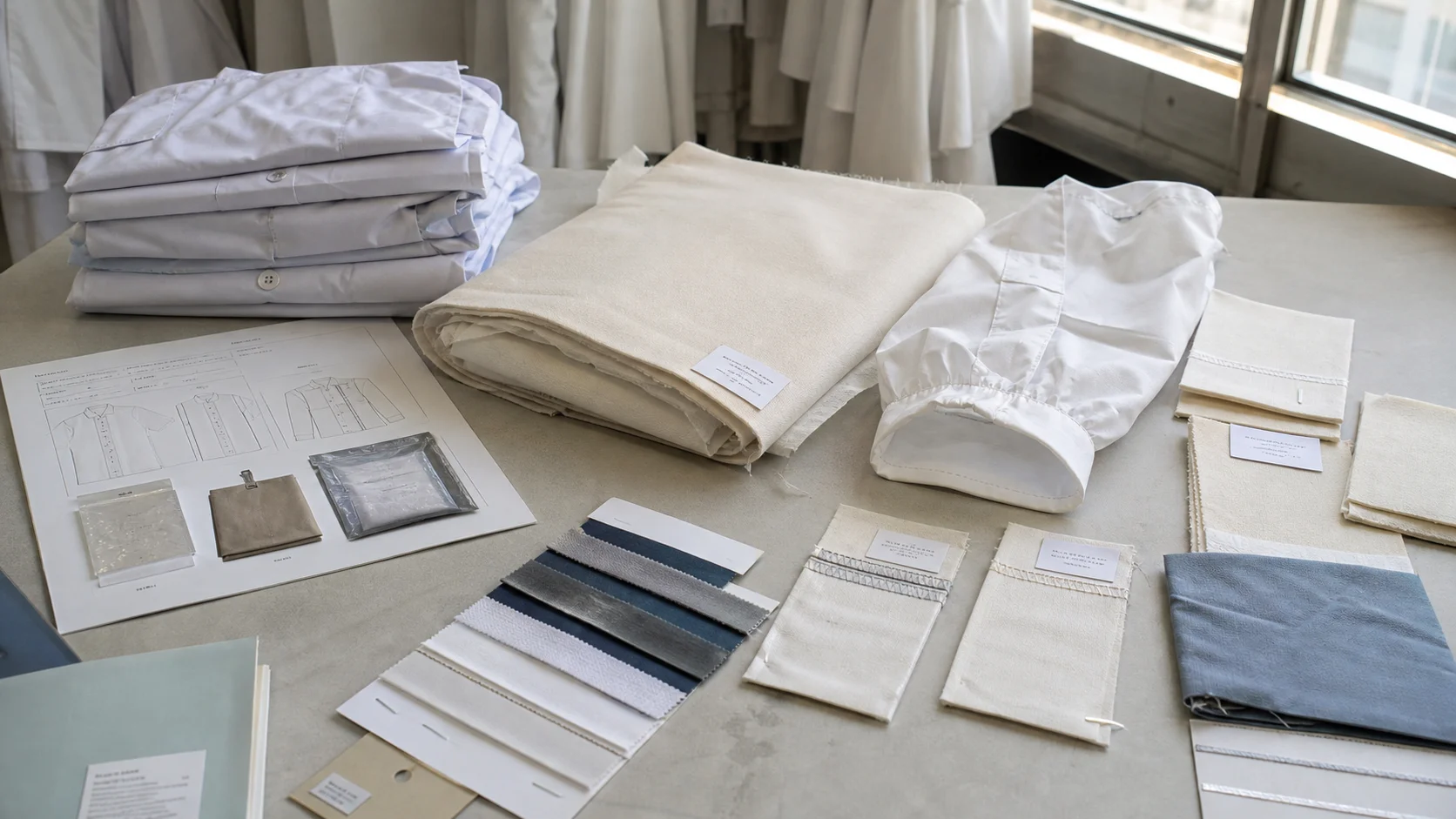
A quality and inspection outline for school operations teams evaluating lab coat fabrics, test reports, wash durability, safety performance, and supplier...
Lab Coat Fabric Testing Guide for School Buyers - Quality & Inspection manufacturing guide
School lab coats are not fashion garments. They are daily-use protective uniforms handled by students, teachers, lab technicians, laundry staff, and operations teams. A weak fabric choice can create problems across the whole school year: shrinkage after washing, yellowing, loose seams, poor stain resistance, rough hand feel, inconsistent sizing, and coats that look worn after only a few practical sessions.
For school buyers, fabric testing is not a luxury add-on. It is the control point that separates a reliable uniform program from a recurring complaint cycle. A lab coat supplier may show a clean sample, quote an attractive price, and promise quick delivery. That is only the starting point. The real question is whether the bulk fabric performs consistently after cutting, sewing, washing, wearing, and repeated handling.
A good lab coat supplier fabric testing guide for school operations teams should focus on practical risks, not just laboratory terminology. Buyers need to know which tests matter, when to request them, how to read basic results, and where to set tolerances. The goal is not to over-test every order. The goal is to match the testing plan to the school’s actual use case.
Purchasing judgment: if the lab coats are for occasional demonstrations, a standard poly-cotton fabric may be enough. If students use chemicals, heat sources, dyes, biological stains, or weekly laundering, fabric testing should be treated as part of the purchase specification, not an optional report.
School operations teams usually work under budget and timeline pressure. Testing adds cost and can add days to approval. Still, skipped testing often costs more later through replacements, complaints, emergency reorders, and supplier disputes. Fabric performance should be agreed before bulk production begins, because once fabric is cut, correction options become limited.
Factories and suppliers may have different testing habits. Some keep internal wash records. Some rely on mill certificates. Some can arrange third-party testing if the buyer requests it. The buyer should be clear about the level of evidence required. For many school orders, a combination of supplier fabric data, pre-production sample review, wash testing, and final inspection is more realistic than a full laboratory testing package for every style.
Testing is only useful when the buyer has a clear specification. Without a written spec, results become hard to judge. A supplier can say the fabric “passed,” but passed against what? School operations teams should define the fabric type, weight, construction, color, trim, wash requirement, and intended wear conditions before asking for testing.
Most school lab coats use cotton, polyester-cotton blends, or polyester-rich blends. Each option has tradeoffs.
Composition should not be described only as “white lab coat fabric.” The purchase order should state the fiber content tolerance and whether the supplier must provide a fabric composition test report. If the school has safety requirements, the fabric composition must align with those policies.
Lab coat fabric is commonly ordered in the approximate range of 150 to 240 gsm, depending on market, climate, age group, and durability expectations. Lightweight fabrics are cheaper and more comfortable in warm classrooms, but may become transparent and wear faster. Heavier fabrics look more substantial and protect clothing better, but can feel hot and may increase garment cost.
Construction also matters. Plain weave, twill, and drill fabrics behave differently. Twill or drill constructions may provide better durability and opacity, while plain weave can be lighter and cheaper. The supplier should state fabric weight, weave, yarn count if available, and finishing type. If these details are missing, comparison between quotes becomes unreliable.
Fabric Option Typical Use Buyer Advantage Buyer Risk 150-170 gsm poly-cotton Occasional classroom use Lower cost, lighter feel Possible transparency and lower durability 180-200 gsm poly-cotton Regular school laboratory use Good balance of cost and wear Must check shrinkage and pilling 210-240 gsm cotton or drill Higher durability programs Stronger appearance and coverage Higher price, longer drying timeWhite is the default for many school lab coats, but white is not a single shade. A blue-white fabric, cream-white fabric, and optic-white fabric can look very different when issued together. If the order is repeat-based, the buyer should keep an approved shade standard from the previous delivery.
Shade variation is especially risky when fabric is sourced from different dye lots or when the supplier splits production across more than one fabric batch. Buyers should ask how the supplier controls shade lots and whether all garments will be cut from the same approved batch. For larger orders, shade band approval before cutting is a sensible control.
Fabric testing should be connected to trim performance. A durable fabric will not save the order if buttons crack, snaps rust, thread yellows, or pocket fabric shrinks differently from the main body.
Buyers placing multi-size school orders should also check that pocket placement, sleeve length, collar shape, and closure spacing remain consistent across sizes. These are not fabric tests, but they influence student comfort and practical use.
Not every school order needs a full technical testing package. The right testing plan depends on order value, usage frequency, and risk exposure. A practical approach is to divide testing into essential checks, recommended checks, and conditional checks.
A composition test confirms whether the fabric matches the claimed fiber content. This matters when comparing cotton-rich and polyester-rich quotes. A supplier may quote a fabric as poly-cotton, but the exact blend affects shrinkage, comfort, cost, and durability.
For larger tenders, composition should be verified through a mill certificate or third-party test. For smaller replenishment orders, buyers may accept a supplier declaration if the supplier has a stable track record and the sample performance is acceptable. That is a cost decision, but it should be deliberate.
GSM testing checks grams per square meter. It is one of the most basic and useful controls because it directly affects opacity, durability, hand feel, and cost. A few gsm difference may be acceptable, but a large drop from the approved sample can signal fabric substitution.
School buyers should set a tolerance. For example, a 190 gsm specification might allow a practical tolerance around plus or minus 5%, depending on the fabric and supplier agreement. The tolerance should be written in the purchase order or technical sheet, not discussed after delivery.
Shrinkage is one of the most common complaints in school lab coats. Students may receive the correct size at issue, then find sleeves and body length too short after washing. Cotton-rich fabrics are more exposed to this risk, but blends can also shrink if finishing is poor.
A basic wash test should simulate the school’s expected laundering method. If parents wash coats at home, the test condition should reflect domestic washing. If the school uses central laundry, the supplier needs the wash temperature, drying method, detergent type if relevant, and expected wash cycle frequency.
As a practical benchmark, buyers often look for shrinkage within a controlled range such as 3% or lower for many school uniform applications. Specific tolerances should be confirmed with the supplier and fabric type. The important point is consistency: a garment that shrinks unevenly across body, sleeve, and pocket panels will look worse than one with minor controlled shrinkage.
Even white lab coats need colorfastness checks. White fabrics can yellow, gray, or pick up staining during washing. Colored piping, embroidery, trims, or school logos can bleed into the white body fabric if not properly tested.
Colorfastness to washing is especially important when coats include contrast embroidery or colored labels. A clean sample before wash does not prove wash stability. Buyers should request wash-tested samples before approving bulk production for designs with colored components.
Rubbing tests check whether color transfers from fabric to other surfaces in dry or wet conditions. For pure white lab coats this may seem less relevant, but it becomes important for contrast trims, printed logos, colored cuffs, or dyed fabric panels.
Wet rubbing performance is usually more difficult than dry rubbing. School environments include spills, water, sweat, and frequent handling, so weak wet rubbing results can become visible quickly.
Students pull sleeves, stuff pockets, hang coats on hooks, and move between benches. Fabric strength matters, especially around stress areas. Tear strength checks how fabric behaves when a small cut or nick begins to spread. Tensile strength checks resistance under pulling force.
For school buyers, these tests are most relevant when the quote seems unusually low or when the fabric feels thin compared with the approved sample. A low-cost fabric can pass appearance review but fail under routine wear.
Pilling makes lab coats look old even when they are structurally usable. It is more common with certain blends and surface finishes. Pilling resistance should be considered for coats worn weekly or for uniforms expected to last more than one academic year.
Buyers should inspect high-friction areas: cuffs, lower sleeves, side seams, pocket openings, and front placket. Pilling test grades can be useful, but a physical washed sample often gives school teams the clearest understanding of appearance retention.
Dimensional stability is broader than shrinkage. It includes twisting, seam puckering, collar distortion, pocket deformation, and placket waviness. A lab coat may technically shrink within tolerance but still look poor if panels twist after washing.
School buyers should wash and dry the pre-production sample, then check garment measurements and appearance. This is a simple step that catches many problems before bulk cutting.
School lab coats are often described as protective garments, but buyers must be precise about what kind of protection is expected. A standard school lab coat is usually intended to protect clothing and provide basic coverage during laboratory activities. It should not be assumed to provide chemical, flame, biological, or industrial protection unless the fabric and garment are tested for those specific requirements.
Many school science environments involve diluted chemicals, dyes, and staining agents rather than high-risk industrial chemicals. Still, buyers should ask what the fabric is expected to resist. Standard cotton or poly-cotton lab coats may absorb liquids. This can be acceptable for general classroom use but not for higher-risk work.
If liquid repellency is required, the supplier should state the finish used and provide testing information. Buyers should also ask how many washes the finish is expected to withstand. A finish that performs before washing but disappears after several cycles may not be suitable for a school year program.
School labs may include Bunsen burners or heat sources. Fabric response to flame and heat should be reviewed according to the school’s safety policy. Cotton and polyester behave differently near flame. Polyester can melt, while cotton can ignite. Blends have their own risk profile.
Buyers should not accept vague claims such as “safe for lab use” without clarification. If flame resistance is required, it should be specified clearly, tested accordingly, and priced separately. Flame-resistant fabrics or finishes usually cost more and may involve higher MOQ or longer lead time.
Opacity matters in schools, particularly with white coats worn over uniforms. Lightweight white fabric can become transparent under bright lighting or when damp. GSM helps, but weave and finishing also affect opacity.
A practical inspection method is to review the sample over dark and light garments under classroom-like lighting. Buyers should not rely only on a folded fabric swatch because multiple fabric layers can hide transparency issues.
Students are more likely to wear lab coats properly when they are comfortable. Heavy fabrics may last longer but can feel hot. Polyester-rich fabrics may dry quickly but feel less breathable. Cotton-rich fabrics may feel better but need more care.
School operations teams should balance durability with climate and student age. Younger students may prefer lighter garments that are easy to move in. Older students in regular lab programs may need stronger fabric and better coverage.
Lab coats contact the neck, wrist, and sometimes forearm areas. Buyers should consider whether restricted substance testing is needed, especially for large school programs or younger students. Tests may include checks for harmful substances depending on destination market requirements and school policy.
For many school buyers, the practical starting point is to request supplier compliance declarations, fabric safety documentation, and confirmation that dyes and finishes are suitable for school garments. Higher-risk tenders may require formal third-party reports.
A structured sample approval process prevents disputes. Verbal approval is weak. Photos alone are not enough. School operations teams should document each approval stage and keep physical reference samples where possible.
The first approval should be the fabric swatch or lab dip if color is involved. For white coats, this includes shade, hand feel, thickness, opacity, and weave. Buyers should compare swatches against the intended specification and previous order samples if available.
At this stage, the buyer can reject fabrics that are too thin, too stiff, too transparent, or visibly different from the requested composition. It is cheaper to reject a swatch than a finished sample.
The fit sample checks pattern, sizing, length, sleeve shape, collar, pocket position, and general construction. It may not use final bulk fabric, but the buyer should know if substitute fabric is used. A fit sample in different fabric can approve size and pattern, not final performance.
School orders often cover a wide size range. Buyers should confirm whether grading across sizes is proportional and whether larger sizes have suitable ease. Tight coats are harder to wear over school uniforms and may split at stress points.
The pre-production sample should use actual bulk fabric, trims, labels, buttons, thread, logo application, and packaging method. This is the most important approval sample before bulk production.
Buyers should check the pre-production sample before and after washing. Measure the garment before wash, wash it under agreed conditions, dry it as expected, then remeasure. Inspect collar shape, pocket distortion, sleeve length, seam puckering, button security, and label readability.
For school programs with multiple sizes, a size set helps confirm grading. A full size set is best for larger orders. For smaller orders, buyers may review core sizes and one small plus one large size.
Size set review reduces the risk of receiving a bulk order where the middle size fits but small and large sizes are poorly graded. This is common when suppliers adapt a generic lab coat pattern without checking the full school size range.
The approved sample should be sealed, labeled, and referenced in the purchase order. One sample can stay with the buyer and one with the supplier. Final inspection should compare bulk goods against this approved sample.
The sealed sample should include all relevant details: fabric, shade, trims, label, logo, stitch appearance, garment measurements, packaging, and folding. If any change is approved after sealing, it should be documented in writing.
Approval Stage Main Purpose Buyer Decision Fabric swatch Confirm material direction Approve, reject, or request alternatives Fit sample Confirm pattern and sizing Approve fit or request corrections Pre-production sample Confirm final fabric and trims Approve bulk production only after review Washed sample Confirm shrinkage and appearance Approve if performance is within tolerance Sealed sample Set inspection reference Use as final comparison standardFabric testing and sourcing decisions are closely linked to MOQ and lead time. A buyer may want a custom fabric, custom size range, embroidered logo, and testing reports, but each requirement affects production planning.
MOQ varies by supplier, fabric availability, customization level, and season. For school lab coats, typical ranges may look like this:
These are typical commercial ranges, not fixed rules. A supplier with stock white poly-cotton fabric may support lower quantities. A buyer asking for a custom treated fabric should expect higher MOQ and longer development time.
Lead time depends on several moving parts. Fabric availability is usually the first constraint. If the supplier holds suitable fabric in stock, sampling and production can move faster. If fabric must be woven, dyed, finished, or tested, the timeline expands.
School buyers should plan backwards from the issue date. If coats must be distributed before the academic year starts, approval delays can create air freight costs, rushed production, or weaker inspection. Early specification work is usually cheaper than urgent correction later.
The cheapest quote usually removes something: fabric weight, testing, inspection time, seam quality, trim quality, or service flexibility. That does not mean low-cost suppliers should be rejected automatically. It means the buyer should understand what is being traded away.
A slightly higher fabric weight may improve opacity and durability. A stronger button and thread package may reduce repairs. A wash-tested pre-production sample may prevent a full batch of shrinking coats. Testing costs can feel inconvenient at purchase stage, but they can protect the budget when order quantities are large.
For sourcing support, school operations teams can review broader manufacturing and quality service options through Fabrikn’s services page. A structured supplier process is especially helpful when comparing multiple quotes that use different fabric assumptions.
Final inspection should not be treated as a quick carton count. Lab coats have predictable risk areas. A focused inspection checklist helps buyers catch issues before goods are accepted or distributed.
Fabric substitution is a major risk when the approved sample feels different from bulk goods. The difference may be due to a new batch, a different mill, a finishing change, or a deliberate cost reduction. Inspectors should compare bulk garments against the sealed sample for hand feel, thickness, opacity, and shade.
If the difference is significant, buyers may request GSM checks, composition verification, or supplier explanation before accepting the goods. Once coats are issued to students, proving substitution becomes much harder.
White lab coats from different shade lots can look mismatched when distributed together. The issue becomes obvious in classrooms where students stand side by side. Inspectors should check shade across cartons, sizes, and production lots.
A small shade variation may be commercially acceptable if it is not visible in normal use. A strong variation should be treated as a quality issue, especially for repeat programs where the school expects consistency.
Lab coats are worn over uniforms, so ease matters. Tight sleeves, short body length, and narrow shoulders cause complaints. Measurement inspection should include key points: chest, shoulder, sleeve length, body length, collar, cuff, and pocket placement.
Buyers should define measurement tolerances by size and garment area. Large sizes may need different practical tolerance than small sizes. A consistent measurement chart should be attached to the purchase order.
Common construction defects include skipped stitches, open seams, loose thread ends, puckering, uneven topstitching, weak pocket corners, and poor button attachment. Pocket corners need special attention because students often place notebooks, pens, phones, or tools in them.
Reinforcement at stress points may add minor cost but can reduce failures. For school use, pockets and side seams are more important than decorative finish.
Some defects appear only after washing. These include seam twisting, collar bubbling, placket waviness, label fading, logo distortion, and shrinkage. A final inspection that only checks unwashed garments may miss these risks.
For larger orders, buyers can request random wash testing from bulk production before shipment. This is not always standard, so it should be agreed in advance.
School distribution depends on accurate size ratios. A carton packing error can delay issue day even if garment quality is acceptable. Inspectors should verify size labels, carton markings, assortment ratio, polybag information if used, and packing list accuracy.
Labels should be clear enough for school staff to sort quickly. If the school prohibits individual plastic packaging, that requirement should be stated early because it affects packing method and carton planning.
A supplier scorecard helps school buyers compare options beyond unit price. It also creates a record for future tenders and repeat orders. The scorecard does not need to be complicated. It should measure the areas that affect delivery success.
Evaluation Area What to Check Purchasing Judgment Fabric transparency GSM, weave, opacity over uniform Reject if too sheer for school environment Wash performance Shrinkage, twisting, seam appearance Approve only after sample wash review Testing evidence Mill certificate, internal tests, third-party reports Match evidence level to order risk Trim quality Buttons, snaps, thread, labels, embroidery Check after washing, not just before MOQ flexibility Stock fabric, custom fabric, size distribution Lower MOQ may limit customization Lead-time reliability Sampling, testing, production, inspection schedule Do not compress approval steps before school deadlinesBuyers should ask suppliers direct questions before placing the order:
These questions reveal whether the supplier is selling a garment or managing a quality process. A practical supplier should be able to explain fabric options, not just send photos and a price. Buyers can also learn more about sourcing background and company positioning through the Fabrikn about us page.
School operations teams do not need to test every possible property for every order. A risk-based plan is more efficient. The testing level should rise when order quantity is high, the garment is customized, the use case is more demanding, or the supplier is new.
A low-risk order may involve a small quantity of stock lab coats for occasional classroom use. In this case, buyers may rely on supplier specifications, physical sample review, basic wash testing, and final inspection. The key is to check that the sample is not too thin and that sizing is acceptable.
A medium-risk order may involve several hundred coats, school branding, multiple sizes, and regular weekly use. Buyers should request fabric composition details, gsm confirmation, pre-production sample approval, wash testing, and a documented measurement chart. If the budget allows, third-party testing for shrinkage and colorfastness is sensible.
A high-risk order may involve a large tender, strict school safety policy, treated fabric, central laundry, or multiple campuses. In this case, buyers should require formal testing reports, sealed approval samples, size set approval, bulk lot control, and pre-shipment inspection. If flame resistance, liquid repellency, or restricted substance compliance is required, these must be tested against the relevant standard rather than assumed.
Purchasing judgment: spend testing budget where the failure cost is highest. A small top-up order may not justify the same testing package as a full academic-year rollout across multiple schools.
A purchase order should include more than quantity and price. It should record the agreed quality standard. If a dispute happens, the written specification becomes the reference point.
At minimum, the purchase order or technical pack should include:
Buyers should avoid vague phrases such as “good quality,” “standard fabric,” or “school grade.” These terms are open to interpretation. A supplier may consider a fabric acceptable because it is common in the market, while the school may expect higher opacity, better wash durability, or a softer hand feel.
For buyers who need help structuring requirements or discussing fabric testing with a supplier, the Fabrikn contact page is the direct route for starting a sourcing conversation.
A good school lab coat order starts with fabric clarity. The buyer should know the composition, weight, weave, shade, wash behavior, and trim package before bulk production begins. The supplier should know what will be inspected and what evidence is required.
Testing should be practical, not excessive. For most school operations teams, the strongest control points are fabric swatch approval, pre-production sample in bulk fabric, wash testing, measurement review, and final inspection against a sealed sample. Third-party testing becomes more important as order quantity, compliance risk, and performance expectations increase.
Price still matters. Schools have budgets, and not every program needs premium fabric. The right buying decision is the fabric that meets the school’s use case at an acceptable total cost, including quality risk. A cheap lab coat that shrinks, stains badly, or looks transparent is not a saving. A costly technical fabric may also be unnecessary if the coats are only used occasionally.
School buyers should ask suppliers to prove the basics before negotiating extras. Confirm the fabric. Wash the sample. Check the size set. Inspect the trims. Lock the standard in writing. That process will prevent more problems than any last-minute inspection after production is finished.
Get a free quote from Fabrikn — your trusted B2B clothing manufacturer with 10+ years of experience. MOQ as low as 200 pieces.
Get a Free Quote →Polyester-cotton blends, especially around 65/35, are commonly used because they balance durability, washability, cost, and appearance retention. Cotton-rich fabrics can feel more breathable but may shrink or wrinkle more. The best choice depends on climate, wash method, budget, and lab use intensity.
Many school lab coats fall between about 150 and 240 gsm. Lightweight fabrics reduce cost and heat, but may be more transparent. Mid-weight fabrics around 180 to 200 gsm often provide a practical balance for regular school use. Heavier fabrics can improve durability but may feel warmer and cost more.
Third-party testing is recommended for larger orders, new suppliers, strict tender requirements, treated fabrics, or higher-risk lab use. For smaller low-risk orders, buyers may rely on supplier documentation plus sample wash testing and inspection, provided the risk is acceptable.
Shrinkage testing is one of the most important for school buyers because poor shrinkage control affects fit, comfort, and complaints after washing. GSM, composition, colorfastness, tear strength, and pilling resistance are also important depending on the order size and usage.
At minimum, buyers should approve a fabric swatch and a pre-production sample made with final bulk fabric and trims. For larger programs, a fit sample, size set, washed sample, and sealed approval sample should also be included before bulk production.
Typical MOQs may start around 100 to 300 pieces for stock fabric and basic styles. Custom labels, embroidery, or fabric changes often move MOQ toward 300 to 500 pieces or more. Special fabric finishes or custom dyeing may require 500 to 1,000 pieces or higher, depending on the supplier and mill requirements.
Lead time depends on fabric availability, sampling, testing, trim sourcing, production capacity, and inspection. Stock fabric orders can move faster, while custom fabric or third-party testing adds time. School buyers should plan early and avoid compressing sample approval before the academic year deadline.
A standard school lab coat usually provides basic coverage and helps protect clothing, but it should not be assumed to provide chemical or flame protection. If specific protection is required, the fabric and garment must be specified and tested for that purpose.
Inspectors should check fabric against the sealed sample, shade consistency, measurements, stitching, pocket strength, button attachment, labels, logo quality, packing accuracy, and carton size ratios. Random wash testing is useful for larger orders where shrinkage and post-wash appearance are critical.
Schools can reduce problems by writing a clear fabric specification, approving final bulk fabric before production, washing the pre-production sample, setting measurement tolerances, keeping a sealed sample, and inspecting goods before acceptance. Clear documentation is the strongest protection against supplier misunderstandings.