
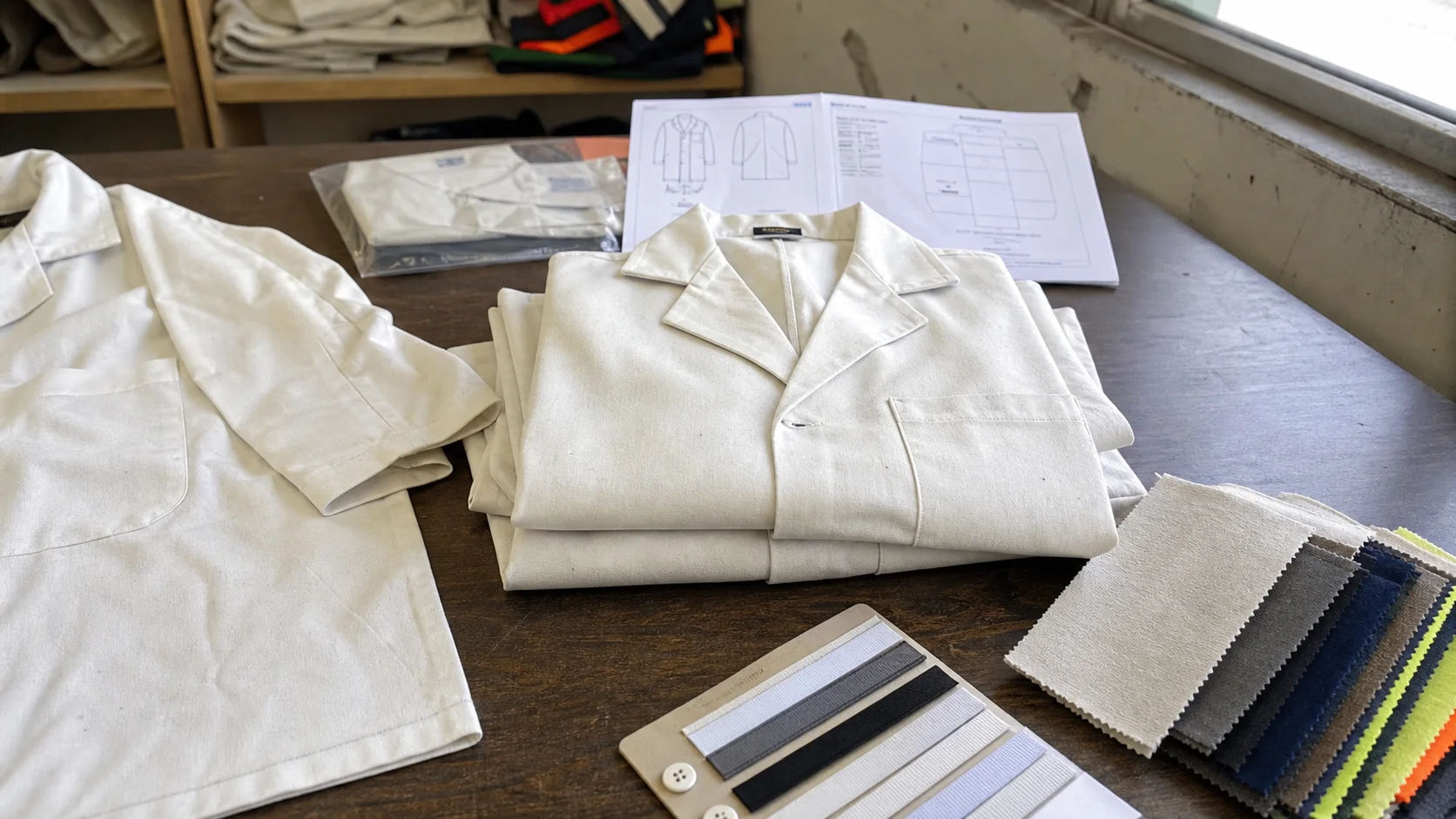
A quality and inspection focused outline for construction safety buyers reviewing lab coat factory MOQs, pricing tiers, materials, compliance details, and...
Lab Coat MOQ Pricing Review for Safety Teams - Quality & Inspection manufacturing guide
Lab coat factory MOQ pricing is not just a purchasing detail. For construction safety teams, it affects budget control, wearer compliance, replacement planning, and the ability to maintain a consistent protective workwear program across job sites. A low unit price can look attractive on a quote sheet, but if the minimum order quantity forces excess inventory, the real cost may be higher than expected.
This review focuses on lab coat factory MOQ pricing for construction safety teams that buy protective garments for site laboratories, quality control rooms, concrete testing areas, material inspection teams, environmental monitoring crews, and technical staff who move between office, field, and controlled testing environments. These buyers usually need practical garments that are durable, easy to identify, and consistent across repeat orders.
Lab coats used around construction operations are not the same as fashion uniforms or disposable visitor coats. The garment may need stronger seams, more practical pockets, better coverage, color-coded trims, logo placement, and fabric that can tolerate frequent washing. Some teams also require flame-resistant, anti-static, chemical-resistant, or high-visibility elements, depending on the site risk assessment. Each of these decisions can change the MOQ and price structure.
MOQ pricing should be reviewed as a sourcing system, not as a single number. A factory may quote 300 pieces as a standard MOQ, but that may only apply to one fabric, one color, one style, and limited size grading. Once the buyer asks for special fabric, contrast trims, custom labels, embroidered logos, or extended sizing, the true MOQ can shift. Safety teams should ask for the MOQ by style, color, fabric, size range, and logo method before comparing suppliers.
The best MOQ is not always the lowest MOQ. The better target is a quantity that supports stable production, practical inventory levels, and repeatable quality at a cost the safety budget can defend.
This article is written for procurement managers, safety officers, project administrators, contractor group buyers, and quality inspection teams sourcing lab coats from factories or apparel vendors. It is especially relevant when a construction business needs custom lab coats rather than off-the-shelf garments.
Construction safety teams often buy lab coats for a mixed user group. One team may include laboratory technicians, site engineers, testing staff, supervisors, visitors, subcontractor representatives, and auditors. That mix creates sizing complexity and may increase the number of SKUs. The more SKUs a buyer creates, the harder it becomes to stay within a factory’s preferred MOQ.
For buyers reviewing suppliers, the most useful questions are not limited to “What is your MOQ?” or “What is your best price?” A stronger review looks at whether the factory can maintain fabric consistency, control shrinkage, place logos accurately, grade sizes correctly, and pass inspection without repeated rework. For B2B apparel projects, MOQ and quality should be judged together.
Teams that need help structuring apparel sourcing projects can review supplier development and production support options through Fabrikn services. For early-stage planning, it is usually better to clarify specifications before requesting final pricing.
Lab coat MOQs vary by factory, fabric, customization level, and production setup. Buyers should treat the following ranges as practical market references, not fixed rules. A factory’s quote can differ based on capacity, season, raw material availability, and whether the order fits an existing production line.
Order Type Typical MOQ Range Pricing Impact Best Fit Stock fabric, basic white lab coat 100-300 pieces Lower development cost, moderate unit price Small safety teams, pilot orders, replenishment tests Custom color or contrast trim 300-600 pieces Higher fabric or trim coordination cost Company-wide identification programs Custom woven label and embroidery 200-500 pieces Logo setup and placement control required Branded contractor and quality teams Special fabric such as FR or anti-static 500-1,000 pieces or more Higher fabric MOQ and certification review Higher-risk industrial or regulated work areas Multi-style or multi-color program 600-2,000 pieces combined More production management and SKU control Large construction groups and repeat programsFor a basic woven lab coat using common polyester-cotton fabric, a factory may accept 100 to 300 pieces if fabric is available locally or already in inventory. This can be useful for a safety team that wants to test fit, wearer feedback, and wash performance before committing to a larger production run.
For a custom lab coat with a unique shade, special pocket layout, branded buttons, or contrast collar details, the MOQ often moves closer to 300 to 600 pieces. The reason is simple: the factory needs enough volume to justify pattern setup, cutting markers, trim purchasing, line balancing, and quality control time.
Special technical fabrics usually raise the MOQ further. Flame-resistant cotton, anti-static fabric, acid-resistant finishing, or certified protective textiles can have fabric mill MOQs separate from the garment factory MOQ. A garment factory might be willing to sew 300 pieces, while the fabric supplier may require enough yardage for 800 pieces. Buyers should confirm whether the MOQ is driven by the garment factory or the fabric mill.
MOQ pricing is built from several cost layers. Fabric is usually the largest component, but it is not the only one. Construction safety teams should ask suppliers to explain the pricing structure clearly enough to compare options.
Fabric cost depends on fiber content, weight, weave, finishing, color, and testing requirements. Common lab coat fabrics include polyester-cotton twill, cotton twill, polyester-cotton poplin, canvas blends, and technical protective fabrics. A lightweight 160 gsm poly-cotton fabric will price differently from a 240 gsm cotton twill or FR-treated fabric.
For construction-related use, the cheapest fabric is not always the right choice. A lightweight coat may look acceptable in a sample but fail after repeated washing, snag more easily, or feel too thin for site laboratory work. A heavier fabric can improve durability but may reduce comfort in hot climates. The right decision depends on use conditions, not only quote comparison.
Trim includes buttons, snaps, thread, pocket reinforcement, labels, care labels, packaging, hook-and-loop closures, reflective tape, and logo applications. Embroidery, heat transfer, woven patches, and screen printing each carry different setup and minimum charges.
Embroidery is durable and professional, but it can pucker on lighter fabrics if stabilizer and stitch density are not controlled. Heat transfer can be cleaner for fine logos, but wash performance must be tested. Woven patches are useful for heavy-duty uniforms, though they add sewing steps and can create edge-curling issues after laundry.
Factories quote better prices when a style is easy to run efficiently. A simple lab coat with standard pockets, straight seams, and common closures is easier to produce than a coat with multiple utility pockets, reinforced elbows, internal pen slots, badge loops, and contrast panels.
Low MOQ orders are usually less efficient because setup time is spread over fewer units. This is why a quote for 100 pieces can be significantly higher per unit than a quote for 500 pieces. The buyer is not only paying for sewing time; they are paying for the factory’s changeover, pattern handling, cutting setup, inspection allocation, and administrative work.
Size distribution affects both price and production risk. A factory may quote based on sizes S to 2XL. If the buyer adds XS, 3XL, 4XL, tall sizes, or women’s fit options, pattern grading and fabric consumption can change. Larger sizes consume more fabric, and extended size sets can create cutting inefficiency.
Safety teams should provide an estimated size breakdown early. A balanced size curve can keep pricing stable. A purchase order with a large number of outlier sizes may need a revised quote.
A good MOQ pricing review starts with a clear specification sheet. Without it, suppliers may quote based on different assumptions, making price comparisons unreliable. Construction safety teams should define the garment’s use case before finalizing fabric and trim details.
Construction safety teams should be careful with vague terms like “chemical resistant,” “heavy duty,” or “industrial grade.” These phrases are not enough for a purchase specification. If a garment needs a performance claim, the buyer should request the relevant test method, test report, wash durability conditions, and limitations of use.
Reflective tape is sometimes requested for lab coats used around active work zones. This can be useful for identification, but it should not be assumed to make the coat compliant with high-visibility workwear standards unless the whole garment is designed and certified for that purpose. A lab coat with reflective strips is not automatically a certified high-visibility garment.
White remains common for laboratory use, but construction teams may prefer navy, gray, royal blue, or color-coded trims to distinguish quality control, safety, environmental, or visitor roles. Color can improve visual management on site, but custom dyeing may increase MOQ and lead time.
If color consistency matters across future repeat orders, buyers should request a fabric color standard and keep an approved swatch. Relying on a digital image is risky. Fabric shade can shift between dye lots, especially when the order volume is small and the factory sources from available stock.
Sampling is where many MOQ pricing problems become visible. A supplier may quote attractively, but the first sample can reveal weak pattern work, poor pocket placement, incorrect fabric weight, or misunderstanding of branding instructions. For safety teams, sampling should be treated as a control step, not a formality.
For simple orders, buyers may combine some stages. A small 150-piece order may not justify a long development cycle. Still, at least one approved pre-production sample should be retained. Without a sealed approval sample, inspection arguments become harder to resolve.
Wash testing is especially important for lab coats. A garment may fit correctly before laundering but shrink beyond tolerance after several wash cycles. Buyers should specify acceptable shrinkage, such as a maximum percentage after defined washing conditions. They should also review seam twisting, colorfastness, label durability, and logo performance after washing.
Construction teams should also check practical movement. Lab coats may be worn while bending, reaching, carrying samples, or standing at test benches. A coat that looks clean on a mannequin may restrict shoulder movement or pull at the buttons during field use. Fit approval should include wearer feedback from the intended user group when possible.
Lead time depends on fabric availability, sample approval speed, production capacity, order quantity, branding method, testing requirements, and shipping method. A realistic schedule protects both buyer and supplier.
Stage Typical Time Range Main Dependency Spec clarification and quote 3-10 business days Completeness of tech pack and size breakdown Initial sample 7-20 business days Fabric availability and pattern complexity Sample revisions 7-15 business days per round Buyer feedback speed and factory workload Bulk fabric and trim purchasing 1-4 weeks Stock fabric versus custom fabric Bulk production 3-7 weeks Quantity, line capacity, and inspection requirements Shipping Several days to several weeks Air, courier, truck, sea freight, and customs clearanceA basic stock-fabric lab coat order may be completed faster than a technical protective garment order. A custom FR fabric program can require extra testing and documentation review, which can lengthen the timeline substantially. Buyers should not approve a safety-critical garment based only on a short delivery promise.
The approval timeline is often controlled by the buyer as much as the factory. Slow logo confirmation, unclear size quantities, missing care label requirements, or delayed sample feedback can push production back. Construction projects operate under tight schedules, so safety teams should plan lab coat sourcing before the current inventory is nearly depleted.
Seasonality also matters. Factories may have peak periods when capacity is booked by larger uniform, schoolwear, medical, or industrial orders. A small MOQ order placed during a peak month may not receive priority unless the buyer agrees to a higher unit price or flexible delivery window.
Lab coats look simple, but inspection failures are common when specifications are loose. Construction safety teams should identify the most likely risks before production begins.
Inspection should include measurements against an approved size chart. The size chart should list tolerances, not just target measurements. For example, a chest tolerance may differ from a sleeve length tolerance. Tolerances should be realistic for the fabric and construction method.
Buyers should also check packing accuracy. A lab coat order may pass visual inspection but fail distribution needs if sizes are packed incorrectly. Construction teams often ship garments to multiple sites, so carton marking, size stickers, polybag labels, and packing lists should match the purchase order.
Pre-shipment inspection is the most common control point, but it may be too late to solve major fabric or fit problems. For larger programs, an in-line inspection can identify issues while production is still adjustable. For smaller orders, reviewing the pre-production sample carefully may be the most cost-effective control.
AQL inspection can be used for bulk production, but the acceptance level should match the risk profile. Cosmetic issues may be handled differently from functional safety issues. A missing logo may be a branding defect; a weak seam or wrong protective fabric may be a more serious problem.
Quality and inspection support should be planned before production starts. Buyers that need external assistance can contact Fabrikn to discuss sourcing controls, inspection planning, and supplier communication requirements.
MOQ pricing is a tradeoff between flexibility and cost efficiency. A lower MOQ reduces inventory risk but usually raises the unit price. A higher MOQ improves production efficiency but can tie up budget and create dead stock if sizes or job-site needs change.
A practical approach is to separate trial quantity from program quantity. Safety teams can start with a controlled pilot order, gather feedback, confirm wash performance, then negotiate a larger annual or semi-annual production plan. This can give the factory enough volume to improve price while protecting the buyer from an oversized first order.
Blanket purchase orders or scheduled releases can also help. Instead of taking 1,000 pieces at once, a buyer may negotiate a total commitment with staggered deliveries. Not every factory will accept this, especially if fabric must be purchased upfront. When accepted, it can balance price stability with inventory control.
Before approving a lab coat factory MOQ quote, construction safety teams should review the following points. This checklist helps prevent low-price surprises later in production.
Review Area Buyer Question Purchasing Judgment MOQ basis Is the MOQ per style, color, fabric, size range, or total order? Reject vague MOQ terms before purchase order approval. Fabric Is the fabric stock, custom dyed, or mill-order only? Custom fabric may improve consistency but raises MOQ and lead time. Safety claim Does the garment require FR, anti-static, chemical, or visibility performance? Do not accept unsupported protective claims without documentation. Logo What is the logo method and minimum setup charge? Choose durability over appearance if laundering is frequent. Sizing Does the quote include all required sizes and extended sizes? Confirm size curve before price comparison. Sampling Is a pre-production sample included before bulk cutting? Do not skip sample approval for custom garments. Inspection What inspection standard and measurement tolerance will apply? Agree on tolerances before production starts. Packaging Are size labels, carton marks, and site-level packing required? Packing errors can damage rollout efficiency. Repeat orders Will fabric, trims, and patterns be held for future orders? Repeat consistency should be priced into the program.For construction safety teams, the best purchasing route is usually a staged approach. First, define the risk environment and garment purpose. Next, create a clear specification sheet. Then request pricing at several quantity levels, such as 100, 300, 500, and 1,000 pieces, so the team can see the price break structure.
Buyers should avoid comparing one supplier’s 100-piece price against another supplier’s 500-piece price without checking specifications. A quote comparison should include fabric weight, fiber content, logo method, size range, sample cost, production lead time, packing details, testing requirements, and inspection terms.
If the garment is basic and non-technical, a lower MOQ may be acceptable for the first purchase. If the garment carries safety claims or must be distributed across multiple sites, a higher MOQ with stronger documentation and inspection control may be the safer commercial decision.
For larger organizations, it can be useful to standardize one core lab coat style and then customize only the logo or trim color by department. This reduces SKU complexity and helps the factory maintain production efficiency. Too many variations may look organized on paper but can raise cost, delay production, and increase inspection errors.
Procurement teams can learn more about Fabrikn’s sourcing background at Fabrikn about us. The key point is to treat lab coats as a controlled workwear item, not a low-risk commodity, when they are part of a construction safety program.
Lab coat factory MOQ pricing for construction safety teams should be judged on total program value. A cheap coat that shrinks, tears, loses its logo, or arrives with inconsistent sizing will create more problems than it solves. A premium garment may also be wasteful if the work environment does not require advanced fabric or custom construction.
The strongest buying decision sits between those extremes. Choose a fabric that matches the actual site use, specify trims and branding clearly, approve samples carefully, and negotiate MOQ around realistic demand. For many teams, a 300 to 600 piece custom order is a practical range for branded lab coats using standard durable fabric. Special protective fabrics or multi-site programs may require higher quantities.
MOQ should never be reviewed in isolation. It must be connected to sample approval, fabric sourcing, size forecasting, lead time, inspection, and repeat order planning. When those controls are in place, safety teams can secure better pricing without sacrificing garment reliability.
Get a free quote from Fabrikn — your trusted B2B clothing manufacturer with 10+ years of experience. MOQ as low as 200 pieces.
Get a Free Quote →A typical MOQ for custom lab coats is often 100 to 300 pieces for stock fabric and basic customization. Orders with custom colors, trims, branding, or special fabrics commonly move into the 300 to 1,000 piece range.
Higher MOQs spread setup, cutting, sampling, administration, and production line costs across more units. Factories also gain better efficiency when they produce a stable style in larger volume.
Some suppliers may accept fewer than 100 pieces if using stock garments or existing fabric. Factory-direct custom production below 100 pieces is usually expensive and may offer limited customization.
Polyester-cotton twill is often a practical option for general durability and cost control. Cotton twill can improve breathability, while FR, anti-static, or chemical-resistant fabrics should only be selected when the site risk assessment requires them.
Reflective tape can help identification in certain work areas, but it does not automatically make the lab coat certified high-visibility workwear. Buyers should confirm the applicable visibility requirement before adding tape.
A pre-production sample should be approved before bulk cutting. It should show the final fabric, trims, logo placement, construction, measurements, labels, and packaging approach where possible.
Common risks include wrong measurements, weak seams, poor pocket placement, logo misalignment, fabric shade variation, button failures, incorrect labels, and shrinkage after washing.
Buyers can reduce risk by starting with a pilot order, approving samples carefully, using standard fabric where suitable, limiting unnecessary style variations, and negotiating scheduled releases for larger programs.
No. The lowest MOQ can carry a higher unit price, limited fabric options, weaker factory priority, and less room for quality control. The best MOQ balances price, inventory, customization, and inspection reliability.
Quotes should be compared using the same specifications, including fabric weight, fiber content, size range, logo method, sample terms, lead time, packaging, testing requirements, and inspection tolerances.