
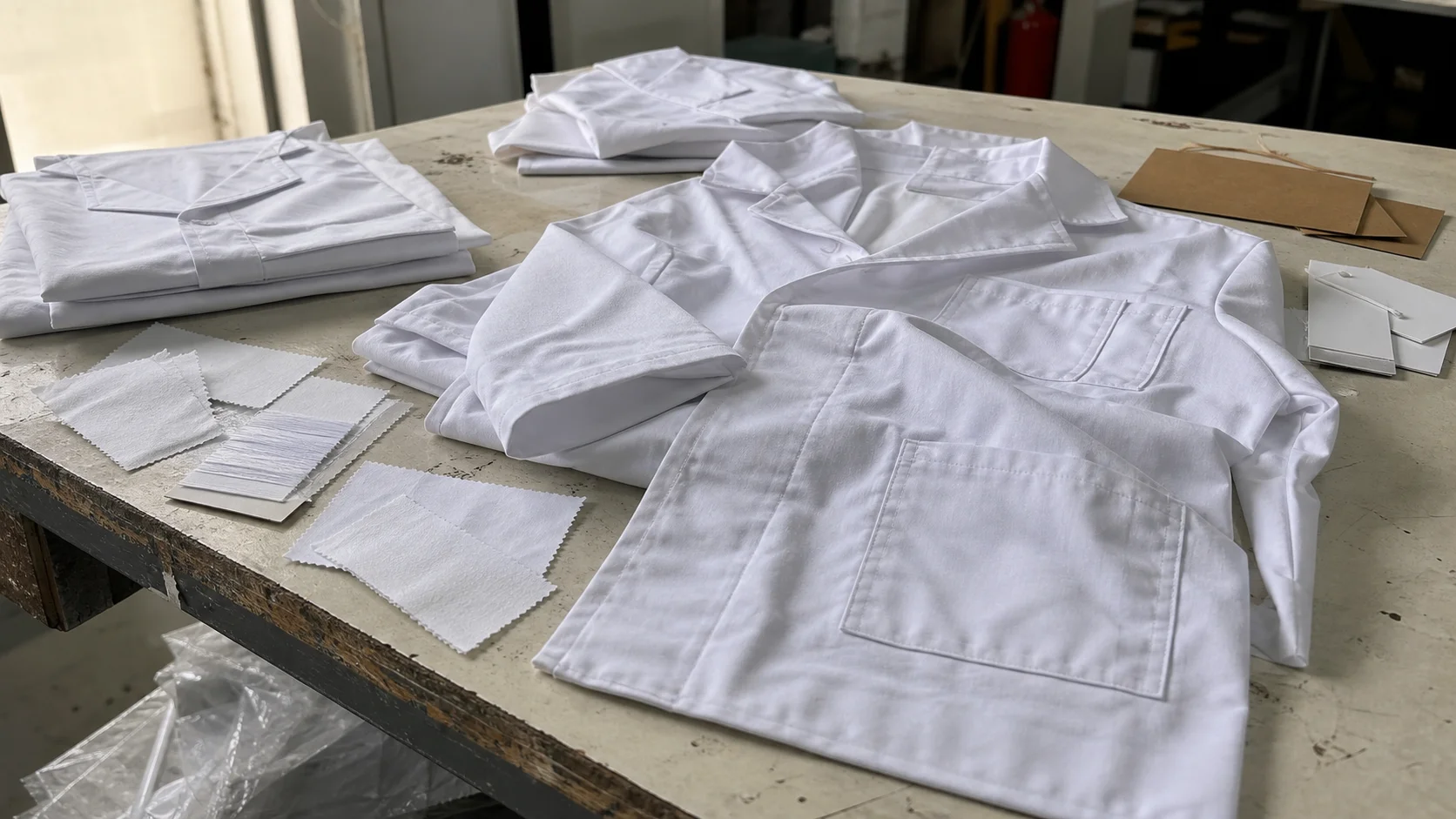
A product-specific outline for evaluating factory wash test results on lab coats used by construction safety teams, with focus on durability, visibility,...
Lab Coat Wash Test Review for Safer Team Buying - Quality & Inspection manufacturing guide
A lab coat factory wash test review is not just a laundry check. For construction safety teams, it is a buying control that helps confirm whether a garment will keep its size, visibility, comfort, and basic protective function after real use. Safety managers often focus on fabric weight, color, logo placement, and delivery date. Those details matter, but wash performance is where many uniform programs start to fail.
Construction environments are rough on workwear. Lab coats used by site engineers, quality inspectors, testing technicians, survey support teams, concrete lab staff, and safety supervisors may be exposed to dust, cement residue, oils, mild chemicals, soil, perspiration, repeated abrasion, and industrial laundering. A coat that looks acceptable at shipment can become unsafe or unprofessional after three to five wash cycles if the factory did not validate fabric and trim behavior.
The practical question is simple: will the coat still fit, identify the wearer clearly, and support the team’s safety procedure after laundering? If the answer is uncertain, the purchase risk is too high for a team uniform program.
For B2B buying, the safest time to catch wash failure is before bulk cutting. Once production fabric is cut, shrinkage and color migration problems become expensive arguments instead of manageable approvals.
Wash testing is especially important when a lab coat is not a standard medical coat but a construction safety team garment. These coats may need reinforced pockets, reflective tape, color-coded panels, embroidered names, screen-printed logos, pen slots, radio loops, snap closures, or chemical-resistant finishes. Every added component changes how the coat behaves in washing.
Buyers should treat factory wash testing as part of quality and inspection, not as an optional lab report. It protects budget, team compliance, and wearer acceptance. A coat that shrinks at the sleeve, curls at the placket, bleeds onto reflective tape, or loses snap strength can create operational problems across the jobsite.
A useful lab coat wash test review should prove four things: the garment remains wearable, the safety features remain functional, the branding remains acceptable, and the supplier can control repeat production. A factory may present a neat washed sample, but buyers need measurable evidence. Visual approval alone is not enough.
At minimum, the review should cover dimensional stability, appearance after wash, colorfastness, seam behavior, trim performance, and finish durability. Construction safety teams should also review pocket distortion, reflective material adhesion, closure performance, and labeling readability.
Review Area What to Check Buying Risk if Ignored Shrinkage Chest, length, sleeve, shoulder, pocket placement Coats become tight, short, or non-compliant with fit requirements Colorfastness Main fabric, contrast panels, trims, printed logos Color bleeding, uneven shade, poor team appearance Reflective trim Cracking, peeling, dullness, edge lift Reduced visibility and failed safety expectations Seam strength Side seams, armhole, pocket edges, back vent Early tearing during site work Closures Snaps, buttons, zippers, hook-and-loop tape Garment opens unexpectedly or becomes difficult to use Labels Care label, size label, compliance label Wrong laundering by end users and poor traceabilityA wash test does not make a garment automatically safe for every hazard. It confirms that selected materials and construction survive the stated laundering conditions. If the garment is intended to support chemical splash resistance, flame resistance, antistatic behavior, or high-visibility performance, the buyer should request the relevant standard-based testing from qualified labs. Factory washing is still useful, but it cannot replace certified performance testing where certification is required.
For general construction safety team lab coats, a practical factory wash test usually focuses on wash durability and appearance retention. For higher-risk use, the specification should define the safety standard, test method, pass criteria, and required documents before sampling begins.
The term “lab coat” can be misleading in construction sourcing. Some buyers mean a white laboratory coat for material testing rooms. Others mean a longer oversmock worn by quality control staff on site. A safety manager may need a coat for cement testing, asphalt sampling, soil analysis, equipment inspection, or visitor control in restricted zones. Each use case changes the wash test priorities.
A coat for an indoor construction materials lab may need stain resistance, pocket stability, and professional appearance. A coat worn near active site movement may need high-visibility color blocking and reflective trims. A coat for supervisors walking through dusty work areas may require darker panels, stronger seams, and industrial wash tolerance. One specification cannot serve all of these needs equally well.
Before asking a factory for samples, the buyer should define the wearing environment. Key questions include:
These answers guide fabric choice and wash test conditions. A cotton-rich coat may feel breathable and familiar, but it can shrink more than polyester-rich fabric if not controlled. A polyester-cotton blend may hold shape better and dry faster, but it may be less comfortable in hot climates. A heavier twill may look durable, yet it can feel restrictive when worn over safety vests or harness-related clothing.
Construction safety teams should avoid buying lab coats only from a catalogue photo. The garment must be reviewed as a work tool. Fit, function, laundering, and safety signaling all affect acceptance on site.
Fabric selection drives most wash test outcomes. For lab coats used by construction safety teams, common choices include polyester-cotton twill, cotton twill, poly-cotton poplin, canvas blends, ripstop blends, and treated fabrics. Each option has a different balance of comfort, durability, cost, drying time, and shrinkage.
Typical fabric weights for work lab coats often fall between 150 gsm and 260 gsm. Lighter fabrics can be more breathable and lower in cost, but they may show stains and wear faster. Mid-weight twill around 190 gsm to 240 gsm is often a practical range for general site inspection coats. Heavier fabrics can improve abrasion resistance, yet they may reduce comfort and increase drying time after wash.
Shrinkage should be measured after the agreed wash cycle. A common commercial expectation for stable woven workwear is approximately 3% or less shrinkage in key dimensions after several home-laundry washes, although stricter or looser limits may apply depending on fabric and end use. Cotton-heavy garments can exceed this if fabric is not pre-shrunk or if the washing temperature is aggressive. Industrial laundering may create stronger shrinkage pressure due to higher temperatures, mechanical action, and drying conditions.
Colorfastness is another major issue. Construction teams may use white, navy, grey, orange, yellow, or contrast-panel coats. High-visibility colors and dark contrast panels can create bleeding risk when combined in one garment. Buyers should ask the factory to test color staining, shade change, and trim contamination. A dark collar bleeding onto a yellow body or reflective strip is not acceptable for a professional safety program.
Hand feel after washing should not be ignored. A stiff coat may discourage consistent wearing. A fabric that pills, roughens, or wrinkles severely after washing may still pass basic dimensions but fail user acceptance. Practical sourcing judgment matters here: a lower-cost fabric that passes measurements but looks worn after five washes can cost more in replacement complaints.
Strength after wash is also important. Washing can expose poor yarn quality, weak seams, under-fused interlining, and cheap thread. Pocket corners, side vents, sleeve seams, and snap areas are common failure points. Construction teams often carry pens, notebooks, small gauges, phones, badges, and testing tools. Pocket design should be tested under realistic loading, not just flat measurement.
A factory wash test is only meaningful when the specification is clear. If the buyer changes fabric, trims, logo method, or laundering instruction after the test, the previous result becomes less useful. The safest approach is to lock a technical specification before wash approval.
The fabric specification should include composition, weave, weight, color, finish, shrinkage tolerance, colorfastness requirement, and approved shade reference. For example, a buyer may specify a polyester-cotton twill at 200 gsm with pre-shrunk finish and colorfastness to washing suitable for repeated laundering. If high-visibility fabric is required, the buyer should define the applicable performance expectation and whether certified materials are needed.
Trims are a common source of wash failure. Buttons can crack, snaps can rust or loosen, zippers can wave, hook-and-loop tape can collect lint, and reflective tape can peel. The trim sheet should identify material type, color, size, placement, and care compatibility.
Logo method affects wash durability. Embroidery usually has strong wash resistance, but it can pucker lightweight fabric and add cost. Screen printing can be economical for larger orders, yet it may crack or fade if ink and curing are not controlled. Heat transfer can look clean, but it can lift under harsh laundering if the transfer is not suited to the fabric and temperature.
For construction safety teams, branding may include company logos, safety role labels, department names, or color-coded badges. The wash test should include every decoration method used in bulk production. Testing a blank coat and approving a decorated bulk order is a common sourcing mistake.
Fit must account for shrinkage and layering. If wearers use the coat over polo shirts only, a standard fit may work. If they wear it over thicker work shirts or light jackets, extra ease may be needed. Buyers should confirm size grading, sleeve length, shoulder width, chest allowance, and coat length before wash testing.
One practical purchasing rule is to measure the garment before wash, after wash, and after drying. Record both actual measurements and percentage change. Do not rely on the factory saying “normal shrinkage.” Normal for the factory may not be acceptable for your team.
The wash method should match real laundering as closely as possible. A gentle home wash test may not represent industrial laundry. A hot tumble dry may be harsher than the buyer’s intended care process. The review should define cycle count, temperature, detergent type if relevant, drying method, and measurement points.
For early development, many buyers request three to five wash cycles on sample garments. For production approval, five to ten cycles may be more useful when the garment will be repeatedly laundered. Industrial or safety-critical programs may require more cycles and third-party testing. The right number depends on risk, budget, order size, and expected garment life.
Test Item Typical Review Approach Notes for Construction Safety Teams Pre-wash measurement Measure chest, sweep, length, sleeve, shoulder, pocket placement Use the same measuring method as bulk inspection Wash cycles 3-5 cycles for initial review, 5-10 for stronger confirmation Match home or industrial laundry conditions Drying method Line dry, tumble dry low, or industrial drying as specified Tumble drying often increases shrinkage risk Post-wash measurement Measure after full drying and conditioning Compare against agreed tolerance, not opinion Appearance review Check wrinkling, skewing, puckering, shade change Review under consistent light where possible Function review Check closures, pockets, labels, reflective tape, logo Include user movement where practicalFactories sometimes wash fabric panels instead of finished garments. Fabric panel testing is helpful during material selection, but it cannot replace finished garment testing. Finished coats include seams, trims, pockets, labels, decoration, and pressing. These details can distort or fail after washing even when the fabric itself is stable.
The buyer should ask for photos before and after washing, measurement charts, wash conditions, and comments on defects. For higher-risk orders, sealed approved samples should be kept by both buyer and factory. A third-party inspection partner can then compare bulk goods against the approved reference.
Support from a sourcing and quality partner can help standardize this process. Buyers reviewing apparel manufacturing programs can explore related production support through Fabrikn services, especially when specifications, sampling, and inspection need to be aligned before production.
A disciplined sample process reduces wash test confusion. Many buying problems happen because the team approves one sample for look, another sample for fit, and a different sample for wash. By the time production starts, no single approved reference represents the final garment.
A practical approval path should include prototype sample, fit sample, pre-production sample, wash-tested sample, and final sealed sample. Some projects combine steps to save time, but the buyer should understand the risk. Combining too many approvals can speed the calendar while leaving fabric and trim problems unresolved.
The prototype confirms the basic design: coat length, pocket layout, collar shape, closure type, sleeve style, and general appearance. It is not usually the right stage for final wash approval unless final fabric and trims are already used.
The fit sample checks size, movement, and layering. Construction safety team coats should be tried over the clothing that users actually wear. A coat that fits in an office may restrict arm movement when worn over a work shirt and safety vest.
The pre-production sample should use approved bulk fabric, approved trims, approved logo method, approved labels, and correct stitching. This is the most important sample for wash testing. If the factory cannot produce a correct pre-production sample, bulk production should not proceed.
The wash-tested sample should be measured and photographed before and after washing. Defects should be listed clearly. If changes are needed, the supplier should revise the affected material or construction and repeat the relevant test.
The sealed sample becomes the production standard. It should be marked with date, version, fabric lot if available, size, and approval status. Both buyer and factory should keep matching references. This step is basic, but it prevents many disputes.
Sample approval can take one to four weeks depending on fabric availability, logo development, trim sourcing, factory workload, shipping time, and the number of wash cycles required. Custom fabric, certified reflective tape, special dyeing, and non-standard sizes can extend the timeline. Rushing this stage is rarely worth it for a safety team order.
Passing a factory wash test does not eliminate inspection risk. Bulk production may use a different fabric lot, substitute trims, altered sewing tension, or different pressing conditions. Quality control should continue through production and final inspection.
The most common inspection risks for lab coats include shade variation, measurement out of tolerance, seam puckering, loose threads, broken stitches, incorrect labels, weak snaps, uneven pocket placement, and poor logo execution. After wash testing, inspectors should pay special attention to the features that were most vulnerable during sample review.
A final random inspection usually checks workmanship, measurements, packing, labeling, quantity, and overall appearance. For lab coats tied to safety programs, buyers may add special checkpoints for reflective trim, logo accuracy, role identification, and care label correctness. If the order is large or critical, inline inspection can catch problems before the full quantity is finished.
Wash testing of random bulk garments may also be considered. This takes extra time, but it gives stronger confidence that production matches the approved sample. A practical approach is to reserve several units from bulk production and run the agreed wash cycle before final shipment approval, especially for repeat programs or first orders with a new supplier.
Buyers should be cautious with factories that resist measurement records or refuse to disclose wash conditions. A reliable supplier does not need to overpromise. They should be able to explain what was washed, how it was washed, what changed, and what controls are in place for bulk production.
MOQ depends on fabric availability, customization level, color, trim complexity, and factory production setup. For standard lab coat styles using available fabric, typical MOQ may start around 100 to 300 pieces per style or color. For custom colors, special trims, certified fabrics, or private-label production, MOQ may rise to 500 to 1,000 pieces or more. Fabric mills may impose their own minimums that are higher than garment factory minimums.
Small orders are possible in some cases, but buyers should expect tradeoffs. Unit price may be higher, customization options may be limited, and factories may use stock fabric rather than custom-developed material. For construction safety teams with multiple sites, consolidating demand across departments can improve price and consistency.
Lead time also varies. A simple stock-fabric order may take four to seven weeks after sample approval, depending on capacity and order size. Custom fabric dyeing, special reflective trims, lab testing, and complex logo work can push lead time to eight to twelve weeks or longer. Sampling and wash testing should be planned before the delivery deadline becomes urgent.
Order Type Typical MOQ Range Typical Lead-Time Considerations Stock fabric, standard lab coat 100-300 pieces Faster sampling, fewer fabric choices, limited customization Custom color or contrast panels 300-800 pieces Lab dips, shade approval, higher colorfastness risk Reflective or high-visibility design 500-1,000 pieces Trim certification, placement approval, wash durability checks Special finish or certified performance 500-1,500+ pieces Testing, documentation, stricter material sourcingCost decisions should be made carefully. A cheaper fabric that shrinks 5% may create sizing complaints and replacement orders. A low-cost reflective tape that dulls after washing may undermine safety expectations. A cheaper print that cracks can damage brand presentation. The lowest quote is not always the lowest program cost.
Smart buyers compare total value: fabric stability, factory control, inspection access, replacement risk, and communication quality. When safety teams are involved, the buying standard should be higher than a promotional garment order.
A supplier scorecard makes wash test review less subjective. It also helps purchasing, safety, and operations teams compare factories using the same criteria. The scorecard does not need to be complicated, but it should be specific enough to catch the real risks.
Score Area Pass Criteria Review Notes Specification alignment Fabric, trims, logo, labels match approved tech pack No wash approval if components differ from bulk plan Shrinkage control Within agreed tolerance after required cycles Measure all critical points, not only chest and length Appearance after wash No severe puckering, skewing, fading, staining, or distortion Compare with unwashed control sample Safety feature durability Reflective trim, color panels, and identification remain usable Escalate if safety signaling is reduced Trim performance Closures, labels, pockets, and interlining remain secure Check corrosion, delamination, and edge lifting Factory documentation Clear wash method, photos, measurements, and defect notes Poor records reduce confidence in repeatabilityBuyers can rate each area as pass, conditional pass, or fail. A conditional pass should require a corrective action before bulk production. For example, if the coat passes shrinkage but the label fades, the factory can replace the label and retest that component. If the coat fails shrinkage badly, the fabric choice or pattern allowance may need more serious revision.
Scorecards also help avoid emotional decisions. A sample may look good in a meeting, but the measurements may show unacceptable sleeve loss. A factory may offer an attractive price, but poor documentation may create risk during bulk production. Purchasing judgment should combine sample appearance with measurable controls.
Teams that need broader sourcing support can review company background and service approach through Fabrikn’s about page. For buying teams building a new uniform program, early alignment on quality controls is usually more effective than fixing defects after shipment.
The best lab coat factory wash test review gives construction safety teams a practical basis for buying. It does not guarantee perfection, but it reduces uncertainty. A buyer should know how the coat changes after washing, which features are vulnerable, and whether the factory can control those points in bulk.
For most construction safety team programs, a balanced specification is better than an overbuilt garment. A coat that is too heavy may sit unused in hot conditions. A coat that is too light may fail quickly. A highly customized design may improve team identification but increase MOQ and lead time. A standard design may be faster and cheaper but may not meet site-specific safety signaling needs.
Direct purchasing judgment comes down to this:
The factory should be able to explain the garment’s wash limits honestly. If industrial laundering is not suitable, the care label and buyer documentation should say so. If reflective tape is rated for a limited number of cycles, that should be understood before purchase. If cotton shrinkage requires pattern allowance, it should be built into the size chart and confirmed through testing.
Construction safety teams also need internal discipline after purchase. End users should receive care instructions. Laundry partners should follow the approved method. Replacement planning should account for garment life. Procurement should keep the approved sample, test reports, and inspection records for repeat orders.
A wash test review is most valuable when it becomes part of a repeatable buying system. The first order establishes the approved fabric, trim, fit, and laundering behavior. Repeat orders should use the same specification unless there is a controlled change. If the factory changes fabric supplier, reflective trim, dye lot, or decoration method, the buyer should ask whether retesting is needed.
For teams preparing a new lab coat or site safety garment program, early supplier discussions should include wash expectations, MOQ, sampling, inspection, and documentation. Buyers can start that conversation through Fabrikn’s contact page when they need help structuring apparel sourcing requirements.
In the end, the right lab coat is not the one that only looks sharp in the first sample photo. It is the coat that survives the wash method your team will actually use, keeps its fit across sizes, maintains safety identification, and arrives with enough quality control evidence to support a confident purchase. That is the standard construction safety teams should apply before placing bulk orders.
Get a free quote from Fabrikn — your trusted B2B clothing manufacturer with 10+ years of experience. MOQ as low as 200 pieces.
Get a Free Quote →A lab coat factory wash test review checks how a lab coat performs after laundering before bulk production or shipment. It usually reviews shrinkage, colorfastness, seam condition, trim durability, logo performance, pocket shape, and overall appearance after the agreed wash and drying method.
Construction safety teams need garments that keep their fit, visibility, identification, and durability after repeated use. Dust, soil, sweat, site residue, and frequent laundering can expose weak fabric, poor trims, unstable colors, and construction defects. Wash testing reduces the risk of buying coats that fail too early.
For early sample review, three to five cycles is common. For stronger production confidence, five to ten cycles may be more useful. Safety-critical or certified garments may require standard-based testing and more controlled procedures. The wash cycle count should match the garment’s risk level and expected laundering method.
Many woven workwear programs aim for shrinkage around 3% or less in critical measurements, but the acceptable limit depends on fabric, fit, laundering method, and buyer requirements. The important point is to agree on the tolerance before testing and to measure the same points before and after washing.
Fabric testing is useful during development, but finished garment testing is more relevant for approval. Finished garments include seams, pockets, closures, labels, reflective tape, and decoration. These components can fail even when the fabric panel looks stable.
Common risks include sleeve and body shrinkage, color bleeding, pocket distortion, seam puckering, reflective tape peeling, logo cracking, snap corrosion, interlining bubbling, and unreadable care labels. These risks increase when the coat uses contrast colors, special trims, or harsh laundering.
Typical MOQ may start around 100 to 300 pieces for stock fabric and standard designs. Custom colors, reflective trims, certified materials, or private-label requirements may push MOQ to 500 to 1,000 pieces or more. Fabric mill minimums can be higher than garment factory minimums.
Yes, if the fabric, trims, and construction are suitable for the intended use. The tradeoff is that lower-cost options may limit fabric weight, finish, decoration quality, or long-term durability. Buyers should judge cost against shrinkage risk, replacement risk, and safety team acceptance.
Buyers should reject or hold approval when shrinkage exceeds tolerance, colors bleed, safety trims deteriorate, logos fail, seams distort, or the factory cannot provide clear wash conditions and measurements. A conditional approval may be possible for minor trim or label fixes, but major fabric instability should be corrected before bulk cutting.
No. Factory wash testing helps verify laundering durability and appearance, but it does not replace certified testing for flame resistance, chemical resistance, antistatic performance, or regulated high-visibility requirements. If a safety standard applies, buyers should request proper documentation from qualified testing sources.