
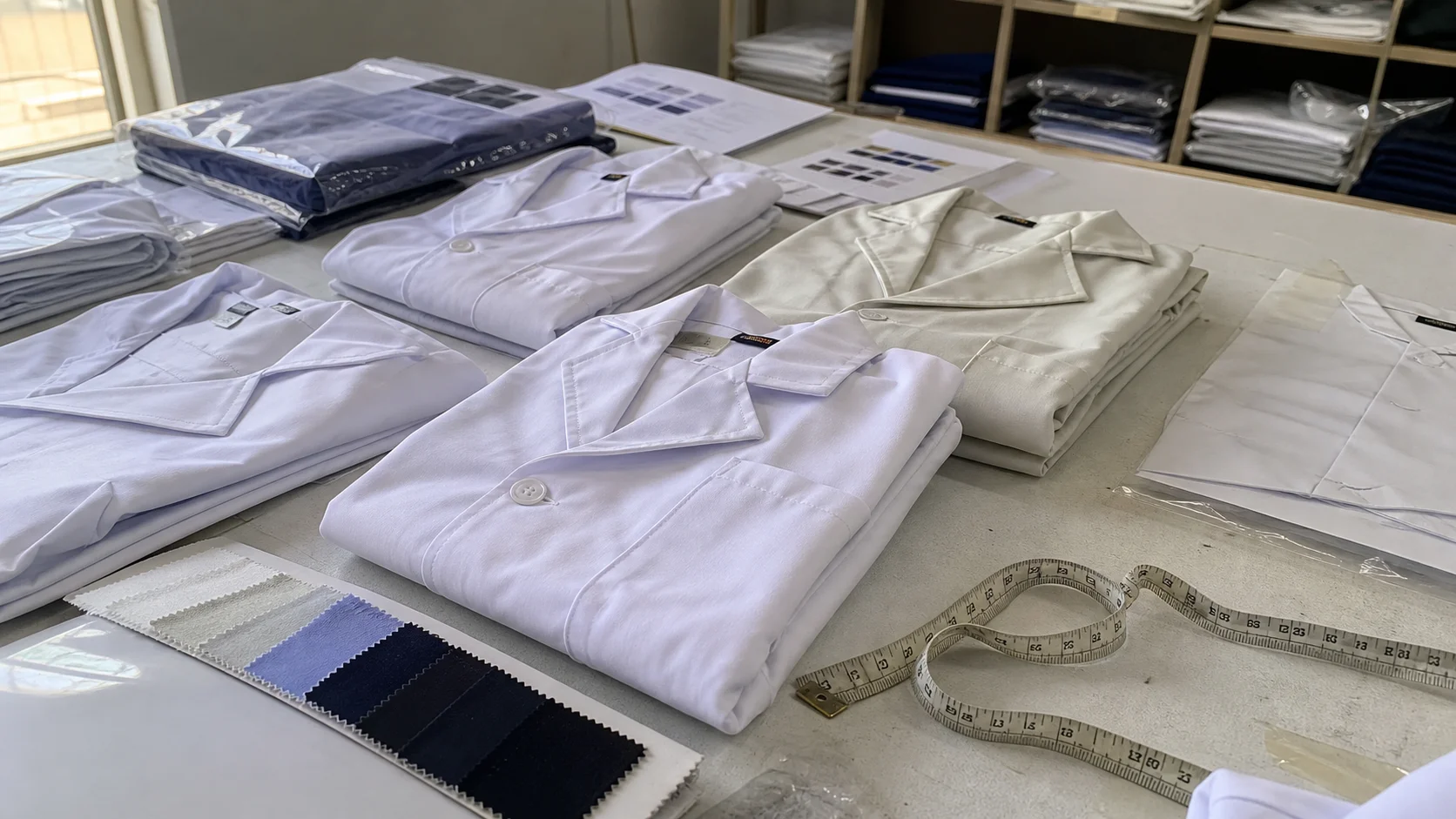
A practical quality control outline for school operations teams ordering lab coats, covering specifications, decoration checks, fit verification, packaging...
Lab Coat Order QC Checklist for School Buyers - Fabrikn production reference
School lab coat orders look simple on paper: white coats, multiple sizes, student-safe fabric, school logo if required, and delivery before term starts. In practice, these orders can create avoidable problems when quality control is treated as a final warehouse check rather than a purchasing discipline from the beginning.
A lab coat order quality control checklist for school operations teams should cover more than stitching and stains. It should confirm that the coats match the school’s classroom use, washing routine, student age range, storage process, safety expectations, and budget. A coat that passes a basic visual inspection may still fail in daily use if the fabric is too thin, pockets tear after a few weeks, sleeves run long for younger students, or labels do not support easy distribution.
For school buyers, the main risk is not usually one dramatic defect. It is the accumulation of small issues across hundreds or thousands of units: inconsistent sizing, weak seams, poor button attachment, loose threads, uneven embroidery, yellowish fabric shade, packaging errors, and cartons that do not match the size breakdown. These issues delay distribution and create extra work for operations teams already managing uniforms, supplies, facilities, and academic calendars.
Practical purchasing judgment: treat lab coats as reusable school equipment, not disposable promotional apparel. The QC standard should match how often the garment will be worn, washed, stored, and reassigned.
This article gives school operations teams a structured QC checklist for lab coat orders. It is written for buyers coordinating with apparel manufacturers, uniform suppliers, distributors, or sourcing partners. For teams that need support with production planning and inspection coordination, Fabrikn’s apparel manufacturing services page is a useful starting point.
Quality control starts before a sample is made. A vague order brief invites different assumptions from the supplier, factory, fabric mill, trim vendor, embroidery team, and packing staff. School buyers should prepare a written lab coat specification before requesting pricing.
Schools often buy lab coats on a tight calendar. A clear brief reduces quotation confusion and makes later QC disputes easier to resolve. If the supplier quotes based on one fabric and the school approves another verbally, accountability becomes weak. Specifications should be written into the purchase order, tech pack, or supplier confirmation.
Fabric choice is the most important cost and performance decision in a school lab coat order. Many defects that appear during use come from fabric that was selected mainly for price. A thinner fabric may reduce unit cost, but it can become transparent, wrinkle heavily, shrink unpredictably, or tear around stress points.
School lab coats are commonly made from cotton, polyester-cotton blends, or polyester-rich woven fabrics. Each has tradeoffs.
For many school operations teams, a mid-weight polyester-cotton twill is the practical choice. It usually gives acceptable durability, manageable cost, and easier washing. If the lab coat is intended for formal chemistry protection, the school should review safety requirements separately, because a standard school lab coat is not automatically chemical-resistant, flame-resistant, or PPE-certified.
Purchasing judgment: do not accept “white poly-cotton” as a complete fabric specification. Ask for composition, GSM, weave, shrinkage performance, color standard, and hand feel sample.
Testing requirements should match budget and risk. A full lab testing program may not be practical for every small school order, but fabric composition, shrinkage, shade, and basic workmanship checks should not be skipped. Larger district-wide orders should use more formal testing and pre-shipment inspection.
Sizing problems create operational headaches. If coats are too large, sleeves interfere with experiments and students roll cuffs loosely. If coats are too small, movement is restricted and returns increase. A school order needs a size plan that reflects student age, gender mix, growth, and whether coats are worn over uniforms or regular clothing.
The supplier should provide a size chart, but the school should not assume it matches local student needs. A youth size chart from one factory may differ from another. Adult unisex sizing can also be too long in sleeve and body length for younger secondary students.
A balanced size breakdown matters as much as fit approval. Schools commonly underestimate larger sizes for older students and over-order small sizes for multi-year programs. If lab coats are issued annually, historical uniform data can help. If the school is ordering for a new program, allow a practical buffer in the most flexible sizes.
Buyer Scenario QC and Purchasing Risk Practical Approach Primary school science program Sleeves and body length too long Use child-specific pattern, not scaled adult sizing Secondary school lab program Broad height variation within same grade Approve size set and order extra medium/large sizes Teacher and staff coats Unisex fit may not suit all users Offer wider adult size range or separate staff sizing Shared lab coats Heavy washing and mixed users Prioritize durable fabric and clear size labelsOperations teams should test fit before the order is locked. Select several student representatives from the intended age group if school policy allows. The goal is not perfect tailoring. It is to catch obvious sleeve, shoulder, and length issues before hundreds of coats are made.
Good lab coat construction is not complicated, but it must be consistent. School garments are handled roughly, washed repeatedly, stored in bulk, and sometimes shared between users. The main construction risks are seam popping, pocket tearing, loose buttons, uneven hems, and distorted collars.
School buyers do not need to dictate every factory sewing method, but the specification should define visible quality expectations. Common requests include straight stitching, no open seams, no skipped stitches, no puckering, secured thread ends, and neat topstitching where visible.
Stitch density should be appropriate for the fabric. Very low stitch density can weaken seams. Excessively tight stitching can cause puckering or fabric damage. For many woven lab coats, a moderate stitch density is acceptable, but the final standard should be agreed with the manufacturer during sample approval.
Inspection risk: pockets often look acceptable during a flat visual check but fail after use. Pull lightly at pocket corners during inspection and confirm bartacks or reinforcement where specified.
Trims are small cost items that cause large distribution problems when poorly controlled. Buttons, snaps, labels, logo embroidery, size stickers, and cartons all need inspection. A lab coat order can pass sewing inspection but still create school-level disruption if sizes are mislabeled or cartons are mixed incorrectly.
Buttons are usually cheaper and easier to repair. Snaps can be faster for younger students but may add cost and require better attachment control. For school buyers, the decision should depend on user age, repair expectations, and budget.
Labels need to do more than show size. They should support school operations. A clear internal labeling plan reduces distribution time and lost garment issues.
If the lab coats include a school logo, approve logo placement and color before bulk production. Embroidery is durable but can pucker lightweight fabric. Printing may be cheaper for large orders but can crack or fade if the method is not suitable for the fabric and washing conditions.
The school should approve a physical logo strike-off or pre-production sample. A digital mockup is not enough because thread colors, print opacity, and placement can change in production.
Individual polybags increase cost and packaging waste but make distribution easier and protect white garments from dirt. Bulk packing can reduce cost and waste, but it increases handling risk. Schools should choose based on storage conditions, distribution process, and sustainability policy.
Sampling is the buyer’s best chance to prevent production defects. School buyers should not rely on a photo sample alone for lab coat orders unless the order is very small and low risk. A physical sample allows the operations team to evaluate fabric, fit, stitching, logo, labels, and packaging.
For small repeat orders, some stages can be combined if the supplier is using the same approved pattern, fabric, and trims. For new suppliers, new fabric, new sizes, or logo changes, skipping samples is a false economy.
The final approved sample should be retained by the buyer or supplier as the production standard. If inspection disputes arise, the approved sample becomes the reference point.
Inspection should happen at several points, not only when cartons are ready to ship. The larger the order and the tighter the school calendar, the more important staged QC becomes.
Before cutting begins, confirm that fabric, trims, labels, and packaging materials match the approved sample. This stage catches wrong fabric weight, incorrect logo thread, missing care labels, and button mismatches before production volume is committed.
A during-production check is useful once the first units are sewn. Inspectors can review measurements, seam quality, pocket placement, button alignment, and logo execution. If defects are found early, the supplier can correct the line before the whole order is affected.
Final inspection usually happens when production is complete and at least most units are packed. The inspector checks quantity, workmanship, measurements, labeling, packaging, carton marks, and general conformity to the approved sample.
Many apparel inspections use AQL sampling. School buyers do not need to become inspection technicians, but they should understand the basic idea: a statistically selected sample is checked, defects are classified, and the lot passes or fails based on agreed limits. Critical defects should have zero tolerance. Major and minor defect limits depend on the agreed inspection level.
For schools ordering under tight deadlines, the supplier should share inspection timing early. A failed final inspection close to the delivery date leaves little time for repair. Operations teams should build a buffer between supplier completion and classroom distribution.
Lab coat defects tend to appear in predictable places. A focused checklist helps school buyers and inspectors spend time where risk is highest.
White garments are unforgiving. Even minor dirt marks can lead to rejection by parents, students, or school administrators. If coats are bulk packed, cartons and handling areas must be clean.
Minimum order quantity and lead time depend on the supplier, fabric availability, customization level, and packaging requirements. School buyers should ask for realistic timelines rather than optimistic promises.
These ranges are general. Some suppliers accept lower quantities at a higher unit cost, while others require higher MOQs to justify fabric sourcing and production setup. Buyers should compare total delivered value, not only unit price.
A simple repeat order from existing stock may move quickly. A custom lab coat with fabric sourcing, multiple child and adult sizes, school embroidery, individual packing, and carton sorting may require several weeks or longer. Buyers should add a buffer for approval delays and reinspection.
There are sensible ways to control cost without damaging quality. Simplifying packaging, using a standard approved fabric, limiting logo complexity, and ordering a practical size range can reduce cost. Cutting fabric weight too aggressively, skipping samples, or accepting unclear measurement tolerances usually creates more risk than savings.
Best tradeoff for many schools: use a standard durable poly-cotton fabric, approve one reliable pattern, keep branding simple, and invest in final inspection before shipment.
For school teams comparing manufacturing options, Fabrikn’s about us page gives context on its apparel production focus. If a school operations team wants to discuss order planning, specifications, or timelines, the contact page is the right next step.
The following checklist can be used before approving production and again before shipment. It is designed for school operations teams managing lab coat purchasing, receiving, and distribution.
A school lab coat order should be easy to receive, store, and distribute. If the QC system only focuses on the garment and ignores carton labeling, size sorting, and delivery timing, the operations team still carries the burden. A strong checklist protects both product quality and administrative efficiency.
Get a free quote from Fabrikn — your trusted B2B clothing manufacturer with 10+ years of experience. MOQ as low as 200 pieces.
Get a Free Quote →The most important check is whether the bulk production matches the approved sample and written specification. That includes fabric, fit, stitching, labels, logo placement, size breakdown, and packaging. For school operations teams, measurement accuracy and correct size labeling are especially important because they affect distribution.
A polyester-cotton blend is often a practical choice for school lab coats because it balances durability, wash stability, and cost. Common blends include 65/35 or 80/20 polyester-cotton. Pure cotton can be more breathable but may wrinkle and shrink more. The right choice depends on use case, washing routine, budget, and any safety requirements.
Not always. Many school lab coats are general classroom garments and may not meet certified PPE standards for chemical resistance, flame resistance, or specialist laboratory protection. If the school needs PPE-level performance, the buyer should specify the required standard and request documentation from the supplier.
Typical MOQs vary by supplier and customization level. Blank stock lab coats may start around 50-200 units. Custom logo orders often start around 100-300 units. Fully custom fabric, pattern, or district-wide programs may require 300-1,000 units or more. Lower MOQs may be possible at a higher unit cost.
Lead time depends on fabric availability, sample approval, logo setup, production queue, inspection, and shipping. Repeat stock orders can be faster, while custom orders may require several weeks or longer. School buyers should build in time for sample corrections, final inspection, and internal distribution before classes begin.
Yes, for most custom or large orders. A physical sample allows the buyer to check fabric quality, opacity, fit, stitching, labels, logo execution, and closures. Photos and digital mockups are useful, but they do not replace a physical sample for production approval.
Critical defects such as unsafe objects, severe contamination, or hazardous trims should lead to rejection until investigated. Major defects such as wrong sizing, missing buttons, open seams, incorrect logo, or mislabeled garments should require repair, replacement, or reinspection. Minor defects may be acceptable only within the agreed inspection limit.
Use a standard proven fabric, keep the design simple, limit logo complexity, avoid unnecessary packaging, and plan size breakdown carefully. Skipping sample approval, choosing overly thin fabric, or ignoring final inspection can reduce upfront cost but often increases operational problems later.