
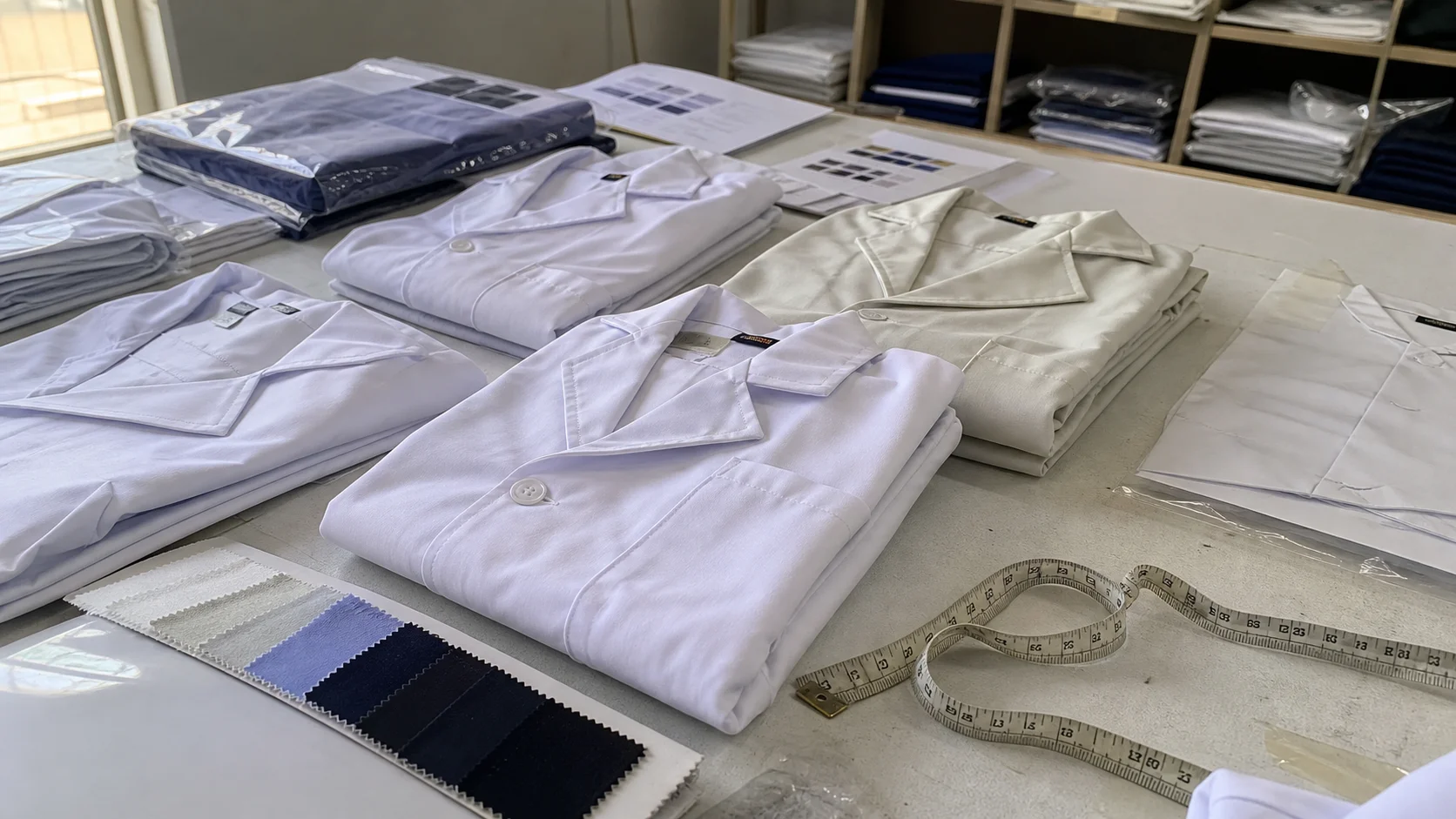
A practical quality and inspection outline for school operations teams ordering lab coats, focused on shrinkage testing, wash protocols, fit allowances,...
School operations teams that place lab coat orders are usually buying for a mix of durability, student fit consistency, and budget control. Shrinkage is one of the most common reasons a well-planned order turns into a sizing problem after the first wash cycle. A lab coat that looks acceptable on delivery can become too short in the sleeve, tight across the chest, or uneven in length after laundering. That creates avoidable replacement costs, student complaints, and delay in issuing uniforms.
A practical shrinkage control plan starts before the order is confirmed and continues through sampling, fabric approval, bulk production, inspection, and wash testing. The goal is not to eliminate shrinkage entirely. That is unrealistic for many cotton and cotton-rich fabrics. The goal is to control it to a predictable range and size the coat with that movement in mind.
For school buyers, the best approach is simple: define the fabric clearly, ask for wash performance data, approve a measured sample, and make shrinkage limits part of the purchase specification. That keeps the buying decision grounded in repeatable standards rather than guesswork.
Lab Coat Shrinkage Plan for School Buyers - Fabrikn production reference
Lab coats for schools are often assigned by size range rather than customized per student. That makes tolerance management important. If shrinkage is inconsistent, the same labeled size can fit very differently after washing. One batch may hold size well, while another batch shrinks enough to create a measurable mismatch.
The issue is especially visible when coats are used in science labs, vocational programs, or healthcare training environments where garments are washed frequently. School operations teams may also face parent complaints if a coat purchased for the term no longer fits after a few washes. In many cases, the problem is not poor manufacturing alone. It is an unclear shrinkage expectation at the purchase stage.
For school buyers, shrinkage should be treated as a sizing spec, not just a fabric trait. If it is not written into the order, it is easy for it to be ignored.
Shrinkage usually comes from a combination of fiber content, fabric construction, finishing method, and laundry conditions. Cotton fibers naturally relax and contract after washing. Blended fabrics usually shrink less, but not all blends behave the same way. Construction quality matters too. Poorly controlled stitching, weak seam tension, or uneven fabric relaxation can create dimensional changes after wash.
School buyers should also remember that a garment’s measured shrinkage is not always uniform. Sleeves may shorten more than body length, or the hem may twist slightly after washing. That is why shrinkage control should include both dimensional tolerance and visual appearance checks.
A good shrinkage plan works in stages. It starts with the product brief and ends with post-wash verification. The plan below is designed for school operations teams, procurement departments, or uniform committees managing a lab coat purchase.
Before talking about fabric, define how the coat will be used. A coat for elementary science labs is not the same as one for secondary school chemistry, technical training, or nursing practice. The expected wash frequency, contamination risk, and required appearance will all affect the right fabric choice.
Do not wait until bulk production to discuss shrinkage. A typical school purchase specification may set allowable shrinkage at a modest percentage after a controlled wash test. The exact target depends on the fabric, but school buyers often prefer tighter limits for body length and sleeve length because those affect fit the most.
A common buying approach is to ask the supplier to state the expected shrinkage after one and five wash cycles under defined conditions. If the supplier cannot provide that data, the buyer should treat the item as higher risk.
The fabric sheet should clearly show fiber content, fabric weight, yarn count if available, finishing process, and care instructions. This is not paperwork for its own sake. It helps the buyer compare options and gives the factory a fixed standard to follow.
A pre-production sample should match the final intended fabric, trim, buttons, labels, and stitching. If the sample uses a different cloth or different finish, it is not a useful shrinkage reference. The sample should be measured before wash and after wash using a clear test method.
The wash method used in testing should reflect how the school will actually clean the coats. If the school uses warm water and tumble drying, a cold-water-only test will not be enough. Shrinkage values should be recorded after wash and after drying, not just after one step.
If the selected fabric has a normal shrinkage profile, the garment pattern should include a small allowance. This is a tradeoff. Too much allowance can make the coat oversized before wash. Too little allowance can leave the coat too short after wash. The right balance depends on fabric type and student sizing range.
The final order should state the approved fabric, the wash test standard, the acceptable shrinkage range, and what happens if the bulk goods fail the agreed limit. If these points are missing, it becomes harder to resolve disputes later.
Fabric choice is the single biggest factor in shrinkage control. School buyers often focus on price per unit, but the cheapest option can become expensive if it shrinks too much or needs replacement sooner.
Fabric type Typical shrinkage risk Buying note 100% cotton Higher Comfortable and breathable, but more likely to shrink unless pretreated well. Cotton/polyester blend Moderate to lower Often a practical choice for schools because it balances comfort and stability. Polyester-rich blend Lower More dimensionally stable, though comfort and heat retention should be checked. Pre-shrunk cotton Lower than untreated cotton Not shrink-proof, but usually a better option for repeated laundering. Wrinkle-resistant finished fabric Variable Can improve appearance, but the finish should be checked for wash durability.A school buyer should not assume that “pre-shrunk” means no further movement. It usually means the fabric has already been processed to reduce shrinkage, not eliminate it. That distinction matters when approving size charts.
Trim components also matter. Buttons, thread, labels, and reinforcement tape can behave differently from the body fabric. If a coat shrinks slightly but the trim does not, the garment may pucker or distort. This is one reason why a full garment wash test is more useful than fabric-only testing.
School operations teams should write down key specifications in clear, measurable terms. That reduces misunderstanding between buyer and supplier.
One practical judgment call is whether to prioritize comfort or dimension stability. For younger students or hot climates, a breathable cotton blend may be the better buying decision. For high-turnover programs with frequent washing, a more stable blend may save money over time. The best option is usually the one that fits the school’s laundry reality, not just the catalog description.
Lab coat approval should follow a controlled sequence. Skipping steps often creates avoidable problems in bulk production.
This should confirm all measurements, fabric details, and wash performance expectations. The document should be simple enough for procurement staff to verify and detailed enough for production.
If the order covers multiple sizes, ask for a size set rather than one random sample. A small coat can reveal different shrinkage behavior than a larger one if pattern grading is not well managed.
Take baseline measurements from the sample. Common check points include shoulder width, chest width, sleeve length, total length, and pocket placement. These baseline values should be recorded and shared with the supplier.
Use the actual care method expected for the school. A sample washed once may not show the full pattern of shrinkage, so it is smart to test after multiple washes when time allows. Many buyers focus only on first wash results, but repeated wash performance is what affects the student experience across a term.
If the sample fails shrinkage expectations, the buyer should request fabric correction, pattern adjustment, or a different blend. Do not move straight into bulk production on the promise that “it will be fine.” That is a common source of rework and delay.
In school uniform buying, a signed sample is only useful if the bulk order is made from the same fabric lot, the same trim, and the same construction method.
Even after sample approval, bulk orders can vary. That is why inspection is important. Schools often order in smaller volumes than commercial buyers, so one faulty batch can affect the entire program.
During bulk inspection, the main shrinkage risks are fabric substitution, inconsistent finishing, and uneven construction. A supplier may source a slightly different fabric lot if the approved cloth runs short. That can change shrinkage performance even if the appearance looks similar.
For a school buyer, a sensible inspection plan usually includes visual checks, measurement audits, and selected wash testing from the production lot. A full destructive test on every coat is not realistic. Spot testing is more practical, but it should be done on a meaningful sample size.
If your procurement team is still building a quality process, consider reviewing supplier support options on Fabrikn services and making sure the conversation starts early through contact us. A clearer brief at the beginning usually saves time later.
Shrinkage control adds a little time, but it usually prevents much larger delays later. The extra time comes from sampling, wash testing, sample revision, and final approval. Buyers should factor that into the schedule rather than treating it as a supplier slowdown.
Typical lead-time dependencies include fabric availability, sample turnaround, trim sourcing, print or embroidery requirements, and the number of revision rounds. If the buyer requests a special fabric finish or tight shrinkage tolerance, the timeline may be longer than a basic coat order.
School teams sometimes rush the order to meet term start dates. That is where shrinkage problems often begin. A short delay for testing is usually cheaper than issuing poorly fitting coats or replacing a whole batch midterm.
Minimum order quantity, or MOQ, affects how much leverage a school has in fabric selection and quality control. Smaller orders can limit customization options. Larger orders may get better pricing, but they also raise the cost of a mistake.
For lab coats, typical MOQ ranges can vary widely by factory and fabric type. Many suppliers set lower MOQs for standard fabrics and higher MOQs for custom cloth, special trims, or embroidered branding. School buyers should ask early whether the MOQ changes if shrinkage testing or custom sizing is required.
A practical strategy is to order a pilot quantity first if the school is moving to a new supplier or new fabric. This can be useful when the school is unsure how the coats will hold up after repeated wash cycles. A small pilot is not just a trial for fit. It is a test of the entire laundry and issue process.
Good supplier communication is direct and specific. The more measurable the request, the easier it is to control risk.
These questions may sound simple, but they often reveal whether the supplier is working to a real quality process or just offering a low unit price. School buyers should favor suppliers who can discuss dimensional control clearly and without vague promises.
For more background on working with a clothing manufacturer and shaping a production brief, the company overview at about us can help frame the kind of supplier relationship that supports better garment control.
School buyers should be strict on fabric composition, wash performance, and approved measurements. These are the core controls that affect shrinkage. They should be more flexible on minor cosmetic details, such as small label placement shifts, if those do not affect function or compliance.
The tradeoff is straightforward. A very strict specification can narrow supplier options and raise price. A vague specification can reduce price at first, but increase replacement and complaint costs later. In most school programs, a controlled mid-range fabric with a clear shrinkage test is the safer procurement choice.
For teams that need support on specification setup, sampling, or production coordination, Fabrikn’s manufacturing support pages at services and contact us are useful starting points for a more structured buying process.
A lab coat shrinkage plan is not a technical luxury. It is a basic purchasing control for any school operation that wants predictable sizing and fewer post-delivery issues. The strongest plans start with a clear fabric brief, realistic wash expectations, measured sample approval, and a written tolerance for shrinkage. Once those elements are in place, the buyer can compare suppliers on more than just unit cost.
For school operations teams, the best outcome is a coat that still fits after washing, stays presentable through the term, and arrives within a realistic lead time. That requires discipline at the ordering stage. It also requires choosing suppliers who can speak plainly about fabric behavior, not just promises of low pricing.
Get a free quote from Fabrikn — your trusted B2B clothing manufacturer with 10+ years of experience. MOQ as low as 200 pieces.
Get a Free Quote →The main cause is usually fabric composition, especially higher cotton content combined with heat and repeated washing. Fabric finishing and sewing construction also play a role.
It depends on the fabric and wash method. School buyers should ask the supplier for expected shrinkage after one and five wash cycles under the school’s actual laundry conditions.
No. Pre-shrunk fabric usually shrinks less, but it can still change size after washing, especially if the wash cycle uses hot water or high heat drying.
A size set is better when the order includes multiple sizes. It helps reveal whether shrinkage behavior changes across different garment sizes.
The purchase order should include fabric composition, fabric weight, size chart, shrinkage tolerance, wash test standard, approved sample reference, and what happens if the bulk order fails inspection.
MOQ varies by supplier, fabric, and customization level. Standard fabrics usually allow lower MOQs than custom fabrics or branded finishes. Buyers should ask early because MOQs often affect both price and lead time.
Use a fabric with better dimensional stability, approve a measured sample, test under realistic laundry conditions, and build the expected shrinkage into the pattern and size chart.