
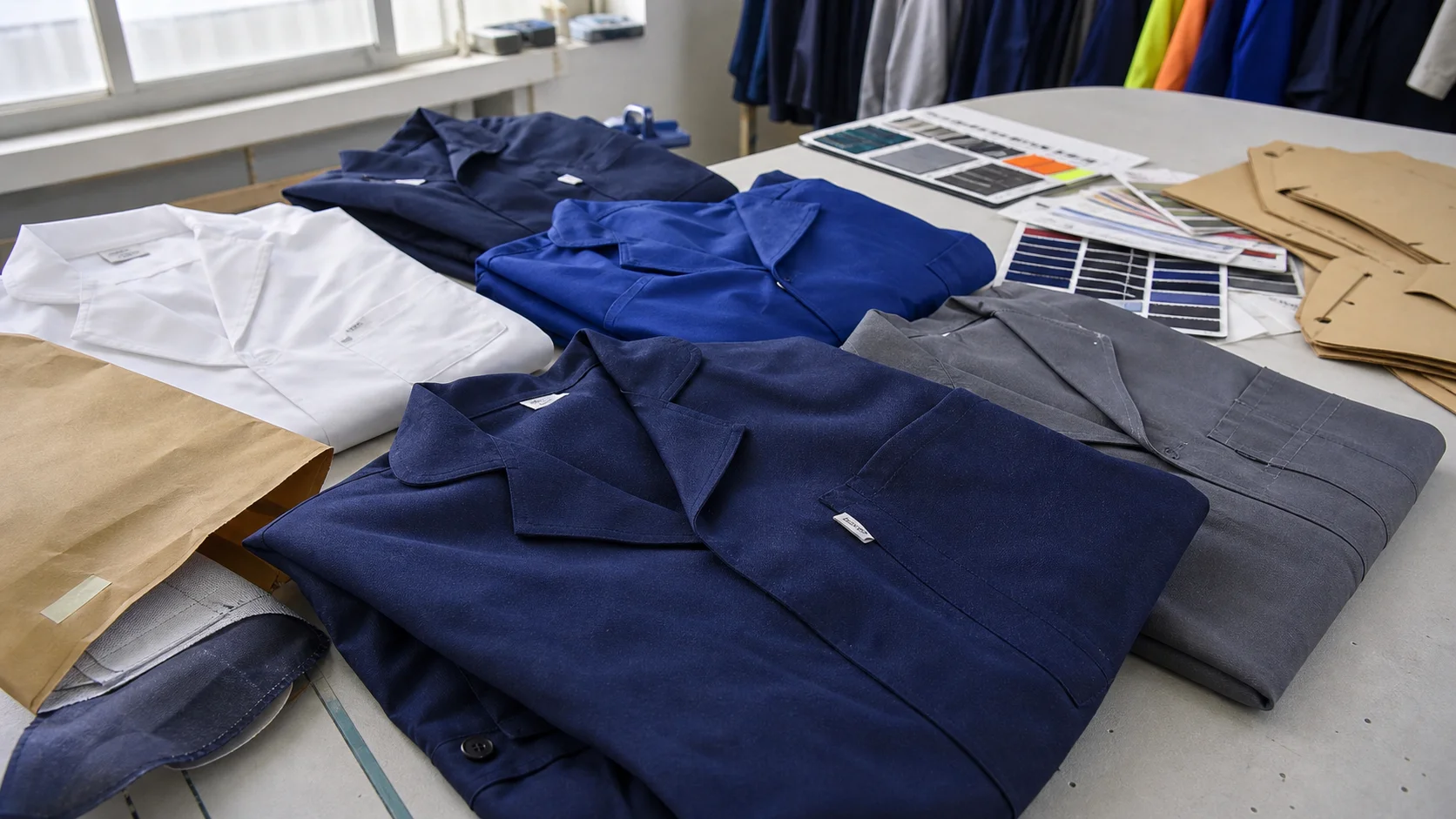
A quality inspection outline for evaluating printed lab coats used by construction safety teams, with focus on wash resistance, abrasion, ink adhesion,...
Lab Coat Print Durability Review for Safety Buyers - Fabrikn production reference
Construction safety teams often use lab coats for site laboratories, material testing rooms, quality control areas, environmental sampling, visitor identification, and contractor compliance functions. In these settings, a printed lab coat is not just a uniform item. It may carry a company logo, safety role, department name, visitor status, emergency information, or reflective identification. If the print fails too early, the garment looks unprofessional, the role marking becomes unclear, and replacement costs increase.
This review is written for safety buyers, procurement teams, QA managers, and apparel sourcing staff evaluating lab coat factory print durability for construction-related use. The focus is practical: print method selection, fabric compatibility, wash resistance, inspection points, sample approval, MOQ expectations, lead-time risks, and the tradeoffs that matter before issuing a purchase order.
In construction environments, garments are exposed to more abrasion and dirt than office uniforms. Lab coats may be worn in concrete testing labs, asphalt sample rooms, paint or coating inspection areas, geotechnical testing zones, and temporary site offices. Even when the wearer is not doing heavy labor, the coat can rub against benches, clipboards, testing equipment, dust, cement residue, and cleaning chemicals.
Print durability matters because markings must remain readable after repeated use and washing. A faded safety role label or peeling department logo creates avoidable confusion. For visitors, auditors, supervisors, and safety observers, identification has to be visible from a practical working distance.
There is also a cost issue. A low-cost print that cracks after five washes can become more expensive than a better print that survives 30 to 50 wash cycles. The right choice depends on the intended wear life, wash method, coat fabric, print area, and the buyer’s tolerance for cosmetic ageing.
For safety-related apparel, buyers should treat print durability as a compliance-support feature, not a decoration detail. The print does not need to look new forever, but it must stay legible for the expected service period.
Lab coats in construction-related operations are usually not the same as medical lab coats. The design may be similar, but performance priorities can differ. A construction safety team may need stronger fabric, darker colors, larger back prints, reflective trims, or easy visual separation by department.
Each use case changes the durability requirement. Visitor coats may not need heavy wash resistance if they are used lightly and replaced periodically. Daily-use technician coats need stronger print bonding and better resistance to laundering, abrasion, and staining.
The fabric is the first durability decision. Print failure is often blamed on the print shop, but the root cause may be fabric composition, surface finish, dye migration, or improper curing. Safety buyers should specify both the garment fabric and the print method instead of approving artwork alone.
For general construction laboratory use, a polyester-cotton twill is often the practical starting point. It offers better dimensional stability than all-cotton fabric and usually supports clear printing. Cotton-rich coats may feel more breathable, but shrinkage and wrinkling can affect print appearance after washing. Polyester-rich coats can be easy to maintain, but dye migration and heat transfer edge lifting become bigger concerns.
If the lab coat includes functional safety features, such as flame resistance, anti-static performance, chemical splash resistance, or high-visibility elements, print decisions require extra caution. Decoration can alter performance if the wrong ink, film, backing, or heat setting is used. The buyer should request compatibility confirmation and testing before approving bulk production.
The best print method depends on fabric, artwork, order size, wash expectations, and budget. Safety buyers should not choose only by unit price. A cheap method can be suitable for short-term visitor coats, while daily-use safety team garments need more robust decoration.
Screen printing is common for logos, large back prints, and simple text. It is cost-efficient for medium and large orders, especially when artwork uses limited colors. On cotton or poly-cotton twill, properly cured screen print can perform well through repeated laundering.
Heat transfer is useful for smaller orders, multi-color artwork, names, role titles, and variable identification. It can be clean and consistent, but durability depends heavily on transfer film quality, press temperature, pressure, dwell time, and fabric compatibility.
Embroidery is not technically a print, but many buyers compare it with printing for logos and names. It is durable and professional for chest logos, but it is less suitable for large back text on lightweight lab coats because it can add stiffness, puckering, and cost.
Digital printing can reproduce complex artwork, but it is not always the strongest choice for industrial lab coats. Fabric structure, pretreatment, ink chemistry, and curing determine performance. For daily-use construction safety garments, digital methods should be approved only after wash and abrasion testing.
Some construction safety teams request reflective markings on lab coats for visibility in low-light areas. This can be useful in mixed indoor-outdoor workflows, but reflective materials have their own durability limits. Industrial laundering, abrasion, and high heat can reduce reflectivity.
A reliable lab coat factory should be able to support basic print durability review, either through in-house checks or third-party testing arranged by the buyer. The level of testing depends on order size and risk. A small visitor coat order may not justify a full lab test package. A national rollout for safety teams usually does.
Wash testing should follow the expected care method. If the buyer plans domestic laundering, test that method. If coats will go through an industrial laundry, the print must be evaluated under harsher conditions. Heat transfer films that survive home washing may fail faster under high-temperature industrial cycles.
For safety buyers, the most useful test evidence is visual comparison: pre-wash sample, 10-wash sample, 25-wash sample, and final wash target sample. Written ratings help, but photos and physical swatches often make decision-making clearer.
A lab coat factory may sew garments well but still have weak decoration control. Some factories print in-house, while others outsource embroidery, screen printing, or heat transfer. Outsourcing is not automatically a problem, but it needs control. The buyer should know who is responsible for artwork preparation, print testing, production approval, and final inspection.
Buyers working on broader apparel programs can review service capability and production structure through Fabrikn’s services page. For customized safety apparel, decoration control should be discussed early, not after lab dips, fabric booking, or bulk cutting.
A clear sample approval process prevents many print durability failures. Safety buyers should avoid moving from digital artwork directly to bulk production. At minimum, the factory should produce a physical printed sample on the actual fabric or a confirmed equivalent.
The pre-production sample is the key control point. It should not be treated as a formality. If the factory changes fabric batch, print film, ink supplier, curing settings, or decoration subcontractor after approval, the buyer should request confirmation that durability will remain equivalent.
Print durability is not fully proven during final inspection because long-term wash results take time. Still, shipment inspection can catch many visible and process-related risks before the goods leave the factory.
Safety buyers should inspect the whole lab coat, not only the print. A durable logo on a weak garment still creates replacement problems.
For construction safety teams, sleeve and pocket durability deserve attention. Lab coats used around benches and field testing equipment often fail at pocket corners and cuffs before the body fabric wears out. If a coat includes a printed sleeve mark, inspect it after flexing the sleeve and checking seam interference.
MOQ and lead time depend on fabric availability, garment complexity, decoration method, size range, color, and testing requirements. Buyers should treat any quoted lead time as conditional until fabric, trims, artwork, samples, and payment terms are confirmed.
These ranges are general purchasing references, not fixed rules. A supplier with ready fabric may accept a lower MOQ. A special color, unusual size range, or reflective decoration can push MOQ higher. Reorders are usually easier if the buyer keeps the same fabric, print method, and artwork.
Lead time is most often delayed by incomplete artwork, late sample comments, unavailable fabric, trim substitutions, and failed print tests. Safety buyers can reduce risk by approving a detailed specification before asking for aggressive delivery commitments.
Teams planning a rollout can use Fabrikn’s contact page to discuss requirements such as MOQ, sampling, decoration method, and inspection planning. Early review is especially useful when the lab coats include reflective, FR, anti-static, or project-specific identification features.
Not every lab coat program needs the highest-cost print solution. The right decision depends on garment purpose. A visitor coat for occasional use can justify a simpler heat transfer if it remains legible for the intended period. A daily-use safety technician coat should justify stronger decoration, better fabric, and wash testing.
The biggest mistake is over-customizing a low-quantity order without budgeting for sampling and testing. A complex reflective back print, multiple sleeve marks, individual names, special fabric, and tight delivery date can create more risk than value. In many cases, a simpler coat with one durable chest logo and one clear back identifier gives better total performance.
For many construction safety or testing teams, a balanced lab coat specification may look like this:
This is not the cheapest option, but it avoids many common failures. The fabric is stable, the decoration methods are realistic, and the garment remains suitable for repeated use. Buyers can adjust weight, trim, and print method based on climate, site conditions, and budget.
A practical quality control plan should combine document review, sample approval, production monitoring, and final inspection. For larger orders, inline inspection is useful because print defects found late can be expensive to repair. Once a coat is printed incorrectly, it often cannot be reworked without visible marks.
For safety buyers unfamiliar with custom apparel production, it is useful to learn how a supplier manages development, sourcing, and inspection. Background on production approach and company structure can be reviewed through Fabrikn’s about page.
Print durability is not only a factory issue. Care instructions can either protect or damage the print. If the lab coat is washed at excessive temperature, tumble dried on high heat, or ironed directly over a transfer, early failure becomes more likely.
If lab coats may contact hazardous substances, care instructions must align with workplace safety procedures. Printed identification does not replace PPE selection, chemical protection, or contamination control. Safety buyers should avoid specifying a standard lab coat for tasks that require certified protective clothing.
A low quote can still be acceptable if the scope is simple and clearly controlled. The risk appears when the supplier gives vague answers on fabric, printing, testing, and lead time.
The strongest suppliers tend to ask more questions at the quotation stage. That can feel slower, but it usually produces a more reliable order. For construction safety teams, unclear specifications create more downstream cost than a slightly longer development phase.
For lab coat factory print durability, the best purchasing approach is to match decoration strength to the garment’s real working life. Screen printing and embroidery are often reliable choices for repeated-use poly-cotton lab coats. Heat transfer can work well for small runs and variable text, but it must be tested for edge adhesion and wash resistance. Reflective printing should be treated as a functional material with specific care limits, not as a normal logo option.
Buyers should approve a complete pre-production sample, test realistic laundering, and inspect placement and curing before shipment. The specification should include fabric composition, weight, print method, artwork size, placement tolerance, trim details, care label, and inspection standard. Without these details, print durability becomes guesswork.
The practical tradeoff is simple: if the coat supports safety identification in a working construction environment, pay for confirmed fabric-print compatibility and sample testing. If the coat is short-term visitor wear, keep the design simple and avoid over-engineering. Both choices can be correct when the use case is clear.
Get a free quote from Fabrikn — your trusted B2B clothing manufacturer with 10+ years of experience. MOQ as low as 200 pieces.
Get a Free Quote →For many poly-cotton lab coats, properly cured screen printing is a strong option for large text and back logos, while embroidery is highly durable for small chest logos. Heat transfer can also work, but it needs wash and adhesion testing, especially on polyester-rich or treated fabrics.
It depends on the use case. Visitor coats may only need limited wash durability, while daily-use safety or testing team coats often require review at 20 to 50 wash cycles. Industrial laundry conditions are harsher than home washing and should be tested separately if used.
Common causes include poor fabric compatibility, under-curing, incorrect heat press settings, low-quality transfer film, dye migration, excessive laundering heat, and printing over treated fabric without proper testing.
Stock lab coats with simple logos may start around 50 to 200 pieces. Custom lab coats using available fabric often fall around 300 to 800 pieces. Special dyed fabrics, FR fabrics, anti-static materials, or technical trims can push MOQ to 800 to 2,000 pieces or more.
Embroidery is a good choice for small chest logos and names because it is durable and professional. It is less practical for large back text on lightweight coats because it can add stiffness, puckering, and cost. Many programs use embroidery on the chest and screen print on the back.
Not automatically. Reflective decoration can improve visibility, but certified high-visibility PPE must meet relevant standards and design requirements. Buyers should define whether the coat is for role identification or certified visibility protection.
Approve fabric composition and weight, garment construction, trims, artwork size, print placement, print method, care label, size range, packing method, and a complete pre-production sample. Wash review is recommended before approving bulk production for regular-use garments.
The biggest visible risks are print misplacement, peeling transfer edges, under-cured ink, color mismatch, stains, and cracked prints. Garment risks such as weak pockets, incorrect measurements, loose buttons, and wrong labels should be inspected at the same time.