
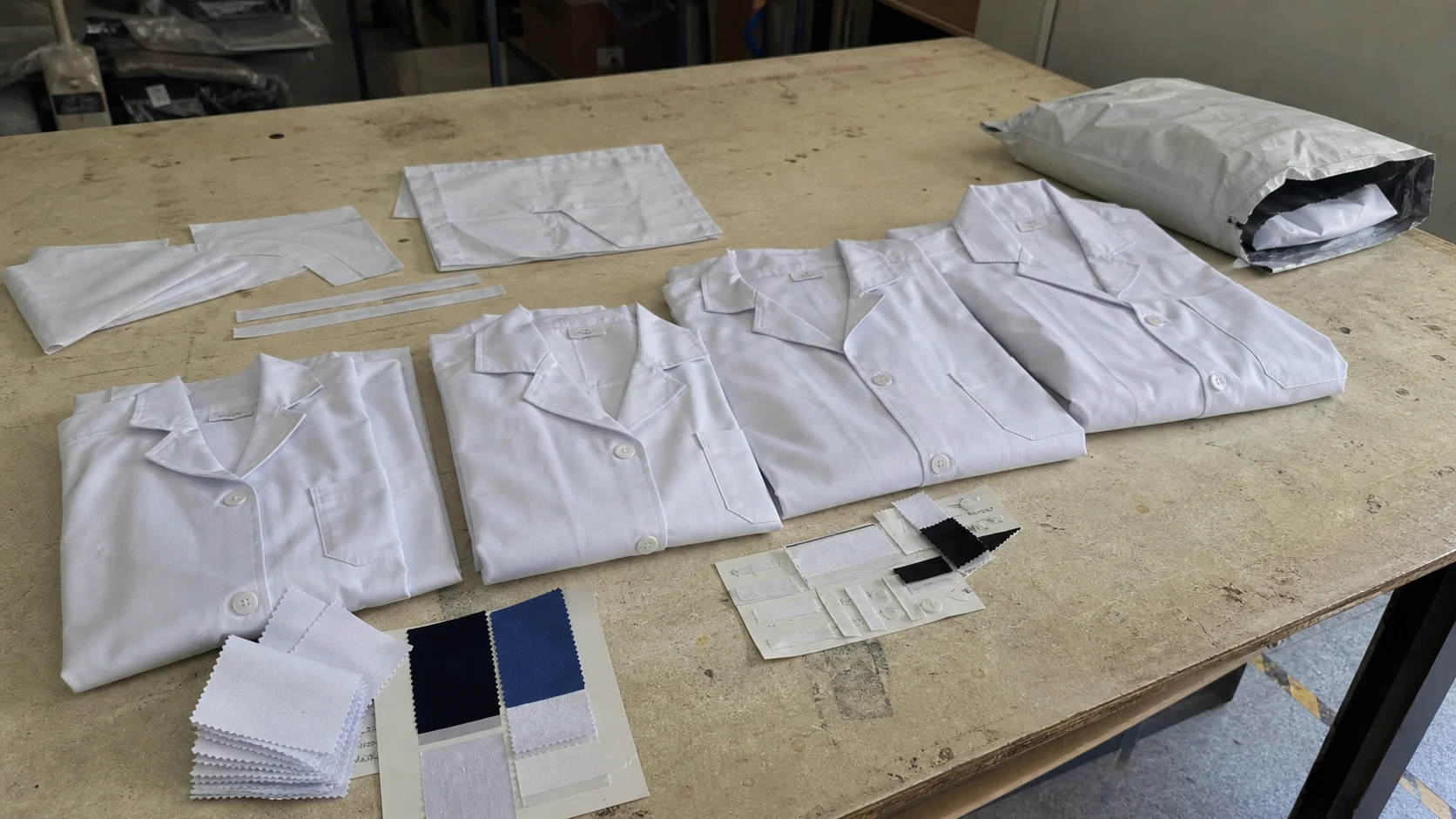
A quality inspection outline for reviewing lab coat factory size grading before construction safety team rollouts, with checks for fit range, garment...
Lab Coat Size Grading Review for Safety Team Buyers - Quality & Inspection manufacturing guide
For construction safety teams, lab coats are not fashion garments. They are workwear issued to supervisors, site engineers, quality inspectors, environmental health and safety staff, materials testing crews, maintenance technicians, and visitors who need controlled coverage in workshops, laboratories, batching areas, testing rooms, or temporary site offices. A lab coat that fits poorly can restrict movement, expose clothing underneath, interfere with PPE layering, or create a snagging risk around equipment. That is why a lab coat factory size grading review should be treated as a quality and inspection task, not just a merchandising detail.
This article reviews how safety team buyers should assess lab coat sizing before bulk production, with a focus on construction-related environments. It covers size charts, grading rules, measurement tolerances, sample approval, MOQ expectations, fabric and trim choices, production lead-time dependencies, inspection risks, and purchasing tradeoffs. The goal is simple: reduce fit complaints, avoid rework, and issue garments that workers can actually use.
Lab coats used by construction safety teams often serve a different purpose from coats used in medical clinics or academic labs. The wearer may be walking between a testing lab, a concrete cube curing room, a materials inspection bench, and an active site entrance. The coat may be worn over a polo shirt, high-visibility vest, thermal layer, or light coverall. In some cases, the lab coat is part of a visitor-control program, where a standard coat helps identify authorized personnel in controlled zones.
Size grading is the system used to increase or decrease garment measurements from one size to the next. A factory may grade chest, waist, hip, shoulder, sleeve length, body length, cuff opening, bicep, and sweep measurements according to a standard rule. If those increments are poorly set, the medium may fit well while the 2XL becomes too short, the small becomes too narrow at the armhole, or the larger sizes gain width without enough sleeve length.
Construction safety buyers should be especially careful because workforces are rarely uniform in body shape. A single issue order may need to cover office-based safety managers, field inspectors, lab technicians, contractors, and temporary staff. A basic S to 3XL size run may not be enough if the coat is expected to layer over winter clothing or high-visibility workwear.
A good lab coat size grading review asks whether the garment fits the job, the wearer, and the PPE system. A size chart that looks balanced on paper can still fail if it ignores layering, movement, laundering, and local body-size distribution.
A factory can only grade accurately when the buyer provides a clear brief. Many fit problems start when the order is placed with a vague instruction such as “standard lab coat sizes” or “regular unisex fit.” Those terms are open to interpretation. One factory may use a slim medical coat block, while another may use a loose industrial workwear block. Both may call the result “standard.”
The brief should define the intended wearer group, wearing conditions, size range, fabric, wash requirements, closure type, pocket layout, and fit preference. If the coat will be worn over other PPE, say so at the quotation stage. If the garment is for hot climates, the buyer may prefer a slightly relaxed fit with breathable fabric. If it is for controlled testing rooms with frequent washing, shrinkage and seam stability become more important.
Buyers working through a sourcing partner can formalize these details during product development. For broader manufacturing support, sourcing teams may review capability, sampling, costing, and quality control through services such as Fabrikn services. The important point is to settle the fit direction before the factory cuts the first sample.
A factory lab coat size chart should show finished garment measurements, not body measurements, unless clearly labeled otherwise. This distinction matters. Body measurements describe the wearer. Finished garment measurements describe the actual coat. The difference between the two is wearing ease, which allows movement and layering.
For construction safety teams, chest ease is usually more generous than in a fashion coat. A regular lab coat may need roughly 10 to 16 cm of chest ease over the body, depending on fabric, gender fit, and layering. A coat worn over a fleece or vest may need more. Tight coats lead to button strain, armhole discomfort, and reduced mobility when the wearer reaches forward, bends, or handles documents and testing tools.
Measurement tolerances should also be stated. For woven lab coats, common tolerances may be around plus or minus 1 cm for small points such as pocket placement and plus or minus 1.5 cm to 2 cm for larger points such as body length or chest circumference. These are typical ranges, not universal rules. Tighter tolerances may raise inspection pressure and cost, while loose tolerances may create size inconsistency across the order.
A buyer should check whether the factory measures garments flat or around the full circumference. Chest width, for example, is often measured flat from underarm to underarm, then doubled for circumference. Confusion here can cause serious ordering errors. The measurement method must be written into the tech pack or purchase specification.
Grading should be logical across the full size range. The easiest way to review it is to compare each size step and look for sudden jumps or flat measurements. If size M to L increases by 4 cm at the chest, but L to XL increases by 8 cm, ask why. If sleeve length stays the same from XL to 4XL, the larger sizes may look short on taller wearers.
Many factories use a base size, often M or L, then grade up and down. For unisex industrial lab coats, chest circumference may increase by roughly 4 cm to 6 cm per size, while body length may increase by around 1 cm to 2 cm per size. Sleeve length may increase by 0.5 cm to 1.5 cm per size depending on the pattern. These figures are common working ranges, not fixed standards. The right rule depends on the target body data, fit requirement, and coat style.
Split sizing may be worth considering. A mixed construction safety team may be better served by men’s and women’s fits instead of one unisex coat. The tradeoff is higher SKU count, higher stock planning complexity, and potentially higher MOQ. A unisex coat is simpler to buy and distribute, but it can fit poorly on some wearer groups. For short-term visitor use, unisex sizing is often acceptable. For daily safety team uniforms, better fit usually pays back through comfort and compliance.
Size grading cannot be reviewed in isolation from fabric. A lab coat made from 100% cotton twill behaves differently from one made from polyester-cotton blend. Cotton may offer comfort and heat resistance advantages, depending on construction and finish, but it can shrink more if not properly controlled. Polyester-cotton blends are often selected for durability, wrinkle resistance, and easier laundering. Disposable nonwoven coats follow a separate logic and usually have looser, less tailored sizing.
Common reusable lab coat fabrics include 65/35 polyester-cotton twill, 80/20 polyester-cotton, 100% cotton twill, and lighter poplin blends. Fabric weights may range from around 140 gsm to 240 gsm for many standard coats. Heavier fabrics feel more durable and provide better structure, but they can be hotter and may restrict movement if the pattern is narrow. Lighter fabrics improve comfort in warm conditions but may show wear sooner at elbows, pockets, and seams.
Shrinkage is one of the most common reasons an approved lab coat becomes a failed bulk garment. A sample may fit correctly before washing, then lose sleeve length, chest ease, or body length after laundry. Buyers should ask for shrinkage data and, where practical, review washed samples. For industrial laundry programs, wash testing should reflect the real process as closely as possible. Domestic wash data is not enough if the coats will be processed by a commercial laundry at higher temperature or with stronger mechanical action.
Trim choice also affects fit and durability. Snap closures are faster to use and may be preferred in some workwear programs, but poor-quality snaps can detach or fail inspection. Buttons are familiar and easy to replace, but buttonholes must be clean and secure. Elastic cuffs can improve wrist coverage but may feel hot and may interfere with gloves. Open cuffs are cooler and simpler, but they may create a looser sleeve end. Each option should be judged against the workplace, not just the unit price.
A reliable lab coat order usually moves through several sample stages. Not every project needs every stage, especially for repeat orders, but skipping fit confirmation is risky when the coat is new, the size range is broad, or the workforce has specific layering needs.
Size set samples are particularly important for construction safety team buyers. A base-size sample can hide grading weaknesses. The medium may look acceptable, while the 3XL has short sleeves and tight biceps. A small may be too long for shorter staff. If the order includes extended sizes, request at least one sample from the top end of the range before bulk production.
Fit testing should use realistic layering. If safety staff will wear the coat over a high-visibility vest, test it that way. If the coat is used in a hot materials lab over a light shirt, test that condition instead. Ask wearers to reach forward, bend, sit, button the coat fully, place items in pockets, and move through normal tasks. A static mirror check is not enough.
For branding, approve placement after the fit is settled. Embroidery or heat transfer can distort lightweight fabric if the backing, stitch density, or heat setting is wrong. Large chest logos may pull on the fabric or make the coat less breathable in that area. Name badges, department labels, and safety identification should not interfere with pockets or lapel roll.
Minimum order quantity depends on fabric availability, color, customization, size range, trims, and factory setup. For stock fabric and simple lab coats, typical MOQ may fall around 300 to 500 pieces per style or color. Custom fabric, special colors, flame-resistant specifications, antistatic features, or extended size ranges can push MOQ higher, often 800 to 1,000 pieces or more. Small trial orders may be possible through stock programs, but the buyer may have less control over grading and trims.
Size split also affects MOQ. A supplier may quote a total MOQ across all sizes, or a minimum per size and color. The second model is harder for safety teams because smaller sizes and extended sizes may have low demand. Buyers should clarify this point early. A cheap unit price loses value if the factory requires unrealistic quantities in rarely used sizes.
A realistic development timeline for a new customized lab coat may require several weeks for sampling and approvals before bulk production begins. Bulk lead time may range from around 30 to 60 days after all approvals for standard garments, with longer timelines for custom fabric or special compliance features. Shipping time, customs clearance, and internal distribution should be added separately.
Buyers who need help aligning specifications, production timelines, and inspection planning can contact a sourcing team through Fabrikn contact. Early review is more useful than late-stage troubleshooting, especially when size grading and fabric shrinkage are still adjustable.
Inspection should not only count defects. It should verify whether the lab coats match the approved standard. For size grading, that means checking finished measurements against the approved size chart and tolerance table. AQL inspection can identify visible defects, but measurement review needs clear sampling by size and color.
Common inspection risks include inconsistent body length, uneven sleeve length, tight armholes, skewed plackets, misplaced pockets, incorrect size labels, fabric shade variation, loose threads, weak bartacks, poor button attachment, seam puckering, and wrong carton assortments. Size labels are a serious risk because a mislabeled coat may pass visual inspection but fail during issue to workers.
Construction safety buyers should pay close attention to pockets and closures. Lab coats for site teams often carry pens, small notebooks, ID cards, inspection tools, phones, or sample labels. Pocket corners should be reinforced, especially lower patch pockets. Chest pockets should not sit too high or too low across the graded size range. A pocket placement that works on size M may look awkward on 4XL if the factory grades the body but not the pocket position sensibly.
Carton packing can create another issue. If coats are distributed to multiple construction sites, carton assortments should reflect the issue plan. Mixed cartons may be convenient for site allocation, while size-solid cartons may be easier for warehouse control. The buyer should choose based on distribution method. Unclear packing instructions can cause delays even when the garments themselves are acceptable.
The cheapest lab coat is not always the lowest-cost option. Poor grading creates hidden costs: unused sizes, worker complaints, urgent replacements, reinspection, sorting, and damaged confidence in the safety program. At the same time, over-specifying every detail can make a simple garment slow and expensive to produce. The right approach is to identify which specifications genuinely affect safety, comfort, durability, and issue efficiency.
For short-term visitor coats, a basic unisex size range and stock fabric may be the practical choice. Fit does not need to be perfect if the coat is worn briefly and the work environment is low-risk. For daily-use safety staff coats, buyers should invest more time in size set approval, fabric testing, pocket reinforcement, and wearer feedback. For specialist environments, such as chemical handling, flame exposure, or antistatic control, garment performance standards must be reviewed separately from basic lab coat grading.
Buyers should also decide how much size data to collect internally. If the company has past uniform issue records, those records are useful. They show which sizes were actually worn, which sizes ran out, and which sizes stayed in inventory. If no records exist, a small fitting trial before bulk order is often worth the effort. Guessing the size curve can lead to oversupply in common middle sizes and shortages in extended sizes.
A factory’s willingness to discuss grading is a useful signal. A supplier that can explain pattern increments, measurement tolerances, shrinkage allowances, and size set sampling is usually easier to manage than one that only sends a generic chart. Company background and sourcing approach can also be reviewed through pages such as Fabrikn about us when buyers are comparing support options for apparel manufacturing programs.
A practical review framework should connect specification, sampling, production, and inspection. Treat the size chart as a controlled document. Each revision should carry a date or version number, and the approved pre-production sample should match that version. If the factory changes fabric, trims, or pattern after approval, the buyer should decide whether a new sample is required.
Review Area Buyer Question Recommended Action Fit purpose Is the coat for visitors, daily staff, or specialist work? Set the fit standard before requesting quotation. Size range Does the range match workforce needs? Use issue history or conduct a fitting trial. Grading Are increments consistent and practical? Review size chart line by line before sample approval. Layering Will workers wear other PPE underneath? Test samples under real wearing conditions. Shrinkage Will washing change fit? Request test data and review washed samples where needed. Inspection Can the inspector verify sizing objectively? Provide approved measurements, tolerances, and method diagrams.This framework prevents the common mistake of treating size grading as a supplier-only responsibility. The factory cuts and sews the product, but the buyer defines the acceptance standard. If the standard is unclear, disagreement during inspection becomes more likely.
A lab coat factory size grading review for construction safety teams should focus on real use, not catalog assumptions. The coat must allow movement, layering, laundering, and multi-site distribution. The size chart should be based on finished garment measurements, with clear tolerances and sensible increments across the full range. Fabric shrinkage, pocket reinforcement, closure quality, and inspection method all affect whether the approved fit survives bulk production.
The best purchasing decision is usually not the most complex garment. It is the most controlled garment: clear specification, approved size set, stable fabric, practical MOQ, realistic lead time, and inspection criteria that match the work environment. When those pieces are aligned, lab coats become easier to issue, easier to reorder, and less likely to create avoidable safety team complaints.
Get a free quote from Fabrikn — your trusted B2B clothing manufacturer with 10+ years of experience. MOQ as low as 200 pieces.
Get a Free Quote →Lab coat size grading is the method used to increase or decrease garment measurements from one size to another. It controls how chest, sleeve, shoulder, body length, sweep, and other measurements change across the size range.
Construction safety teams may wear lab coats over shirts, vests, or other PPE. Poor grading can restrict movement, reduce coverage, cause button strain, or create inconsistent fit across different worker sizes.
Typical MOQ for standard reusable lab coats may be around 300 to 500 pieces per style or color when stock fabric is available. Custom fabric, special colors, extended sizes, or performance finishes may raise MOQ to around 800 to 1,000 pieces or more.
A full size set is recommended when the order is new, the workforce is mixed, or the size range includes extended sizes. At minimum, buyers should review the smallest, base, and largest sizes before bulk cutting.
Chest, shoulder, sleeve length, bicep, body length, sweep, cuff opening, and pocket placement are key measurements. The inspector should use the same measurement method and tolerance table approved during sampling.
Shrinkage can reduce chest ease, sleeve length, and body length after washing. Buyers should request shrinkage data and consider washed sample approval, especially for reusable coats that will be laundered frequently.
Unisex lab coats can work for visitor programs and simple issue systems. Daily-use safety teams may benefit from separate men’s and women’s fits, but that increases SKU count, MOQ pressure, and inventory planning complexity.
The biggest risk is approving a base-size sample without checking grading across the full range. Large sizes may become too short or tight in the sleeve, while small sizes may become too long or oversized.