
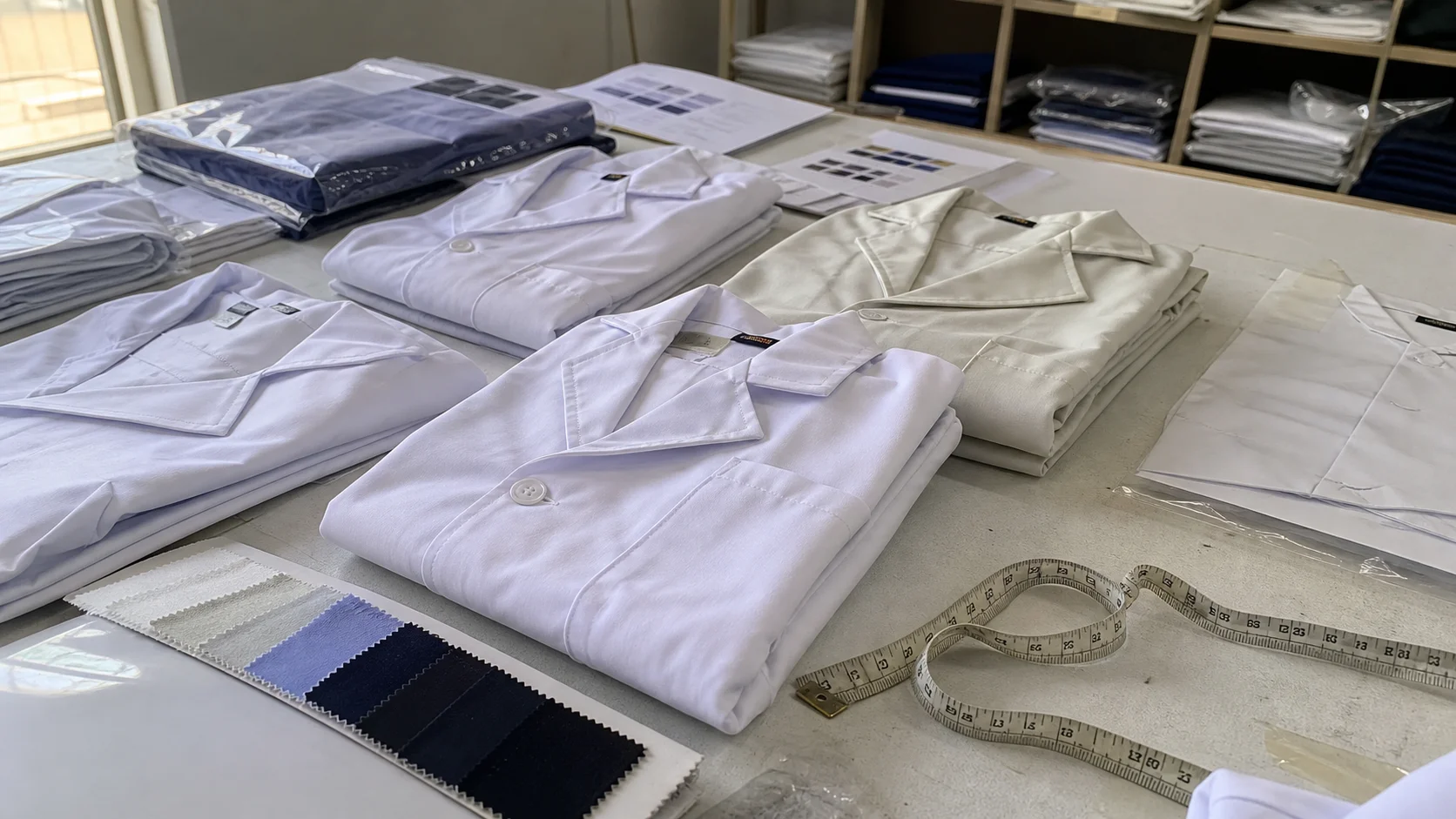
A product-specific quality control outline for school operations teams buying student, faculty, or lab staff lab coats, covering fabric, sizing, safety,...
Lab Coat QC Checklist for School Buyers - Fabrikn production reference
For school operations teams, a lab coat order is not just another uniform purchase. It affects science class safety, student compliance, laundry workload, parent satisfaction, and the school’s ability to issue consistent apparel across grades and departments. A weak lab coat supplier quality control checklist can turn a simple procurement project into months of size exchanges, missing stock, fabric complaints, and reorders that arrive too late for the academic calendar.
This guide is written for school buyers, procurement managers, operations teams, and uniform coordinators who need a practical checklist for sourcing and inspecting student lab coats. It focuses on buyer-side controls: what to specify, what to check before production, what to inspect before shipment, and what risks commonly appear in school lab coat programs.
If your school is comparing suppliers or planning a new uniform program, it is worth reviewing production capability early. You can also explore apparel manufacturing support through Fabrikn services, or contact the team through Fabrikn contact when supplier qualification, sampling, or inspection support is needed.
School lab coats usually sit between uniform apparel and light protective clothing. They are not always certified personal protective equipment, yet they still need to support safe classroom behavior. Poor fabric, loose buttons, weak seams, or inconsistent sizing can reduce student use and create avoidable work for the operations office.
School buyers also face a different risk profile from retail buyers. A fashion retailer can sometimes absorb minor style variation across batches. A school cannot easily explain why one year group received off-white coats while the next group received bright white coats, or why half the students need sleeve alterations. Consistency matters.
A strong QC checklist protects three things: classroom usability, administrative efficiency, and reorder consistency.
Lab coat quality control should begin before purchase order placement. Waiting until cartons arrive at the school is too late. By that point, the buyer may be dealing with fixed event dates, parent distribution schedules, and limited time for replacement stock.
For school operations teams, the right approach is to define acceptance standards early, approve a complete sample, monitor production risk, and inspect finished goods against the same requirements. This reduces disputes with the supplier because quality is measured against written specifications, not general expectations.
A lab coat supplier can only quote accurately when the buyer provides enough detail. A vague request such as “white student lab coat” often leads to wide differences in fabric, finishing, fit, packaging, and price. Before comparing suppliers, prepare a written product specification.
Each detail affects price and production time. For example, 100% cotton may be preferred for comfort and certain science class expectations, but it can shrink more if not properly controlled. Polyester-cotton blends often dry faster and resist creasing, but may not be suitable for every classroom policy. Buyers should ask the science department, health and safety lead, and uniform coordinator before locking the specification.
School lab coats should not be marketed internally as certified protective garments unless the supplier provides valid documentation for the relevant standard. If a coat is only a classroom uniform layer, describe it that way. If flame resistance, chemical splash resistance, or other performance claims are required, request test reports from recognized labs and confirm that the fabric, trims, and finished garment match the tested item.
This distinction is important for liability and expectation management. A basic cotton or poly-cotton school lab coat can support neatness and limited splash coverage, but it is not automatically equivalent to certified PPE.
Supplier qualification should happen before price negotiation reaches the final stage. A low unit price is not useful if the supplier cannot hold sizing tolerance, manage school delivery dates, or reproduce the same coat for reorders.
Typical MOQ ranges vary by supplier and customization level. Plain stock lab coats may be available from low quantities, sometimes from 50–100 pieces if stock sizes are used. Custom production often starts around 300–500 pieces per style or color, and some factories may require 800–1,000 pieces or more for custom fabric, custom dyeing, or complex branding. Size-level minimums also matter. A supplier may accept 500 total pieces but resist producing only 5 pieces in an uncommon size.
Buyers should be cautious when a supplier promises very low MOQ, very fast lead time, custom fabric, perfect quality, and the lowest price at the same time. One of those claims may be realistic. All of them together deserve careful checking.
Supplier qualification is not only about factory capacity. It is also about communication discipline. If a supplier cannot confirm basic specifications clearly before the order, they may not manage changes and inspections well during production.
Fabric choice drives comfort, durability, shrinkage, opacity, and washing performance. For school use, the right fabric is usually a balance between cost control and repeated wear. A slightly stronger fabric can be cheaper over a full academic year if it reduces replacements.
For many school programs, a fabric weight around 160–200 GSM is a practical middle ground. Younger students may prefer lighter coats, while high school labs may need stronger fabric. The school should also consider laundering. If coats are washed at home, care instructions need to be simple. If the school launders centrally, the fabric must tolerate repeated commercial washing conditions if those are used.
Trim failure is a common school complaint because students pull pockets, tug closures, and wear coats over bulky uniforms. It is better to specify reinforced stress points than to handle repeated repairs later.
A lab coat sample is not just a visual reference. It is the buyer’s main control document before production. School buyers should avoid approving a sample based only on a product photo.
Not every order requires four physical sample rounds. A small reorder of an unchanged coat may only need a pre-production sample or retained reference confirmation. A new school-wide program should not skip fit and branding review.
Written sample comments should be specific. “Make it better” is not a production instruction. A useful comment says, for example, “Increase sleeve length by 2 cm on sizes 10–14” or “Move chest logo 1.5 cm toward center front.” Clear comments reduce supplier interpretation and make later inspection more objective.
Sizing is one of the largest operational risks in school lab coat buying. Students vary widely in height, shoulder width, and uniform layers. A coat that looks correct on a hanger may be uncomfortable in class.
Measurement tolerance should be agreed before production. For many woven lab coats, a practical tolerance may be around 1 cm for smaller measurement points and 1.5–2 cm for larger body measurements, depending on size and construction. The exact tolerance should be written into the specification and understood by both buyer and supplier.
Fit testing should include the uniform layers students normally wear. If students wear blazers, sweaters, or thick shirts under the lab coat, the sample must be tried over those garments. A coat approved over a thin T-shirt may feel too tight during actual school use.
Schools should also decide whether the coat is intended for one-year use or multi-year growth allowance. A larger fit may reduce annual replacement pressure, but it can create sleeve safety issues if cuffs hang too low. For younger students, long sleeves can interfere with practical activities. Elastic cuffs may help, but they add cost and may feel restrictive.
Do not rely only on generic supplier size ratios. School body profiles vary by region, age group, and gender mix. Use previous uniform purchase data if available. If there is no historical data, collect height ranges or run a size trial with sample sets before placing a large bulk order.
A practical school order may include buffer stock in popular sizes. The buffer does not need to be excessive, but having no spare stock can create problems when new students join mid-year or coats are damaged. For custom production, reorder lead times may be too long to solve immediate needs.
Production QC should focus on preventing defects before the full order is finished. Final inspection is useful, but it is more expensive and stressful to discover major issues after all units are sewn and packed.
For school lab coats, visible symmetry is important. Students often line up together in laboratories or school photos, so inconsistent pocket placement, crooked logos, or uneven coat lengths become obvious quickly. These are not just cosmetic defects; they can trigger parent complaints and undermine uniform consistency.
Finishing is where many school orders lose quality. A coat may be sewn acceptably but delivered with loose threads, poor pressing, dirty cuffs, or mixed sizes. The buyer’s checklist should treat finishing as a separate control stage.
Final inspection should happen when production is complete and at least most goods are packed. The goal is to verify that the shipment matches the approved sample, purchase order, and agreed quality standard before it leaves the supplier.
Inspection sampling should be agreed in advance. Many apparel inspections use AQL-based sampling, but the school buyer should not use the term casually without knowing what defect levels are acceptable. For smaller school orders, a more direct inspection of all critical sizes or a higher sampling rate may be more practical.
The inspection standard should reflect school use. A single loose thread may not justify rejecting a shipment, but widespread weak button attachment should not be ignored. The purchasing judgment is simple: accept minor correctable issues, but do not accept defects that create distribution chaos, safety concerns, or high replacement volume.
For a broader view of manufacturing process support and quality planning, school buyers can review Fabrikn about us to understand how structured apparel sourcing support can reduce preventable production issues.
Packaging is often treated as an afterthought, but it matters heavily in school operations. The same order can be easy or difficult to distribute depending on how it is packed.
There is a tradeoff with individual packaging. Polybagging each coat keeps white garments cleaner and helps distribution, but it increases waste and unpacking time. Bulk packing reduces packaging material, but it can lead to dirt marks and sorting errors if not controlled. Schools with parent collection days may prefer individually packed and size-stickered coats. Schools distributing through classroom teachers may prefer cartons sorted by class or grade.
Labels should be checked before bulk production because relabeling finished garments is time-consuming. At minimum, school lab coats often need size and care labels. Some buyers also require student name labels, school branding, department labels, or barcodes for inventory tracking.
Care instructions should match the actual fabric and trims. A coat with embroidery, snaps, or heat transfers may need different washing guidance from a plain coat. Incorrect care labels can increase shrinkage complaints and supplier disputes.
School buyers work around fixed calendars. A delayed lab coat shipment can miss orientation, lab start dates, or parent distribution windows. Lead time planning needs to include more than production days.
These ranges are only typical market references. Actual MOQ depends on fabric availability, supplier capacity, size spread, customization, and season. A school should confirm whether MOQ is calculated by total order, style, color, fabric, or size.
For custom orders, buyers should avoid planning only around the supplier’s stated production lead time. A quote that says “30 days production” may not include sample approval, fabric booking, inspection, shipping, or internal school distribution. A safer procurement timeline may start 10–16 weeks before the required in-school date for custom programs, depending on complexity and shipping method. Stock or repeat orders can be faster, but only when sizes and materials are available.
Reorders are where many schools discover whether their supplier is organized. If the first order is not documented properly, the second order may arrive with a different fabric weight, altered logo placement, or changed sizing.
For schools that expect annual lab coat orders, consistency may be more valuable than saving a small amount per unit. Changing suppliers every year can create hidden costs in sampling, approval, size mismatch, and parent complaints.
Lab coats appear simple, but they have recurring defect patterns. A buyer who knows these risks can focus inspection time where it matters.
The highest-risk defects for school operations are wrong sizing, dirty white garments, incorrect logos, and poor packaging by size. These defects directly affect distribution. A small sewing flaw on one unit is manageable. A full carton of mislabeled sizes is a serious operational problem.
A simple supplier scorecard helps school operations teams compare vendors beyond unit price. This is especially useful when procurement, science faculty, finance, and administration all have input.
Criteria What Good Looks Like Buyer Judgment Specification clarity Supplier confirms fabric, sizes, trims, packaging, and tolerance in writing Strong sign of production control Sampling discipline Pre-production sample matches intended bulk order Essential for custom school programs MOQ flexibility MOQ fits school quantity and size spread Low MOQ helps, but stock limitations may reduce consistency Lead-time reliability Supplier provides realistic timeline including approvals Prefer realistic timing over optimistic promises Quality control Supplier accepts inspection and has internal QC checkpoints Important for reducing shipment surprises Reorder consistency Supplier can retain specs and repeat approved style High value for annual school operations Packaging support Supplier can pack by size, campus, department, or class if needed Reduces receiving and distribution workloadPrice should still matter. School budgets are real, and over-specifying a coat can waste funds. The best supplier is not always the most expensive one. The better buying decision is to choose the supplier that can meet the required standard consistently at a sustainable price.
If a school only needs short-term coats for a small group, stock lab coats with basic logo application may be enough. If the school is building a long-term uniform program across multiple grades, custom production with controlled specifications is usually the cleaner operational choice.
The following checklist can be used as a working reference before placing an order and before approving shipment.
A lab coat supplier quality control checklist does not need to be complicated, but it must be specific. School buyers should insist on written standards, approved samples, and shipment checks. That is the practical way to avoid preventable problems during the academic year.
Get a free quote from Fabrikn — your trusted B2B clothing manufacturer with 10+ years of experience. MOQ as low as 200 pieces.
Get a Free Quote →A school lab coat QC checklist should include fabric composition, GSM, color, shrinkage expectations, size chart, measurement tolerance, stitching quality, pocket placement, closure strength, labels, logo placement, packaging, carton marking, and quantity by size. It should also define which defects are critical, major, and minor.
Custom school lab coat MOQs often range from 300 to 1,000 pieces per style or color. Stock lab coats may be available from lower quantities, sometimes around 50 to 100 pieces, depending on supplier inventory. Custom fabric, special colors, and complex branding usually increase MOQ.
Production time depends on sampling, fabric availability, order quantity, branding, factory capacity, inspection, and shipping. A custom school lab coat program may need 10 to 16 weeks from specification to in-school delivery. Stock or repeat orders can be faster if sizes and fabric are available.
There is no single best fabric for every school. 100% cotton is breathable and commonly preferred where natural fiber is required, but it can shrink and wrinkle. Polyester-cotton blends are durable and easier to care for, but may not suit every safety policy. Many schools choose fabrics around 160–200 GSM for a balance of durability and comfort.
Only treat school lab coats as PPE if the supplier provides valid documentation showing the garment meets relevant protective standards. Many school lab coats are uniform or classroom garments, not certified PPE. Buyers should avoid making safety claims unless supported by testing and compliance documents.
Schools can reduce size exchanges by testing fit samples over actual school uniforms, using historical size data, creating a clear size chart, allowing sensible ease, and ordering buffer stock in common sizes. Generic size ratios should be checked against the school’s student profile.
Common defects include dirty white fabric, loose buttons, open seams, incorrect size labels, sleeves outside tolerance, uneven pocket placement, poor logo positioning, and mixed-size cartons. Packaging errors can be as disruptive as sewing defects because they slow down school distribution.
Final inspection should happen after production is complete and when most or all goods are packed, but before shipment leaves the supplier. This timing allows the buyer or inspector to check quantity, measurements, workmanship, trims, branding, and packaging while there is still time for correction.
Schools should keep an approved sample, final size chart, fabric details, logo placement, label information, and packaging instructions on file. Reorder data should include size exchange patterns and any complaints from the previous year. This helps maintain consistency and improves future purchasing accuracy.
School buyers can work with apparel sourcing and manufacturing partners that understand specifications, sampling, production controls, and inspection planning. For support with apparel programs, visit Fabrikn services or use the contact page to discuss sourcing requirements.