
A product-specific SEO outline for construction safety teams reviewing lab coat trim sourcing before placing or approving an order, with inspection...
Lab Coat Trim Sourcing Review for Safer Orders - Quality & Inspection manufacturing guide
Lab coat sourcing for construction safety teams is not the same as buying standard medical coats from a catalog. The garment may look simple, but the trim package can decide whether the order performs well on site or becomes a daily irritation for workers, supervisors, and procurement teams.
In this category, “trim” means every non-body-fabric component that supports function, identification, fastening, comfort, compliance, and presentation. Buttons, snaps, hook-and-loop tape, labels, thread, reflective tape, pocket reinforcements, interlining, hangtags, size stickers, polybags, and cartons all sit inside the trim review. Small parts carry large consequences.
Construction safety teams often use lab coats for inspection work, quality checks, material testing, concrete sampling, environmental monitoring, site laboratory duties, and visitor control. These garments may move between indoor testing rooms and active construction zones. They may be exposed to dust, abrasion, oils, adhesives, cement particles, cleaning chemicals, heat, and repeated laundering. A weak button or poor label is not just a cosmetic issue. It can shorten garment life, affect identification, or create snagging and contamination risks.
A practical sourcing review should catch these problems before purchase order placement or at least before bulk cutting. The buyer’s goal is not to specify the most expensive trim. The goal is to choose the correct trim for the use case, confirm supply stability, approve samples properly, and set inspection checkpoints that reduce dispute risk.
If your team is building a new lab coat program or revising an existing one, use the trim review as a buying control. It gives the manufacturer a clear bill of materials and gives the buyer a measurable standard for approval. For broader production support, buyers can review apparel development and production options through Fabrikn services.
Many lab coat quality problems begin with an incomplete trim list. A buyer may specify “white poly-cotton lab coat with logo embroidery” but leave closures, labels, thread, interlining, and packaging open to factory choice. That can work for low-risk promotional garments. It is not ideal for construction safety teams where daily wear, department identification, and durability matter.
A complete trim review should include visible and hidden components. The visible parts shape appearance and user experience. Hidden parts affect strength, wash performance, and consistency across repeat orders.
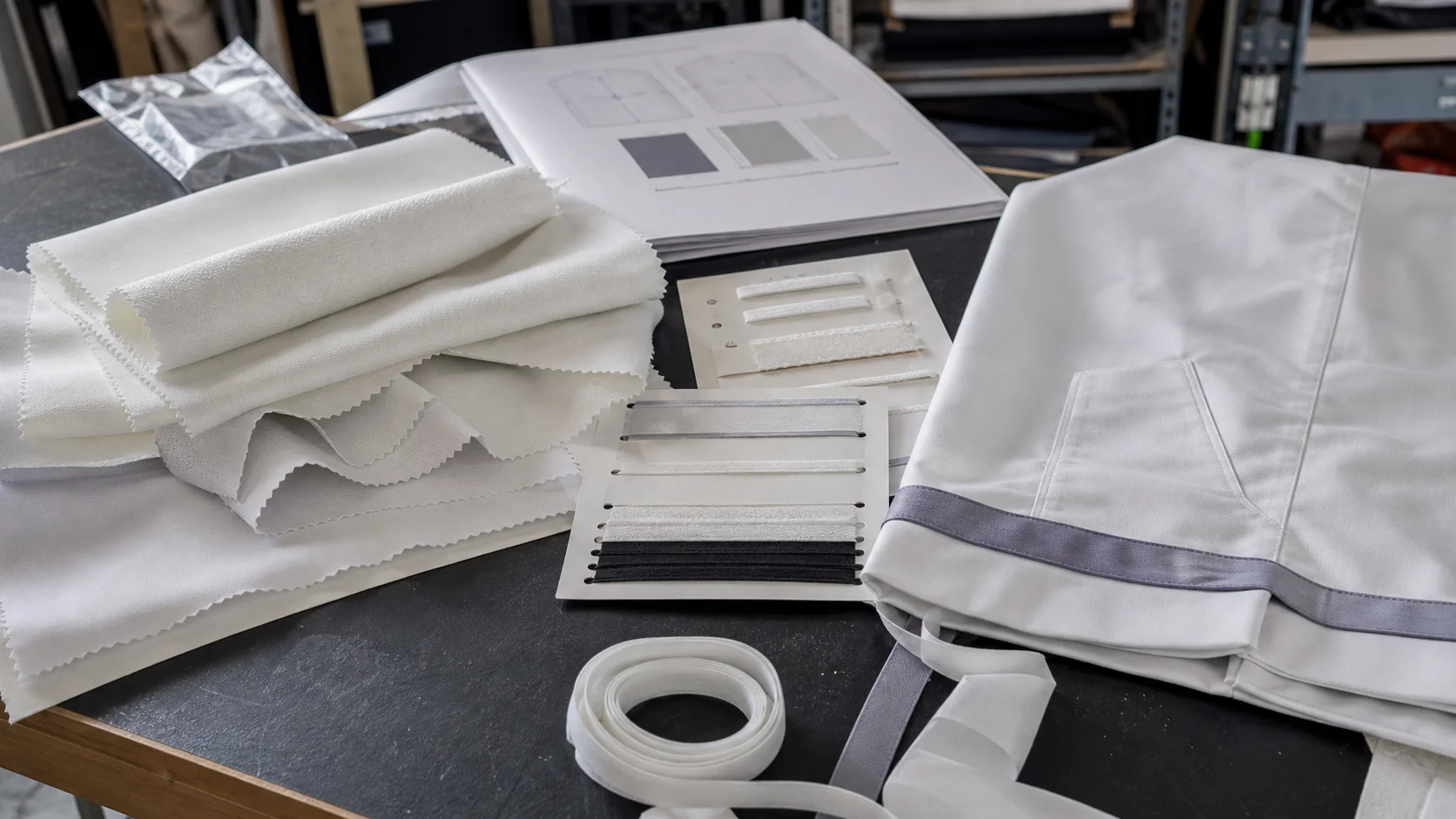
The buyer should request a trim card or trim sheet before approving bulk. A trim card is a physical or digital board showing each component with color, size, material, supplier reference, and placement. It is not paperwork for paperwork’s sake. It prevents the common problem where the sample is made with one button, bulk is made with another, and the replacement looks close but performs differently.
A lab coat used by a construction safety team has a different risk profile from a laboratory coat worn only in a clean, controlled room. Procurement should consider the job environment before confirming trim.
Construction safety staff may carry pens, small notebooks, inspection tags, thermometers, tape measures, ID cards, and sample bags. They may bend, climb stairs, enter temporary offices, visit site labs, and walk through dusty or wet areas. The coat trim must not catch easily, fall off, discolor quickly, or become unreadable after a few washes.
Purchasing judgment: if a lab coat will be worn on or near active construction areas, durability and snag control should outrank decorative detail. A cleaner-looking trim package is usually safer and easier to inspect than a heavily decorated one.
Not every construction safety lab coat needs flame resistance, chemical resistance, or high-visibility certification. Those claims should only be made when the garment materials, trims, testing, and documentation support them. If the coat is intended as a general inspection coat, avoid overstating protective performance. If it is intended as certified PPE, involve a qualified compliance specialist and require formal test documents for both fabric and relevant trim.
A trim sourcing review should produce a practical specification sheet. This document becomes the reference for sampling, costing, purchase order confirmation, production inspection, and repeat orders. It should be specific enough to control risk but not so restrictive that it blocks reasonable sourcing alternatives.
The best format is a bill of materials table paired with sketches or garment photos. Each trim item should have a defined material, color, size, placement, quantity per garment, performance requirement, and approval status. If an exact supplier item is required, name the reference clearly. If alternatives are allowed, define what “equivalent” means.
Trim Item Recommended Spec Detail Inspection Concern Front Buttons Resin or polyester, 4-hole, size confirmed by sample, color matched to shell or contrast standard Cracking, sharp edges, loose attachment, color variation Snaps Rust-resistant metal or coated snap, pull strength defined, cap diameter stated Detachment, misalignment, rust, poor closing strength Thread Polyester core-spun or spun polyester, ticket size matched to fabric weight Seam breakage, color bleeding, puckering Care Label Printed satin, nylon, or polyester label with approved wash symbols and fiber content Fading, missing legal information, scratchy edge Reflective Tape Width, color, placement, wash-cycle requirement, and certification status confirmed Peeling, cracking, false compliance claims Embroidery Logo size, stitch count, thread color, backing type, placement tolerance Puckering, wrong color, poor registration, backing irritationBuyers should also include tolerance ranges. For example, logo placement may be allowed within a small measurement tolerance. Pocket size may have a practical production tolerance. Button spacing should be consistent but not unrealistically tight. Unrealistic tolerances increase rejection risk without improving wearer safety.
Trim cannot be reviewed separately from fabric. A button, snap, thread, or tape that performs well on one fabric may fail on another. Lab coats for construction safety teams commonly use cotton, polyester-cotton blends, polyester, or heavier twill blends. Each base fabric changes trim behavior.
A lightweight polyester-cotton poplin may need smaller buttons, lighter interlining, and controlled embroidery backing to avoid puckering. A heavier twill can support stronger snaps and reinforced pockets, but it may also need sharper sewing controls to prevent bulky seams. If the lab coat will be washed industrially, both fabric and trim need to tolerate heat, agitation, detergent, and drying conditions.
For construction safety teams, pocket use deserves special attention. Many standard lab coats have pockets designed for light items. Safety staff may carry heavier objects. Ask the manufacturer to reinforce side pockets and chest pockets with bartacks at stress points. If a pen pocket is needed, specify slot width and length. If a radio loop or badge tab is requested, confirm whether it creates snag risk.
Thread choice is often underestimated. Polyester thread is widely used because it is strong, stable, and wash-resistant. Cotton thread may be required in some specialized contexts, but it is not automatically better. For most general construction safety lab coats, polyester or polyester core-spun thread is a practical choice. Match thread size to fabric weight; overly thick thread can cause puckering, while overly fine thread can break at pocket stress points.
The front closure is one of the most visible trim decisions. It affects speed of wear, repairability, cost, laundering, and safety. Buyers should choose the closure based on how the coat will be used rather than copying a generic lab coat style.
Buttons are economical, familiar, easy to replace, and suitable for many standard lab coats. Resin or polyester buttons are common. For construction safety teams, specify smooth edges, consistent color, and secure attachment. Four-hole buttons often provide better attachment strength than two-hole buttons, though final performance depends on sewing quality.
The downside is that buttons can come loose if sewing is poor or if workers frequently open and close the coat. Spare buttons should be included if the coat is expected to remain in service for long periods. Buyers should state whether spare buttons are required in a small internal bag, sewn to the care label area, or omitted to reduce cost and packaging.
Snaps give faster closure and a cleaner front appearance. They can also be easier to use with gloves. For site use, rust resistance and pull strength matter. Low-grade snaps can detach during wear or laundering, leaving sharp edges or holes in the placket.
If snaps are selected, request a pull test standard from the supplier. The exact value depends on the snap type and fabric reinforcement, but the buyer should at least require that the factory perform internal snap attachment checks and document results during production. Reinforced plackets are often needed so snaps do not tear through the fabric.
Zippers are less common on traditional lab coats, but they may be used for utility coats or protective overshirts. They add cost and create a stronger visual style. Coil zippers can be lightweight and flexible; molded tooth zippers can feel more rugged. Metal zippers may not suit all lab or wash conditions.
The tradeoff is repair difficulty. A failed button is easy to replace. A failed zipper can make the garment unusable. If zippers are used, specify zipper length, tape color, slider type, top and bottom stops, and whether the zipper is concealed.
Hook-and-loop tape can be useful for quick closure or adjustable cuffs. It is not always ideal in dusty construction environments. Dust, fibers, and debris can reduce grip and make the garment look worn quickly. If used, choose quality tape and consider placement where it will not collect excessive debris.
Purchasing judgment: for most general construction safety lab coats, buttons or snaps are usually more practical than hook-and-loop tape. Snaps are faster; buttons are easier to repair. The right choice depends on the user’s work routine and maintenance plan.
Labels do more than carry a brand name. They support garment care, size control, legal requirements, warehouse handling, and worker acceptance. A scratchy label can make a coat unpopular. A fading care label can create laundering mistakes. A missing country-of-origin label can create receiving or compliance problems.
The label package should be reviewed before production. Ask for artwork proofs and physical label samples. Confirm spelling, size scale, color, language requirements, fiber content, care instructions, and placement. If the coat uses a blended fabric, the fiber content on the label must match the fabric being ordered, not the previous season’s version or the sample-room substitute.
Construction safety teams often need department names, site codes, or role identification. Keep the system simple. A left-chest logo plus a color-coded size label or department label may be enough. Complex personalization increases sorting errors and production lead time.
Packaging trims also deserve a sourcing review. A lab coat order may pass garment inspection but fail receiving because cartons are poorly marked or size ratios are mixed incorrectly. Specify whether garments are individually polybagged, bulk packed by size, folded with tissue, or packed with hangers. Many B2B buyers prefer individual bags for clean handling, while some sustainability programs prefer reduced plastic. The tradeoff should be decided before costing.
For projects that need supplier communication, order clarification, or custom production discussion, buyers can use the Fabrikn contact page to start a more detailed sourcing conversation.
Sampling is where trim decisions become visible. A lab coat sample should not be approved only for fit and fabric. Trim must be checked line by line against the bill of materials. The sample approval process should create a clear record of what is approved, what is rejected, and what must be changed before bulk.
Not every order needs every sample stage. A repeat order with no changes may only require a confirmed trim card and pre-production sample. A new construction safety program with logos, snaps, reinforced pockets, and reflective tape should not skip pre-production approval.
Buyers should photograph approved samples and keep them as reference standards. If possible, retain one sealed approved sample at the buyer side and one at the factory side. This reduces argument later when bulk production differs in button shade, label placement, or logo size.
A sample may look acceptable at first glance and still fail in use. Construction safety teams usually need garments that tolerate repeated movement and cleaning. Washing one or two samples before bulk approval can reveal shrinkage, trim fading, puckering, reflective tape lifting, or snap rust concerns. This does add time, but it is cheaper than discovering the issue after receiving hundreds or thousands of coats.
MOQ and lead time depend on fabric availability, trim customization, factory capacity, garment complexity, size range, and packaging requirements. Buyers should treat any quoted MOQ as conditional until the full trim package is known.
For standard lab coats with available fabric and stock trims, typical MOQs may fall around 300 to 500 pieces per style or color, depending on the manufacturer. For custom trims, custom labels, special snaps, reflective tape, or logo work, MOQs often move into the 500 to 1,000 piece range. Highly customized fabric, certified trims, uncommon colors, or complex size assortments can require 1,000 pieces or more. Smaller quantities may be possible, but the unit price usually rises and trim choices become narrower.
Order Type Typical MOQ Range Lead-Time Impact Stock fabric, stock buttons, simple labels 300-500 pieces Often faster if fabric and trims are available Custom logo, custom care labels, standard closures 500-1,000 pieces Label and embroidery approvals add time Snaps, reinforced pockets, special packaging 500-1,000 pieces Extra testing and setup may be needed Reflective tape or certified trim package 1,000+ pieces may apply Documentation and trim sourcing can extend schedule Low-quantity pilot order 100-300 pieces if accepted Higher unit cost and limited customization likelyLead time can range from a few weeks to several months. A simple repeat order may move quickly if fabric and trims are in stock. A new custom order usually needs time for sample development, trim sourcing, approvals, bulk production, inspection, packing, and freight. As a planning estimate, buyers should allow 2 to 4 weeks for sampling and approvals, then 4 to 8 weeks for bulk production after all materials are approved. Seasonal factory load, fabric dyeing, holiday closures, inspection booking, and shipping mode can change the schedule.
The safest purchasing practice is to separate sample approval timing from bulk production timing. Factories cannot reliably start bulk production until trims are approved and available. If the buyer delays label artwork or changes snap type after sample approval, the production calendar shifts.
Inspection should not wait until cartons are sealed. Trim defects are easier to correct before garments are fully finished. A sound quality plan includes incoming trim checks, inline production checks, final random inspection, and packing verification.
Incoming trim inspection checks whether the factory received the correct components before production begins. This is especially important when trims are purchased from multiple vendors. Inspectors should compare bulk trims against the approved trim card for color, size, finish, quantity, and labeling.
Inline inspection catches errors while garments can still be repaired. It should check trim placement, seam strength, pocket reinforcement, closure alignment, and logo position. If a button is sewn in the wrong location on the first 50 coats, the issue can be corrected. If it is found after 2,000 coats are packed, the cost is much higher.
For lab coats, inspect pocket bartacks carefully. Safety teams often stress pockets more than office users. Weak bartacks, skipped stitches, or poor pocket corner reinforcement should be corrected early. Closure alignment also matters. A coat with uneven snaps or buttons can twist on the body and look unprofessional.
Final inspection should confirm workmanship, measurements, trim attachment, color consistency, labeling, packaging, and carton accuracy. The buyer and manufacturer should agree on an inspection standard before production. Many apparel inspections use AQL sampling, but acceptance levels should reflect the buyer’s risk tolerance and order purpose.
Defect Type Likely Severity Reason Missing care label Major May affect compliance, laundering, and receiving requirements Loose button Major Can detach during use and shorten garment life Slight thread shade variation inside seam Minor Usually low functional impact if not visible or severe Reflective tape peeling Major or critical depending on claim Can undermine visibility requirement or safety claim Wrong fiber content label Major Creates compliance and customer information risk Sharp snap edge Major or critical May scratch wearer or damage fabricInspection risk increases when the order includes many sizes, multiple department logos, personalized names, or different trim colors by team. Complexity creates sorting errors. If the order requires multiple variants, the packing list must be detailed and carton marks must be clear. Randomly opening cartons by size and department is worth the time.
A good trim sourcing review is partly technical and partly commercial. The buyer needs to know what the supplier can control, what is being outsourced, and what could change after approval. Ask direct questions before issuing a purchase order or before authorizing bulk trim purchasing.
Buyers should be cautious when a supplier says a trim is “same quality” without providing details. Equivalent trim should be confirmed by material, size, appearance, test performance, and sample approval. This is especially important for snaps, reflective tape, and heat transfers. Two trims can look similar in a photo and behave differently after laundering.
If the supplier is coordinating fabric, trim, production, and inspection under one program, clarify who owns each approval. A good order file should include approved fabric swatch, trim card, sample comments, measurement spec, artwork files, packaging instructions, and inspection checklist.
Trim sourcing is full of tradeoffs. The lowest trim cost can increase repair claims. The strongest trim can make a lightweight coat bulky. A premium label can improve comfort but raise MOQ. A custom snap can support brand identity but delay production. The buyer’s job is to decide which tradeoffs matter for the team using the garment.
Choose simpler trims when the order is urgent, quantities are low, or the coat is used for general identification rather than specialized protection. Stock buttons, standard woven or printed labels, and basic embroidery can be enough. Simpler trims are easier to source, easier to replace, and usually faster to approve.
Upgrade trims when the coat will be washed frequently, worn in rougher conditions, used by field safety teams, or expected to last through a longer uniform cycle. Better snaps, reinforced pockets, durable labels, stronger thread, and tested logo applications can reduce complaints. The added cost is often justified when replacement and downtime costs are considered.
Over-specification can be as risky as under-specification. Requiring a rare button, custom-dyed tape, unusual label substrate, or very tight placement tolerance can slow production and raise costs without improving function. If a standard trim meets the performance need, use it. Save customization for visible branding, safety-related function, or durability improvements.
Purchasing judgment: for construction safety lab coats, prioritize closure durability, pocket reinforcement, accurate labeling, and wash-stable branding before decorative upgrades. These are the trim decisions most likely to affect daily use.
A strong trim sourcing review also supports repeatability. Construction companies, engineering firms, testing labs, and safety departments often reorder uniforms as teams expand or garments wear out. If the first order uses undocumented trims, repeat orders may drift in appearance and quality. Documenting the trim package protects consistency.
For buyers evaluating manufacturing partners or wanting to understand a supplier’s background and working model, the Fabrikn about page provides additional company context.
Before placing a lab coat order for construction safety teams, run through the following checklist. It is designed for sourcing, quality, and procurement teams that need a cleaner approval path.
The review does not need to be complicated. It needs to be disciplined. A one-page trim sheet, clear sample comments, and a practical inspection checklist can prevent many common order problems.
Lab coat trim sourcing for construction safety teams should be treated as a quality and inspection issue, not just a design detail. Trims affect durability, wearer comfort, identification, laundering, compliance communication, and receiving accuracy. Buttons, snaps, labels, thread, pocket reinforcement, branding, and packaging all need defined standards before bulk production begins.
The best sourcing approach is practical: specify the trims that matter, avoid unnecessary customization, approve samples using actual materials, and inspect early enough to correct problems. Typical MOQs may range from 300 to 500 pieces for simpler stock programs and 500 to 1,000 pieces or more for custom trim packages. Lead times depend heavily on fabric readiness, trim availability, approval speed, factory capacity, and inspection requirements.
For construction safety teams, the safest purchasing decision is usually not the cheapest trim package or the most elaborate one. It is the trim package that matches the work environment, holds up through cleaning, supports clear identification, and can be repeated consistently in future orders.
Get a free quote from Fabrikn — your trusted B2B clothing manufacturer with 10+ years of experience. MOQ as low as 200 pieces.
Get a Free Quote →Review buttons, snaps, zippers, hook-and-loop tape, thread, labels, reflective tape, embroidery, pocket reinforcement, interlining, hangtags, polybags, barcode labels, and carton marks. Any component added to the body fabric should be included in the trim review.
For stock fabric and standard trims, typical MOQs may be around 300 to 500 pieces per style or color. Custom labels, logos, snaps, reflective tape, or special packaging often push MOQ toward 500 to 1,000 pieces or more. Small pilot orders may be possible at higher unit cost with limited trim options.
Snaps are faster to use and can be easier with gloves, but they need strong attachment and rust resistance. Buttons are cheaper and easier to repair. For many general-use coats, buttons are sufficient. For teams opening and closing coats frequently, snaps may be worth the added review and testing.
Reflective tape should only be added when it matches the garment’s intended use and any visibility claims are supported. If the coat is not designed or certified as high-visibility apparel, avoid implying that reflective trim makes it compliant. Confirm tape width, placement, wash durability, and documentation before approval.
Create a complete bill of materials, approve a trim card, use actual bulk trims in the pre-production sample, inspect incoming trims, check inline production, and verify final packing. Keep one approved sample as the reference for bulk inspection and repeat orders.
Common issues include loose buttons, misaligned snaps, fading care labels, wrong logo placement, puckered embroidery, weak pocket bartacks, inconsistent thread color, peeling heat transfers, and incorrect carton labeling. Many of these can be caught before final inspection if trim checks are done early.
New custom orders often need 2 to 4 weeks for sample development and approval, followed by 4 to 8 weeks for bulk production after materials are confirmed. Timelines vary by fabric availability, trim sourcing, order quantity, factory capacity, inspection needs, and shipping method.
Closure durability, pocket reinforcement, accurate labels, and wash-stable branding usually matter most. Decorative trims should come after functional requirements are secured. A lab coat that looks good but loses buttons, tears pockets, or has unreadable labels will not perform well in a construction safety program.