
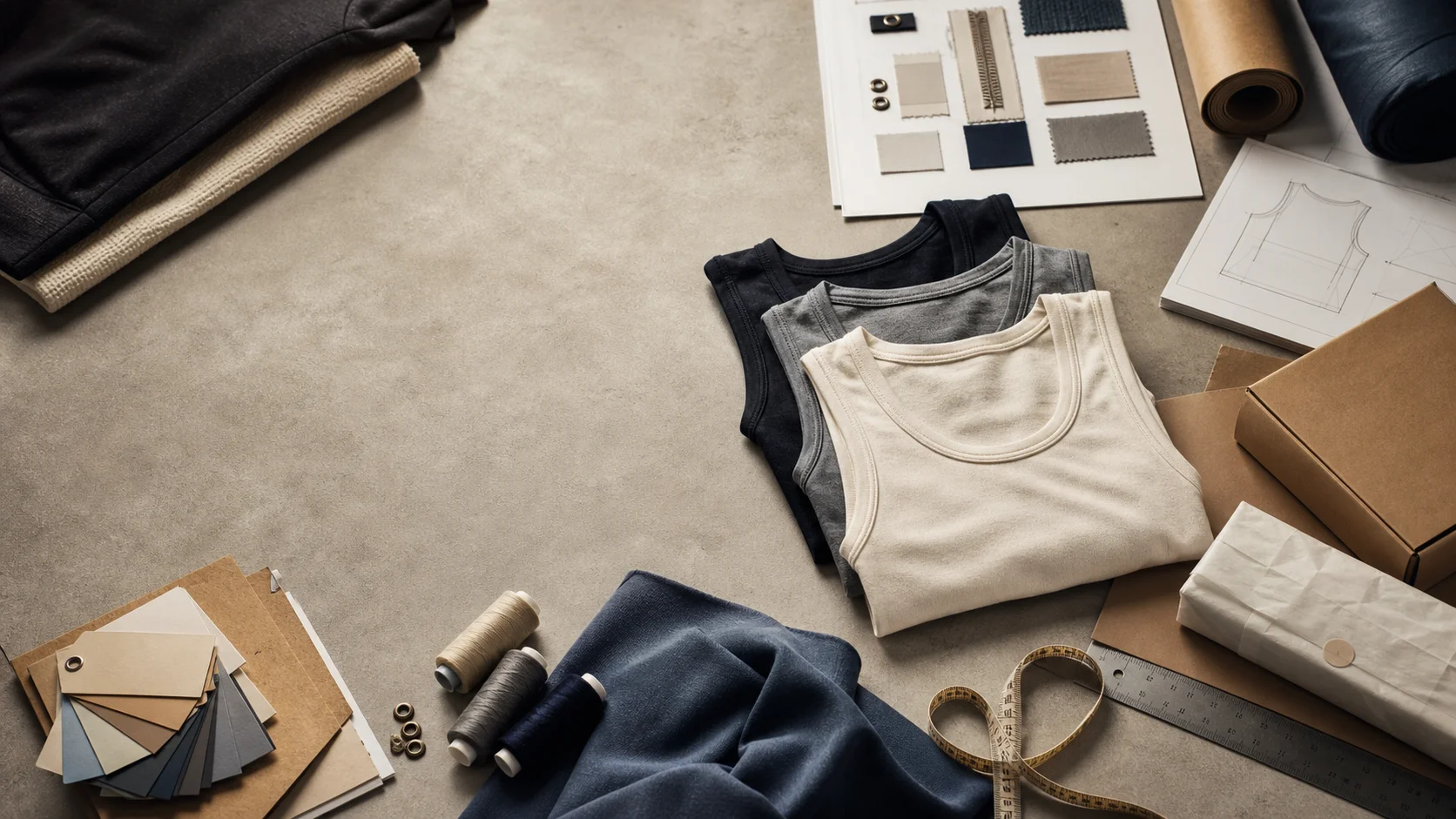
Lookbook Inserts for Clothing Packaging Boxes with checks for samples, fit, MOQ, QC evidence, pricing terms, and delivery risk.
Fast answer: Lookbook Inserts for Clothing Packaging Boxes: Costs, Design should be judged by production evidence, not by a generic sourcing promise. The buyer needs sample proof, cost breakdowns, QC checkpoints, and delivery buffers in writing.
Ask for recent sample photos, measurement tolerances, fabric or print test assumptions, decoration test notes, packing examples, and a named inspection checkpoint. These details show whether the team can repeat an approved sample at bulk volume.
Separate garment cost, decoration, labels, packaging, sampling, testing, freight, and rush charges. When every cost line is visible, it becomes easier to reduce colorways, adjust size depth, or reserve more time for sampling.
One folded sheet can do what a whole sales rail sometimes cannot. In a Milan pop-up, I watched a customer open a rigid box produced in Guangzhou, pull out the insert, and carry the matching trouser straight to the counter. The lookbook inserts for clothing packaging boxes did not decorate the purchase; they closed it, aided by a silk-screened headline printed on a Heidelberg Speedmaster CX 102 press that handled rich blacks and warm neutrals with equal ease.
Retail teams still underrate the first touchpoint inside the box. On factory visits across eight countries, including a GRS-certified mill near Ho Chi Minh City and a WRAP-compliant finishing house in Istanbul, I kept seeing a 170 gsm sheet beat a 300 gsm board when the layout stayed clean, the fold opened easily, and the images showed the full outfit in under three seconds. Speed matters. Clarity matters. So does that quiet feeling that the brand knows what belongs together.
Brands use inserts to cut hesitation. Premium labels I have worked with often see stronger add-on sales and fewer size-exchange questions when the insert shows fit notes, styling pairings, and a second item that completes the look. Mid-market brands lean on them to improve giftability, especially in the $40-$120 range, where packaging can help justify the purchase. Fast-fashion players, especially in China and parts of Southeast Asia, use them to push repeat orders and app scans. In Europe, the same insert often works harder for image than for volume.
The price point changes the job. A $12 tee in a polybag does not need the same editorial treatment as a $240 knit set in a rigid carton. Still, brands on both ends of the market miss the same point: the insert is not decoration. It is a selling surface. That is why the best clothing packaging solutions treat the paper piece like a miniature store associate, not a filler sheet.
Here’s what most people miss: cheaper paper can outperform heavier stock if the finish, image selection, and fold logic are right. In Dhaka, a supplier showed me a 140 gsm uncoated insert with a crisp z-fold that outperformed a glossy 250 gsm version from a rival plant because the matte surface held the typography better and the fold opened without resistance, even after a run on a Komori Lithrone press and die-cut trimming on a Bobst Expertcut 106 machine.
The insert has one job before it has five: earn attention. After that, it can introduce the collection, cross-sell, educate, or reinforce values. I have seen inserts fail because they try to do all four with too many words and six product thumbnails. A shopper who just paid $68 for a sweatshirt does not want an essay. They want a reason to keep looking.
My best-performing apparel packaging inserts use a tight editorial structure. One hero image. Two supporting looks, not eight. SKU references for warehouse teams so pieces can be matched quickly. QR codes that link to size charts, styling videos, or a category page. Care tips belong there too, especially for 320 GSM French terry, enzyme-washed jersey, or cashmere blends that need specific washing instructions. Social proof works when it is factual: “best seller in 6 markets” or “95% of buyers added the matching trouser.” I write those stats in the same typeface as the rest—usually a GOTS-compliant, FSC-certified paper with soy-based inks, printed on an HP Indigo 12000 digital web press so short runs can land in 18-22 business days.
Copy should be short enough to scan in one glance. I count 35 to 60 words as the sweet spot for most inserts, with a maximum of two micro-paragraphs and one list. A customer who scans a box insert usually gives it 4 to 7 seconds, then decides whether to keep reading. That is why headlines matter more than body copy. Seasonal drops and capsule collections need a sharper angle than permanent core lines. A limited edition should feel collectible; a basics range should feel functional.
Sustainability messaging needs restraint. If a brand says “eco-friendly” without proof, trust drops fast. I prefer specifics: 100% FSC-certified paper, soy-based inks, or recycled stock with 30% post-consumer content. Trade data from U.S. International Trade Administration guidance on trade and sourcing shows that buyers increasingly ask for documented origin, not vague claims, and that scrutiny now reaches the insert inside the box too. One line of evidence beats a paragraph of green language. For brands working with textile compliance, the standards published by Textile Exchange and the testing guidance at OEKO-TEX are useful references, and the ones I check most often are OEKO-TEX Standard 100, GOTS, WRAP, BSCI, and GRS certifications.
For infants or children’s basics, the packaging should be even cleaner. I have worked with teams using custom baby clothing manufacturing who found that parents respond better to care guidance, fabric safety notes, and simple styling than to glossy editorial language. The insert becomes reassurance, not noise.
Format decides whether an insert feels premium or crowded. Postcards are cheapest and best for one hero product. A5 inserts handle a compact collection with one front image and a clear back panel. Trifolds and z-cards suit capsule drops because they create a sequence, almost like walking through three racks in a showroom. A stitched mini-lookbook looks luxurious, but it only makes sense if the brand has at least 6 to 8 SKUs to justify the extra pages and binding cost.
Readability matters more than novelty. I have visited plants where a 12-page booklet looked impressive on press but failed on the packing line because the team needed 40 extra seconds per box to insert it cleanly. That is not scale. That is friction. Most brands do better with one folded sheet than with a small book unless they are selling a full seasonal story at $150 and above.
Paper choice changes both touch and recyclability. FSC-certified uncoated stock gives a calmer, more editorial feel and usually folds better at 170-200 gsm. Recycled stock with visible fiber can look honest and modern, though color density may soften by 8% to 12%. Coated paper gives brighter photography, but it can crack on tight folds if the scoring is poor. In Germany and the Netherlands, trim tolerances are often tighter, around 1 mm to 1.5 mm. In parts of South Asia, 2 mm to 3 mm can still be normal on smaller jobs, which affects alignment on multi-panel inserts.
Finishes should earn their place. Soft-touch lamination can feel expensive, but it adds waste and complicates recyclability. A light aqueous coat, blind emboss, or a single spot varnish often gives more value per dollar. I have seen a two-color insert printed black and warm beige outperform a four-color premium version because the layout was disciplined and the paper quality was better matched to the brand. That is not a compromise. It is editorial control.
For brands building broader systems across labels and product types, I often point them toward private label clothing services because packaging and product language need to match from the first sample to the final carton. When the visual system is coherent, the insert feels intentional rather than attached at the end.
My rule after 200-plus factory visits is simple: if the insert cannot be folded, packed, and read in under 15 seconds, redesign it.
Print method changes the economics fast. At 500 pieces, digital printing often lands around $0.35 to $0.90 per insert for a single-sheet A5 job, depending on paper weight and finish. At 5,000 pieces, offset can fall to roughly $0.10 to $0.28 per insert, but only after setup fees, plates, and proofing are absorbed. At 25,000 pieces, the gap widens further, especially if the drop includes die-cut windows, spot UV varnish, or hot-foil stamping, which are common prepress requests when the insert complements a rigid carton.
For premium deliveries that include soft-touch lamination, a dual-sided soft-touch and matte varnish, and an embedded QR on recycled stock, expect a bump to $2.50-4.00 per unit at 500 MOQ, particularly when the supplier offers full artwork management, platemaking, and finishing locally in Guangzhou or Ho Chi Minh City. That scenario usually couples with a 10% to 12% waste allowance and a finishing run on a Heidelberg Polar cutter and a Bobst Spotter for crease lines, which keeps the margin of error under 1 mm per panel.
Service level affects lead time. A standard run on the HP Indigo 12000 for 5,000 sheets plus UV coating, packing, and export documentation often takes about 18-22 business days when the factory runs a mix of GRS-certified recycled paper and OEKO-TEX Standard 100-certified inks. Rushing a job would push the factory to schedule an additional shift, which can add 3 to 5 days depending on the binding and folding equipment available at the finishing house.
Start by shortlisting suppliers that produce both your carton and insert. In Istanbul, I met a converter that pairs offset runs with inline die-cutting and UV coating, giving them the flexibility to add embossing without a secondary pass. They run on both a Heidelberg PM 74 for bulk sheets and a Polar N62 for size-critical cutting, which keeps their trim error to 1 mm even on stacks of 2,000 sheets. Their certification stack—WRAP, BSCI, and OEKO-TEX Standard 100—makes onboarding faster for European buyers.
Look for the same capacity in Guangzhou or Ho Chi Minh City, where a lot of fast-fashion brands source their inserts. Ask for sample packs showing various materials: from 100% GOTS-certified cotton canvas sleeves to 350 gsm recycled board with a tactile, uncoated finish. Inspect the machines—Mitsubishi LP printing for high-opacity blacks, Bobst folding for precision, and screening lasers for cutouts. When possible, run a press check at their factory to measure density readings with a densitometer and confirm the scoring is crisp.
When you scope a project, specify process details up front. Name the finishing requirements (aqueous coating, spot varnish, foil), indicate the machine (HP Indigo or Komori), and list the certifications you need (GOTS, OEKO-TEX Standard 100, WRAP, BSCI, GRS). That way, the supplier can quote delivery with confidence, and you can avoid last-minute surprises from a plant that only quoted based on a standard digital setting.
Plan backward from your drop date. If marketing needs the insert to arrive with the first batch of shipped cartons, work from the finished carton arrival date. Allow 18-22 business days for production on complex inserts with variable data and finishes, plus three days for QA and packaging, and five days for freight from Guangzhou to your distribution center in New Jersey or Rotterdam. If you are working with a supplier in Dhaka or Istanbul, add two to three business days for consolidation and customs clearance, especially when the job includes recycled paper with a GRS certificate.
Build in design rounds. Assume two roundtrips for approvals when you tweak the layout after press proofs. That adds roughly 72 hours per revision, especially if you need to coordinate with a color-management specialist in Ho Chi Minh City or a lithographer in Istanbul. If you have new photography, tie it to the insert layout early so the retoucher can deliver files optimized for CMYK and the finish you plan—whether it is a matte aqueous coat or a pearlized lamination.
Always confirm your MOQ ahead of time. Some convertors require a minimum of 2,000 sheets per SKU if you want die-cutting, but they may allow 500 units for a simple A5 fold. Knowing that difference lets you plan both inventory and budget.
1. Define the insert’s job: hero image, cross-sell, or education. Align that goal with the physical format that best supports it (postcard, z-fold, mini-booklet).
2. Choose materials and finish that match both price point and sustainability story—FSC or GOTS sheets for premium labels; OEKO-TEX Standard 100 inks, WRAP-certified converters for ethically minded teams.
3. Capture manufacturing requirements: exact dimensions, trim tolerances, fold types, and process details such as offset, digital, or hybrid runs.
4. Set a production calendar with the supplier. Factor in 18-22 business days for production, plus shipping time from Guangzhou, Dhaka, Ho Chi Minh City, or Istanbul.
5. Review proofs on-site or via high-resolution scans, and verify that the die-cut, scoring, and finishes align with the press and finishing machines described in the initial quote.
6. Confirm certifications—BSCI, GRS, WRAP—for compliance. Document the paper mill’s source, the ink supplier, and the waste-reduction plan.
7. Field-test the insert with your packing line. Ensure it takes under 15 seconds to insert and that it complements the garment inside the carton.
How do I know if an insert needs spot UV or soft-touch? Test both with a mock-up. Soft-touch works for tactile luxury, but spot UV highlights specific portions—like a headline or brand logotype—without overwhelming the overall sheet. Often brands pair a matte uncoated background with a single spot gloss on the hero image.
Do I need to source inserts and boxes from the same supplier? Not necessarily, but alignment helps. The supplier should understand the full packaging system and be able to maintain consistent alignments and fold tolerances. If you work with separate vendors, share dielines, color profiles, and finishing specs.
What certifications matter most for inserts? For apparel brands focused on sustainability and compliance, ask for GOTS, OEKO-TEX Standard 100, WRAP, BSCI, and GRS documentation. That covers fiber origin, chemical safety, social compliance, and recycled content traceability.
How soon can I get a run delivered? With repeatable specs and a trusted supplier in Guangzhou or Ho Chi Minh City, expect 18-22 business days for production. Add logistics and customs time if you are importing from Istanbul or Dhaka.
Is a higher gsm always better? Not always. A 170 gsm uncoated sheet with tight folds often feels more cohesive than a 300 gsm board that resists bending. Match the gsm to the fold type and the tonality you want—lighter for z-folds, heavier for two-panel cards with embossed logos.