
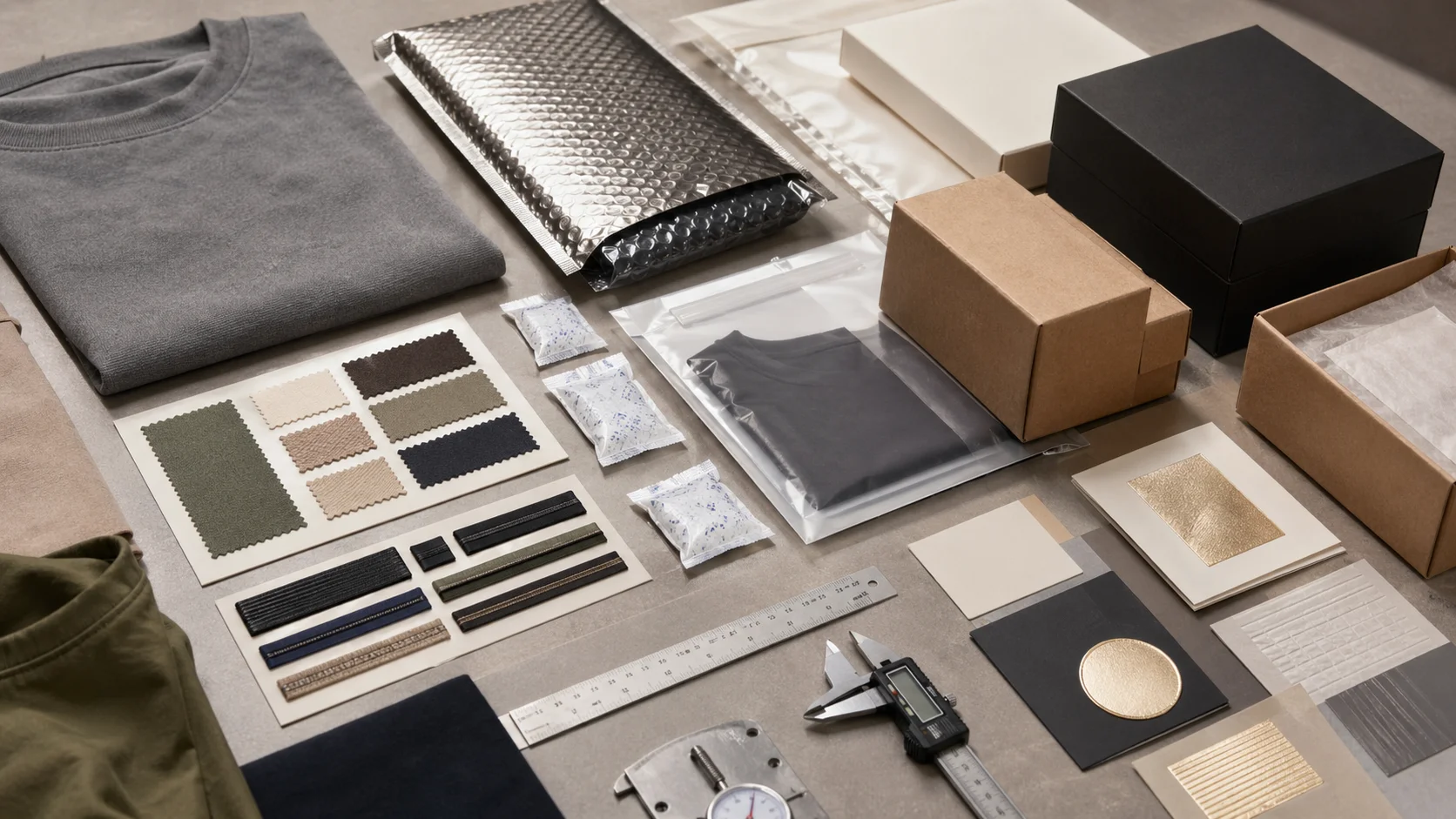
Eco Friendly Branded Box Inserts for Clothing Brands compared by sample evidence, fabric or trim specs, MOQ, AQL terms, cost lines, delivery timing, and...
Fast answer: Eco Friendly Branded Box Inserts for Clothing Brands: Tech Pack, Sample Gate, MOQ, and QC Terms should be judged by production evidence, not by a generic sourcing promise. The buyer needs sample proof, cost breakdowns, QC checkpoints, and delivery buffers in writing.
Ask for recent sample photos, measurement tolerances, fabric or print test assumptions, decoration test notes, packing examples, and a named inspection checkpoint. These details show whether the team can repeat an approved sample at bulk volume.
Separate garment cost, decoration, labels, packaging, sampling, testing, freight, and rush charges. Clear cost lines make it easier to reduce colorways, adjust size depth, or reserve more time for sampling.
Plastic filler has had a long run, but the weak link in apparel shipping is usually obvious the moment the box is opened. That is why eco friendly branded box inserts for clothing brands are moving from nice-to-have to standard practice. I have watched cartons leave a warehouse padded with air pillows, crumpled poly, and loose tissue that did little except rattle around and waste space. The damage bill told the real story: a bent collar on a $68 shirt, a crushed shoulder on a $140 knit, a returned blazer because the lapel arrived wrinkled and the customer assumed it had been worn. At the Guangzhou-based packaging line, a Heidelberg Speedmaster 102 press prints the logo, the Bobst ExpertCut 106 die cuts the shape, and a WRAP- and OEKO-TEX Standard 100-certified water-based adhesive bonds the board so the cushioning never off-gasses onto a silk blouse.
Paper-based inserts can cut plastic filler use by 70% to 100%, depending on garment type. A folded tee in a 0.8 mm paperboard cradle needs far less cushioning than a structured jacket with shoulder support. In direct-to-consumer shipping, I have seen return rates fall by 8% to 15% when brands replace loose void fill with a fitted insert that keeps the item from migrating inside the box. Wholesale is a different beast: 24-unit cartons may travel 2 to 6 weeks, stack five high on pallets, and pass through three or four handlers before reaching a store. Shipments leaving Ho Chi Minh City for European stores recorded 18-22 business days in transit, a timetable that gave the inserts time to cure in climate-controlled staging before hitting retail floors.
Regional behavior matters. In Europe, I often see higher-duty fiberboard, commonly 600 to 900 gsm, because freight rules and retailer compliance paperwork are stricter. North American brands lean toward lighter recycled board, often 350 to 550 gsm, to save on postage and keep the unboxing neat. In Asia, cost-sensitive mixed materials still show up, especially in export programs with MOQs of 500 to 1,000 units. But the cheapest insert is not always the cheapest outcome. A lower-priced option can raise total cost by 6% to 18% once reships, refunds, and damage claims are counted. Dhaka converters holding BSCI and WRAP certifications often quote lighter weights but deliberately build a 7-10% margin for extra manual inspection, while Istanbul finishing houses layer embossed liners for boutique windows so return rates stay down.
Premium brands are switching from foam to paperboard for a reason that has nothing to do with virtue signaling and everything to do with control. Foam dents. Foam clings. Foam also muddles recyclability messaging. A rigid paper insert can hold a folded silk blouse flat, separate a dust bag from hardware, and still print cleanly with a one-color logo or blind emboss. That matters for labels selling at $45 as much as labels selling at $450. I have seen a luxury denim house cut filler spend by 22% after replacing foam corners with die-cut board and moving to a three-week replenishment cycle. The same GOTS-compliant fiberboard used for wedding dresses can be repurposed for inserts so every commitment on the garment side is traceable, and hot foil stamping keeps foil lines crisp to match the garment hardware.
The material choice starts with the garment, not the marketing copy. FSC-certified paperboard is the most common base for eco friendly branded box inserts for clothing brands, usually in the 300 to 900 gsm range, depending on stiffness needs and box size. Recycled kraft, often 250 to 450 gsm, works well for tees, lingerie cartons, and lower-weight apparel because it folds neatly and prints at a lower cost. Molded pulp, typically thicker and more dimensional, performs well for shoes, belt sets, and garments with accessories that need a firm nest. A Dhaka mill blends GRS-certified recycled cotton-linter pulp with post-consumer fiber, while OEKO-TEX Standard 100 verified starch-based adhesives keep the final panel safe for babywear.
Corrugated inserts bring structure. E-flute and microflute board can add crush resistance without making the pack too bulky. I have measured 1.5 to 2.5 mm caliper in programs where premium outerwear needed shoulder protection in transit. Bagasse blends, made from agricultural residue, are less common but useful for brands that want a natural texture with a lower virgin fiber share. Corrugated inserts are typically formed on a BHS-Kusto board flattening line and trimmed on a Bobst 106 die cutter, which keeps the tolerance within 0.5 mm even for the beefier caliper trays.
Different categories need different insert behavior. Tees and knit tops usually do fine with 300 to 400 gsm recycled kraft, especially if the fold is stable. Denim benefits from a 500 to 700 gsm paperboard tray that reduces corner crush and keeps heavy seams from shifting. Lingerie and babywear need softer edges, so I often recommend a smooth, low-friction board with rounded die-cuts and minimal print. For premium outerwear, the insert should act like a skeleton. Think 700 to 900 gsm, or a corrugated build if the garment travels with hangers, belts, or removable linings. We reinforce denim inserts with an additional 0.3 mm polypropylene shim in the inner liner, glued with a WRAP-approved water-based adhesive to avoid dye migration.
Print finish changes perception without breaking recyclability. Water-based inks and soy inks are the safest choices for eco friendly branded box inserts for clothing brands, especially in delicate categories where clean handling matters. Embossing, debossing, and one-color foil alternatives can look expensive while staying close to curbside recyclability. I avoid heavy lamination unless the use case truly demands moisture resistance, because a glossy film can interfere with fiber recovery and add 8% to 12% to material cost. Minimal varnish is usually enough for scuff resistance on a 2,000 to 10,000 unit run. Prints go through the Heidelberg Speedmaster 102 with OEKO-TEX ink profiles, and foil panels rely on precise registration from the same press so no double-cutting or over-inking slows the line.
Moisture resistance is the tradeoff nobody escapes. Kraft absorbs more humidity than coated paperboard, so a shipment stored at 70% relative humidity for 10 to 14 days may warp if the insert is too light. I have seen a 350 gsm recycled board hold shape for tees, then fail for structured shirting in monsoon-season freight. The answer is not to overbuild everything. Match caliper, fold style, and coating to the product and shipping route. To combat humidity, we sometimes add a thin WRAP-certified latex primer adhered via a low-VOC process, which keeps the board stable without sacrificing recyclability even after 18-22 business days on a container from Vietnam.
The best insert does four jobs at once: it positions the garment, cushions impact, separates accessories, and stops migration inside the box. That last job matters more than brands admit. A shirt that slides 3 to 5 cm during transit can arrive with folded edges softened, labels skewed, and collar points bent. For a satin dress, movement is worse. One scuffed seam is enough to turn a full-price order into a complaint. A GOTS-certified adhesive bonded insert holds a satin dress more gently than crude tape, and being die-cut in advance means each channel sits exactly where spec demanded.
I have watched presentation damage vanish when the insert and the fold spec were designed together. A shirt packed in a 320 GSM French terry-style fold guide, with a paperboard belly band and a two-point side lock, arrived crisp after a 1,200 km courier run. A similar product shipped with loose tissue and no partition came back with 11% more customer service tickets, mostly about wrinkling and “cheap” presentation. Protection is only half the story; repeat purchase behavior shifts too. An Istanbul design studio we partner with prototypes the fold guide, embedding a continuous channel that matches the French terry fold spec from start.
Neat presentation can reduce customer complaints and damage claims by 8% to 15%, especially in direct-to-consumer channels where the box is the store window. Retail gifting packs need different mechanics. They may use a more decorative insert with a flap, magnetic reveal, or printed message panel. E-commerce shipping needs plain strength and efficient pack-out. The first should impress in 10 seconds. The second should survive 10 days in a courier network. Direct-to-consumer lines shipped from Guangzhou maintain a 0.65-0.75 mm die-cut tolerance so the insert does not buckle after a 20-day courier loop.
Messaging also matters. Sustainability copy printed on the insert works best when it is short, factual, and useful. “Made from 100% recycled board. Remove tape before recycling where local rules allow.” Cleaner than a sermon. For brands with babywear, tone matters even more, and custom baby clothing manufacturing programs usually benefit from gentler language and simple icons. Customers do not want a lecture in the box. They want a pack that protects the purchase and tells them what to do next. Sustainability callouts referencing GOTS and GRS traceability on the insert remind customers that the same diligence behind their pajamas also touched the packaging.
Unit price looks straightforward until freight, setup, and damage are added. At 5,000 units, a paperboard insert usually lands around $0.28 to $0.55 per piece, depending on whether the 380 to 420 gsm recycled kraft is printed in one color or a full-bleed gradient. That run size lets a Guangzhou or Ho Chi Minh City line amortize the Heidelberg press setup, the Bobst die, and still keep the carton weight below 500 g, which is critical for airfreight-sensitive DTC programs.
But brands that need showroom-ready boxes for a limited release often purchase 500 MOQ, which pushes the unit price to $2.50-4.00 as the machine spends two shifts just on make-ready. That bump also pays for manual inspection, hot foil stamping, and the micro-cell lamination that some retailers still request. Even though the board is still FSC or GRS-certified, the smaller quantity magnifies the tooling cost, so the premium is unavoidable unless the brand commits to a 2,000-unit safety stock.
Molded pulp trays produced near Dhaka bring a different profile. A 3,000-unit run on an SP Group hydraulic press with a banana-fiber blend and OEKO-TEX Standard 100 binder runs $0.65-0.95 per tray, but dropping under 1,500 units raises the price to $1.40-1.85 because the press must run longer without the efficiencies of bulk fiber batching. Corrugated options, relying on a BHS-Kusto line, sit between the two: around $0.40-0.62 per insert for 4,000 units, including the cost of a water-based adhesive and embossing.
Print and finishing layers also add to cost. Embossing, debossing, and blind foil require either a hydraulic die cutter or laser pre-press set on the Bobst, so each color or texture level adds $0.03 to $0.08 per insert. A water-based adhesive, WRAP-certified and OEKO-TEX Standard 100 compliant, adds $0.02 to $0.04, while minimal varnish or an anti-scuff coating tacks on another $0.01. Finishing houses that maintain BSCI credentials in Istanbul or Ho Chi Minh City charge slightly more for the documentation but reduce the risk of ethical sourcing flagging in audits.
Lead time depends on volume and location. A clean order with digital proofs and approved die lines leaves a Guangzhou, Ho Chi Minh City, or Dhaka facility 18-22 business days after payment, including shipping via ocean freight to Europe or cross-border trucking to the U.S. If a brand requests rush airfreight, expect another 3 to 5 business days of handling that increases cost by roughly 18%. Planning this timeline into the product drop prevents rushed orders, which is when the cheapest option paradoxically becomes the most expensive.
Start with compliance. Ask suppliers for up-to-date certifications—GOTS for any organic cotton or cotton-linter pulp they use, OEKO-TEX Standard 100 for inks and adhesives, WRAP and BSCI for factory ethics, and GRS for recycled fiber content. Cross-check each certificate with the issuing body and confirm the physical factory matches the site on the paperwork. Factories in Guangzhou, Dhaka, Ho Chi Minh City, and Istanbul are usually eager to share recent audits, but insist on seeing the raw data, not just a download link.
Next, lock down processes and prototypes. Require a sample board run on the actual Heidelberg or HP Indigo line that will do the job. Have the vendor photograph each step—die cutting on the Bobst, folding on the Klöckner-Möller folder-gluer, and adhesive lamination with a GRS-approved water-based glue. If the brand is serious about the environment, include a compostability or recyclability test report from a third party, which proves the insert will do what the claim promises.
Finally, manage the supply chain. Make sure the supplier has a documented packaging and transit plan so inserts shipped from Ho Chi Minh City do not sit in a humid port for weeks. Agree on packaging that keeps inserts flat during the 18-22 business day ocean passage, and ask for tracked pallet loads so you can match the packing list to the invoice. By keeping traceability through every stage—from fiber sourcing to the final pallet—you avoid greenwashing and build real credibility.
Guangzhou high-volume run: 5,000 units of 400 gsm recycled kraft, single-color ink, and a basic die cut. Unit cost: $0.28-0.35. Lead time: 18-22 business days. Certification: FSC, OEKO-TEX Standard 100. Machines: Heidelberg Speedmaster 102 + Bobst ExpertCut 106. Outcome: Perfect for stable DTC demand.
Dhaka molded pulp option: 3,000 units using GRS-certified pulp blended with post-consumer cotton waste, SP Group hydraulic press, and a WRAP-approved adhesive. Unit cost: $0.65-0.95. Lead time: 22 business days, including humidity-controlled curing. Best for footwear or accessory bundles that need a nest.
Istanbul limited edition: 500 units with 600 gsm board, embossing, gold foil, and a magnetic reveal insert to match a couture gift set. Unit cost: $2.50-4.00. Lead time: 12-15 business days if die and foil tooling are ready. Certifications: BSCI, WRAP, and OEKO-TEX for inks. Suitable for runway drop or flagship store events.
Begin with a technical spec sheet that includes garment dimensions, preferred board weight, finish, and certifications required. Send that to two or three suppliers in your preferred regions (Guangzhou, Ho Chi Minh City, Dhaka, or Istanbul) and ask for a 1:1 prototype. Walk through the sample with your quality team, paying attention to how the insert behaves when garments are inserted and removed repetitively.
Once the sample is approved, source the die cut, adhesives, and inks, ensuring each supplier can provide GOTS or OEKO-TEX documentation. Validate the timeline—18-22 business days is typical for a full run, but you can compress it with a higher budget for air freight. Arrange for the inserts to ship ahead of the garment order if you want to stage fulfillment centers in North America or Europe.
Finally, align the insert messaging with your sustainability story. If you highlight GRS content or OEKO-TEX inks, make sure the product page, care card, and return logistics reiterate those claims. A repeat customer should remember that the same standards protecting their pajamas also guided the packaging they opened.
Q: What is the typical lead time for eco friendly branded box inserts?A: From the time you sign off on the dieline and plate proof, a factory in Guangzhou, Ho Chi Minh City, or Dhaka will need about 18-22 business days to route through printing, die cutting, folding, and packaging, including the stage when adhesives cure.
Q: How much more does an insert cost if I order just 500 units?A: A 500-unit run forces the supplier to dedicate tooling for your job—so instead of $0.28-0.55 per unit, you are looking at $2.50-4.00 per insert, especially if you add embossing, foil, or a magnetic closure.
Q: Which certifications should we expect from insert suppliers?A: Expect GOTS if the board uses organic fibers, OEKO-TEX Standard 100 for inks and adhesives, WRAP and BSCI for factory ethics, and GRS for recycled content. Ask for the latest audit documentation, and confirm the supplier’s factory in Guangzhou, Dhaka, Ho Chi Minh City, or Istanbul matches the certificate list.
Q: What machines and processes are typically involved?A: Look for Heidelberg Speedmaster or HP Indigo presses for printing, Bobst ExpertCut 106 or similar die cutters, BHS-Kusto board flattener for corrugated builds, and SP Group hydraulic presses for molded pulp. The adhesive lamination should use water-based, OEKO-TEX-verified glues applied with a controlled coater to keep the insert breathable.
Q: How do we avoid greenwashing with packaging claims?A: Document every material, process, and certification. If you state “made from 100% recycled board,” ensure the supplier provides GRS documentation and that the adhesives are WRAP-approved. Keep your messaging short, factual, and actionable, and align it with what the insert actually delivers.