
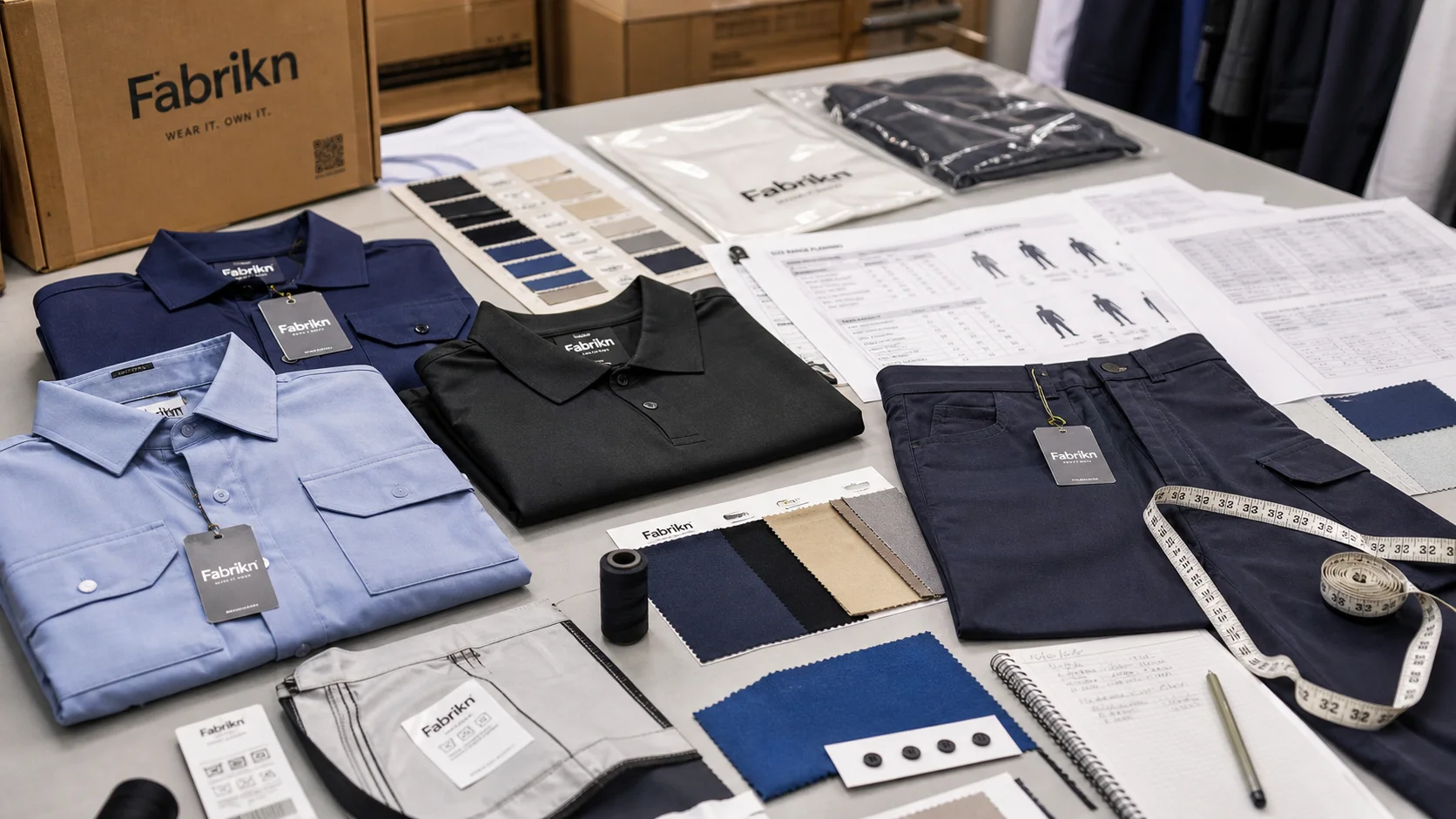
Fashion Lookbook Inserts with checks for samples, fit, MOQ, QC evidence, pricing terms, and delivery risk.
Fast answer: Fashion Lookbook Inserts: Page Count, Paper, Print, and Retail Impact should be judged by production evidence, not by a generic sourcing promise. The buyer needs sample proof, cost breakdowns, QC checkpoints, and delivery buffers in writing.
Ask for recent sample photos, measurement tolerances, fabric or print test assumptions, decoration test notes, packing examples, and a named inspection checkpoint. These details show whether the team can repeat an approved sample at bulk volume.
Separate garment cost, decoration, labels, packaging, sampling, testing, freight, and rush charges. When every cost line is visible, it becomes easier to reduce colorways, adjust size depth, or reserve more time for sampling.
Ten seconds is all most customers give a brand before deciding whether it feels worth the price. lookbook inserts for clothing packaging often shape that verdict first, not the garment itself. A clean insert can make a $28 tee feel intentional. A flimsy one can flatten a $180 knit.
Across factory visits in Vietnam, Portugal, and Bangladesh, the pattern kept repeating. Brands at the $20 to $40 level leaned on thin 100-120 gsm stock and one-color print. DTC labels in the $90 to $250 range used 170-250 gsm card, full-bleed images, and finishes like spot varnish or soft-touch lamination. Buyers do not need to name the paper grade to feel the difference. They just feel it.
Online apparel has a harder job than a candle or a phone case. The insert steps in and explains fit, fabric, and care without sounding robotic. Mention French terry at 320 GSM, enzyme wash versus stone wash, or how a boxy cut sits on different body types, and post-purchase doubt drops fast. I have seen that kind of clarity improve clothing packaging solutions performance on repeat orders, especially when the parcel is the only physical touchpoint before the next sale.
Here is the part most teams miss: simpler often wins. In one factory audit, a four-page spread with six product shots and three QR codes went straight into the bin, while a single folded card with one image, one outfit idea, and one care panel stayed on the desk. Kept. Re-read. Photographed for social.
That is the commercial case. Light paper, heavy influence. Return intent shifts. Sharing increases. Brand memory sticks. Across 200-plus factory floors, I have seen brands spend $0.12 on a weak insert and lose far more in missed repeat sales than they saved on print. Small paper. Large effect.
Three jobs. Inspire, instruct, convert. Miss one and the insert turns into clutter. Hit all three and the buyer feels guided instead of sold to. A parcel is not a billboard. It is a trust moment.
Specificity beats generic brand poetry every time. Show the piece moving, not just lying flat on a white background. Pick one outfit pairing. For occasionwear, a styling suggestion helps justify price. For basics, utility carries more weight. A plain tee may only need fiber content, care instructions, and a fit note. A satin slip dress needs layering advice, undergarment guidance, and a line about event wear.
Educational copy cuts returns. ISO standards around product information do not dictate the creative, but the logic is plain: clearer information means fewer mistakes. Explain shrinkage risk, fabric handfeel, and washing temperature, and expectations settle before the first wash. A customer who knows brushed fleece may pill a little after 6-8 wears is less likely to treat normal wear as a defect.
Upsell paths work only when they feel useful. A QR code can lead to styling videos, a size guide, or a companion item. Referral prompts land better when they stay quiet. “Share your look and earn 10% off your next order” does the job without shouting. Brands that sell custom baby clothing manufacturing usually lean gentler still, because parents want reassurance, fabric safety, and easy care.
Some inserts read like every department got a turn at the page. Those fail. Strong ones feel edited like a magazine spread: one concept, one voice, one reason to keep the card. Sharp language. Intentional modules. If a line does not help the customer wear, wash, or want the product, drop it.
Format changes everything. A postcard-style card is the lowest-friction option: 148 x 105 mm or A6, single or double-sided, easy to tuck into a poly mailer or rigid box. It works well for high-volume basics, where reinforcement matters more than editorial depth. It ships flat. It costs less. Waste stays low.
A tri-fold sheet gives more room without jumping to booklet pricing. Brands that need styling, care, and sustainability copy can use the extra panels well. Mid-tier labels at $45 to $120 often fit here, because buyers expect more than a thank-you note. A stapled booklet or saddle-stitched mini-magazine, usually 8 to 16 pages, suits premium capsules and seasonal drops. It brings presence, but binding steps and postage weight rise fast if the parcel is already near the limit.
Paper choice matters just as much as the format. Uncoated recycled stock around 130-170 gsm feels tactile and honest. Silk-coated paper at 150-200 gsm sharpens photography. Soft-touch lamination adds a velvety finish, though it can blur the environmental story if used carelessly. Spot varnish pulls the eye to logos or fabric texture. In private label programs, I often see brands use a smaller insert to keep the same premium feel while supporting private label clothing services across multiple SKUs.
From a production angle, the fold count and trim size usually affect lead time more than the artwork does. A simple A6 card can move through print in 5-7 days. A 12-page stitched booklet may need 12-18 days once folding, binding, and QC are added. Die-cuts slow the line too. I have watched a supplier miss a ship date because the die board was approved late, not because the visuals changed.
High-volume apparel orders care about shipping efficiency. Flat inserts pack neatly at 500 to 1,000 units per outer box. Booklets take more space, and if the order is headed to multiple distribution centers, that extra volume gets expensive fast. Choose the format your customer will keep and your warehouse can move without drama. Pretty is not enough. Production reality wins.
Pricing for lookbook inserts for clothing packaging moves quickly because three things drive the unit economics: paper grade, print coverage, and finishing. At 1,000 units, a simple 4 x 6 inch card on 300 gsm uncoated stock with full-color one-side print might land at $0.24 to $0.48 per piece domestically. At 10,000 units, the same card can drop to $0.07 to $0.16 per piece. Setup cost gets spread across volume, and the curve changes.
For a folded 4-page insert on 150 gsm silk paper, expect $0.38 to $0.85 at 1,000 units and roughly $0.12 to $0.24 at 10,000 units. Add foil stamping, and the unit price can jump by $0.10 to $0.35 depending on coverage. Embossing, die-cut windows, and soft-touch lamination each add another layer. Those are not decorative extras on a spreadsheet. They are line items.
Domestic production is usually faster, often 5-10 working days after proof approval, but freight per piece may be higher on smaller orders. Overseas production can lower the print cost, yet freight, duties, import brokerage, and minimum order quantities change the landed total. I have seen a brand save 22% on print in Asia and lose 15% of that gain in air freight after a last-minute campaign extension. Cut and sew teams use the same logic on labels and packaging, which is why cut and sew manufacturing teams often align insert orders with garment production schedules.
Sustainability changes the budget in messy ways. FSC-certified paper may add 3% to 8% over standard stock. Recycled content can cost the same as virgin fiber in one market and more in another, depending on mill capacity. Vegetable-based inks usually add little, maybe 1% to 4%, but specialty coatings can wipe out those savings. According to Textile Exchange, supply-chain transparency and material choice are shaping procurement decisions across apparel categories, and packaging buyers are starting to behave the same way.
Procurement teams often miss a simple point: an expensive-looking insert can actually be cheaper if it is designed well. One strong image, one fold, one QR code, one short care paragraph — that beats a 12-page booklet that burns budget on pages nobody reads. I worked with a brand that moved from a six-panel brochure at $0.91 per unit to a two-panel insert at $0.29. Engagement did not fall.
It rose.
For budgeting, use this rough frame:
Reprints usually start with a bad brief. When I visit factories, the cleanest programs arrive with trim size, paper stock, color profile, bleed, binding method, and packing instructions already locked. For a lookbook inserts for clothing packaging project, I want millimeters, not guesses. I also want the final count per carton, because a mismatch turns into a warehouse headache before the first parcel leaves.
Files need to be ready for the first proof to match brand expectations closely. That means 300 dpi images, embedded fonts, and correct CMYK values. If the insert includes a barcode or QR code, leave enough quiet space around it so scanners can read it on matte and coated stock. A QR that works on screen but fails on paper wastes square inches.
Approval should move in stages. Digital proof first, then a physical mockup, then a press proof if the job is color-sensitive, and finally a pre-production sample. Seasonal drops leave no room for improvisation. If an influencer mailer is tied to a 3-week launch window, one wrong crop can delay the campaign, the shipping batch, and the social calendar.
Common failure points stay stubbornly predictable. Fold alignment drifts by 1-2 mm when the trim size is too tight. Color shifts happen when a brand sends RGB files instead of CMYK. Text placed closer than 3 mm from the trim can get clipped. QR codes below 18 mm square often fail at the warehouse scanning stage. I have seen all four mistakes in one run.
A precise brief protects timing and budget. It protects trust too. Your supplier should know whether the insert is being packed inside a hanger bag, a rigid mailer, or a mailer with a garment folded to 250 x 180 mm. The more specific the use case, the fewer surprises. Need a checklist? Ask for a pre-flight proof list before file upload. That extra step can save 2 to 4 days of back-and-forth.
Cutting footprint does not have to make the insert feel cheap. But the trade-offs are real. Recycled stock, lighter paper weights, and fewer finishes usually lower environmental impact. A 140 gsm uncoated sheet often feels more responsible than a 250 gsm glossy card, especially when the copy explains why. Buyers trust a matte, fiber-rich sheet almost immediately.
Regional sourcing changes the equation. Some mills in Europe offer high recycled content and strong certification. Some local printers in North America or Southeast Asia cut transport emissions because freight is shorter, though paper choices may be narrower. Data from WRAP backs the broader point: waste reduction starts with planning, not just materials. Same logic here. Overorder less. Reprint less.
Hidden waste usually comes from overprinted inventory. Campaigns change. Drop dates move. Color stories shift. I have seen 20,000 inserts pulped because a model image no longer matched the collection by the time goods landed. That is not sustainable, no matter what the stock says.
The thing nobody tells you: premium-looking uncoated stock often communicates sustainability better than glossy paper, even before a buyer reads a single line of copy.
When you evaluate a manufacturer, supplier, or factory, ask for certified stock options, waste reporting, and ink specifications. Ask whether offcuts can be recycled in the local system, not just in theory. Ask if the printer can run vegetable-based inks and keep coverage efficient. If the supplier cannot quantify scrap rate or trim waste, that is a warning sign. A good partner should be able to tell you how many kilograms of offcut were recovered last quarter, or at least explain why they cannot.
For wholesale and bulk programs, sustainability also depends on MOQ planning. Ordering too early can create storage waste, while ordering too late can trigger rushed freight and extra emissions. If you are sourcing from China, compare factory capacity, quality controls, and production timelines alongside recycled content and finish options. That is where the real environmental and commercial balance usually sits.
Start with one goal. More repeat orders? Fewer returns? Stronger brand recall? Higher QR scans? Pick the primary metric before touching the layout. Then choose the format that fits the product and the budget. A basic tee line may only need a folded card. A premium knit capsule may justify a mini-magazine. A bridal or occasionwear label may need a sharper, more editorial insert with room for fit notes and styling.
Next, write the copy with discipline. One page, one panel, one job. Request quotes from at least 3 suppliers, and compare not just unit price but lead time, minimum order quantity, and freight. A run of 2,000 units might look inexpensive at $0.18 each, but if the supplier needs 10,000 MOQ and 21 days, it is not a fit for a tight launch. Proof the insert in sequence: digital, physical, press, pre-production. Do not skip steps because the art is “simple.” Simple jobs fail too.
Run a small pilot before a full roll-out. I like A/B tests with one styling-led insert against one sustainability-led insert. The styling version may drive more QR scans. The sustainability version may keep the card longer and improve trust. Either result is useful. Last year I worked with a brand that mailed 4,000 parcels with two different inserts and learned that the more editorial option lifted repurchase by 8% while the sustainability version reduced customer service questions about care.
Measure the after-launch data carefully. Track scan rate, return-rate impact, insert retention, social mentions, and repurchase lift over 30 to 60 days. If the insert is seasonal, align print timing with sell-through, not the design calendar. Artwork that sits in a warehouse for 4 months is already stale. Inventory stranded because the campaign changed is just paper waiting to be written off.
I have spent enough time on factory floors to know this: the smallest components often carry the heaviest brand memory. A good insert does not shout. It teaches, reassures, nudges. Build one with intent, test it hard, and treat the result like a product decision, because that is what it is.
They are used to inspire, educate, and convert after purchase. A strong insert can show styling ideas, explain fabric and care, and point shoppers to a reorder path in 1 to 2 clear steps.
At 1,000 units, simple cards often run $0.24 to $0.48 each, while folded inserts can land at $0.38 to $0.85 each. At 10,000 units, the same formats may fall to roughly $0.07 to $0.24 each, depending on paper and finishing.
Simple card inserts can be produced in 5 to 7 working days after proof approval. Folded or stitched formats usually take 12 to 18 days, especially if they need custom die-cuts, special finishes, or a press proof.
Yes. Inserts that explain fit, fabric, shrinkage risk, and washing instructions can reduce expectation gaps. In my experience, brands that clarify these details often see fewer “not as expected” returns and fewer customer service questions.
Start with suppliers that offer FSC-certified paper, recycled-content stock, and vegetable-based inks. Ask for waste reporting and confirm whether offcuts can be recycled locally. A supplier should be able to show certification paperwork before production starts.