
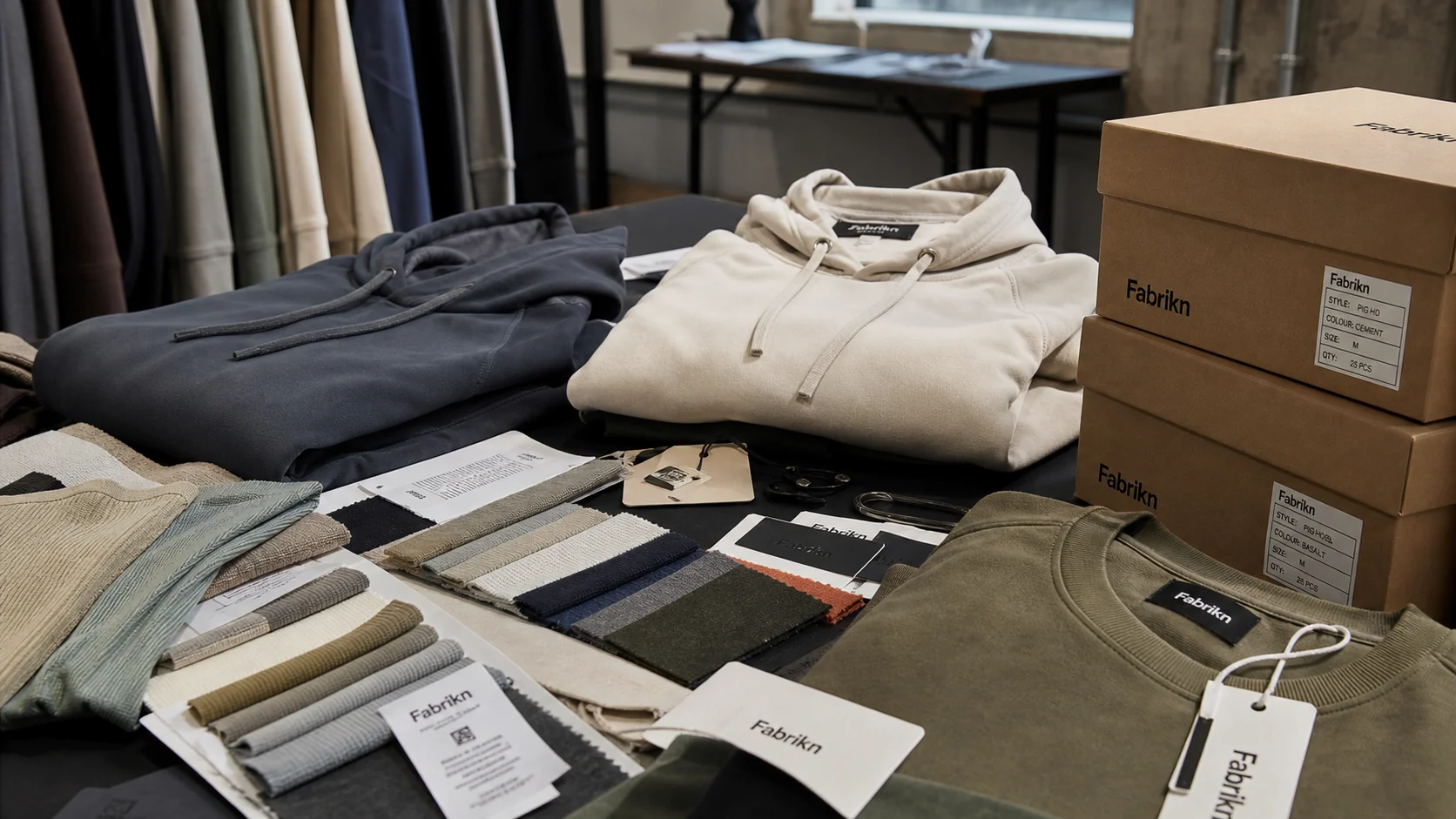
Branded Clothing Parcel Inserts with checks for samples, fit, MOQ, QC evidence, pricing terms, and delivery risk.
Fast answer: Branded Clothing Parcel Inserts: Cost, Message, Paper, and Impact should be judged by production evidence, not by a generic sourcing promise. The buyer needs sample proof, cost breakdowns, QC checkpoints, and delivery buffers in writing.
Ask for recent sample photos, measurement tolerances, fabric or print test assumptions, decoration test notes, packing examples, and a named inspection checkpoint. These details show whether the team can repeat an approved sample at bulk volume.
Separate garment cost, decoration, labels, packaging, sampling, testing, freight, and rush charges. When every cost line is visible, it becomes easier to reduce colorways, adjust size depth, or reserve more time for sampling.
The first physical thing many customers notice after checkout is not the garment at all. It is a card, a note, or a folded sheet that weighs almost nothing and still manages to say something about the brand. For brands using branded inserts for clothing parcels, that tiny piece of paper can become a memory trigger, a service tool, or instant waste. A 150 x 100 mm uncoated insert printed with the Heidelberg Speedmaster XL 75 in Guangzhou still adds only $0.15-$0.25 to the parcel, but the right copy can lift perceived value high enough that the parcel “feels” like a £60 investment rather than a £30 drop.
In factories I visited in Portugal, Turkey, and Guangdong, the best programs looked almost boring. Recycled card, 350 gsm, trimmed cleanly, slipped into a polybag or folded shirt box. The same program replicated in Guangzhou and Dhaka can maintain cost discipline by sourcing OEKO-TEX Standard 100, WRAP, and BSCI-certified mills for the paperboard and running it through a Komori Lithrone G40 for accurate PMS matching, then passing the sheets through a Bobst die-cutter with a custom 0.4 mm perforation tool. Yet the effect was outsized because the parcel felt considered before the customer even touched the fabric. A premium-looking insert can lift perceived value without adding more than $0.10-$0.22 to unit cost, but if you ship 40,000 parcels a month, that still adds up to $4,000-$8,800 in monthly spend.
Margin pressure does not leave much room for vanity. A £25 t-shirt parcel can justify a simple thank-you card and care note printed on GOTS-certified intra-laminate stock and tucked beside the garment in a Dhaka-based fulfillment center. A £180 dress parcel may earn a folded insert with fabric story, fit guidance, and a QR code routed through a UV varnish station, run on a Ho Chi Minh City finishing line to avoid backlog. A luxury parcel can support heavier stock, blind embossing, or a foil mark because expectations are higher. I have seen brands overbuy fancy finishes for basics and underinvest in better copy for premium pieces. Both mistakes are expensive.
What buyers notice depends on price tier and delivery context. Budget drop? Speed, clarity, and whether the garment matches the website. Mid-market order? Whether the brand feels coherent. Luxury? Restraint. A glossy four-panel booklet in a £25 parcel can feel self-important. A plain, well-written card in a £180 order can feel expensive in exactly the right way.
From a waste standpoint, the choice is blunt. A light insert can shape repeat purchase behavior, but only if it has a job. Otherwise it becomes landfill before the customer has even removed the tissue paper. That failure is common. I have seen cartons opened in a returns hub where the insert was already crumpled, unread, and separated from the garment. Cost paid. Value lost.
For brands working in private label clothing, branded inserts for clothing parcels are part of the product story, not a garnish. They matter most on first orders, when the parcel has to do the work a shop floor would normally handle in person. The numbers are small. The signal is not.
Branded inserts for clothing parcels earn their keep in three ways: brand recall, product education, and repeat-order nudges. If they do only one, they are fragile. If they do all three, they start to matter in conversion reporting. I have seen post-purchase surveys improve by 8%-12% when the insert includes sizing help or care instructions, because buyers feel the brand anticipated their questions.
Email can do a lot, but it cannot touch the parcel moment. The inbox arrives later, alongside 47 other messages. The box is immediate. That is why insert campaigns work best when they support a service message, not just a logo. A return portal QR, a wash guide, or a reorder code does more than decorate the experience. It reduces confusion and gives the customer one useful next step.
Data from WTO, trade.gov, and market trackers show how cross-border buying patterns vary, and branded inserts for clothing parcels should follow that reality. In the UK and EU, compliance language around materials, recycling, and claims needs to be tighter. North American parcels often prioritize promotions and loyalty hooks, but sustainability claims still need substantiation. A recycled-content statement is harmless only if it is specific. “Made with 80% recycled paper procured from a GRS-certified mill near Istanbul” is stronger than “eco-friendly.”
Minimalist inserts often outperform glossy ones when the garment itself is already premium. Nobody tells you that a £220 knit can lose authority if the card looks overdesigned. I have seen a single uncoated card with one sentence, one QR code, and one care instruction generate more saves and fewer service contacts than a six-page brochure packed with slogans. Less decoration. More purpose.
That pattern holds across categories. In custom baby clothing manufacturing, parents respond to wash guidance and skin-safe material notes. In tailored basics, buyers respond to fit and reorder prompts. In a bra program built through custom bra manufacturing, inserts that explain clasp care and fit checks can cut confusion better than generic discounting. The insert is not the sale. It is the after-sale reassurance.
The right format depends on the job. Postcards work for fashion drops and launch campaigns because they are cheap, legible, and easy to slip into 1,000 or 50,000 parcels without drama. Thank-you cards suit premium basics. Swing tags belong near product education. Care guides are strongest for knitwear, denim, and any item where returns are driven by misuse rather than taste. Subscription parcels often benefit from a recurring format, while seasonal campaigns can justify a short-lived, sharper visual treatment.
Material choice carries its own trade-offs. Recycled paper lowers virgin fiber use, but not all recycled stocks print equally well. Some premium FSC-certified boards hold ink density better and reduce reprints, which matters if your color palette depends on saturated red or dark navy. According to Textile Exchange and OEKO-TEX, material sourcing claims need discipline, because vague sustainability language is increasingly challenged by buyers and regulators alike. We favor GOTS-certified cotton-based cover stock for inserts that sit in lingerie parcels, because the fiber traceability links directly to the garment.
Finishes change both feel and recyclability. Uncoated paper is usually the safest route for curbside recycling and fast writing. Soft-touch coatings feel expensive, yet they can complicate recovery. Foil and embossing create contrast, but they raise cost and can slow production. I have seen a folded insert with foil corners add 18%-24% to the quote and require an extra proof round. For high-volume programs, that is not cosmetic. It is freight, time, and spoilage risk.
Insert size matters more than most brands expect. A 150 x 100 mm card may cost pennies to print, but a larger 210 x 148 mm piece can affect carton fill and final pack weight. Multiply that across 30,000 parcels and postal charges can move. Small per parcel, yes. Still meaningful when a fulfillment center is charged by volumetric thresholds rather than by sentiment.
Supplier speed is uneven. Paper stock quotes often come back within 24-48 hours, and basic print can be turned in 5-7 days. Specialty finishes typically add 7-15 days, sometimes more if Pantone matching is strict or if the plant is already running a two-shift schedule. For brands producing alongside cut and sew manufacturing, that timing needs to be locked early, not after garments are packed. If you need a manufacturer or factory partner for branded inserts for clothing parcels, the production schedule should be agreed before the apparel line is frozen.
All of these formats, materials, and finishes tie back to the machines that make them. Offset jobs run on Heidelberg Speedmaster or Komori presses in Guangzhou and Istanbul, while Dhaka workshops keep a fleet of digital Konica Minolta C1100 presses for short runs that include UV spot varnish. Automatic die-cutters from Bobst and Gietz ensure repeatable folds and tabs, while inline lacquers and cold foil in Ho Chi Minh City allow a single pass for closed-loop finishing.
Simple black-and-white cards are the cheapest path in branded inserts for clothing parcels, but “cheap” depends on run size. At 1,000 units, a one-sided card might land at $0.22-$0.32 per piece when produced on a digital press in Dhaka with no special effects. At 5,000 units the same piece can drop to $0.18-$0.26 because the press schedule amortizes better. Custom die cuts or GRS-certified 350 gsm bamboo blend board with an anti-crease varnish add another $0.12-$0.20 depending on how many units you order.
For mid-tier budgets, you can expect to spend $1.10-$1.80 per insert when you add a two-sided print, spot UV, and perforation. A 500 MOQ for a premium-care card printed in Istanbul with foil stamping typically runs $2.50-$4.00 per unit; the minimum order helps the converter justify the foil run and the additional inspection steps required to maintain WRAP accreditation. These costs also cover proofing time, waste allowances, and courier charges to ship samples from Guangzhou or Ho Chi Minh City 18-22 business days before the rest of the run.
High-end parcels afford $4.50-$6.50 per insert for emboss/refined embossing, tactile soft-touch laminate, and metallic foil coupled with tactile 3D varnish. Those inserts are often produced in small batches (500-1,000 units) in Istanbul or Guangzhou, paired with GOTS-certified cotton paper to maintain the premium narrative. Shipping them to European distribution centers from Istanbul via road freight keeps lead times at 18-22 business days while still satisfying BSCI audit criteria.
It is important to factor the cost of add-ons such as polybagging, cotton threads for swing tags, and heat sealing for care cards. Those steps run $0.04-$0.08 more per unit but can be essential for how the insert survives transit. Add tracking barcodes or RFID chips to care cards for $0.30 more and they become part of an interactive service layer rather than just decoration.
Design should start with the job the insert is doing. If the goal is education, give prominence to fit charts, care icons, and fiber details. Include measurements in millimeters, garment care symbols that match those on the swing tags, and a small block that explains certifications such as GOTS, WRAP, or OEKO-TEX Standard 100 where relevant. For promotional inserts, a clean QR code promoting reorder discounts or a loyalty referral should be backed with a unique UTM link so you can track conversion back to the parcel.
Typography matters. Use fonts that are legible even on textured stock, and keep kerning loose enough to avoid pinholes during the folding process. If you plan to print at a Guangzhou facility with a Komori press, confirm whether it supports 600 dpi screening. Otherwise, vector art with 300 dpi will ensure the letters don’t feather. Always leave 2 mm bleed for trimming and double-check that vital copy stays within a 3 mm safe area; automated ganging made for offset production sometimes eats into margins.
Every insert should include a call-to-action that takes less than five seconds to read. For example: “Scan, save, or recycle—your wardrobe care routine starts here.” Place this CTA near a QR code that points to fit guidance or a return portal hosted on a localized domain (for example, “fit.fabrikn.co.uk” for UK customers). Avoid clutter, especially in luxury parcels where space is at a premium. The more you can drive the customer to one primary action—whether it is saving the garment, checking sizing, or sharing a story—the more likely the insert will survive beyond the opening moment.
Ask any production manager in Guangzhou, Dhaka, Ho Chi Minh City, or Istanbul and they will tell you the same thing: insert programs are only easy when the schedule accommodates them. Blocks of offset press time must be booked weeks in advance, and a misaligned dieline in the artwork can force a second run. Typical lead times for standard inserts are 18-22 business days, which includes 2-4 days for sample approval, 7-10 days for production, and another 5-8 days for finishing and inland shipping.
Quality checks happen in three steps. The first is material validation—confirm the paper is from the approved OEKO-TEX Standard 100, GOTS, or GRS-certified mill and that moisture content is within 6%-8%. The second is printing—the colors need Pantone matching under D65 lighting. The third is finishing—die-cut registration, foil adhesion, emboss depth, and coating coverage must meet the standard operating procedure logged in the WRAP and BSCI audits. Factories run inline spectrophotometers on Heidelberg presses to maintain color CIE Lab values within DeltaE 1.5.
Risk is most often human. A quick shift swap can push an insert through without a final inspection, leading to a misaligned QR code or missing care text. To prevent that, the best facilities use digital work orders tied to ERP systems that flag any change in dieline or material. Some plants in Istanbul have started using automatic sheet counters linked to quality cameras, ensuring any deviation bigger than 0.7 mm triggers a stop.
Start with clarity on purpose. Document what the insert must communicate, what action you want the customer to take, and what the success metrics are. Then match that purpose to production reality: choose a certified material (OEKO-TEX Standard 100, GOTS, WRAP, BSCI, GRS), map the print method (digital for short runs in Dhaka, offset for large runs in Guangzhou), and plan finishing (die-cut, foil, soft touch) with the right machine—Heidelberg Speedmaster for solids, Komori for high-speed CMYK work.
Next, align the supply chain. Book press time in your chosen location 4-6 weeks ahead—18-22 business days lead times are reliable only when the plant is not running a last-minute garment campaign. Share dielines in PDF/X-4 format, include Pantone chips, and confirm tooling requirements. Ask if the converter can provide a first article inspection report or a digital mock-up showing how the insert sits next to the garment. That prevents the “we measured differently” excuses later.
Finally, sync it with fulfillment. Folding, inserting, and placing into polybags should be part of the packing SOP. If the insert is fragile, consider sending it separately inside a plastic sleeve or securing it with a cotton ribbon. Keep cost impact transparent by modeling insert spend as part of COGS, not a marketing expense. When the parcel feels considered, the math starts to support the strategy.
Q: Can I get certified materials without blowing my budget? A: Yes. GRS-certified post-consumer waste board and OEKO-TEX Standard 100 sheets are increasingly available in Guangzhou, Istanbul, and Dhaka at $0.10-$0.20 per unit more than un-certified options. Buying in 5,000-unit batches smooths the price curve and keeps the premium manageable.
Q: Do fancy finishes delay the line? A: Specialty finishes add 7-15 days. Foil, embossing, or soft-touch coatings require additional drying, lamination, and sometimes hand trimming. Factor that into your 18-22 business days lead time so the insert arrives when the garments are ready.
Q: What’s the best way to track insert impact? A: Add a unique QR code, promo code, or refill reminder to the insert and watch conversion through Shopify, Klaviyo, or your ERP. Track customer service mentions, returns, and reorder volume before and after the insert rollout to isolate the effect.
Q: How do I keep inserts from becoming waste? A: Give them a job that adds value—care guidance, reorder prompts, loyalty invites—and keep the card lightweight. Use recycled or certified materials, reassure customers about recyclability, and avoid laminates unless absolutely necessary. The offset press and finishing line should match your sustainability story.