
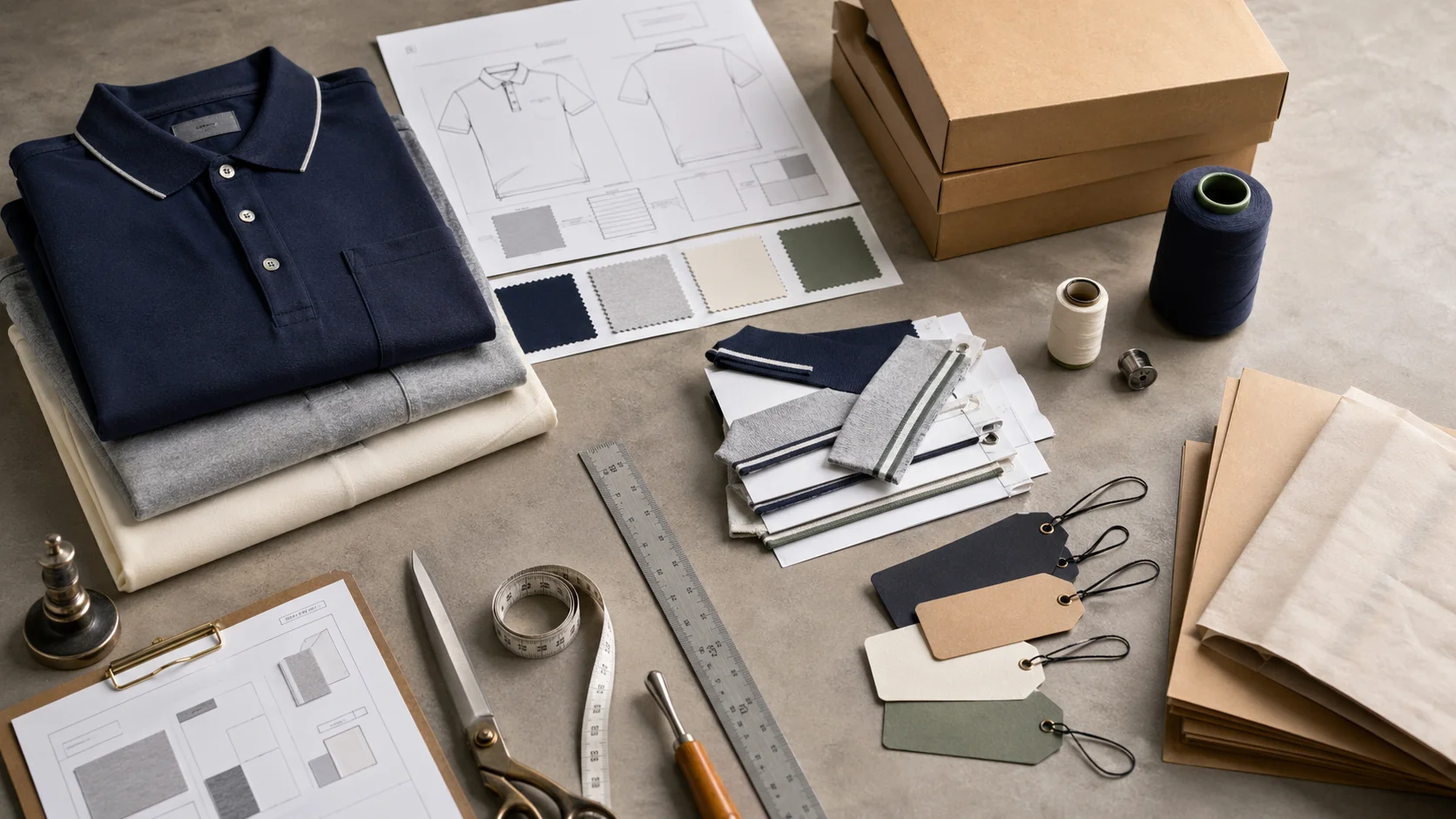
Low MOQ Apparel Manufacturer for Ecommerce Brands compared by sample evidence, fabric or trim specs, MOQ, AQL terms, cost lines, delivery timing, and...
Fast answer: Low MOQ Apparel Manufacturer for Ecommerce Brands: Sample Evidence, MOQ, Capacity, and Rework Terms should be judged by production evidence, not by a generic sourcing promise. The buyer needs sample proof, cost breakdowns, QC checkpoints, and delivery buffers in writing.
Ask for recent sample photos, measurement tolerances, fabric or print test assumptions, decoration test notes, packing examples, and a named inspection checkpoint. These details show whether the team can repeat an approved sample at bulk volume.
Separate garment cost, decoration, labels, packaging, sampling, testing, freight, and rush charges. Clear cost lines make it easier to reduce colorways, adjust size depth, or reserve more time for sampling.
The first collection is where many ecommerce brands learn the expensive version of the truth. I’ve watched a $14 tee tie up $7,000 in cash at 500 units, then sit for 120 days while ad spend kept burning. That is why a low moq apparel manufacturer for ecommerce brands matters now: smaller first runs make being wrong less costly.
Factory visits in Portugal, Vietnam, Turkey, and Los Angeles all pointed to the same blunt reality. A brand ordering 100 units can test sell-through in 3 to 6 weeks, then reorder with actual data instead of wishful thinking. A brand committing to 1,000 units may shave $1.20 off unit cost and still take on ten times the risk if fit misses or color trends shift. DTC brands and marketplace sellers live or die on that first read of demand.
Bangladesh plays by different rules. A factory there might quote $3.10 per tee at 3,000 units but refuse 100 units unless the design gets stripped down to one fabric, one color, one label. In Los Angeles, a shop may accept 50 units, though the same tee could land at $8.50 to $12.00 because labor costs are higher and cutting efficiency is lower. Neither is better in a vacuum. They solve different problems.
The thing nobody tells you is that smaller factories often move faster on sampling, sometimes delivering a first proto in 7 to 10 days, but can stall when a brand asks for custom zippers, special dyes, or imported trims with a 20,000-yard minimum. I’ve watched a nimble workshop finish a hoodie sample in 8 days, then wait 4 weeks for branded drawcord tips from a supplier that only sold in cartons of 5,000. Speed is real. So are bottlenecks.
That is the frame for this guide. I’m not romantic about low-volume production. It can save cash, but it can also hide expensive shortcuts. The real job is to weigh MOQ, quality, timing, and margin with open eyes, the way I do after years of factory visits across 8 countries.
Low MOQ is practical, not magical. In my reporting, it usually means 50, 100, 150, or 300 units per style, depending on fabric complexity and how much the factory has to interrupt its normal flow. A basic jersey tee can sometimes start at 50 to 100 units. A lined blazer or bonded outerwear piece may need 200 to 500 units because labor and material prep are more intricate.
Tees and tanks usually sit in the $4.50 to $8.00 production band at small quantities. Hoodies in French terry 320 GSM can land between $14 and $28, especially if you add puff print, enzyme wash, or heavyweight ribbing. Leggings and swimwear are sensitive to stretch recovery and sewing precision, so the minimum often climbs to 150 or 300 units. Dresses swing widely because lining, zippers, and hem complexity change the labor minutes per piece. Denim and outerwear sit higher still.
Hidden variables push the minimums around. A reactive-dyed fabric can require a separate dye lot. Screen print setup might cost $35 to $120 per color. Pattern grading can add $150 to $400 before production even starts. Trims matter too. Custom silicone badges, metal snaps, branded woven labels — all of it can push quantities higher so the factory can cover ordering and waste. Compliance testing, especially for children’s wear or intimate apparel, can add 5 to 10 days and a few hundred dollars per style.
That is why a $6 tee and a $28 hoodie do not follow the same logic. The tee may be cut from one jersey fabric, sewn on four machines, and packed in plain polybags. The hoodie may need brushed fleece, rib cuffs, kangaroo pocket reinforcement, garment wash, and more skilled sewing time. A price tag is not just a price tag. It is a footprint of machine time, labor skill, and material constraints.
I separate sample production from bulk production every time. Sampling is a proof of concept. Production is repeatability. A factory may make one perfect sample and still struggle to hit 100 consistent units if it lacks a stable cutting table, trained operators, or a clear spec sheet. That is why ecommerce teams need both systems working together, not one pretending to replace the other. For brands building private collections, private label clothing and cut and sew manufacturing solve different stages of the same problem.
The cheapest quote is often the most expensive one. I’ve seen a $5.80 tee turn into an $11.90 landed cost after freight, duties, rework, and a 14% defect allowance were added. That is why I never compare unit price alone. I compare unit price, sample fee, setup cost, freight, duties, and expected defect rate side by side. A factory that looks expensive at first can be cheaper by the third reorder.
Here is the basic math I use. If a factory quotes $6.20 per tee, charges $85 for sampling, adds $140 for screen setup, and your air freight is $1.10 per unit, your real first-order cost is already $7.50 before customs and warehousing. Add duty at 12% to 18% in some markets, plus receiving fees and 2% to 5% shrink or damage, and the number shifts fast. The same pattern shows up at 100 units and at 1,000 units, only the cash exposure gets bigger.
Timelines deserve the same scrutiny. Sample lead times can range from 7 days in a small local workshop to 21 days offshore if fabric and trims are not in stock. Bulk production may take 3 to 4 weeks domestically, 6 to 10 weeks in nearby regions, and 10 to 14 weeks if you are waiting on imported fabric or a full container schedule. Shipping then adds another 3 to 7 days regionally or 25 to 40 days by sea. That timeline affects ad launches, creator seeding, and cash conversion.
Regional patterns are predictable. Nearby suppliers shorten replenishment, which helps when you sell through in 17 days and need a 500-unit reorder fast. Offshore suppliers can deliver lower unit cost, but your cash cycle stretches because deposits, production, and ocean freight all happen before revenue comes back. I have watched brands save $0.90 per unit only to wait 11 weeks for replenishment and miss the second wave of demand. Cost and speed trade places depending on the channel.
My decision lens is simple. At launch, I care most about sample quality, MOQ flexibility, and total first-order cash outlay. At reorder, I care about speed, defect consistency, and whether the factory held fabric shade across multiple lots. At scale, I care about tooling stability, freight efficiency, and how well the supplier can repeat the exact spec without weekly hand-holding. That is the only way to compare quotes without getting fooled by a shiny number.
For brands that need rapid sampling and clear communication, I often tell them to request a written timeline and quote variance policy before they request the first proto. Then, if the project is moving, they can request a custom quote for apparel manufacturing with enough detail to compare like for like.
Low MOQ does not mean low quality. It usually means the brand has less room for error. Ecommerce returns punish small defects hard. A collar that twists 1 cm, a waistband that relaxes after two washes, or a logo print that shifts 4 mm can wreck reviews on a $22 product just as quickly as on a $220 one. I check seam strength, fit consistency, shrinkage, colorfastness, and packaging accuracy before I talk about style.
Before you place a purchase order, ask for a pre-production sample, a size set, and lab dips if the fabric is dyed. For knits, I want shrinkage data after wash 1 and wash 3. For prints, I ask for colorfastness rated against AATCC methods or an equivalent lab test. According to AATCC, standard test methods are the difference between a guess and a measurable tolerance. That matters when a brand is selling 100 units, not 10,000.
I have seen smaller factories outperform larger ones here because the founder or production manager is in the room. They catch a stitching issue on the first 20 units instead of discovering it after 2,000. A larger plant may have better machinery but slower escalation. In one workshop in Izmir, a supervisor remade 30 units overnight after spotting a neckline issue. In a larger operation, the same issue would have required three approvals and at least 5 days.
Still, process controls cannot be assumed. Ask for allowable defect rates in writing. I look for 2% or lower on cosmetic issues and near-zero tolerance on functional failures like broken seams or mislabeling. Ask how many QC checkpoints exist: incoming fabric, inline sewing, final inspection, and carton audit. Ask who pays for replacements if 5% of units fail spec. If the answer is vague, the risk is not small just because the order is.
Smaller factories can also be more flexible on fixes, but only if the problem is clear and documented. Send annotated comments, measurement tolerances in centimeters, and photos of acceptable versus unacceptable samples. That reduces the emotional back-and-forth that slows low-volume orders. Good quality control is not a luxury. It is the reason a 100-unit run can become a profitable reorder instead of a customer-service mess.
Low MOQ changes the margin shape. It raises unit cost, yet it can lower inventory exposure sharply. I would rather see a brand sell 120 units at a healthy gross margin than sit on 800 units that require markdowns after week 6. The math is cold. If your garment cost is $9.50 instead of $7.10 because you ordered 100 units, but you avoid 400 dead units, the expensive option may protect your cash better.
Break-even should be calculated at several order sizes. A brand might pay $11.80 landed for a dress at 100 units and sell it at $48, leaving room for packaging, returns, and paid media. At 500 units, the landed cost may fall to $9.40, which improves margin by 5 to 8 points. Yet that only helps if the sell-through rate holds. If creator content brings 1.8x more demand than expected, the smaller order wins because stock is available again sooner. If demand is weak, the bigger order becomes a liability.
Here is where the hidden costs pile up: repeated sampling. A brand that asks for 4 rounds of revisions at $65 each is spending $260 before one unit sells. Add courier charges of $35 to $90 per sample set, and the cheap development process gets messy. I’ve seen brands sample the same fleece hoodie three times because they kept changing drawcord length by 2 cm and switching between enzyme wash and stone wash. That is not product development. That is indecision with invoices attached.
I’m opinionated on sustainability here. Smaller, better-forecast runs usually reduce dead stock, and dead stock is the ugliest form of waste I see in factories. But low volume only helps if brands stop over-sampling, stop redesigning every 30 days, and commit to a style long enough to read its market. Fabric waste drops when orders are disciplined. It rises when founders use “small batch” as permission to churn endlessly.
From a cash-flow angle, the right test order can fund the next order. The wrong one can freeze your ad budget for a quarter. A clean cost model should include product cost, packaging at $0.20 to $0.60, freight, duties, warehousing, returns, and paid media. If your margins disappear once you add those lines, the problem is not MOQ. The problem is the retail math.
The best supplier depends on the sales channel. DTC brands need quick replenishment, stable fit, and packaging that survives unboxing videos. Wholesale needs carton discipline, barcodes, and label consistency across 6, 12, or 24-piece assortments. Amazon needs compliance discipline, prep standards, and fewer surprises at the fulfillment center. I’ve seen a factory that was excellent at DTC basics fall apart once a retailer asked for inner cartons, case packs, and GS1 barcodes.
Communication tells you a lot. Red flags include vague MOQ language, no written QC process, a tech pack review that never mentions seam type or stitch density, and any refusal to discuss fabric substitutions. If a supplier cannot tell you whether your rib is 1x1 or 2x2, they are not reviewing your spec. They are quoting around it. That is dangerous at low volume, where every mistake gets amplified.
Capacity and specialization matter more than glossy websites. A factory that handles 50 to 300 units of basic tees every week may not be the right fit for asymmetrical dresses or bonded jackets. A niche specialist may be superb at bras, swimwear, or compression fits, but weak at scaling a 1,500-unit reorder. For intimate apparel, I often point brands toward custom bra manufacturing only if the factory can show measured fit data and graded size sets, not just pretty photos.
Domestic, nearshore, and offshore suppliers each fit a different stage. Domestic works best for urgent launches and fast content loops. Nearshore can balance 3 to 5 week transit with moderate labor savings. Offshore makes sense when you already know the product and can hold 8 to 12 weeks of calendar time. The supplier should match your inventory strategy, not your vanity. A brand with unstable demand does not need a perfect price. It needs control.
For ecommerce, I usually recommend a supplier shortlist of three types: one local, one nearshore, one offshore. Compare them on sample speed, re-order lead time, defect policy, and willingness to hold fabric for 30 days. That comparison shows whether a factory is truly a low moq apparel manufacturer for ecommerce brands, or just a factory pretending the MOQ is flexible until details arrive.
Your first 14 days should be structured. Day 1 to 2, define SKU count, target MOQ, target landed cost, and launch date. Day 3 to 5, assemble the tech pack, size spec, artwork, fabric references, compliance requirements, and packaging details. Day 6 to 9, send the same brief to 3 to 5 factories so quotes can actually be compared. Day 10 to 14, review samples, communication speed, and whether the factory asks smart questions or just lowballs the price.
I keep the same vetting sequence every time. First: sample quality. Second: communication. Third: capacity. Fourth: references. Fifth: contract terms. Ask who owns the pattern, what happens if a color lot shifts by 0.5 shade, and how many days the supplier needs to correct a failed unit batch. Ask for written payment milestones, often 30% deposit and 70% before shipment, or another structure that protects both sides.
Documents matter because vague briefs create vague quotes. If you are making leggings, specify fabric composition, compression level, inseam, gusset shape, and waistband height. If you are making hoodies, specify GSM, brushed or unbrushed fleece, rib width, pocket construction, and wash finish. For these projects, a clear cut sheet is worth more than a polished mood board. Brands serious about repeatable production should treat cut and sew manufacturing as a process, not an improvisation.
Once you have the quotes, compare them on one sheet. Unit price. Sample fee. Setup cost. Freight. Duties. Defect policy. Lead time. Payment terms. Then decide whether the first order is a test, a content-driven launch, or a repeatable core style. If you are still choosing fabrics or checking fit blocks, keep the run small. If the product is already proven, scale with discipline, not hope.
The brands that win with low MOQ are not the ones ordering the smallest quantities forever. They are the ones that use small runs to learn fast, then reorder with precision and protect margin on the second and third buy. If you need a starting point, document your brief, line up your comparison sheet, and ask the right low moq apparel manufacturer for ecommerce brands for a quote built on the same spec.
In practice, low MOQ usually means 50, 100, 150, or 300 units per style. The exact minimum depends on fabric type, color count, trims, and whether the garment needs special sewing or compliance testing.
Basic tees often land around $4.50 to $8.00 per piece at small runs, while hoodies can range from $14 to $28. Freight, duties, sampling, and defect allowances can add 15% to 40% to the real landed cost.
Sampling can take 7 to 21 days, and bulk production often takes 3 to 10 weeks depending on region and fabric availability. Shipping adds 3 to 7 days regionally or 25 to 40 days by sea.
Yes, but custom trims often raise the MOQ because suppliers must order extra material to cover waste and setup. If you want branded zippers, woven labels, or silicone badges, ask for minimums before finalizing the tech pack.
Domestic sourcing is best for speed, tighter fit control, and fast replenishment. Nearshore can balance cost and lead time, while offshore usually offers lower unit prices but longer cash cycles and slower reorders.
Look for clear sampling terms, written QC checkpoints, realistic lead times, and transparency on MOQ, production, and defect policy. A strong manufacturer or supplier will explain fabric limits, custom options, and quality standards without hiding the trade-offs.
China can be a strong option for low MOQ bulk and wholesale production because many factories have deep sourcing networks and flexible production systems. Still, the right choice depends on your quality needs, timeline, and how much control you want over shipping and communication.