
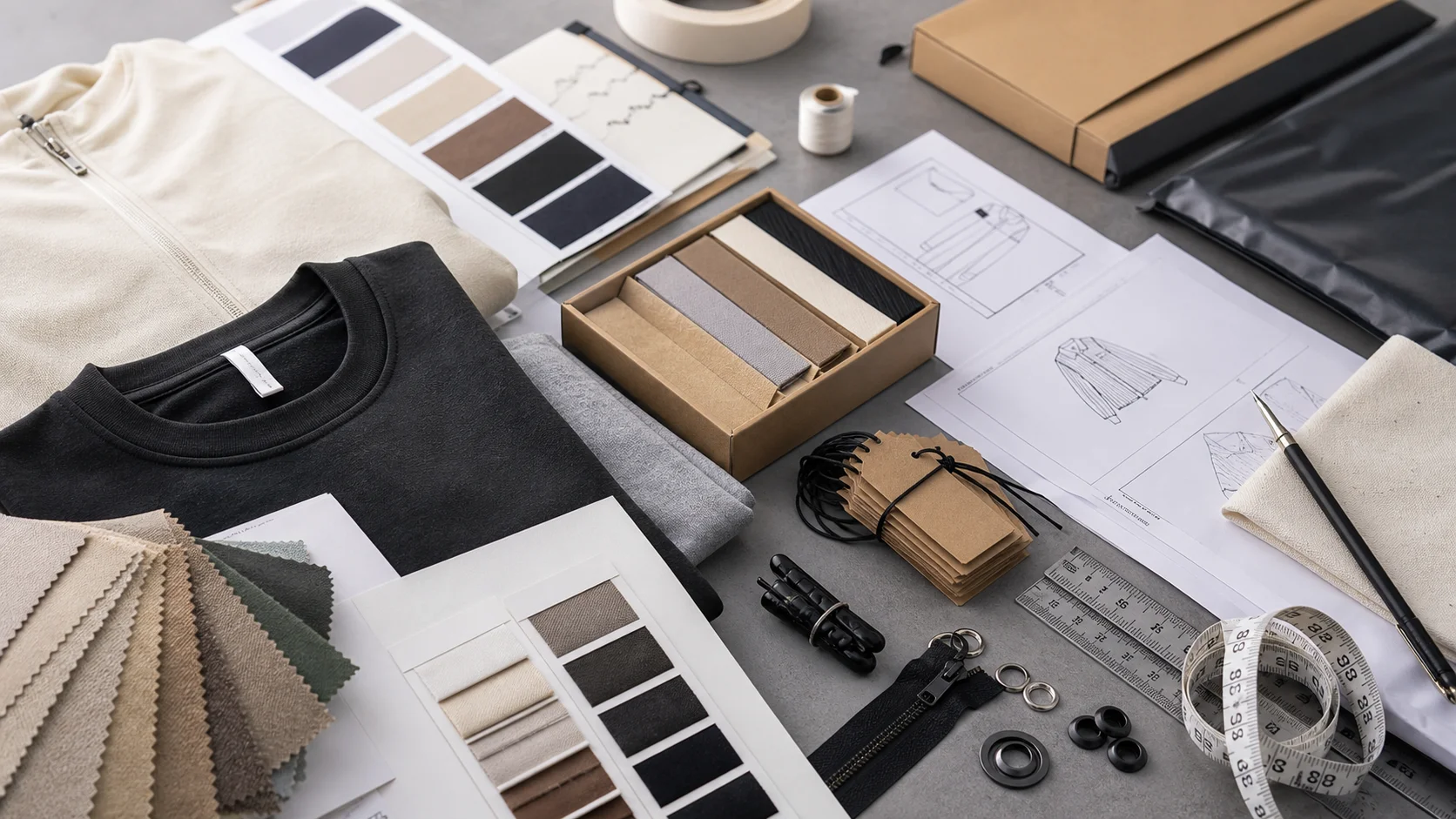
Luxury Apparel Packaging Design Services with checks for samples, fit, MOQ, QC evidence, pricing terms, and delivery risk.
Fast answer: Luxury Apparel Packaging Design Services: Costs, Timelines, ROI should be judged by production evidence, not by a generic sourcing promise. The buyer needs sample proof, cost breakdowns, QC checkpoints, and delivery buffers in writing.
Ask for recent sample photos, measurement tolerances, fabric or print test assumptions, decoration test notes, packing examples, and a named inspection checkpoint. These details show whether the team can repeat an approved sample at bulk volume.
Separate garment cost, decoration, labels, packaging, sampling, testing, freight, and rush charges. When every cost line is visible, it becomes easier to reduce colorways, adjust size depth, or reserve more time for sampling.
At a handbag and shirting factory outside Porto, I watched a box cross a packing table in under 12 seconds. The luxury verdict came before the garment cleared the tissue. Weight, finish, closure sound, fit — that’s what luxury apparel packaging design services are judged on in real production, not the glossy unboxing clip posted three days later. Just enough time for a buyer to nod or shake their head.
Brands I’ve seen spend $0.38 on packaging for a $28 garment and $3.90 for a $180 one. The second pack can carry 15% to 25% of perceived value while staying under 4% of COGS. Packaging isn’t decoration. It’s pricing psychology with freight attached. I stopped calling it decoration the moment I saw that margin math.
Box weight tells a story before the logo does. A 1.2 mm rigid board with soft-touch lamination reads differently from a 0.7 mm folding carton, even when the print is identical. Ribbon quality matters too. A polyester ribbon at $0.06 per unit frays fast; woven satin at $0.24 to $0.40 feels deliberate. Tissue, inserts, closure systems — they’re not small extras. They control crush resistance, crease recovery, and the brand’s discipline in the customer’s hands. Small risks, big messes when you skip them.
Regional expectation changes the brief. In much of Europe, restraint signals confidence: a matte uncoated box, one-color foil, precise folds, minimal filler. Across the U.S., theatrical layering often wins at premium price points, especially for giftable categories. In parts of Asia, especially Tokyo and Seoul, presentation can be exacting and ceremony-driven, but volume is not automatically rewarded. The best packs I’ve seen in Milan were quiet. And the most expensive-looking packs I saw in Los Angeles were louder, heavier, and often less efficient to ship.
Packaging can account for as little as 2% to 6% of product cost and still influence 20% or more of the customer’s value judgment. That is why luxury apparel packaging design services function as branding and risk control. When a shipment includes silk shirts, structured blazers, or garment-dyed knits, the wrong pack turns small transit damage into a margin leak. A crushed corner becomes a return. A wrinkled collar becomes a complaint. Then a reseller markdown.
On the manufacturing floor in Guangzhou, I watched a run of rigid two-piece boxes where premium buyers were quoted $2.50-4.00 per unit at a 500 MOQ, including UV coating, hot-stamp foil, and hand-applied magnetic lids. The same facility could push the lead time to 18-22 business days when the job included Bobst SP 103E die cutting, Heidelberg Speedmaster 52 print, and the insertion of laminated tissue protected by cold-seal glue. Long runs in Dhaka or Ho Chi Minh City using automatic gluing lines and ultrasonic sealing reduced that per-unit cost slightly, but they traded speed for freight and coordination overhead. Still, the math is real.
Discovery comes first. A serious supplier asks for retail price, carton dimensions, SKU count, target markets, and the actual product hand feel. I want to know whether the client is shipping couture, premium basics, denim, knitwear, or accessories, because each category changes the packaging logic. A 320 GSM French terry hoodie in a $95 bracket does not need the same structure as a $1,800 cashmere coat. And sometimes the obvious questions expose the stupid ideas.
From there, the work moves through concepting, dielines, structural engineering, material sourcing, color management, prototyping, testing, and handoff to production. Agencies usually lead brand strategy and visual direction. Packaging studios handle form, print systems, and material choices. Converters manage die cutting, lamination, gluing, and line-ready output. The best projects stitch these roles together early, not after samples have already been rejected. That way no one has to redo a die line.
In factories across Guangdong and Lombardy, the most expensive-looking packs were not always the most complex. A precise fold, clean print registration, and an insert that holds a garment without wrinkling it can outperform a box covered in foil, magnets, and layered foam. Precision is the luxury signal. Excess is just weight. Still, a precise fold keeps the drama away.
Buyers should expect CAD files, at least 2 to 4 sample iterations, QC specifications, print callouts, vendor quotes, and pack-out instructions. For brands using custom clothing packaging solutions, I also ask for a dieline library and a fit test against real production garments, not empty hangers. Otherwise you end up approving a beautiful box that fails when a size 42 blazer arrives with shoulder pads. And ignore any vendor who only wants to send glossy renders.
According to ISO packaging and testing standards, repeatable specifications are what make samples scalable. In plain language, a pack that cannot be measured cannot be repeated. That is where expensive mistakes begin. It means you actually have something to build from.
Machinery matters too. A packaging partner in Istanbul invests in computer-controlled hot-stamping stations, digital varnish units, and Bobst automatic gluing systems that can output 1,200 rigid boxes per hour without sacrificing foil alignment. In Ho Chi Minh City, I’ve seen textile pouch production run through Juki needle-feed machines, 60% recycled cotton canvas sourced locally, and OEKO-TEX Standard 100 and GOTS-certified thread to meet certification requests from Western buyers. Machines keep the drama away.
Cost is where many brand teams get vague, then surprised. Paperboard mailers, rigid boxes, and textile-based packaging sit in very different brackets, and the spread widens fast once you add embossing, foil, magnetic closures, or custom inserts. Entry-level folding cartons can land at $0.45 to $1.20 per unit at 3,000 to 10,000 pieces, while rigid boxes with specialty finishing sit at $1.60 to $4.80. Textile pouches, dust bags, and reusable wraps can range from $0.55 to $2.20, depending on fabric, trim, and print coverage. Pass that along.
Setup costs are the hidden lever. Expect $120 to $350 for a simple dieline and artwork prep, $250 to $900 for a structural sample set, and $400 to $1,800 for custom tooling, especially if magnets, windows, or nested inserts are involved. MOQ 500 to 1,000 pieces is common for highly customized packaging, while 3,000 to 5,000 pieces is more realistic for competitive per-unit pricing. Small runs always look cheap on paper until labor is counted. Those are the sneaky ones.
Regional economics matter. In China, print and assembly capacity is deep, so rigid box production can come in at $1.10 to $2.80 for mid-range finishes on larger runs. In Portugal and Italy, labor-heavy finishing can be more expensive on paper, yet premium folding, linen textures, and careful hand assembly often justify the premium for European brands that need lower defect rates and short replenishment cycles. In India, textile-based packaging, sewn pouches, and cotton dust bags can be cost-efficient at scale, especially when paired with garment production. In the U.S., short-run flexibility is valuable, but per-unit pricing often jumps because labor, freight, and small-batch setup costs are higher. Read that as the same spec feeling cheap or expensive depending on geography.
The trade-offs change by market and by freight lane. A box that costs $1.90 ex-works can become $2.65 landed after ocean freight, carton packing, and a 2% to 3% damage replacement allowance. Sampling, revisions, artwork fixes, storage, and reprints can add another 8% to 15% if the project is poorly managed. Data from trade.gov shows shipping and compliance costs vary sharply by route, which is why a quote without destination assumptions is almost meaningless. Landing costs matter.
I advise buyers to compare suppliers on a single spec sheet. Use the same board grade, finish list, insert detail, quantity, and freight basis. Then look at the real numbers: $0.90 versus $1.25 can be a major swing at 20,000 units, but it may disappear once damage rates, storage fees, and replacement allowances are baked in and returns handled.
A strong brief makes the supplier's job narrower and the quote more reliable. For luxury apparel packaging design services, include the target customer, sales channel, expected order quantity, size range, decoration needs, packaging requirements, and delivery market. Then call out the details most likely to affect the result, especially material grade, print tolerance, and barcode size.
The brief should also explain what cannot change. Some brands care most about hand feel, some about price, some about launch timing, and some about retail compliance. When those priorities are not written down, suppliers tend to optimize for whatever is easiest to quote. Clear priorities help the factory make better tradeoffs before the first sample is cut or printed.
Ask the supplier to respond with assumptions, not just a price. A useful reply states MOQ, sample route, production capacity, inspection plan, packing method, and freight handoff. If the answer is vague, the project may still work, but it needs a tighter pre-production stage before money and calendar pressure build up.
The best time to catch problems is before the pre-production sample is approved. Check measurements, color, placement, material behavior, shrinkage, construction, labels, and packaging in the same review instead of approving each item in isolation. Many bulk issues are not caused by one dramatic mistake; they come from several small unchecked assumptions.
For luxury apparel packaging design services, pay special attention to folding method, pack-out sequence, and retail compliance. These details often look minor in an email but become expensive once cutting, printing, sewing, packing, or shipping begins. A simple checklist with owner, due date, and approval status keeps the brand team and factory aligned.
Bulk production should not start until the supplier can explain how the approved sample becomes a repeatable production standard. That means reference sample storage, line instructions, inline checks, final inspection, and defect handling. A factory that can describe this process clearly is usually safer than one that only promises speed.
Price differences are useful only when the quotes cover the same work. Compare sample cost, material source, trims, decoration, packaging, testing, inspection, and freight assumptions. A low unit price can become expensive if it excludes items the brand needs before launch.
Timeline promises deserve the same scrutiny. Ask what happens if the first sample needs revision, whether materials are in stock, when the production slot is reserved, and how export packing is handled. The most reliable supplier is often the one that gives a realistic calendar instead of the fastest optimistic answer.
Before making the final decision, write down the specification, approval owner, delivery expectation, and the one or two risks that would cause the most trouble if missed. For luxury apparel packaging design services, this usually means checking material grade, print tolerance, barcode size, and the support process after the order is placed.
This last review does not need to be complicated. It simply makes the decision easier to repeat, easier to explain, and easier to verify when the finished product or jewelry arrives.
One useful way to pressure-test the decision is to ask what would happen if the order had to be repeated in six months. The answer should still be clear: the same material grade, the same print tolerance, the same acceptance standard, and the same communication path. If a second order would depend on memory or guesswork, the first order is not documented well enough yet.
Another useful check is to separate preference from requirement. Preference is the look, wording, or finish the brand likes. Requirement is the measurement, tolerance, certificate, material, or delivery condition that cannot fail. Good buying decisions keep both visible, so the final choice is not pushed around by the last email, the cheapest quote, or the prettiest sample photo.
Finally, ask who owns each approval. A project with one accountable owner for sample review, one owner for final content or artwork, and one owner for delivery sign-off usually moves faster than a project where every decision is shared loosely across a team. Clear ownership reduces delays and makes the finished result easier to judge.