
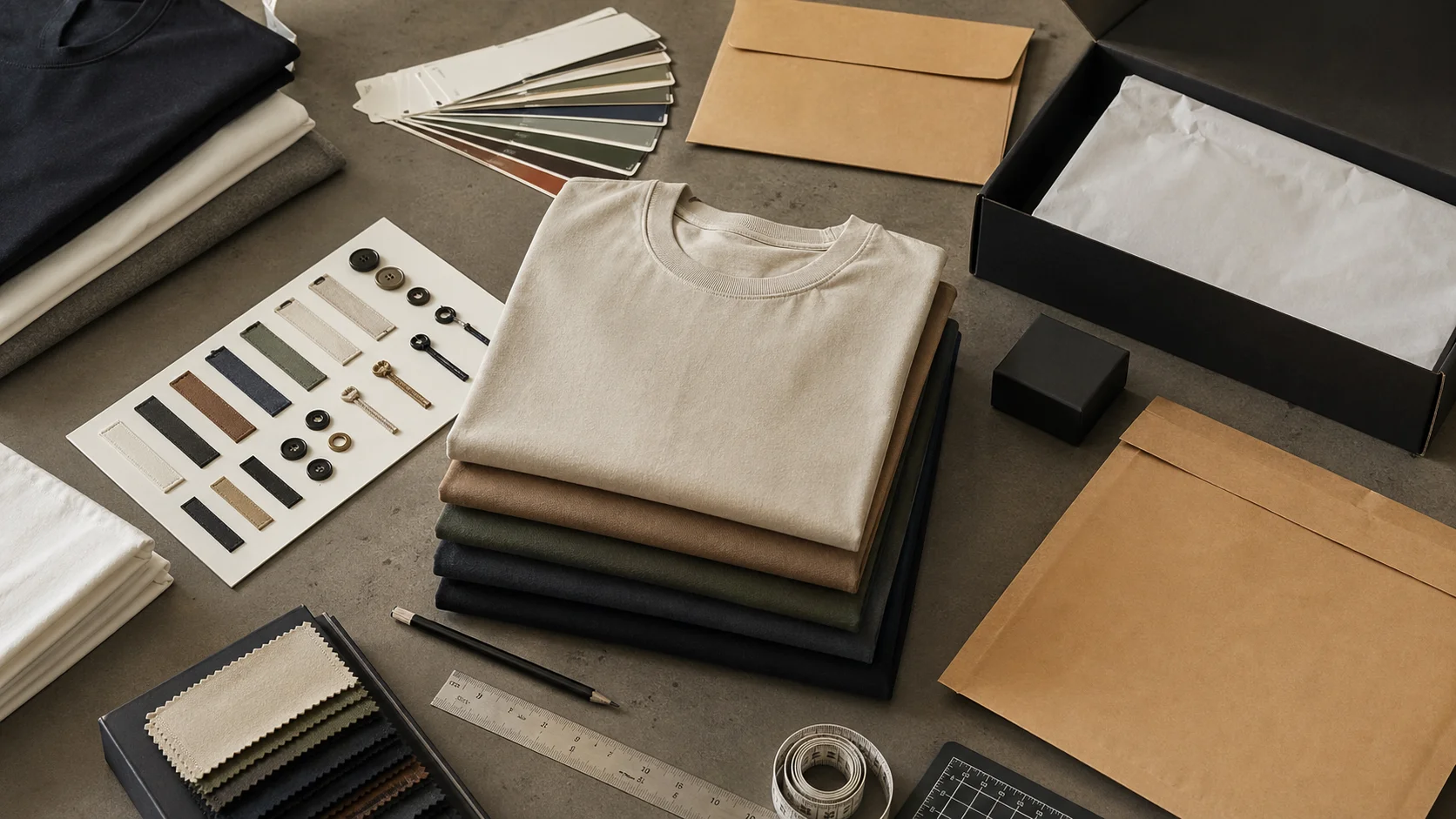
Luxury Packaging Design for Fashion Brands with checks for samples, fit, MOQ, QC evidence, pricing terms, and delivery risk.
Fast answer: Luxury Packaging Design for Fashion Brands: Costs & Impact should be judged by production evidence, not by a generic sourcing promise. The buyer needs sample proof, cost breakdowns, QC checkpoints, and delivery buffers in writing.
Ask for recent sample photos, measurement tolerances, fabric or print test assumptions, decoration test notes, packing examples, and a named inspection checkpoint. These details show whether the team can repeat an approved sample at bulk volume.
Separate garment cost, decoration, labels, packaging, sampling, testing, freight, and rush charges. When every cost line is visible, it becomes easier to reduce colorways, adjust size depth, or reserve more time for sampling.
The right box can make a garment feel expensive before it ever touches skin. I have seen perceived value jump 30% to 40% on packaging alone, and repeat-purchase intent climb 15% when the delivery feels deliberate instead of disposable. That is why luxury packaging design for fashion brands is not decoration. It is part of the product, the margin, and the memory.
In factory visits from Italy to China, teams debated 2 mm folds, 0.3 mm print drift, and whether a lid should close with a soft 150-gram resistance or a cheap snap. Tiny numbers, huge consequences. A rigid box with 2.5 mm greyboard, matte lamination, and a clean magnetic closure announces a different price tier than a 32 gsm poly mailer the second someone touches it. The garment may still be in the warehouse. The brand has already spoken.
Fast-fashion mailers usually win on freight cost, often coming in at $0.18-$0.45 each, but they lose on gift-worthiness and rarely survive a second use. Premium rigid boxes can run $2.20-$6.80 depending on size and finish. Even so, they often cut complaint rates and improve social sharing because customers keep them for storage, gifting, or resale photos. That is a profit decision, not vanity.
At a factory outside Milan, I watched a sample room reject boxes for a 1.5 mm lid gap no shopper would measure. Human eyes catch asymmetry faster than price. In Vietnam, a plant improved perceived quality by switching from gloss varnish to soft-touch film and tightening corner wrap tolerance from 4 mm to 2 mm. Small changes, large signal.
Brands often spend $0.60 on foil stamping and then skimp on board strength, which leaves corners dented after a 6-week ocean shipment. I have also seen the reverse: a plain white rigid box with an uncoated cotton dust sleeve outperform a crowded, overprinted box in gifting tests. Presentation changes return behavior, social posting, and whether the product feels worth keeping. For apparel buyers who also run clothing packaging solutions, luxury packaging design for fashion brands is where packaging stops being an accessory and starts behaving like a sales tool.
Luxury is not a single look. It is a set of cues matched to the ticket price. In heritage luxury, the signals are restraint, weight, and precision: magnetic rigid boxes, blind debossing, thick inserts, cotton dust bags. A $1,200 coat in Paris does not need a loud package. It needs a box that feels expensive in the hand and disappears into the brand story.
Contemporary designer labels often sit between polish and practicality. Drawer sleeves, foil accents, and 1200-1600 gsm rigid board work because customers expect refinement without excess. Premium DTC brands fight a tighter cost ceiling. A $180 dress may justify a $1.50-$3.50 package, not a $7.00 system. Silhouette matters more than ornament.
I have seen the same box read cheap at one factory and expensive at another. Shape was rarely the issue. Board thickness, emboss depth, and how snugly the internal fit held the garment made the difference. A 3 mm insert that keeps movement out can do more for perceived quality than a full-coverage foil print. Overspend on decoration and the package starts to feel like a promotional kit, not luxury.
A simpler box often tests as more premium when the material is stronger and the fit is cleaner. A contemporary label in Portugal moved from a five-color printed sleeve to a single-color rigid box with 18-point board and black cotton ribbon. Cost rose only $0.42 per unit, while customer ratings on “giftable” climbed in post-purchase surveys. Weak structure makes ornament look cheap.
Comparisons across regions prove the point. A Korean supplier may quote $4.80 for a magnetic box with perfect edge wrapping, while a lower-cost plant in South Asia offers $2.10 but tolerances drift beyond 2.5 mm after 1,000 units. For labels building private label clothing, luxury packaging design for fashion brands should echo the garment’s own quality tier. The box must belong to the price, not argue with it.
Most premium apparel packaging uses a narrow set of systems: rigid board for hero pieces, folding cartons for smaller accessories, molded pulp for structure, recycled paper wraps for shipping, fabric dust bags for items that need long-term protection. Shoes need stronger corner support than knitwear. Jewelry wants velvet or silk-like lining. Outerwear needs volume control more than ornament.
Rigid board creates the strongest luxury signal because it holds shape under pressure, but it also adds weight. A typical 28 x 20 x 8 cm rigid box can weigh 180-260 grams before the garment goes in. Folding cartons may weigh 40-70 grams, yet they can feel premium if print alignment is accurate and the stock is dense enough. Cotton dust bags, usually 90-140 gsm, work well for handbags, belts, and small leather goods because customers keep them.
Textile inserts change perception fast. A brushed cotton or microfiber sleeve inside a shoe box feels more intentional than molded pulp alone, though molded pulp has a lower defect rate in wet shipping lanes and better end-of-life recovery. I have seen compostable alternatives mis-specified so badly that they warped in 32°C warehouse heat, turning an eco claim into a quality problem. One brand paid for that mistake with a 7% rework hit.
Coatings, inks, and adhesives affect recyclability and supply risk. UV varnish improves scuff resistance but can complicate recycling. Water-based adhesives are easier to recover, but they may fail if humidity stays above 70% for 10 days. Soy inks can look beautiful on uncoated stock, though color variation often widens by 5%-8% across a long run. According to OEKO-TEX, material safety standards matter because finishing chemistry touches both consumer trust and regulatory exposure.
On production floors, I have tracked yield loss of 3%-6% for complex wraps versus 1%-2% for simpler builds. Shipping weight can swing freight cost by 12%-18% on air shipments, which matters for launch batches of 500 to 2,000 units. For labels working with custom bra manufacturing, luxury packaging design for fashion brands often needs soft structure, not bulk, so the material choice should protect delicate components without wasting cube space.
A simple rigid box usually moves from brief to final production in 4-6 weeks. A complex structure with magnet closures, multi-layer inserts, foil, and custom ribbon can take 8-12 weeks, especially if the supplier needs two sample rounds and board sourcing from different mills. Tooling for custom shapes may run $250-$900, while new cutting dies and emboss plates can add another $120-$400 per design.
At 1,000 units, the unit cost is often painful: $2.80-$7.50 for a basic premium box, $6.00-$12.00 for more complex builds. At 5,000 units, pricing usually falls to $1.40-$4.50 and $3.20-$8.20 respectively. At 20,000 units, well-run factories can get a clean rigid box under $1.10 on simpler specs, while elaborate structures may settle around $2.40-$5.80. Volume helps, but only if specs stay stable.
Domestic production shortens transit time to 3-10 days and simplifies QC visits, yet unit pricing can be 20%-45% higher than offshore options. Offshore production in China, Vietnam, or India often cuts base cost, but freight, customs, and inspection add 8%-18% back into the total. Portugal and Italy can deliver excellent finishing and tighter communication, though lead times often sit in the 5-9 week range because artisan capacity is finite. Data from WTO trade reporting also shows freight shocks hit low-margin shipments hardest, which is why dimensional weight should be modeled early.
Hidden costs show up in warehousing, not just factory invoices. A 10% oversize box can increase dimensional shipping fees by $0.80-$2.10 per parcel on express routes. Rework on 500 damaged units can erase the savings from choosing a cheaper supplier. I have seen brands save $1.20 per box at source and lose $4.00 per unit once repacking, storage, and transit damage were counted. That is why budget belongs in structure, board quality, and closure integrity before it goes into excess decoration.
If a brand asks me where to spend, I say this plainly: put 40%-50% of packaging budget into board strength and structural accuracy, 20%-25% into tactile finish, 15%-20% into inserts and fit, and keep the rest for print detail and shipping protection. The cheapest box is rarely the least expensive one.
The failures I see most often are predictable: corner crush, print drift, weak magnets, glue bleed, and color inconsistency across batches of 1,000 to 5,000. A box may look perfect in a sample and then collapse after a 60 cm drop test because the board score lines were too shallow. Another may open beautifully in the showroom and fail in transit because the adhesive softened at 28°C.
Pre-production samples matter because they expose the gap between intent and reality. A golden sample should be signed off for board thickness, color standard, closure force, and insert fit before mass production starts. I usually want at least 2 sample rounds for new packaging and 1 for a re-order. Batch inspection should catch defects at 5% sampling for early runs and 2%-3% for stable, repeated programs.
Regional capability differs more than buyers expect. Italy and Portugal are excellent at detail and short runs, often at 300-1,500 units. China excels at scale and finish variety, sometimes producing 20,000 units with tight tolerances if the factory has strong QC discipline. Vietnam and India can be extremely competitive on labor-intensive builds, but they need clearer technical packs and more on-site review. I have watched a small plant beat a large supplier on embossed alignment simply because the owner was on the floor every morning. A bigger plant usually wins on throughput.
Measurable checkpoints keep the process honest. I ask for compression testing at 30-50 kg depending on box size, color matching within Delta E 2.0 for branded surfaces, and a 1-meter drop test on packed cartons. Adhesive lines should be continuous, not spotty. Magnetic closures should close within 2-4 mm of true alignment. For cut-and-fold projects tied to cut and sew manufacturing, packaging QA should happen alongside garment QA so the final presentation matches the final stitch quality.
A reliable manufacturer also documents production checkpoints, from paper calibration to final packing counts. That discipline separates a polished result from a costly reprint. If your supplier cannot explain quality tolerances, MOQ implications, or how they handle wholesale and bulk orders, the quote is incomplete.
Recyclable does not automatically mean premium, and premium does not have to mean wasteful. Recycled content, FSC certification, and mono-material builds can reduce footprint, but each one has a cost. A recycled board box may add 5%-12% to material cost if the mill supply is tight. FSC paper often adds $0.08-$0.22 per unit. Reusable packaging, such as dust bags or rigid keep boxes, can raise upfront spend by 15%-30% but extend useful life far beyond the first shipment.
Customer behavior is uneven. In the brands I have studied, roughly 35%-55% of shoppers keep rigid boxes for storage or gifting, while 20%-30% retain dust bags. Proper recycling rates are far lower, often because mixed materials confuse households and local systems. Smart design helps. Mono-material paper systems, uncoated stocks, and minimal adhesives can reduce disposal friction, though they may not deliver the same visual drama as a lacquered box.
Factory evidence shows some eco choices increase defect rates if they are not engineered well. Lightweight recycled board can warp by 2%-4% in humid storage. Compostable films may fail seal tests in cold loading docks. I have seen a brand lose $0.35 per unit on added freight because its “green” mailer was too bulky for efficient carton packing. I prefer longevity over theatrical decoration. Spend on structures customers keep, not on claims they cannot verify.
Trade bodies such as Textile Exchange keep pushing material traceability, and the U.S. International Trade Administration offers practical guidance on sourcing and market access, but packaging buyers still need to check the numbers: grams per unit, recyclability by market, and how many extra grams of freight the material adds. Sustainable packaging should reduce harm without quietly destroying margin.
Before you request quotes, prepare six facts: SKU dimensions, target retail price, order volume, shipping markets, packaging function, and sustainability goals. A supplier quoting for 500 units to Germany and another quoting for 20,000 units to the U.S. are not pricing the same job. If your garment arrives folded at 28 x 22 x 6 cm, say so. If the box must survive 6 weeks in sea freight, say that too.
My 30-day process is straightforward. Days 1-5: issue the brief and collect 3-5 supplier quotes. Days 6-12: review structure drawings and request material swatches. Days 13-20: approve a prototype and test fit with actual product. Days 21-25: compare landed cost, not factory price alone. Days 26-30: sign off the golden sample and confirm production slot.
Compare suppliers on structure, finish, QC process, and response speed. A fast answer is useful, but a clear technical answer matters more. Ask for their defect tolerance, compression test method, MOQ, and what happens if a shipment arrives with 2% damage. Brands that build private label clothing often assume the packaging partner will mirror garment standards. That assumption can be expensive unless the brief is exact.
Testing should follow four stages: drop test, shelf test, transit test, and unboxing test. I want to know if the box survives a 1-meter fall, sits neatly for 14 days in retail, handles a 10-kg stacked load, and opens with the right sound. Spend where customers notice: structure, touch, closure, and fit. Trim where they do not: excess foil, oversized inserts, and decorative layers that add cost without adding memory.
For 1,000 units, expect roughly $2.80-$7.50 per rigid box for a premium build, and $6.00-$12.00 for more complex options with magnets or inserts. At 20,000 units, simpler boxes can drop below $1.10 each, while elaborate structures usually remain above $2.40. Freight, warehousing, and rework can add 15%-30% to the total.
Simple packaging typically takes 4-6 weeks. Complex builds with multiple finishes, inserts, or new tooling can take 8-12 weeks. Add 3-10 days for domestic production or 4-6 weeks for offshore freight if you are shipping by sea.
Many factories will quote from 500 to 1,000 units, but prices improve sharply at 5,000 and again at 20,000 units. Small plants are better for custom detail and short runs. Large plants usually handle scale and repeat orders more efficiently.
Yes, if you use stronger board, good fit, and restrained finishing rather than piling on mixed materials. FSC board, recycled content, and mono-material designs can work well, but they must be engineered to avoid warping and glue failure. A simple box with clean edges often feels more premium than a crowded one.
Ask for board thickness, finish samples, QC process, compression test results, and response time. Compare landed cost, not just factory price. A supplier that can show a golden sample, a clear inspection plan, and a 2%-3% defect tolerance is usually safer than the cheapest quote.