
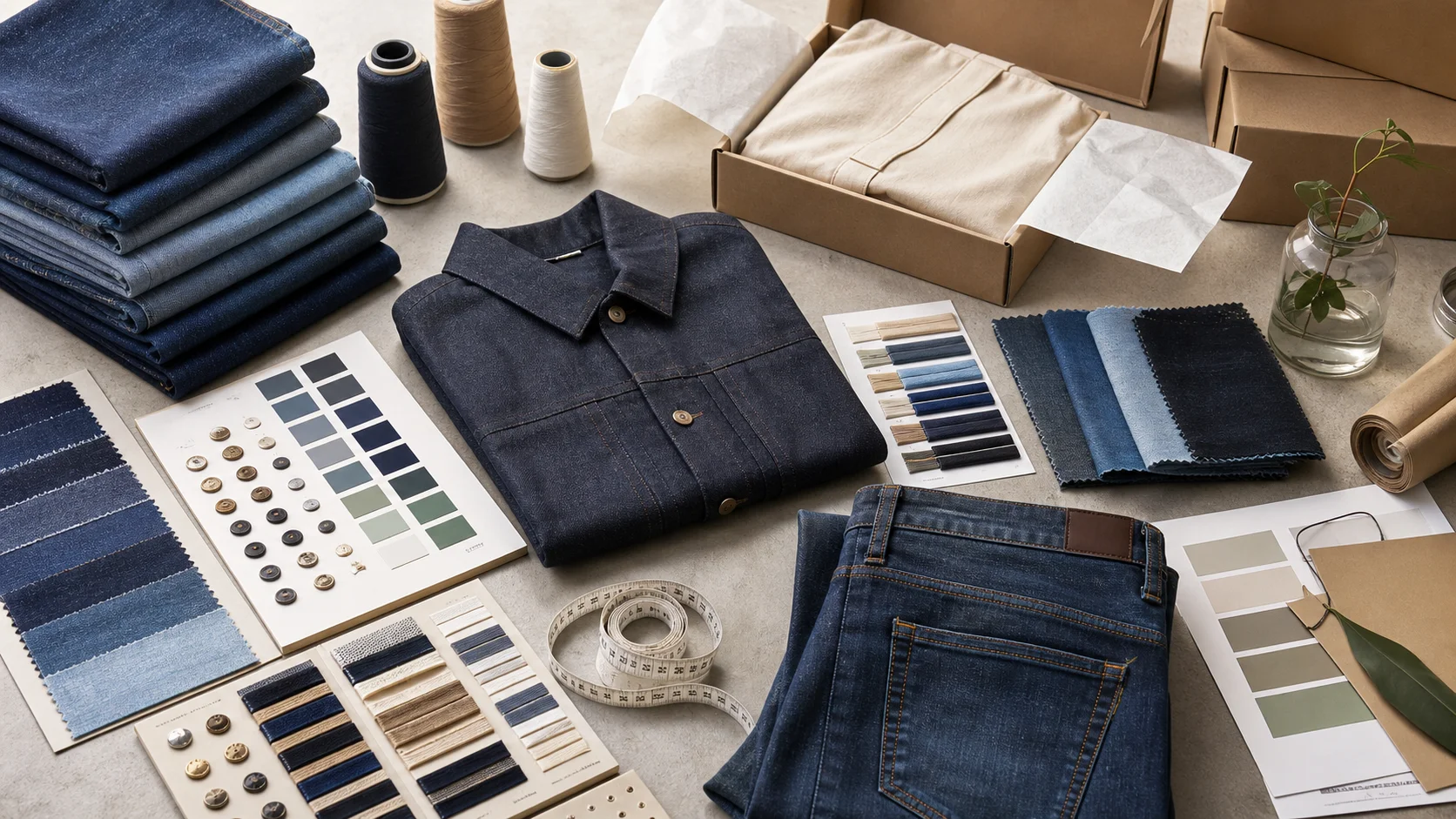
Packaging Design for Private Label Clothing compared by sample evidence, fabric or trim specs, MOQ, AQL terms, cost lines, delivery timing, and rework...
Fast answer: Packaging Design for Private Label Clothing: Material, Print, MOQ, and QC Terms should be judged by production evidence, not by a generic sourcing promise. The buyer needs sample proof, cost breakdowns, QC checkpoints, and delivery buffers in writing.
Ask for recent sample photos, measurement tolerances, fabric or print test assumptions, decoration test notes, packing examples, and a named inspection checkpoint. These details show whether the team can repeat an approved sample at bulk volume.
Separate garment cost, decoration, labels, packaging, sampling, testing, freight, and rush charges. Clear cost lines make it easier to reduce colorways, adjust size depth, or reserve more time for sampling.
Three seconds. That is usually all a shopper gives an apparel item before deciding whether it feels worth the price, and the package often gets judged before the fabric does. In packaging design for private label clothing, that first glance can decide whether a $24 tee feels like a $24 tee or a $42 one. I have watched buyers in Milan, Los Angeles, and Ho Chi Minh City lift a carton or tear strip, then decide almost immediately. The garment may be excellent, but if the package looks thin, sloppy, or generic, the value story collapses before the customer reaches the seam.
In mass-market basics, packaging has one job: arrive intact, stay cheap, and not embarrass the brand. A folded tee in a plain polybag may be perfectly acceptable at $8 to $15 retail if the print quality is crisp and the size label is easy to read. Boutique labels sit in a different zone. They often need tissue, a branded sticker, and a clean insert card because buyers expect a giftable feel at $35 to $80. Premium streetwear can justify rigid boxes, embossed logos, and 157 GSM art paper because the package is part of the drop culture. In my factory visits, I saw one manufacturer in Portugal supply a $2.20 printed mailer that outperformed a $6.80 rigid box from a rival supplier simply because the typography was tighter and the color match was dead on.
Cheap can win. A low-cost format can beat an expensive one when the proportions are right, the logo is centered, and the unboxing sequence feels intentional. I have seen a $0.18 sticker and a $0.06 insert card do more work than a glossy box with a weak dieline. Packaging also signals brand maturity. Clean folds, consistent finishing, and a sensible hierarchy of information tell buyers the label knows its size curve, its SKU system, and its customer. When I visited a denim factory in Turkey last year, the line packing premium jeans used the same carton size for 4 washes and 6 washes, which cut confusion and sped pack-out by 12 percent.
Here is the commercial test I use: if the package does not improve conversion, reduce returns, or raise average order value, it is decoration. That means the discussion starts with measurable outcomes, not mood boards. This is where private label clothing brands often gain or lose margin before the first shipment leaves the factory. Packaging design for private label clothing is not wrapping paper. It is a sales tool, a freight variable, and a brand signal that gets judged instantly.
Buyers usually overrate the box and underrate the small pieces. A mailer can matter, but so can the swing tag, tissue, and insert card. Together they form the first tactile proof that the brand has a point of view. In packaging design for private label clothing, I break the system into seven parts: outer mailer, folding carton, tissue, swing tag, sticker, insert card, and polybag. Each piece has a different job, and not every category needs all seven.
T-shirts and knitwear usually need the simplest structure. A 180 GSM tee in a clean polybag with a branded sticker, size label, and one insert card can look polished if the typography has room to breathe. Denim asks for more protection because of hardware, heavier weight, and crease risk. I have seen 13 oz jeans shipped in a plain carton with a kraft belly band and still feel premium because the box proportions were square and the stock was 350 GSM. Activewear needs moisture logic more than ceremony. A breathable polybag plus a crisp outer mailer often works better than a sealed box that traps odor from the finishing room. Accessories, especially socks and caps, are the most forgiving. They can carry strong identity through a small hang tag and a foil sticker at very low cost.
Minimalist packaging can still feel expensive. Precision does the heavy lifting. A 2 mm shift in logo placement is noticeable. So is a flimsy flap that caves in when stacked. I prefer uncoated kraft for brands that want honesty and texture, matte for everyday premium, soft-touch for higher perceived value, embossing for restraint, and foil only when the brand already has enough visual discipline to support it. A soft-touch 1,000-pack mailer might cost $0.24 to $0.38 more than a standard matte version, but if your product margin supports it and the retail price sits above $60, the upgrade can be justified.
There is also room to save without dulling perception. Use one insert card instead of three. Skip the custom tissue if your garment already arrives pressed and well folded. Keep the print area small and let the stock do more talking. I have seen mid-market brands waste money on laminated finishes that add little beyond glare. The package should frame the product, not compete with it. For stronger physical presentation, many brands pair these choices with clothing packaging solutions that are matched to SKU count, freight limits, and fold standards rather than vanity.
Sustainability claims get messy fast. Recycled content is not the same as recyclability, and compostable is not the same as responsible. I have walked factories in China, Vietnam, and North Carolina where a supplier proudly pointed to a “green” mailer that was 30 percent recycled content, fully recyclable in theory, yet laminated in a way that made local recycling impossible. Data from Textile Exchange shows how quickly material claims can become marketing without chain-of-custody discipline, which is why buyers need to ask for documentation, not adjectives.
The trade-off usually sits between protection and paper. Plastic polybags are still common because they protect against moisture, oil transfer, and warehouse dust. Paper-based alternatives can work, but they often raise tear risk and return damage if the route is humid or the garment is heavy. In Europe, I found paper mailers and recycled cartons widely available, with 2 to 4 week lead times and decent print quality. In Asia, recycled poly, kraft mailers, and water-based inks are easy to source, but the spec sheet matters more than the sales pitch. North America offers better compliance documentation on many runs, yet smaller MOQs often mean a higher per-unit price and slower tooling.
Greenwashing red flags are easy to spot once you have seen enough factories. A supplier saying “eco” without FSC or equivalent paper chain documentation. A compostable claim with no industrial composting pathway. A recycled-content box that uses heavy foil, full lamination, or magnetic closures on a low-price garment. I have also seen brands add two extra layers of packaging to look premium, then call it sustainable because the outer mailer used recycled paper. That is cosmetic, not honest. Extra layers almost always increase carbon, freight, and pack-out time.
For brands that need product safety and cleaner claims, certifications and standards help. OEKO-TEX is useful for chemical safety in adjacent textile inputs, while packaging specs should be tested for real transit conditions rather than assumed. A leaner package that survives a 7 to 10 day international route is better than a pretty one that arrives crushed after one rainstorm. Sustainability should reduce waste, not add a second performance layer that nobody asked for.
For broader sourcing and trade guidance, Trade.gov is a useful reference point for import basics, regional sourcing considerations, and supplier compliance checks.
Packaging costs can look tiny until the freight, tooling, and print setup arrive. Then the budget starts behaving like a real line item. For packaging design for private label clothing, I see low-tier pricing around $0.12 to $0.28 per unit at 10,000 pieces, mid-tier around $0.30 to $0.55, and premium soft-touch or specialty print formats closer to $0.60 to $1.10. Folding cartons usually begin around $0.22 to $0.40 at scale for simple uncoated stock, then move to $0.55 to $1.20 when embossing, foil, or heavier board enters the spec. Rigid boxes can jump to $1.80 to $4.50 or more, depending on wrap, magnet, and insert structure. Tissue sets often sit at $0.03 to $0.12 per sheet, while branded inserts range from $0.04 to $0.20 based on stock and ink coverage.
MOQ changes the math sharply. At 1,000 units, many suppliers will quote a mailer at $0.45 to $1.20 because setup fees get spread over fewer pieces. At 5,000 units, that same item may fall to $0.22 to $0.48. By 10,000 units, pricing often settles into the lower band unless color complexity or special finishing interferes. Print plates, dieline tooling, and sample rounds can add $150 to $800 per SKU, and sometimes more for rigid boxes. On a small run, those charges can exceed the base unit price. Freight can do the same. A carton that costs $0.38 to make may cost $0.62 landed if air shipping or split pallet handling is involved.
Region matters, but not always the way buyers expect. China remains strong on range and speed, especially for printed mailers and cartons with 10 to 20 day production windows after approval. Vietnam is attractive for integrated apparel and packaging coordination, though very complex finishing may require more planning. India can be competitive on paper-based formats and offers strong domestic material access in certain hubs, but some projects need longer lead times for color consistency. Turkey is efficient for Europe-facing brands that want quicker trucking and lower import friction. Eastern Europe is often strong for short runs, premium print, and faster replenishment, though labor cost can push unit price up.
I model packaging as a percentage of landed cost, not a vanity add-on. For a $9 FOB tee with $2.10 freight and duty, packaging might reasonably sit at 2 to 6 percent of landed cost for basics, 4 to 8 percent for boutique labels, and 8 to 12 percent for premium streetwear drops. The difference between a $0.19 mailer and a $0.29 mailer is only 10 cents, but across 50,000 units that is $5,000, before taxes, spoilage, or rework.
Packaging is not just a front-end brand choice. It changes warehouse behavior. A package that is 12 percent heavier or 8 mm larger can alter carton density, pallet count, and dimensional weight charges. In a distribution center packing 3,000 units a day, a slower fold or a more fiddly closure can add 20 to 40 labor hours a month. That is real money. I have seen teams lose margin because a beautiful box required one extra hand movement per unit, which sounds trivial until the line runs 25,000 pieces a week.
Crease protection, odor control, and presentation matter most in categories with higher return sensitivity. Activewear must arrive clean and breathable. Premium shirts, especially satin or viscose blends, need fold control so buyers do not blame the brand for wrinkles caused by transit. Babywear is even stricter, which is why many teams cross-shop packaging against custom baby clothing manufacturing requirements where softness, safety, and labeling discipline all tighten the spec. I have watched a 320 GSM French terry hoodie arrive in a thin polybag and lose perceived value instantly, even though the fabric hand feel was excellent.
Returns are where the math gets brutal. If stronger packaging raises unit cost by $0.14 but cuts damage claims by 1.5 percent on a 40,000-unit season, the savings can easily exceed the spend. I have seen one mid-priced brand drop complaint rate from 3.2 percent to 1.9 percent after switching to a sturdier mailer and a better fold board. Their packing line slowed slightly at first, but refund requests fell enough to offset the change. That is the kind of trade most founders miss. A 10-cent decision can protect 30 to 50 cents of margin later.
Fast formats are usually simpler: mailers, belly bands, flat insert cards. Slow formats include rigid boxes, multiple tissue wraps, and oversized sleeves. If you are shipping direct to consumer, the cleanest mix is often the best mix. The package should travel well, open cleanly, and leave no doubt about what the customer paid for.
Good briefs save weeks. A weak brief creates sample loops, color arguments, and avoidable freight costs. I send suppliers a complete pack before quoting: garment type, finished dimensions, fold method, brand guidelines, target cost, target retail price, compliance needs, and the country of sale. If a style uses sharp hardware, delicate knit, or a coated finish, I say so. If the order must meet retail hangtag rules or language requirements, I say that too. That is how you keep quotes comparable. One supplier cannot quote “premium packaging” while another prices a specific 300 GSM carton and expect an honest comparison.
Ask for four stages of sampling. First, a structure sample to confirm the dieline, size, and closure. Second, a print proof for color and typography. Third, a pre-production sample that uses the final material, adhesive, and finishing. Fourth, a shipment sample pulled from actual packed inventory so you can judge fold consistency and transit performance. I have seen factories pass the first three stages and fail the fourth because the adhesive migrated in humid storage or the fold spec was interpreted two millimeters differently on each line.
Common factory mistakes repeat across regions. Color drift on kraft stock. Weak adhesive on stickers that peel after 48 hours. Fold inconsistency that creates bulging cartons. Poor ink coverage on black paper. I also see suppliers overstate capability by quoting services they do not need. If a vendor pushes six layers of packaging, ask what the customer is actually paying for and how much of that cost is brand value versus habit. A competent partner should be able to explain why a 2-color uncoated mailer can outperform a 4-color laminated box for the same product.
For brands that also use cut and sew manufacturing, packaging must align with garment finishing, not fight it. The package should fit the fold, not force a re-fold on the packing table. That alignment saves labor and keeps the first impression clean.
A 90-day rollout is realistic if decisions stay disciplined. Days 1 to 15: lock the brand position, target cost, and package hierarchy. Days 16 to 30: collect quotes from 3 to 5 suppliers, review dielines, and shortlist two. Days 31 to 45: approve structure samples and narrow the finish choices. Days 46 to 60: review print proofs, confirm color tolerances, and place the order. Days 61 to 75: receive pre-production samples, test drop resistance, and check fold repeatability. Days 76 to 90: final inspection, carton audit, and launch planning.
I recommend A/B testing the unboxing path on at least 2 SKUs, one high-volume and one premium. Compare insert messaging, tissue use, and the feel of the outer mailer. Track return damage rate, pack-out time, complaint rate, and social sharing volume. If one version adds 15 seconds per pack but lowers damage by 0.8 percent, the answer is usually obvious. Start with 20 percent of volume, not 100 percent, so you can catch failure early. Then scale only after the numbers hold.
Use seasonal launches to test bolder materials and evergreen lines to refine the basics. Keep one spec sheet version for each SKU family, and do not let last-minute sales pressure create packaging chaos. A package that works across 3 countries and 2 channels is usually stronger than one designed for a single glossy launch moment.
It is the planning of mailers, boxes, tissue, inserts, tags, and print finishes for a private label apparel brand. The goal is to protect the garment, signal price tier, and reduce cost per order. In practice, good packaging can influence conversion in the first 3 seconds and change return rates by 1 to 2 percent.
Basic mailers often cost $0.12 to $0.28 at 10,000 units, while premium mailers can reach $0.60 to $1.10. Folding cartons usually run $0.22 to $1.20 depending on finish, and rigid boxes can reach $1.80 to $4.50 or more. At 1,000 units, setup costs can make the real unit price two to four times higher.
A normal timeline is 6 to 10 weeks for simple formats and 8 to 12 weeks for premium or custom structures. Structure samples, print proofs, and pre-production samples each need review time. If freight, color matching, or new tooling is involved, add another 1 to 3 weeks.
China is strong for broad format range and speed, Vietnam works well for apparel-linked sourcing, India is often competitive on paper-based materials, Turkey is efficient for Europe-facing brands, and Eastern Europe is useful for shorter premium runs. The best choice depends on MOQ, shipping route, manufacturer capabilities, production lead time, and finish complexity.
Yes. The easiest savings come from removing extra layers, using recycled paper with clear documentation, and choosing one or two finishes instead of multiple special effects. A leaner spec can save $0.10 to $0.40 per unit while reducing freight and labor. The key is to avoid packaging that looks sustainable but adds waste through unnecessary laminates or inserts.