
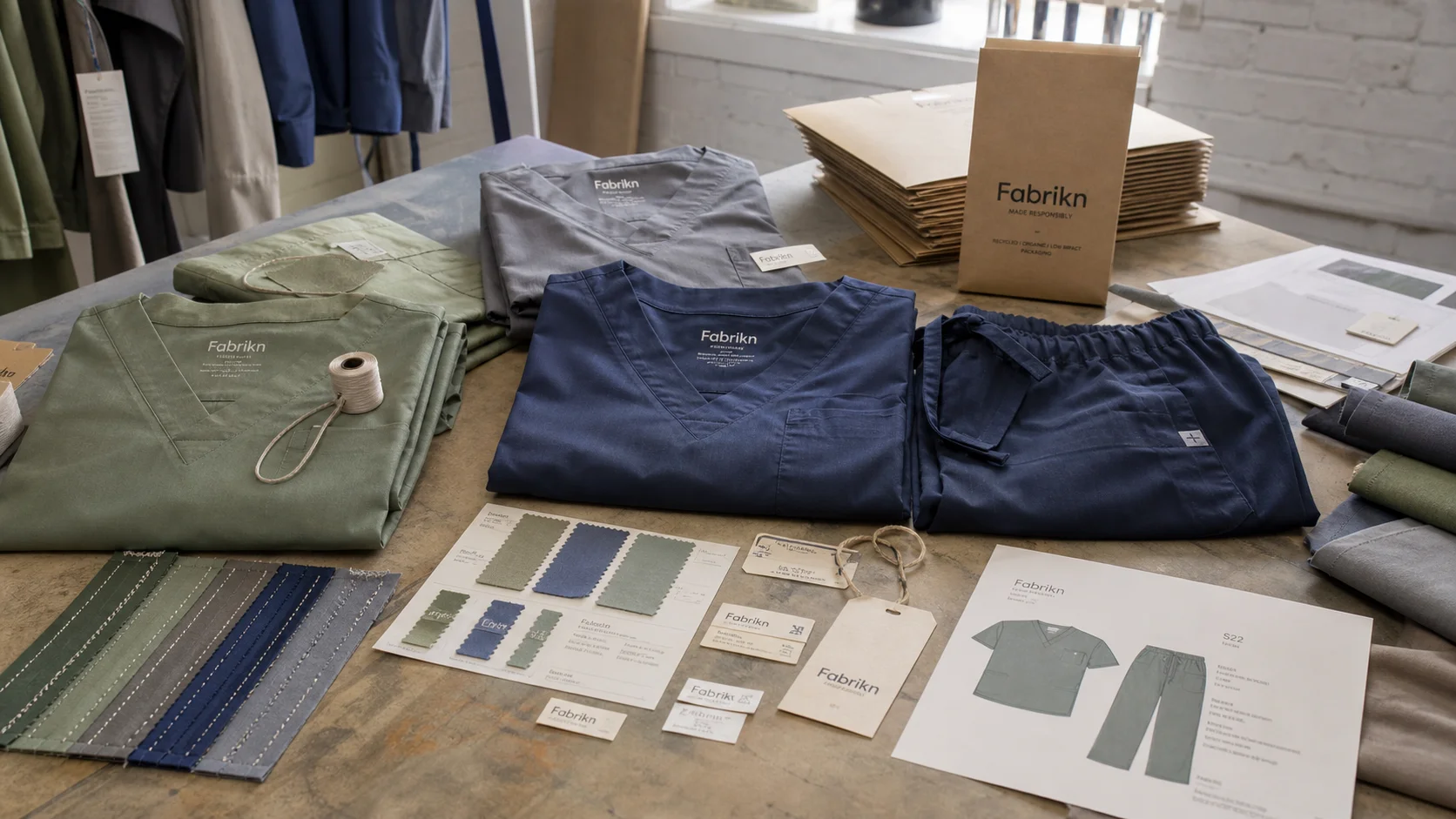
Luxury Fashion Swing Tags with checks for samples, fit, MOQ, QC evidence, pricing terms, and delivery risk.
Fast answer: Luxury Fashion Swing Tags: Materials, Finish, Cost, and ROI should be judged by production evidence, not by a generic sourcing promise. The buyer needs sample proof, cost breakdowns, QC checkpoints, and delivery buffers in writing.
Ask for recent sample photos, measurement tolerances, fabric or print test assumptions, decoration test notes, packing examples, and a named inspection checkpoint. These details show whether the team can repeat an approved sample at bulk volume.
Separate garment cost, decoration, labels, packaging, sampling, testing, freight, and rush charges. When every cost line is visible, it becomes easier to reduce colorways, adjust size depth, or reserve more time for sampling.
Three seconds. That is all a tag gets before the brain decides whether a garment feels worth the price. I’ve watched shoppers in London, Milan, and Tokyo pinch a swing tag, turn the piece once, and make up their mind before they ever studied a seam. Luxury swing tags for fashion packaging are not decoration. They are the first tactile proof that the brand sweats the details.
In store, the tag acts like a price signal. Online, it becomes part of the unboxing script. A flat poly mailer can make a $220 knit feel ordinary. Swap in a structured tag with sharp print, clean edges, and a matte cord, and the same item suddenly feels giftable. I’ve seen customer comments shift simply by moving from 300 GSM coated board to 450 GSM uncoated cotton paper with a blind deboss. Same garment. Different reaction.
Regional taste is not a side note; it changes the brief. In Europe, buyers usually respond to restraint: texture, muted color, immaculate trimming. Japan pushes that further — a 0.5 mm misalignment can read as sloppy. In the US, a bolder logo hit and clearer price storytelling often land better, especially in mid-market retail where shoppers are speed-scanning $80 to $250 alternatives.
Factory visits in Italy and Guangdong kept proving the same point. Thick is not automatically better. Precision wins. Controlled die-cutting, clean registration, and finishing that stays honest under close inspection can make a 1,000-piece run on 350 GSM FSC board look more premium than a 700 GSM tag with crushed edges. Heavy stock can even backfire when packing pressure bruises the corners.
So I treat tags as a packaging asset, not an afterthought. They support conversion in store, add confidence in e-commerce, and shape repeat-purchase sentiment when the parcel arrives looking considered. If you already invest in clothing packaging solutions, the tag deserves the same discipline. For brands planning luxury swing tags for fashion packaging, first touch counts.
Weight. Sound. Edge quality. Those three cues do most of the work. A 400 GSM uncoated paper with a soft tooth usually feels pricier than a glossy 350 GSM board because it kills glare and holds ink with restraint. Then there are the corners. Clean cuts, no fuzz, no whitening on the fold, no crushed tips. I’ve rejected samples for a 1 mm edge burr. The brand message was already slipping.
Paper choice sets the floor. Uncoated cotton papers, FSC board, and textured specialty stocks signal premium apparel more convincingly than shiny coated sheets, especially for luxury tailoring, cashmere, or leather accessories. Gloss has a place in streetwear drops and louder logo-led collections. It can also flatten a minimalist brand by shouting too hard. A 2-color design on 450 GSM cotton paper often beats a 5-color print on coated stock because it leaves the garment room to breathe.
Finishing is where the budget starts to split. Foil stamping may add $0.04 to $0.18 per tag, depending on coverage, plate size, and run length. Gold, silver, black foil — all strong luxury cues. Blind embossing is quieter, more editorial. Spot UV can work too, but only when registration is tight. A 0.3 mm misalignment on a small logo can make the whole piece look rushed.
Hardware details can do more than louder graphics. Matte black cotton cord. Waxed string. Brushed brass eyelet. Any of them can carry the same premium message as a full foil panel, sometimes better. I’ve seen a 12 mm metal eyelet lift a tag more effectively than another varnish pass. But decoration is unforgiving. If lamination bubbles, if foil chips, if the logo sits 2 mm off the fold, the tag stops looking luxurious and starts looking expensive in the wrong way.
For private-label programs, consistency matters just as much as finish. A partner offering private label clothing services can keep the visual system aligned from tag to garment label to carton. That matters when the customer is judging the brand in one glance.
Start with the use case, not the mood board. For premium apparel, I usually narrow it to four material families: virgin board, recycled board, kraft, and cotton paper. Virgin board gives the sharpest print and the cleanest die-cut. Recycled board carries the strongest sustainability story, though fiber variation shows more easily. Kraft suits heritage or rugged positioning. Cotton paper lands well for luxury knitwear, shirting, and accessories.
Shoes and small leather goods can take heavier tags, often 500 to 600 GSM, especially when there’s a hang loop and extra punching. Limited-edition drops can use textured specialty stocks or molded fiber accents, but only if the finish won’t crack during folding. According to OEKO-TEX, transparency in materials and chemical safety matters more every year, and buyers now check claims faster than many brands expect.
Durability is non-negotiable. A tag has to survive folding, abrasion, and moisture. In warehouse tests, I’ve seen low-cost recycled sheets fuzz after 30 to 50 rubs, while a coated FSC board held image integrity after repeated handling. That matters because fulfillment teams touch every item. If a tag scuffs in the pack room, it arrives looking cheaper — simple as that.
Some eco claims fall apart in practice. I’ve handled tags that looked artisanal but shed fibers during packing, especially rough kraft blends with poor calendering. Others creased badly at the eyelet hole after 200 bends. Technically recycled, yes. Customer-ready, no. That is not sustainability. That is false economy.
Factory reality sits underneath all of this. MOQ 500 pieces is common for small specialty runs, but 2,000 to 5,000 usually unlock better pricing and less waste. On high-emboss or multi-foil tags, waste can jump from 3% to 8% if the substrate is temperamental. I watched one mill in Hangzhou lose an entire 400-sheet batch because a textured stock could not hold crisp foil edges at speed. If the tag sits inside a broader cut-and-sew program, the material has to fit the manufacturing cadence, not fight it. Same rule in cut and sew manufacturing.
Cost is where brand ambition meets arithmetic. A boutique run of 500 tags might land at $0.35 to $1.10 per piece depending on board, print, and attachment. At 5,000 pieces, that can fall to $0.12 to $0.42. Push to 25,000 and standard rectangular tags in a single board may go lower still, often $0.06 to $0.18, shipping excluded. Small brands need the whole system priced, not just the press quote.
The main cost drivers are plain enough. Die-cut complexity adds labor. Foil coverage adds plates and press time. Double-sided printing adds setup and more spoilage. Specialty papers raise material cost by 15% to 40%. Matte lamination, soft-touch varnish, edge painting — each one adds a layer. A tag with three finishes can cost 2.5 times more than a clean one-color tag on standard board, even when the size stays identical.
Region changes the numbers too. In Portugal and Italy, unit prices are higher, but I often see tighter color control, lower spoilage, and shorter approval loops on premium runs of 1,000 to 3,000. In China, many factories price more aggressively, especially above 10,000 pieces, yet lead times can slip by 7 to 14 days if the finishing line is crowded. Cheap on paper, expensive in reality — that happens fast.
Here’s the part nobody says out loud: the most expensive tag is often the busy one. Every extra ink color, every contour cut, every special coating adds risk. On one factory visit, a client saved $1,900 by switching from a custom silhouette to a 60 x 90 mm rectangle with rounded corners. The brand still read luxury because the paper, foil, and cord were disciplined. Less noise. More authority.
Use the retail price to set the ceiling. Under $75, keep the tag simple and put the money into typography. Between $75 and $250, allow one premium finish and one premium stock. Above $250, the tag should feel tailored, not theatrical. If you want a cleaner sense of where the money sits before you commit, a structured supplier quote from get a free quote helps a lot.
Scenario Quantity Typical unit cost Best fit Boutique launch 500-1,000 $0.35-$1.10 Tested capsule drops Seasonal program 3,000-7,500 $0.12-$0.42 Core apparel lines Wholesale scale 10,000-25,000 $0.06-$0.18 Repeated SKUsGood suppliers answer technical questions quickly. Great ones show you tolerances before you ask. I always want proofing method, color target system, finishing consistency, inspection standards, and replacement policy on the table. If a manufacturer cannot tell me whether it holds ±0.5 mm or ±1 mm cutting tolerance, I assume the process is looser than the sales sheet suggests. Close logos need tight control.
Sample packs tell you more than promises. Look at three things: print sharpness under daylight, fold performance after 20 bends, attachment strength after 50 tugs. I also want press approvals, not just a PDF. In Asia, speed is often the advantage. In parts of Europe, hand-finishing and smaller runs can be stronger. Local mills can win on freight and turnaround, especially if you need a 7 to 10 day response window.
Supplier documentation separates specialists from general printers. Ask for FSC or recycled-content certifications, batch traceability, and replacement terms if a carton arrives with 5% or higher defect levels. According to ISO, process control depends on documented repeatability, not optimism. That’s the standard I use when a sample looks good but the paperwork looks thin.
Red flags are usually boring. Vague tolerance ranges. No moisture testing. Reluctance to share substrate origin. Poor sample labeling. I once reviewed a run where the supplier mixed two paper lots and never told the buyer; the color shift was small, but enough to break the premium set. A supplier who respects apparel detail will respect packaging detail too. That is why brands building tighter collections often want one vendor across tag, label, and garment production. Smart move. Do it early, not after the first failure.
Luxury design should support the garment price, not compete with it. I’ve seen $35 tees buried under ornate type systems and five shades of foil, while a $280 jacket carried a single logo, a size line, and a discreet origin note. The second version felt far more expensive. Minimalism is not emptiness. It is control.
Typography carries most of the weight. Serif type can signal heritage. Sans serif can feel contemporary. Wrong weight, wrong message. I prefer one strong hierarchy: logo, product line, then utility data. Leave the whitespace alone. A 55 x 90 mm tag can hold more than most teams expect, but that doesn’t mean it should. Overcrowding turns premium into retail clutter.
Storytelling works best when it stays lean. Origin notes, fiber content, craft details, and sustainability data can sit on the back in two to four short lines. If the brand worked with a small-batch studio or a seasonal mill, say so. If the collection used 320 GSM French terry or an enzyme wash instead of stone wash, note it once and move on. A tag is not a brochure.
Color should be disciplined. Black on off-white. Deep navy on warm grey. Soft metallic accents only where they earn their place. High-end brands often use one or two inks; mass-market tags try to squeeze in four to six. A modular system helps with seasonal updates without retooling everything: keep the same die, change the copy block, update the color band, swap the cord if needed. Continuity stays high. Tooling costs stay lower.
Start with a brief that lists retail price, target audience, garment category, and annual quantity. Add exact size, paper preference, finish preference, attachment method, and acceptable defect rate. I want brands to include three reference tags, not just one. A good brief removes two rounds of confusion later. A weak one creates redesign costs, especially if the first samples come back at the wrong GSM or with the wrong hole diameter.
Then sample in stages. Stage 1: digital proof. Stage 2: physical sample. Stage 3: pre-production approval. Test each sample for scuff resistance, color accuracy, attachment strength, and packaging compatibility. I like a 24-hour rub check, a drop test from 1 meter, and a simulated packing run of 100 units. If the cord tangles, the eyelet tears, or the matte surface marks under pressure, stop there.
A realistic timeline runs 2 to 3 weeks for artwork, 1 to 2 weeks for sampling, 3 to 4 weeks for production, and 1 to 2 weeks for freight depending on region. Total: 6 to 9 weeks in many cases. Build in one revision cycle. Don’t wait until launch week to discover the tag clashes with garment bags or folding cartons. Package design is a system, not a single component.
After launch, measure defect rate, customer comments, and unboxing response. I want to know how many tags arrived bent, how many were replaced, and whether shoppers kept the tag for reference. If the premium package is working, the tag will pull its weight without calling attention to itself. If those signals are missing, tighten the spec — not the storytelling.
Premium and sustainable can sit in the same sentence if the details are honest. Recyclable board, certified papers, and lower-ink designs usually create less end-of-life friction than heavily laminated tags with multiple plastic layers. Practical difference, not philosophy. A simple tag that recycles cleanly beats a glossy one that looks premium for 10 seconds and then becomes waste for years.
Brands should ask for documented recycled content percentages, chain-of-custody records, and material certificates. Claims without paperwork are just copywriting. I’ve seen 30% recycled board marketed as fully recycled, and that shortcut damages trust fast. If the finish uses foil or varnish, make sure the supplier can explain the disposal impact and whether the tag still meets local recycling rules. Data from trade.gov shows that sourcing transparency is becoming a trade expectation, not a niche preference.
Consumers keep attractive tags more often than brands expect. I’ve found them tucked into drawers, clipped to mirrors, pinned to vision boards. That makes the tag a memory device. A beautiful, durable tag can extend brand recall while using less material than a bulky insert pack. The goal is not to make the tag disappear. It is to make every gram justify itself.
My view is blunt. Sustainability is strongest when the packaging is beautiful, durable, and honest, not merely described as eco-friendly. If the tag tears, scuffs, or lies about its content, the green message collapses. If it lasts, prints cleanly, and tells the truth, it earns its place.
Most premium tags use FSC board, cotton paper, recycled board, or textured specialty stock. Common weights range from 300 GSM to 600 GSM depending on the garment category and desired feel.
For 500 pieces, expect about $0.35 to $1.10 per tag. At 5,000 pieces, many runs fall to $0.12 to $0.42, with foil, embossing, and custom shapes pushing the price higher.
Typical turnaround is 6 to 9 weeks from brief to shipment. Artwork often takes 2 to 3 weeks, sampling 1 to 2 weeks, production 3 to 4 weeks, and freight another 1 to 2 weeks.
Use a heavier uncoated or cotton paper, keep the layout minimal, and add one controlled finish such as foil or blind embossing. Clean cut edges and precise registration matter more than piling on graphics.
Yes, if you choose certified papers, recyclable board, and lower-ink designs, then avoid unnecessary lamination or mixed materials. Ask for recycled content data, certificates, and traceability so the claim can be verified.