
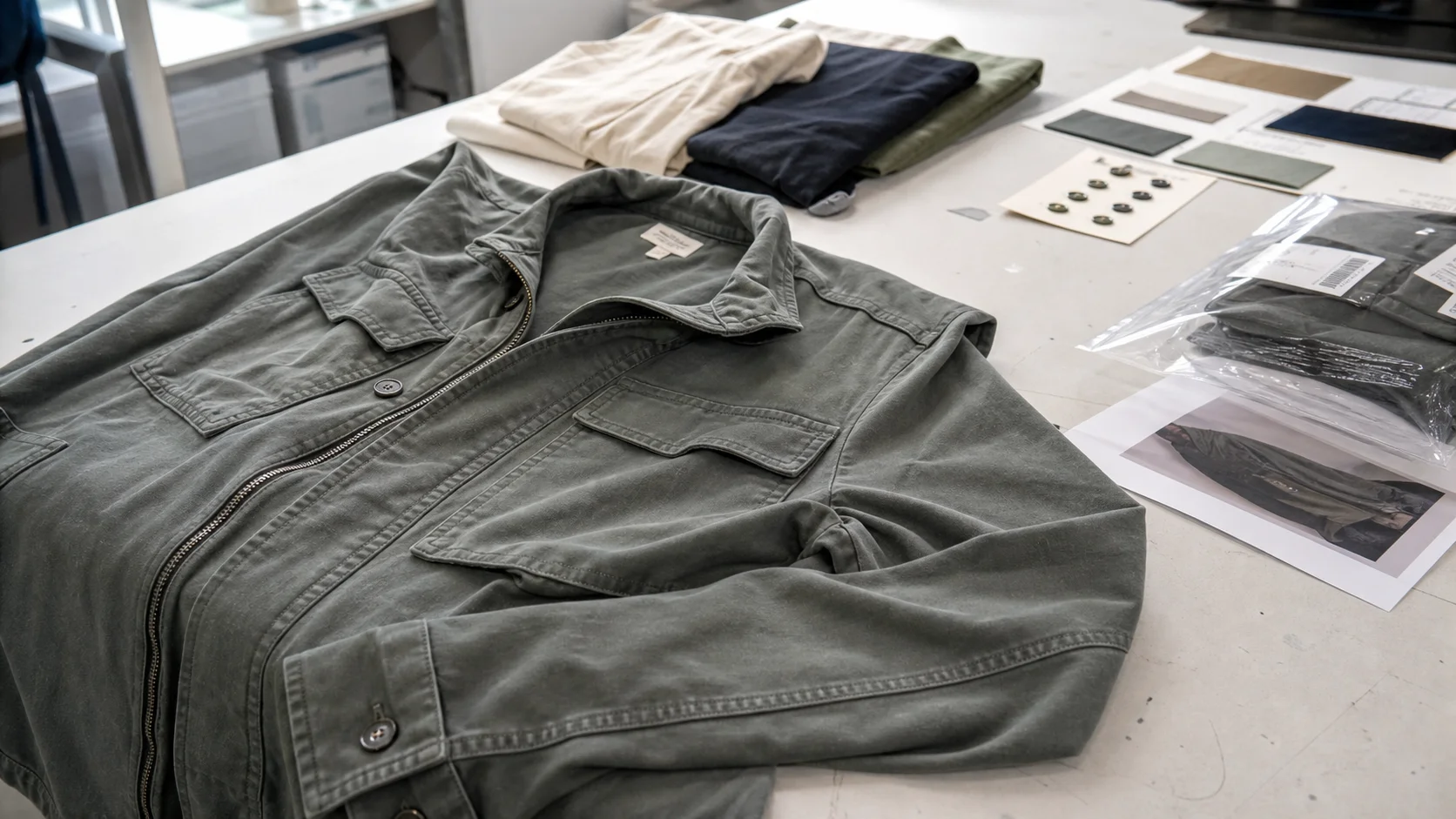
A buyer-focused outline for estimating landed cost, fabric specs, decoration, compliance, and reorder planning for lyocell utility jacket orders made for...
Lyocell Utility Jacket Landed Cost Guide - Sustainable Fashion manufacturing guide
A lyocell utility jacket for cleaning crews looks simple on a line sheet: durable woven fabric, several pockets, button or snap closure, reinforced seams, maybe an embroidered logo. The purchasing reality is less simple. The unit FOB price is only one part of the buying decision. The real number that matters is landed cost: the full cost to get finished jackets into your warehouse, ready to issue to staff or distribute across job sites.
For cleaning crews, the jacket is not a fashion accessory. It is a workwear item that needs to survive repeated laundering, bending, carrying tools, contact with mild cleaning agents, and daily movement. Lyocell is attractive because it has a soft handfeel, a lower-impact positioning compared with many conventional fibers, and good drape. It can also disappoint if the fabric weight, finishing, shrinkage control, or seam construction is not specified correctly.
This guide is written for buyers sourcing lyocell utility jackets for commercial cleaning teams, facilities service providers, hospitality housekeeping departments, janitorial contractors, and sustainable uniform programs. It explains the cost stack from fabric to freight, gives cautious MOQ and lead-time ranges, and highlights the inspection risks that can turn a good quote into an expensive reorder problem.
Practical buying rule: do not compare lyocell jacket quotes by FOB price alone. Compare them by confirmed specs, approved sample quality, projected landed cost, and replacement risk after repeated washing.
If your team needs product development, costing support, or supplier coordination for sustainable uniform programs, review the apparel manufacturing support available through Fabrikn services. For project-specific costing discussions, use the contact page.
Landed cost is the complete cost of purchasing, producing, moving, clearing, and receiving the goods. For a lyocell utility jacket order, the main components usually include product cost, packaging, testing, inspection, freight, insurance, duty, taxes, customs brokerage, port charges, domestic trucking, and warehousing or handling fees.
The biggest mistake in uniform sourcing is treating landed cost as an accounting exercise after the order is placed. It should be built before purchase order confirmation. A jacket that appears 8% cheaper at FOB level may become more expensive if it packs inefficiently, requires air freight to meet a launch date, fails shrinkage testing, or attracts unexpected compliance costs.
Cost Component What It Covers Buyer Watchpoint FOB garment cost Fabric, trims, labor, overhead, factory margin, export handling to port Must be tied to a locked tech pack and sample approval Sampling and development Proto, fit sample, size set, pre-production sample Often excluded from unit quote or credited only after bulk order Packaging Polybag, carton, labels, hangtags, barcode stickers, inserts Sustainable packaging can raise cost and affect carton strength Testing Shrinkage, colorfastness, seam strength, fiber content, restricted substances Uniforms need laundering performance, not only fiber verification Inspection Inline check, final random inspection, measurement audit Skipped inspections can be costly on multi-site uniform rollouts Freight and insurance Ocean, air, rail, trucking, cargo insurance Bulky jackets can have higher freight impact than shirts Duty and taxes Import duty, VAT, GST, customs fees Classification depends on fiber, construction, gender category, and destination Brokerage and destination charges Customs broker, terminal handling, documentation, drayage Small shipments carry high per-unit fixed chargesA utility jacket can move from economical to expensive quickly. The cost drivers are not only fabric weight and order quantity. Pocket count, reinforcement methods, lining, closures, wash finish, logo placement, and size range all matter.
For cleaning crews, a utility jacket should be functional but not overbuilt without reason. Every extra pocket adds cutting time, sewing operations, quality checkpoints, and defect risk. A radio loop or tool pocket may be useful for supervisors, but unnecessary for every team member. A standard crew jacket with two chest pockets and two lower pockets may deliver better cost control than a tactical-looking design with many small parts.
Fabric weight is a direct cost driver and a performance decision. Lighter lyocell fabric improves drape and comfort, but it may wrinkle more and show pocket stress faster. Heavier fabric improves structure and abrasion resistance, but it increases fabric cost, shipping weight, drying time, and wearer heat load.
For indoor cleaning crews, a midweight lyocell blend may be more practical than heavy 100% lyocell. For cooler facilities, night shifts, or transitional outerwear, heavier twill can be justified. A buyer should request fabric swatches and wash test results before approving any material for bulk.
Minimum order quantity depends on fabric availability, dyeing requirements, trim customization, factory line setup, and size breakdown. Lyocell fabric is widely available in some constructions, but custom colors, special finishes, or certified inputs can raise the minimum.
Order Type Typical MOQ Range Best Use Case Cost Risk Stock fabric, standard color 100–300 pieces per style/color Small team rollout or pilot program Limited color control and possible fabric lot variation Stock fabric, custom trims 300–500 pieces per style/color Branded uniform program with moderate volume Trim MOQ may exceed garment quantity Custom dyed lyocell fabric 500–1,000 pieces per color, sometimes more Corporate color matching and repeat orders Lab dip delays, shade variation, fabric wastage Certified sustainable fabric 500–1,500 pieces depending on mill and certification Documented sustainable fashion or ESG uniform program Higher documentation and material planning costThese ranges are not promises. They are planning ranges. A factory may accept lower quantities if it has greige fabric on hand or needs production fill. Another supplier may refuse small orders because the fabric mill MOQ, dye lot size, or snap supplier MOQ makes the order inefficient.
A structured sample path helps prevent hidden cost. For a cleaning crew utility jacket, the typical approval flow should include:
Skipping the wash test is a false saving. Cleaning crew uniforms are laundered often, and some teams use industrial laundry services. Lyocell can perform well, but it needs controlled finishing and proper care instructions. If the jacket shrinks after three washes or pockets distort, the landed cost should include the cost of replacements, complaints, and reissue handling.
A realistic production timeline for a lyocell utility jacket order may run 45–90 days after sample approval, depending on material readiness and factory capacity. Development can add 2–6 weeks before bulk starts. Ocean freight can add several more weeks depending on origin, destination, vessel schedules, customs clearance, and domestic delivery.
Lyocell is commonly positioned as a more responsible fiber because it is made from wood-based cellulose using a closed-loop solvent process in many commercial supply chains. Buyers should still avoid vague sustainability claims. A sustainable fashion category product needs documentation that matches the claim being made.
100% lyocell gives a smooth handfeel and premium drape, but it may not always be the best utility jacket fabric for cleaning crews. A lyocell-cotton twill can improve workwear familiarity and structure. A lyocell-polyester blend may improve durability, wrinkle recovery, and drying speed, though it changes the sustainability story. A small elastane content can improve mobility but may affect recyclability, shrinkage behavior, and long-term recovery after laundering.
Fabric Choice Advantages Tradeoffs 100% lyocell twill Soft, breathable, premium sustainable positioning Can wrinkle, may need careful shrinkage control Lyocell-cotton blend Good structure, familiar workwear handfeel Cotton adds water and land-use considerations depending on source Lyocell-polyester blend Improved durability, faster drying, easier care Less natural fiber story and possible microplastic concerns Lyocell with elastane Better movement for active work Higher risk of growth, recovery issues, and more complex careTrims affect both appearance and durability. Cleaning crews often bend, kneel, reach, and brush against carts, shelves, doors, and equipment. Weak buttons, poor snaps, loose pocket bartacks, or low-quality zippers will fail before the fabric does.
If the jacket will be used by teams handling cleaning chemicals, confirm whether the garment needs resistance to specific substances. Standard lyocell utility jackets should not be assumed to resist bleach, solvents, disinfectants, or harsh chemicals. If chemical exposure is meaningful, the buyer should define the exposure level and request suitable testing or choose a different protective garment category.
The factory’s cut-and-sew quote reflects labor minutes, machine requirements, production efficiency, quality risk, overhead, and margin. A utility jacket has more sewing operations than a basic shirt. Pockets, flaps, collars, cuffs, plackets, yokes, sleeve vents, bartacks, and labels all add time.
For cleaning crew uniforms, the best construction is usually robust but not decorative for its own sake. Double stitching on stress areas and bartacks at pocket corners make sense. Fully bound internal seams may look premium but can be unnecessary if the garment is not sold as retail outerwear. A buyer should spend money where the jacket fails first: pocket stress, sleeve mobility, closure strength, shrinkage, and wash appearance.
Uniform orders often require a broader size range than retail test runs. XS through 4XL may be needed, sometimes with short or tall options. Extended sizes increase fabric consumption and may reduce cutting efficiency. They also require better grading discipline.
Do not approve bulk production from a single medium sample. Cleaning crew teams include different body types, and a work jacket needs arm movement. The fit should allow reaching overhead, pushing carts, carrying supplies, and layering over a polo or T-shirt. If the jacket restricts movement, the product may be technically “on spec” but operationally unpopular.
Freight is where many landed cost models become inaccurate. Utility jackets are bulkier than lightweight tops. A shipment can price by volume rather than weight, depending on packing method and freight mode. Carton dimensions, fold method, polybag thickness, and the number of units per carton all affect freight cost.
Air freight should be calculated before it is needed. If management requires a fixed launch date, build a contingency scenario showing the cost of flying 10%, 25%, or 100% of the order. This keeps the decision commercial rather than emotional when the vessel schedule slips or a sample approval is delayed.
Import duty depends on destination country, product classification, fiber content, gender category, construction, and trade agreements. A 100% lyocell jacket may not be classified the same way as a lyocell-polyester blend. A woven jacket may be treated differently from a knitted layer. Men’s, women’s, and unisex classifications can have different duty implications in some markets.
Buyers should not rely only on the factory’s HS code suggestion. The importer of record is typically responsible for correct classification. Ask a customs broker to review the final product description, fiber content, construction, and intended use before finalizing landed cost.
For buyers building a sustainable uniform program, company background and supply approach can matter to stakeholders. Learn more about the sourcing perspective at Fabrikn’s about page.
Cleaning crew jackets face different risks than retail fashion jackets. The wearer may not treat the garment gently. The jacket may be washed frequently. It may be issued in bulk with limited chance for individual tailoring. Defects that seem minor in a showroom can become costly when multiplied across hundreds or thousands of workers.
At minimum, cleaning crew workwear should be checked for dimensional stability, colorfastness to washing, colorfastness to rubbing, seam strength, button or snap attachment, and appearance after laundering. If the jacket is a dark shade, crocking risk matters because dye transfer can affect undershirts, furniture, carts, or other garments. If the jacket is light-colored, stain visibility and yellowing risk should be considered.
Final random inspection should take place when production is complete and most goods are packed. For larger or higher-risk orders, an inline inspection is useful because it catches pocket placement, seam quality, and measurement issues before the full order is completed. For first-time suppliers, inline inspection is often worth the cost.
Inspection is not only about rejecting bad goods. It gives the buyer leverage to correct process problems before the shipment becomes a landed inventory problem.
The example below is a simplified landed cost model for planning purposes. It is not a quote. Real costs depend on country of origin, destination, exchange rates, duty rate, freight market, fabric choice, factory efficiency, order quantity, carton dimensions, and payment terms.
Cost Line Example Assumption Estimated Cost per Jacket FOB garment cost Midweight lyocell blend utility jacket, 500 pcs $24.50 Sampling amortization $600 development cost spread over 500 pcs $1.20 Testing $450 lab testing spread over 500 pcs $0.90 Inspection $300 final inspection spread over 500 pcs $0.60 Packaging upgrade Recycled polybag or paper-based packaging difference $0.25 Ocean freight and insurance Estimated allocation by carton volume $1.80 Duty Illustrative 12% applied to customs value $2.94 Brokerage and destination charges Fixed and variable fees allocated per unit $1.10 Domestic trucking and receiving Port to warehouse plus handling $0.85 Total estimated landed cost Planning model only $34.14This example shows why a $24.50 FOB jacket can become a $34.14 landed jacket before internal distribution. If the order is only 150 pieces, sampling, testing, inspection, brokerage, and destination fees rise sharply on a per-unit basis. If the order moves by air, the landed cost may climb much higher.
Low MOQ feels attractive, but the buyer pays in other ways: fewer fabric choices, higher unit price, limited customization, and less negotiating power. For a cleaning crew program, it can still be sensible to start with a pilot order if fit, wash performance, or adoption is unproven. The best approach is often a controlled pilot followed by a planned replenishment order once specs are validated.
The right lyocell utility jacket is not always the cheapest, softest, or most sustainable on paper. It is the one that balances crew comfort, wash durability, sourcing credibility, and landed cost discipline.
Choose 100% lyocell when the brand story matters, the jacket is part of a visible sustainable fashion or hospitality program, and the team can manage care instructions properly. It works best when the fabric has been tested for shrinkage and appearance after repeated laundering. The tradeoff is that wrinkle control, seam puckering, and long-term structure need attention.
Choose a lyocell blend when operational durability is the priority. Cleaning crews need garments that look acceptable after many washes and dry within practical laundry schedules. A lyocell-polyester or lyocell-cotton blend may not sound as premium, but it can be more reliable for daily uniform use. The tradeoff is a more nuanced sustainability claim.
Pay for better construction at stress points. Pocket bartacks, secure closures, strong thread, and controlled shrinkage deliver real value. Paying for decorative complexity is less useful unless the jacket must function as customer-facing brand apparel.
Reduce cost by simplifying the design before cutting testing or inspection. Remove nonessential pockets, avoid custom hardware on small runs, use available fabric colors, and standardize packaging. Do not save money by skipping size set review, wash testing, or final inspection on a first order.
Before confirming a lyocell utility jacket order, the buyer should ask direct questions and expect clear answers. Vague replies usually signal weak costing control or limited experience with the material.
DDP pricing can be convenient because it appears to simplify landed cost. It can also hide assumptions about duty, freight, and customs handling. FOB pricing gives the buyer more control but requires better logistics planning. EXW may look cheap but can shift more origin handling responsibility to the buyer. The right Incoterm depends on the buyer’s import experience and risk tolerance.
Use this checklist before approving the purchase order:
A lyocell utility jacket can be a strong sustainable uniform choice for cleaning crews when the sourcing work is disciplined. The buyer should respect the material, specify the garment like workwear, and cost it like an imported product rather than a simple apparel item. That means clear specs, controlled sampling, realistic lead times, wash testing, inspection, and a landed cost model that includes the less visible charges.
For buyers building or refining a sustainable uniform program, Fabrikn can support development conversations through its services and project inquiries through contact-us. The strongest cost outcome comes from aligning product design, supplier capability, quality control, and logistics before the order is placed.
Get a free quote from Fabrikn — your trusted B2B clothing manufacturer with 10+ years of experience. MOQ as low as 200 pieces.
Get a Free Quote →A practical MOQ often starts around 100–300 pieces if stock fabric and standard colors are used. Custom dyed lyocell, certified materials, or custom trims may push MOQ to 500–1,500 pieces depending on the mill, factory, and trim suppliers.
It can be suitable if the fabric weight, weave, finishing, seam construction, and care instructions are properly specified. For heavy daily use and frequent laundering, a lyocell blend may provide better wrinkle recovery, structure, or drying performance.
Many lighter utility overshirts use fabrics around 180–260 gsm, while more structured jackets may use 260–340 gsm. The right weight depends on climate, layering needs, laundry method, durability expectations, and wearer comfort.
Buyers should typically approve fabric swatches or lab dips, proto sample, fit sample, wash test sample, size set, and pre-production sample. The pre-production sample should use actual bulk fabric and trims whenever possible.
Bulk production may take 45–90 days after approvals, depending on fabric availability, dyeing, trims, factory capacity, and order quantity. Development, sampling, testing, ocean freight, customs clearance, and domestic delivery add time beyond sewing production.
Common surprises include air freight, duty misclassification, destination charges, failed testing, inspection rework, packaging changes, low carton efficiency, and fixed costs spread across a small order quantity.
Yes. At minimum, test shrinkage, appearance after washing, colorfastness to washing, colorfastness to rubbing, seam strength, and closure attachment. If chemical exposure is expected, discuss specific chemical-resistance requirements with the supplier and testing provider.
DDP can simplify purchasing for buyers without import infrastructure, but it may hide freight and duty assumptions. FOB gives more control and transparency, but the buyer must manage freight, customs, and destination charges. Compare both using the same product spec and delivery point.
Simplify the design, use available fabric colors, limit custom hardware, standardize packaging, consolidate sizes where practical, and plan ocean freight. Avoid cutting wash testing, size set review, or final inspection on first-time orders.
FOB price does not include all costs required to receive usable inventory. Landed cost captures freight, duty, testing, inspection, brokerage, destination handling, and delivery. It gives a more accurate basis for budgeting, pricing, and supplier comparison.