
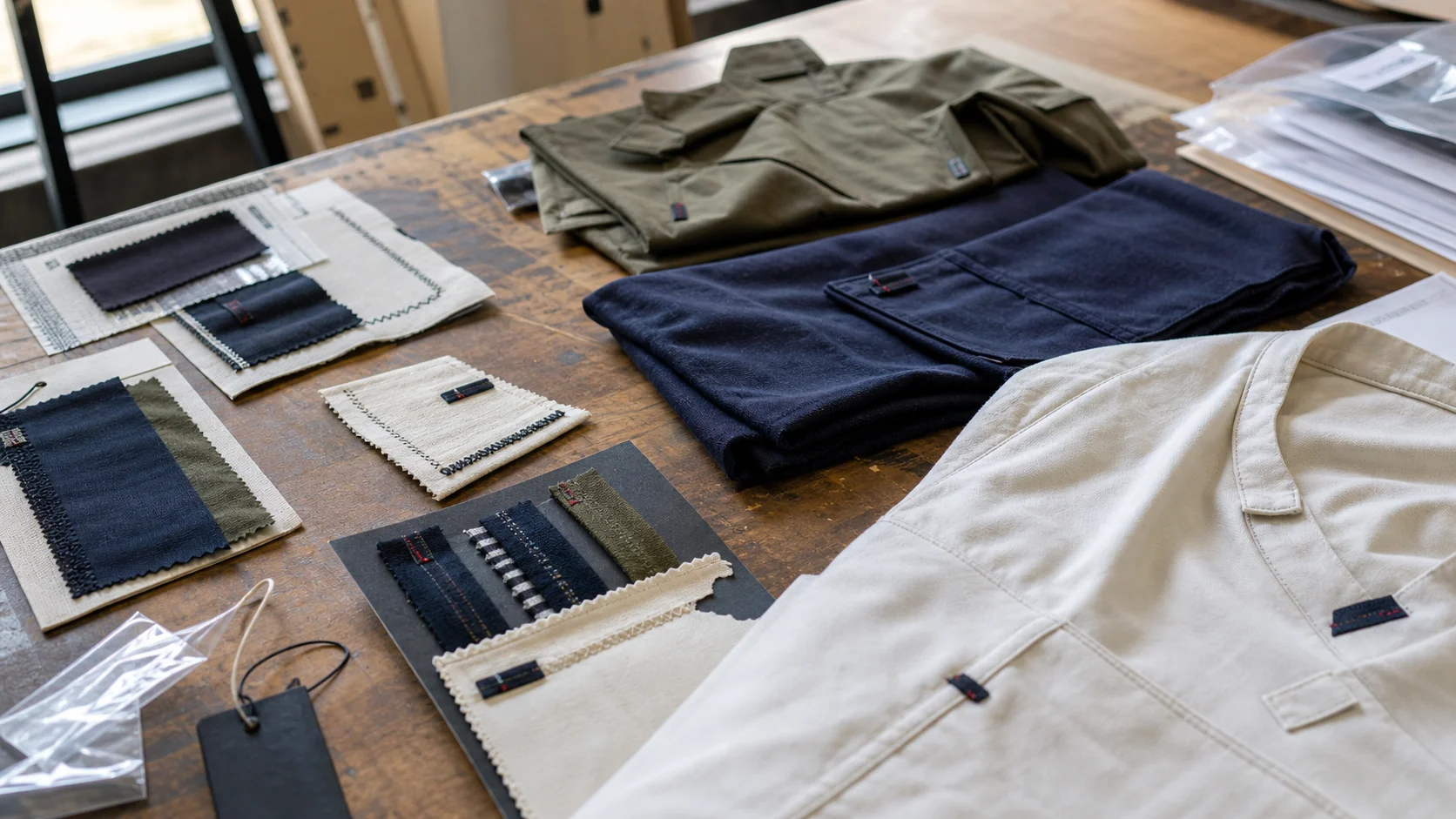
A practical testing guide for cleaning crews evaluating micro embroidery tab fabrics for durability, wash performance, and everyday wear in decorated...
Micro Embroidery Tab Fabric Testing Guide - Fabrikn production reference
Category: Decoration & Printing
Micro embroidery tabs look simple on a uniform, apron, towel, cap, pouch, mop cover, or equipment sleeve. In production, they can become one of the most failure-prone decoration details if the fabric, thread, backing, and cleaning process are not tested together. Cleaning crews put garments and accessories through repeated abrasion, chemical exposure, moisture, and industrial laundering. A small embroidered tab that performs well on a retail hoodie may fail quickly on a janitorial uniform or housekeeping textile.
This guide explains how buyers, sourcing teams, uniform suppliers, and decoration managers should test micro embroidery tab fabric before placing bulk orders. It focuses on practical factory communication: what to specify, what samples to request, what risks to inspect, and how to judge whether the decoration is suitable for daily cleaning work.
If you are developing a uniform or textile program that includes embroidered branding, woven tabs, or small decorative labels, it is worth aligning the decoration testing plan early with your supplier. For broader production support, see Fabrikn’s services or contact the team through Fabrikn’s contact page.
A micro embroidery tab is a small fabric label or tab decorated with embroidery, usually attached to the edge, seam, pocket, sleeve, hem, towel corner, or utility item. The tab may carry a logo, department mark, size code, color code, role identifier, or brand detail. In cleaning crew uniforms, it can help distinguish staff roles, service zones, property groups, or product ownership without using a large chest or back logo.
The word “micro” matters. Small tabs have limited stitch area, less margin for fabric distortion, and tighter readability limits. A design that looks sharp at 70 mm wide may become unclear at 18 mm wide. Fine lettering, thin borders, and multi-color details can also create thread crowding. On a small tab, every mistake is easier to see because there is less background fabric to hide it.
Common micro embroidery tab applications include:
For cleaning crews, the tab must survive more than normal consumer wear. It may be exposed to detergent, bleach residue, disinfectant sprays, alcohol-based cleaners, perspiration, hot drying, repeated wringing, rough stacking, and contact with carts, buckets, and tools.
Cleaning uniforms and textiles operate in a harsh environment. A restaurant server uniform, retail polo, or promotional tote might be washed gently and worn occasionally. Cleaning crew garments are often washed frequently, sometimes daily, and they may be laundered in bulk with mixed textiles.
The main performance risks are practical, not cosmetic only. If the tab frays, curls, bleeds color, irritates the skin, traps dirt, or detaches, the product loses value. If embroidery thread melts under heat or reacts poorly to chemical exposure, the branding may fail before the garment body wears out.
Testing is especially important when the tab is used on items such as microfiber cloths, mop heads, towels, aprons, and utility garments. These items are exposed to harsher cleaning processes than standard casualwear. Microfiber products may also snag easily if the embroidery backing or tab edge is too rough.
Purchasing judgment: do not approve a micro embroidery tab based only on a clean showroom sample. Ask how the tab performs after laundering, abrasion, chemical exposure, and repeated handling. A decoration that looks premium before use can become a complaint driver after ten wash cycles.
The tab fabric must be chosen before embroidery testing begins. Testing embroidery on a substitute fabric gives weak information. The real tab fabric, real garment fabric, real sewing method, and real laundry conditions should be tested together whenever possible.
Common tab fabric choices include polyester twill, cotton twill, poly-cotton woven fabric, nylon, canvas, satin, grosgrain tape, and recycled polyester tape. Polyester is often preferred for cleaning crew applications because it usually offers better dimensional stability, color retention, and wash durability than cotton. Cotton can look more natural, but it may shrink, fade, and absorb chemicals more readily.
Poly-cotton is a balanced option when the uniform fabric itself is poly-cotton. Matching the hand feel and washing behavior can reduce distortion. Nylon can be strong but may react differently to heat and certain chemicals. Satin and very smooth tapes can look premium, but embroidery can pucker if the fabric is unstable or too lightweight.
Micro tabs are small, so fabric weight has a direct effect on sewing and comfort. Too thin, and the tab may curl or collapse after embroidery. Too thick, and it may feel bulky at seams or create needle breakage during attachment.
Typical tab fabric weights may range from about 120 gsm to 280 gsm, depending on the use. Lightweight woven tape may sit around 100 to 160 gsm. Durable twill or canvas tabs may be closer to 180 to 280 gsm. These are broad ranges, not fixed rules. The right choice depends on the garment fabric, tab size, embroidery density, and end-use washing method.
Loose weaves are risky for micro embroidery. They can shift under the needle and cause unclear details. Tight woven twill, stable plain weave, or grosgrain tape usually performs better. Stretch fabrics need extra caution because small embroidery areas can distort when the garment moves or when the backing stabilizes one zone more than the surrounding fabric.
Cleaning crew products often use dark navy, black, charcoal, royal blue, green, red, white, or color-coded trim. Dark tab colors must be checked for color bleeding, especially when placed on white uniforms, towels, or microfiber cloths. White or light tabs must be checked for staining and yellowing after chemical exposure.
For production, ask the supplier to identify the dyeing method and request colorfastness testing where relevant. The tab fabric and embroidery thread should both be tested, because one may pass while the other fails.
Micro embroidery performance depends heavily on thread, stabilizer, edge finishing, and sewing construction. A buyer should not approve only the logo artwork. The technical decoration package should include the key trim specifications.
Polyester embroidery thread is usually the safer choice for cleaning crew applications. It normally offers better resistance to bleach exposure, laundering, and abrasion than rayon. Rayon can have a soft sheen, but it is generally less suitable for harsh wash programs.
For small tabs, thread size matters. Standard embroidery thread may be too heavy for fine micro lettering. Finer thread can improve readability but may increase production complexity and cost. Factories should test the selected thread count against the final artwork rather than assuming a standard logo file will scale down cleanly.
Backing is often overlooked because it is hidden. For cleaning crew products, backing can create several issues: rough hand feel, poor wash performance, residue, shrinkage, or visible show-through on light fabrics. Cutaway backing may provide stability but can feel bulky on a tiny tab. Tearaway backing may be cleaner but may not support dense embroidery on unstable fabric.
Ask whether the backing is cutaway, tearaway, wash-away, heat-seal, or adhesive-backed. Each option has tradeoffs. Adhesive residue can attract lint or create stiffness. Heat-seal backing may be efficient for production but must be tested against dryer temperatures and chemical exposure.
The edge finish is a major durability point. Options include heat cut, ultrasonic cut, folded edge, merrowed edge, laser cut, or sewn-in seam edge. Polyester tape can often be heat cut to prevent fraying, but poor heat cutting can leave hard or sharp edges. Cotton and poly-cotton may need folding or overlocking to reduce fray risk.
For cleaning crew use, a folded edge or seam-captured tab is usually more durable than a raw edge. Heat-cut synthetic edges can work well if they are smooth and do not scratch the wearer or snag microfiber.
The tab attachment stitch should be specified, not left entirely to the factory. Lockstitch is common. Bar tacks may be used for high-stress tabs, but they can add stiffness and create a bulky point. Seam-inserted tabs are usually cleaner, but placement must be controlled during garment assembly.
Use polyester sewing thread for most cleaning crew applications. Cotton sewing thread is usually not ideal because it can weaken faster under repeated laundering and chemical exposure.
A useful testing plan starts with the actual end-use conditions. If the product will be washed in an industrial laundry, domestic wash testing alone is not enough. If the garment is exposed to diluted bleach or quaternary disinfectants, test for that exposure. If the tab sits on a pocket edge where tools rub against it, include abrasion testing.
A practical pre-bulk testing plan should include:
Testing should be performed on both loose tabs and finished garments or finished textile items. Loose-tab testing helps isolate tab performance. Finished-product testing reveals problems caused by stitching, placement, seam bulk, fabric compatibility, and laundering behavior.
Wash testing should reflect the buyer’s real care process. A low-temperature domestic wash may not predict industrial laundry performance. Cleaning crew programs often use higher wash frequency, stronger detergent, bulk drying, and rougher handling.
For development, many buyers start with 5 wash cycles to catch obvious failures, then move to 10, 25, or more cycles for durability validation. The exact number depends on the product value, contract requirements, and expected service life. A disposable or low-cost promotional item may not justify the same testing level as a long-term uniform program.
Colorfastness should be checked after washing, especially when dark tabs are sewn onto light garments or towels. Inspect the surrounding fabric for staining. A tab that keeps its own color but stains the product is still a failed decoration.
Cleaning crews may work around chlorine bleach, peroxide cleaners, quaternary ammonium disinfectants, degreasers, alcohol-based sprays, and acidic cleaners. Not every garment will contact every chemical, but the risk should be discussed before approving the tab.
For a realistic screening test, expose the tab to diluted chemicals that match expected workplace use, then rinse or launder according to the care process. Avoid testing only with full-strength chemicals unless that reflects actual misuse scenarios the buyer wants to evaluate. Full-strength exposure may create unrealistic failures, while weak testing may miss real field problems.
Important chemical risks include:
Purchasing judgment: if cleaning crews frequently use bleach, polyester thread and stable polyester tab fabric are usually safer than rayon thread or cotton-heavy tabs. The final decision still needs testing against the actual cleaner concentration and laundry process.
Micro embroidery creates raised thread on a small surface. That raised texture can snag. On a uniform shirt, this may be manageable. On microfiber cloths or utility textiles, snagging can be a larger issue because the surrounding fabric may catch on the embroidery or tab edge.
Abrasion testing should check how the tab looks after rubbing against similar garments, towels, cleaning cloths, equipment belts, carts, and hard surfaces. The most common failure is not total destruction. It is gradual fuzzing that makes the logo look dirty or unclear.
Dense embroidery can improve visual coverage but increase stiffness and snag risk. Lower-density embroidery can feel softer but may expose base fabric and reduce logo clarity. For cleaning crew applications, durability is usually more important than fine decorative shading. Keep the artwork simple and avoid tiny text unless the supplier can prove repeatable clarity.
Micro embroidery tab development should move through controlled sample stages. Skipping directly from artwork to bulk production is risky, especially for cleaning crew programs with repeated laundering.
Start by checking whether the logo or mark can be embroidered at the desired size. Very small lettering, gradients, thin outlines, and detailed icons may need to be simplified. A tab that is 15 mm to 30 mm wide has tight design limits. If the buyer needs tiny text, a woven label or printed transfer may be more suitable than embroidery.
The supplier should produce a micro embroidery strike-off on the intended tab fabric. Review thread colors, stitch density, clarity, edge finishing, and backing. At this stage, the sample is not necessarily attached to the final garment. It is used to approve decoration execution.
The approved tab should then be attached to a garment or textile sample using the intended sewing method. This step checks placement, seam bulk, comfort, and interaction with the base fabric. It also reveals whether the tab twists, curls, or pulls after laundering.
Run the prototype through the agreed wash and chemical exposure tests. Take photos before and after testing under consistent lighting. Measure tab size before and after washing if shrinkage is a concern. Record any thread damage, color change, staining, fraying, or detachment.
The pre-production sample should use bulk-intended materials: final tab fabric, thread, backing, sewing thread, garment fabric, and packaging method. This sample becomes the control reference for production inspection. If any material changes after approval, the supplier should resubmit the affected component or full sample for review.
For companies building a repeatable sourcing workflow, it helps to document these approvals in a technical pack and supplier file. You can learn more about Fabrikn’s sourcing approach on the about us page.
Minimum order quantity depends on whether the tab is custom embroidered in-line, produced as a separate label, or made from standard tape with custom stitching. Buyers should expect MOQs to vary by factory, trim supplier, thread colors, artwork complexity, and whether custom-dyed fabric is required.
These ranges are general sourcing benchmarks. A supplier may accept smaller test orders at a higher unit cost, especially for development or pilot programs. Larger programs can often reduce unit cost, but they also increase the cost of a mistake. That is why sample approval and testing are not optional for a durable cleaning crew program.
Lead time is affected by more than embroidery runtime. Fabric sourcing, thread availability, lab dips, sample revisions, testing, production scheduling, and inspection all add time. A simple standard-color tab may be developed faster than a custom-dyed, multi-color micro embroidery tab with industrial wash testing.
Typical timing may look like this:
Rushed orders tend to skip the steps that catch decoration problems. If the tab is purely cosmetic and low risk, a shorter process may be acceptable. For cleaning crews, where laundering and chemical exposure are routine, shortened testing should be a conscious business decision rather than an accident.
Bulk inspection should compare production against the approved pre-production sample. Micro embroidery tabs can vary from piece to piece if tension, cutting, placement, or thread trimming is not controlled. Inspection should include both loose tabs and finished products where possible.
Acceptable quality limits should be agreed before production. Tiny tabs can generate many minor defects if standards are vague. For example, a 2 mm placement shift may be acceptable on a large chest logo but obvious on a 20 mm tab. Define tolerance in the tech pack.
This usually happens when the artwork is too detailed for the tab size. Fine letters close up, thread bridges between details, or colors blend after washing. Simplify the artwork, increase contrast, reduce stitch density where needed, or move to a woven label if fine detail is essential.
Curling may come from fabric shrinkage, embroidery tension, backing behavior, or edge finishing. Test the final tab fabric before bulk. Use a stable woven fabric and adjust backing. A folded construction can reduce edge curling, but it may add bulk.
Fading can result from detergent, bleach, disinfectants, sunlight, or poor thread selection. Polyester embroidery thread is usually preferred for cleaning crew textiles. Test actual thread colors because some colors perform better than others.
Fraying often comes from unsuitable fabric or poor cutting. Synthetic tapes may need heat cutting or ultrasonic cutting. Cotton tabs may need folded edges or overlocking. Inspect cut edges before sewing and after wash testing.
Detachment can be caused by weak attachment thread, insufficient seam allowance, poor bartacking, or high stress during laundering. Specify the attachment stitch and thread. Test pull strength on the finished product, not only the loose tab.
Rough backing can irritate the wearer, especially on shirts, aprons, caps, and neck-area placements. Check the back side by hand. If the tab contacts skin, prioritize softer backing and clean trimming. If the tab is on a towel or cloth, rough backing can snag other textiles during washing.
Dark tab fabric or embroidery thread can stain white garments, towels, or microfiber cloths. Run colorfastness to washing and wet rubbing checks. Use stable dyes and avoid untested dark trims on light products.
Micro embroidery tabs are a good choice when the buyer wants a durable, stitched, premium-looking mark and the artwork is simple enough to reproduce at small scale. They work best for icons, short initials, role codes, color coding, and compact logos with strong contrast.
They are not always the best choice. If the design includes tiny text, gradients, photo-like details, or very thin outlines, a woven label, printed tab, heat transfer, or direct print may be more accurate. If the product is exposed to heavy bleach use, a decoration with fewer raised threads may reduce abrasion and chemical retention risks.
The cost tradeoff is also real. Embroidery has setup costs, digitizing, slower production speed, thread changes, and more inspection points. A micro tab can be economical at scale, but it may not be the cheapest option for small trial runs. For small programs, standard tape plus simplified embroidery may be more realistic than a fully custom tab fabric.
Buyers should consider three questions before approving micro embroidery tabs for cleaning crews:
A practical sourcing decision balances appearance against service life. The best micro embroidery tab is not necessarily the most detailed one. It is the one that can be produced consistently, inspected clearly, washed repeatedly, and used by cleaning crews without creating complaints.
A buyer’s tech pack should include more than a logo file. For reliable sourcing, the micro embroidery tab specification should be clear enough for sampling, costing, production, and inspection.
Specification Item Recommended Detail Tab size Width, length, fold length, seam allowance, and tolerance Tab fabric Composition, weight, weave, color, dye standard, shrinkage requirement Embroidery thread Fiber type, thread size, color codes, finish, colorfastness expectations Artwork Final scale, stitch file approval, logo placement, maximum color count Backing Backing type, trimming method, acceptable visibility and hand feel Edge finish Heat cut, folded, ultrasonic, merrowed, or seam-captured Attachment Stitch type, sewing thread, seam allowance, reinforcement requirement Testing Wash cycles, chemical exposure, rubbing, abrasion, pull strength Inspection AQL level if used, defect list, measurement tolerance, approved sample referenceClear specifications reduce arguments later. If the supplier is allowed to choose backing, thread, and edge finish without approval, cost may improve but durability risk increases. If every detail is specified too tightly, cost and lead time may rise. The right balance depends on program size and performance expectations.
Micro embroidery tab fabric testing is a small part of a uniform or textile program, but it can protect the buyer from visible failures. Cleaning crews need decoration that can handle frequent laundering, chemical contact, abrasion, and practical wear. That means testing must go beyond a single attractive sample.
Use final materials. Test the actual wash process. Keep artwork simple. Confirm thread, backing, edge finish, and attachment method. Inspect bulk production against an approved pre-production sample. When performance matters more than decorative complexity, choose stability over novelty.
A micro embroidery tab should support the garment or textile, not become the weak point. With disciplined testing and realistic purchasing expectations, it can be a durable branding and identification detail for cleaning crew uniforms, towels, aprons, pouches, and related work textiles.
Get a free quote from Fabrikn — your trusted B2B clothing manufacturer with 10+ years of experience. MOQ as low as 200 pieces.
Get a Free Quote →Stable polyester twill, polyester tape, or durable poly-cotton woven fabric is often a practical choice. Polyester usually performs better under repeated washing and chemical exposure. The best fabric still depends on the garment, tab size, embroidery density, and laundry method.
In most cleaning crew applications, polyester embroidery thread is the safer option because it generally offers better wash, abrasion, and chemical resistance. Rayon may look attractive but is usually less suitable for harsh laundering and disinfectant exposure.
A basic screening may start with 5 wash cycles, but a stronger validation often uses 10 to 25 cycles or more. The right number depends on the expected service life, laundry process, and contract requirements.
Typical MOQs can range from 500 to 2,000 pieces for standard tape with embroidery, 1,000 to 5,000 pieces for custom fabric tabs, and 3,000 to 10,000 pieces or more for custom-dyed materials. Smaller trial orders may be possible at a higher unit cost.
The most common reason is artwork that is too detailed for the tab size. Small text, thin outlines, and complex logos can close up during stitching. A strike-off sample should be reviewed before bulk production to confirm readability.
They can be used, but snagging and abrasion risk must be tested carefully. The tab edge, backing, and embroidery texture should not catch the microfiber loops or reduce the cloth’s function.
Inspect logo clarity, color accuracy, tab size, placement, edge finish, loose threads, backing visibility, attachment strength, stains, puckering, and consistency against the approved sample. Finished garments or textiles should also be checked after attachment.
A woven label may be better when the design has very fine text, small details, or multiple thin lines. Woven labels can often reproduce tiny details more clearly than embroidery, though they have their own MOQ, texture, and durability considerations.