
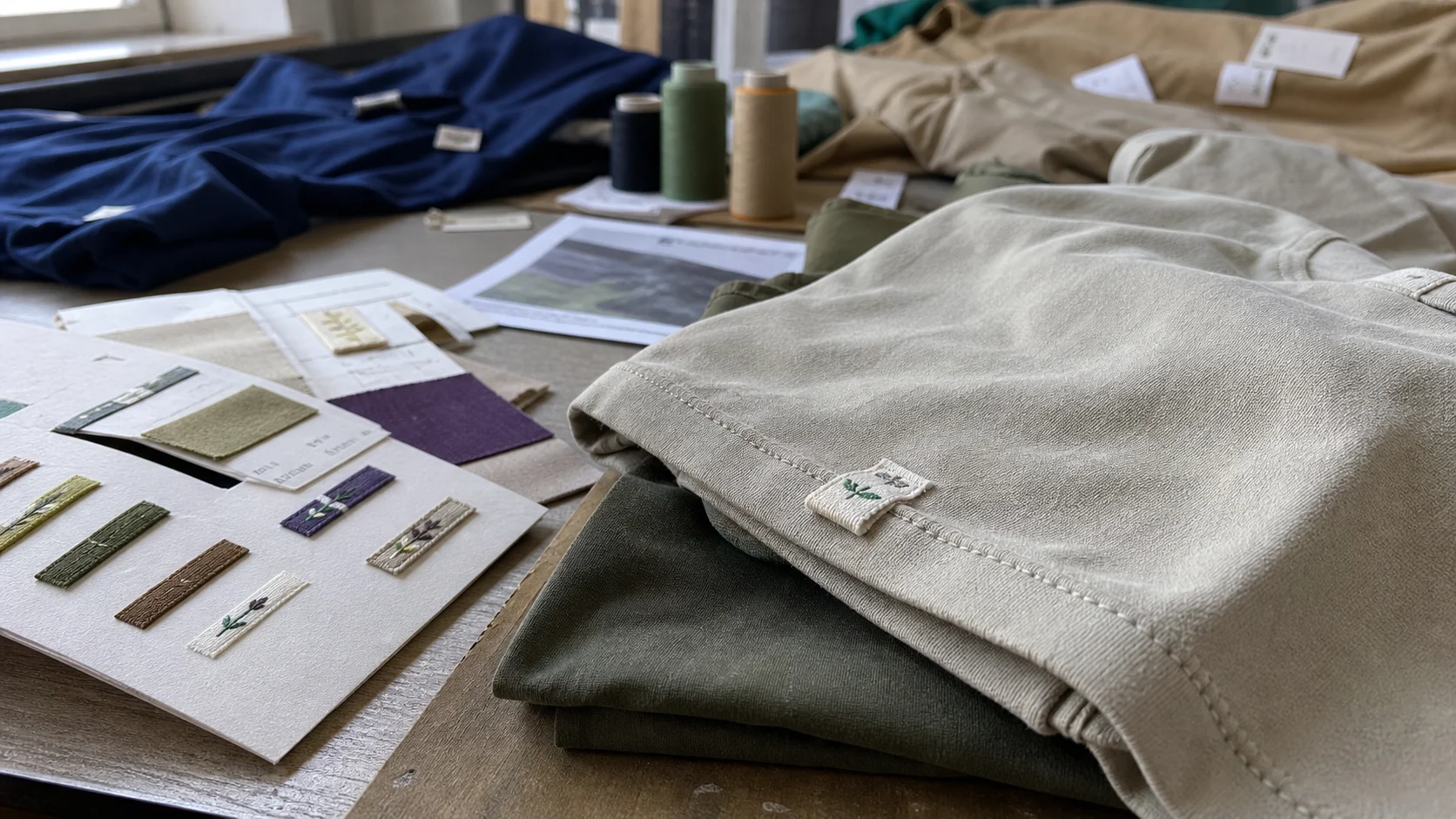
A distributor-focused checklist for approving micro embroidery tabs before factory release, covering stitch clarity, backing, trim, placement, packaging,...
Micro Embroidery Tabs: Factory Release Checklist - Fabrikn production reference
Micro embroidery tabs look simple on a tech pack, but they are not low-risk components. A tab may be only a few centimeters wide, yet it carries brand identity, size coding, collection marking, origin detail, or decorative value. When the embroidery is small, every stitch, edge, backing layer, and cut tolerance becomes more visible. For distributor buyers, that makes the factory release stage especially important.
This checklist is written for buyers sourcing from a micro embroidery tab manufacturer, especially distributors managing private-label apparel, uniform programs, accessories, promotional apparel, outdoor goods, babywear, sportswear, or fashion trims. The goal is practical: reduce rejected lots, prevent unclear approvals, and make sure the factory has enough information to produce consistently before bulk production starts.
A factory release checklist is not paperwork for its own sake. It is a control tool. It confirms what the supplier is allowed to make, what the buyer has approved, what inspection will measure, and what cannot change without written permission. For small embroidered components, this clarity often separates a smooth replenishment program from repeated claims over color, fraying, distortion, or inconsistent logo detail.
Distributor buyers should treat micro embroidery tabs as engineered trims rather than generic decoration. A reliable release process should cover artwork, digitizing, thread selection, stitch density, base fabric, backing, heat-cut or folded edges, packaging, carton marks, inspection standards, and shipment documents. If the tab is later sewn into garments, the checklist should also account for seam allowance, fold behavior, wash durability, and sewing compatibility.
For buyers comparing factory capabilities, it is useful to review service scope before committing to sampling. Fabrikn’s broader manufacturing and sourcing support can be explored through its services page, especially when micro embroidery tabs are part of a larger apparel production package rather than a stand-alone trim order.
Micro embroidery tabs are commonly used by distributors that need compact branding or functional identification without the larger footprint of a woven patch or printed label. They may appear on side seams, sleeves, cuffs, hems, collars, bags, caps, towels, uniforms, children’s garments, performance tops, workwear pockets, and outerwear zipper garages.
Typical distributor applications include:
The commercial challenge is that distributors often buy tabs in mixed styles, colors, and logos, then allocate them across several garment factories. That structure makes control harder. A tab factory may produce the trim correctly, but the sewing factory may attach it incorrectly. A decoration factory may match artwork well, but the thread may fail wash testing. A buyer may approve a beautiful sample, then discover the production tab is too thick for the planned seam.
The best purchasing approach is to release micro embroidery tabs only after confirming both trim performance and downstream use. Ask where the tab will be sewn, what seam allowance is available, what needle size the garment factory uses, whether the tab will be folded, and whether the tab will be exposed to industrial laundry, garment dyeing, enzyme wash, or high-temperature pressing.
A strong release begins with a complete technical spec pack. Many tab defects start with missing or vague specifications, not poor factory effort. “Small embroidered logo tab, black background, white logo” is not enough for bulk production. It invites interpretation, and interpretation creates variation.
The spec pack should include finished tab width, height, shape, fold type, edge construction, embroidery placement, logo dimensions, base material, thread colors, backing type, tolerance, packing method, and sewing allowance. If the tab is folded into a seam, the visible size and total cut size should both be stated. Buyers should not assume the manufacturer understands the intended visible area unless it is drawn clearly.
Recommended specification details include:
For micro embroidery, tolerance must be realistic. A 1 mm shift may look severe on a 10 mm logo but minor on a jacket back embroidery. Buyers should set tolerances according to visual importance and factory capability. A common practical range is +/- 0.5 mm to +/- 1 mm for small tabs, depending on size, cutting method, and edge finish. Very tight tolerances may increase cost, waste, and sampling time.
The spec pack should identify the controlling document. If the buyer sends both a PDF sketch and a spreadsheet, the release checklist should state which document governs in case of conflict. This matters when distributors update artwork during sampling and older files remain in email threads.
Small embroidery does not behave like print. Fine lines may close up. Tiny letters may lose shape. Sharp corners may round off. Thin gaps may disappear after wash or heat pressing. A good micro embroidery tab manufacturer should review the artwork and warn the buyer when the logo is too detailed for the requested size.
Before release, the buyer should approve the production artwork and the digitized embroidery file, not only the original logo. Digitizing converts the artwork into stitch instructions. This step controls stitch direction, density, underlay, pull compensation, sequence, trims, and thread changes. On small tabs, digitizing quality is often the difference between a readable logo and a blurred mark.
Key artwork checks include:
Thread selection should not be treated as a color-only decision. Polyester embroidery thread is widely used for durability, colorfastness, and wash resistance. Rayon can offer a softer sheen but may not be the best choice for frequent laundering or harsh processing. Metallic thread creates a premium effect but can be slower to run and more prone to breakage. Recycled polyester thread may support sustainability claims, but buyers should confirm availability, shade range, and certification documentation before promising it to retail customers.
Color approval should reference a recognized standard where possible. Pantone matching can help, but embroidery thread has texture and sheen that do not perfectly match flat printed color chips. The buyer should approve a physical thread card or strike-off under consistent lighting. For black, white, navy, grey, and red, shade drift is especially noticeable across repeat orders.
Stitch density deserves direct attention. Too loose, and the base fabric shows through. Too dense, and the tab may pucker, curl, feel stiff, or distort after washing. A practical factory should adjust density according to fabric, logo size, and backing. Distributor buyers should avoid pushing for maximum visual coverage without considering hand feel and sewability.
The base material affects appearance, durability, sewing behavior, and cost. Common choices include polyester twill, cotton twill, nylon, satin, felt, canvas, grosgrain tape, woven label substrate, recycled polyester fabric, and specialty performance fabric. Each has tradeoffs.
Polyester twill is stable, economical, and widely used. Cotton twill gives a natural hand but may shrink or fade more depending on finishing. Nylon can suit outdoor or bag applications but may require care with heat cutting and pressing. Satin gives a smooth premium surface but may show needle marks or edge issues. Felt is soft and dimensional, but it may not suit high-wash programs. Grosgrain tape can work well for folded tabs because it has a stable ribbed structure.
Backing and stabilizer selection should match the embroidery density and final use. Tear-away backing may work for simple designs, but small detailed logos often need cut-away or heat-soluble stabilizer for better structure. Adhesive backing can help positioning, yet it may create stiffness or residue problems if not chosen carefully. For tabs sewn into garments, excessive backing can make the seam bulky.
Edge finish is another release-critical point. Options may include heat-cut edges, laser-cut edges, folded edges, overlocked edges, merrowed edges, ultrasonic cut edges, or clean knife cut edges depending on substrate. Micro tabs often use heat cutting or folding because bulky borders can overpower the small scale. Heat-cut polyester can seal fraying, but too much heat may discolor light colors, create hard edges, or slightly shrink the tab. Cotton-based tabs may need folding or stitching because heat sealing is less effective.
Buyers should approve a real edge sample, not just an image. Close-up photos can hide edge hardness, residue, curling, and fray behavior. The release checklist should also state whether edge fuzz, loose fibers, and slight sealing marks are acceptable or not. If the tab is a high-visibility retail feature, visual tolerance should be tighter than for an internal functional tab.
Purchasing judgment: choose a stable base and edge finish before chasing the lowest tab price. A cheaper tab that frays, curls, or jams the sewing line will cost more once it reaches garment assembly.
Sample approval should move in controlled stages. Skipping stages may save a few days at the start and lose weeks after production. For micro embroidery tabs, the sample process should confirm not only appearance but also repeatability.
A practical sample approval flow usually includes:
Distributor buyers should separate “sales sample” from “production approval sample.” A sales sample may be used to show a retailer or brand owner the concept. A production approval sample must represent the materials, thread, backing, machine settings, edge finish, and packaging planned for bulk. If the sales sample was made using available substitute fabric or thread, it should not control factory release.
Physical sample approval should include written comments. Avoid approvals such as “looks good” without defining what was approved. State whether size, color, artwork, backing, edge finish, fold position, and packaging are approved. If the buyer approves with comments, list the changes and require an updated sample or written factory confirmation before bulk.
Common sample problems include lettering that fills in, logo elements that merge, thread shine that looks different from artwork, base fabric grin-through, puckering, hard edges, poor fold balance, and inconsistent cut size. These are not minor issues on micro tabs. They become more obvious when repeated across thousands of garments.
MOQ for micro embroidery tabs depends on factory setup, design complexity, thread changes, base material, cutting method, and packaging. Distributor buyers should expect different MOQ logic for a simple one-color stock-shape tab versus a custom multi-color embroidered and folded tab.
Typical MOQ ranges may look like this:
These ranges are not universal. A factory may accept lower MOQ with a sample charge, setup charge, or higher unit price. Another factory may require higher MOQ to control waste and machine scheduling. Buyers should ask how MOQ is calculated: by design, by color, by size, by backing, by packing type, or by total program volume.
Pricing should be reviewed beyond unit cost. Ask for separate visibility on digitizing charges, sample fees, mold or cutting tool fees if any, material surcharge, special packing cost, labeling cost, and courier cost. For repeat orders, confirm whether digitizing fees apply again and whether the factory stores the approved embroidery file.
A low quote can be attractive, but it may rely on loose tolerances, substitute thread, manual cutting, or unapproved backing. Distributor buyers should compare quotes against the same specification. If one supplier is significantly cheaper, ask what is different. The answer may reveal an acceptable saving, or it may reveal a quality risk.
Factory release means the supplier can begin bulk production. It should happen only when open questions are closed. For micro embroidery tabs, production readiness is a cross-check between commercial order details and technical approval.
Before release, confirm:
Bulk release should also control substitutions. Factories may need to change thread lot, base fabric lot, stabilizer, adhesive, or packaging if materials are unavailable. The release checklist should state that substitutions require buyer approval before production. This is especially important for distributors because the tab may need to match earlier shipments or other trims in the same garment program.
Buyers should request a pre-production photo or short run confirmation when risk is high. This may include the first 50 to 100 tabs from bulk settings. The purpose is not to replace a full inspection. It catches early errors before the factory produces the entire lot.
If the order is split across several deliveries, the release should define how consistency will be controlled. Using the same thread lot for all shipments may be ideal, but it is not always practical. At minimum, the factory should keep production records so repeat orders can match the approved standard as closely as possible.
Inspection risk is high because micro embroidery defects are small but visually important. A standard glance at cartons is not enough. The inspection plan should define what to measure, what to compare, and what defects are critical, major, or minor.
Common inspection points include:
For small tabs, inspectors should use proper lighting, a ruler or caliper, and the sealed approved sample. A photo alone is not a reliable inspection standard because camera angle, lighting, and magnification distort judgment. Buyers should define whether inspection compares against a physical standard, technical drawing, or both.
Sampling level depends on order size and buyer risk tolerance. Many apparel buyers use AQL-based inspection, such as general inspection level II with defined AQL limits, but small trims sometimes require tightened checking if the tabs are highly visible or part of a premium retail program. Critical defects may include wrong artwork, wrong color, wrong size, unsafe sharp edge, contamination, or non-compliant labeling. Major defects may include visible stitch gaps, severe puckering, poor cutting, or incorrect fold. Minor defects may include slight loose fiber within agreed tolerance.
Packaging deserves more attention than it often receives. Micro tabs can be crushed, mixed, lost, or contaminated if packed casually. Bulk tabs should be separated by design, color, size, and lot. Bags should show item code, quantity, production lot, and buyer PO where needed. If several similar tab colors are ordered, color-coded stickers or clear carton separation can prevent costly mix-ups at garment factories.
Lead time for micro embroidery tabs depends on artwork readiness, sample rounds, material availability, production queue, inspection schedule, packing requirements, and shipping method. Buyers often underestimate sampling time because the finished item is small. The item is small; the approval chain is not.
Typical planning ranges may include:
These timelines are planning references, not guarantees. Peak season, public holidays, thread shortages, artwork revisions, failed wash tests, and courier delays can all extend the schedule. Distributor buyers should build in time for at least one sample correction, especially for new artwork or very small lettering.
Release timing should align with garment factory intake. Tabs arriving late can delay sewing lines. Tabs arriving too early without proper storage can be misplaced or mixed with old versions. If the distributor is shipping tabs to several garment factories, the packing list should clearly allocate quantities by factory, style, and delivery window.
For urgent orders, buyers can reduce risk by simplifying the design, using available base fabric, limiting thread colors, accepting standard packing, and avoiding custom dyeing. Paying rush fees may help only if the technical choices are also production-friendly. A complex micro logo cannot always be rushed safely.
Compliance for micro embroidery tabs depends on the end market and product category. A decorative tab for adult promotional apparel may have simpler requirements than a tab used on children’s sleepwear or baby garments. Distributor buyers should clarify compliance before sampling, not after bulk production.
Possible documentation needs include:
Claims must be supported. If a buyer markets the tab as recycled, organic, low-impact, flame-resistant, or suitable for industrial wash, the supplier should provide documentation tied to the actual material used. General marketing claims are not enough for a distributor supplying retailers or corporate accounts.
Labeling should also be practical. If the tab itself includes size, brand, origin, or care information, the artwork must be checked for legal accuracy. If the tab is purely decorative, the packaging still needs clear item identification so garment factories do not attach the wrong trim to the wrong style.
For buyers who need help aligning trim sourcing with broader apparel production requirements, the Fabrikn about us page gives useful background on the company’s manufacturing focus and sourcing approach.
A distributor buyer should not release micro embroidery tabs based only on attractive photos and low unit price. Photos are useful for quick review, but they do not prove hand feel, edge stability, sewing compatibility, or color under standard lighting. Physical samples matter.
The safest supplier is not always the cheapest supplier, and the most expensive supplier is not always the best. The right micro embroidery tab manufacturer is the one that can control small details repeatedly, communicate limitations early, and document what has been approved. For distributor programs, repeatability is often more valuable than one perfect sample.
There are clear tradeoffs:
A strong buying decision starts with the end use. If the tab is sewn into a high-stress seam, prioritize durability and sewing compatibility. If it is a visible retail branding element, prioritize visual clarity and consistent color. If it is used across multiple factories, prioritize packing control and version management. If it supports a sustainability claim, prioritize documentation before sampling.
Buyers should also think about replenishment. Ask whether the factory stores the approved digitizing file, keeps production records, and can reproduce the same tab later. A distributor may need repeat orders months after the first shipment. Without version control, repeat orders can drift in color, size, backing, or stitch density.
When the program involves several garment styles, the buyer should check whether one tab specification can work across all of them. Standardizing one approved tab across multiple styles can reduce MOQ pressure and simplify inventory. The tradeoff is that a universal tab may not be perfect for every fabric or placement. A heavy tab that works on fleece may be too bulky for lightweight jersey.
Supplier communication should be direct. Ask the factory what part of the design is risky. Ask which details may change in bulk. Ask what tolerance they can realistically hold. A responsible factory will not simply say yes to every request. For micro embroidery tabs, cautious feedback is a sign of production understanding, not weakness.
Many distributor claims come from preventable mistakes. The most common is releasing bulk production from a digital mockup without a physical sample. The second is approving a sample without testing it in the final garment seam. The third is changing artwork after approval without updating the sealed sample and production file.
Other common mistakes include:
The best prevention is disciplined approval control. Each approved sample should have a date, version code, style reference, and buyer sign-off. Each purchase order should reference that approval. Each shipment should be inspected against the same standard. This process may feel detailed for a small trim, but it protects the larger garment order.
Distributor buyers can reduce ambiguity by adding clear release language to the purchase order or production confirmation. The wording does not need to be complicated. It should state that bulk must match the approved sample and technical specification, and that any material, artwork, thread, backing, edge, size, or packing change requires written buyer approval.
A practical release note may include:
Bulk production must match approved pre-production sample version [code/date] and technical specification [file name/version]. No substitution of base fabric, thread, backing, digitized file, edge finish, fold method, packing, or carton labeling is permitted without written buyer approval. Supplier must notify buyer before production if any tolerance, material, or delivery risk is identified.
This type of language is not a substitute for a full agreement, but it helps align day-to-day production communication. For higher-value or retailer-facing programs, buyers should use their formal supplier terms and quality agreement.
Micro embroidery tabs are often one part of a larger apparel sourcing decision. If the distributor is also ordering garments, packaging, labels, hangtags, patches, or other decoration, it can be more efficient to coordinate specifications through one production workflow. That reduces the risk of trims arriving late or failing to fit the garment construction.
Buyers who are ready to discuss a program can use Fabrikn’s contact page to share artwork, target quantity, garment category, delivery window, and quality expectations. A complete inquiry should include the tab size, base material preference, logo file, expected annual volume, compliance needs, and whether the tabs will be sewn by the trim supplier or shipped to another factory.
Good sourcing questions produce better factory answers. Instead of asking only “What is your best price?”, ask “What specification will give the best balance of logo clarity, sewability, lead time, and repeat order consistency?” That question leads to a more useful discussion for distributor buyers.
Get a free quote from Fabrikn — your trusted B2B clothing manufacturer with 10+ years of experience. MOQ as low as 200 pieces.
Get a Free Quote →A micro embroidery tab is a small fabric trim with embroidered artwork, text, logo, or coding. It is commonly sewn into apparel seams, hems, sleeves, pockets, caps, bags, and accessories for branding or identification.
Typical MOQ may range from 500 to 1,000 pieces for simple stock-shape tabs and 1,000 to 5,000 pieces for custom, folded, multi-color, or detailed micro embroidery tabs. Specialty materials or certified substrates may require higher MOQ, sometimes 3,000 to 10,000 pieces or more.
Small embroidery can change significantly after digitizing and stitching. Fine text, thin lines, thread shine, puckering, and edge finish cannot be judged accurately from a digital mockup. A physical strike-off lets the buyer approve the real appearance and construction.
Polyester embroidery thread is a common choice because it offers good durability, colorfastness, and wash performance. Rayon, metallic, recycled polyester, and specialty threads may be suitable depending on the design and use, but they should be tested and approved before bulk release.
The main risks include wrong size, poor logo clarity, color mismatch, skipped stitches, puckering, loose threads, fraying edges, burn marks, wrong fold position, backing residue, mixed colors, and incorrect packaging. Inspection should compare bulk goods against a sealed approved sample.
Bulk production for standard micro embroidery tabs often takes 7 to 20 working days after final approval and material readiness. Special materials, custom dyeing, heavy order queues, or additional testing can extend the timeline.
Yes. A tab can look correct as a loose trim but fail in the garment due to seam bulk, edge stiffness, poor fold balance, or incompatibility with the garment fabric. A sew test is strongly recommended before factory release.
The checklist should include approved artwork, digitized file, thread references, base material, backing, edge finish, size tolerance, fold method, MOQ, delivery date, inspection standard, packaging details, compliance documents, and written approval of the pre-production sample.