
A clinic purchasing team’s SEO-focused review outline for evaluating micro embroidery tabs, fit blocks, placement consistency, fabric compatibility, and...
Micro Embroidery Tab Fit Block Review for Clinics - Decoration & Printing manufacturing guide
Clinic purchasing teams often focus on garment color, logo accuracy, unit price, and delivery date. Those are important, but they do not fully protect a uniform program. Small decoration details can create large operational problems when they affect comfort, laundering, staff identification, or reorder consistency. Micro embroidery tabs are a good example. They look simple on a quote sheet, yet they depend on tight coordination between fit block, fabric behavior, tab construction, stitch density, and final garment inspection.
A micro embroidery tab fit block review is the process of checking whether a small branded or functional embroidered tab works properly on the selected clinic garment pattern. The tab may carry a tiny logo, department mark, size cue, role identifier, or subtle brand detail. It may sit on a scrub top hem, sleeve opening, chest pocket, side seam, collar edge, or waistband area. Because the decoration area is small, there is less room for error. A one-millimeter shift can look acceptable on a large chest logo, but it can make a micro tab appear crooked, cramped, or poorly planned.
For clinics, the issue is not just appearance. Staff uniforms must survive repeated industrial or home laundering, frequent bending and reaching, contact with desks and medical equipment, and daily wear across different body shapes. A tab that curls, scratches, distorts the garment edge, or pulls against the seam will generate complaints. A tab that looks inconsistent between production lots will weaken brand control. A tab that delays production because the factory cannot embroider it cleanly at scale will affect onboarding, department launches, and replacement inventory.
This review is written for clinic purchasing teams evaluating micro embroidery tab fit block options in the Decoration & Printing category. It explains what to request from suppliers, where typical risks sit, how MOQ and lead times usually behave, and when the decoration choice is worth the added control work. If your team is still defining the broader uniform program, it is useful to compare decoration methods and garment development support through a supplier’s service structure, such as the apparel production and customization options listed at fabrikn.com/services/.
A micro embroidery tab is a small fabric, woven, twill, grosgrain, or self-fabric element added to a garment and decorated with compact embroidery. It may be sewn into a seam, topstitched onto a panel, folded over an edge, or inserted like a label. The embroidery is usually much smaller than a standard chest logo. Common artwork widths may range from 8 mm to 35 mm, depending on the tab size and stitch complexity.
A fit block is the base garment pattern used to control sizing, proportions, and construction across a production run. In clinic uniforms, the fit block may be a unisex scrub top, women’s scrub top, men’s scrub pant, lab coat, warm-up jacket, polo, tunic, or administrative shirt. A fit block review checks whether the proposed tab placement works across sizes, body movement, seam allowances, laundering, and production handling.
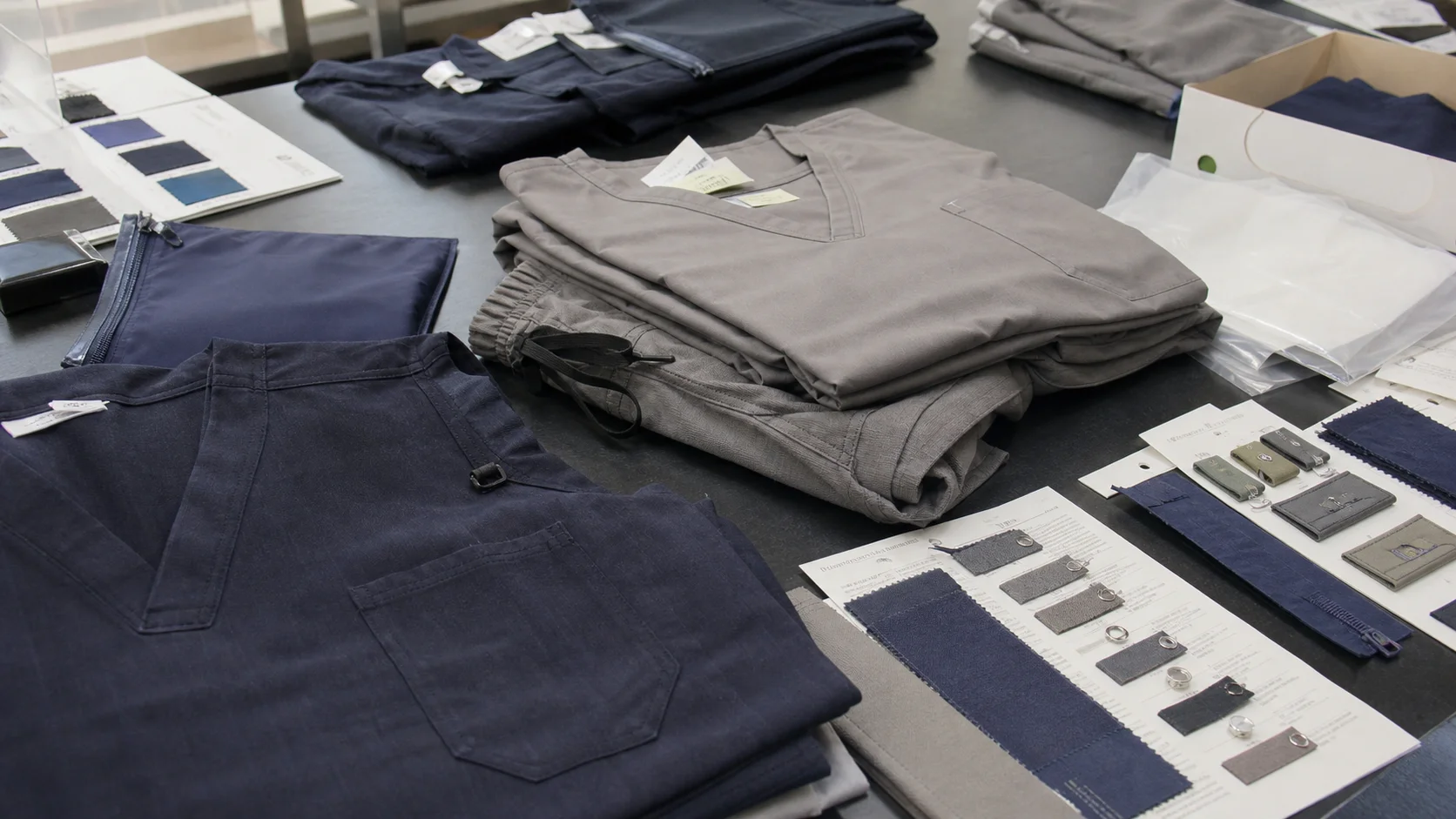
The key point for buyers: the tab cannot be approved only as a flat trim sample. It must be reviewed on the garment fit block. A tab that looks sharp on a supplier’s swatch can still fail when sewn into a curved pocket, a stretch side panel, or a hem that is pressed after wash. Clinic buyers should request garment-mounted samples, not only embroidery strike-offs.
Purchasing judgment: treat the micro embroidery tab as both a decoration item and a construction component. If it is sewn into the garment, it can affect fit, comfort, and production consistency.
Micro embroidery tabs are most useful when the clinic wants subtle branding rather than a large visible logo. They also work well when garments need department differentiation without making staff uniforms look too promotional. On scrubs and lab coats, small tabs can provide a polished retail-style detail while preserving a professional healthcare appearance.
The best use case is a stable uniform program with recurring orders. Micro tabs make less sense for one-off short runs unless the clinic accepts higher sample and setup costs per unit. They are better suited to clinics that reorder the same fit block season after season and want consistent branding across multiple departments.
The fit block review should happen before bulk approval. It is not enough to approve a size medium sample if the clinic orders XXS through 5XL. Tab placement must scale logically across the size range. A placement that is balanced on a medium scrub top may sit too close to the side seam on smaller sizes or too far from the garment edge on larger sizes.
Ask the supplier to show tab placement on at least the base size and one size near each end of the intended range. For example, a clinic ordering women’s XS to 3XL should review XS, medium, and 3XL if budget and timing allow. If only one salesman sample is possible, the technical specification must still define grade rules for placement.
Typical placement tolerances for small tabs are tighter than for larger decoration. A practical tolerance may be 2 mm to 3 mm for tab alignment and 3 mm to 5 mm for distance from a seam or hem, depending on the construction. For very small tabs, a wider tolerance may make the finished goods look random. Buyers should not accept vague placement language such as “near pocket” or “at lower seam.” The tech pack should specify the exact reference points.
Clinics should consider how staff move during a shift. Scrub tops may pull at the side seam when staff reach forward. Pants may stretch at the waistband and hip. Lab coats may rub against chair arms, counters, and stethoscopes. A tab near a high-friction point can fray faster or irritate the wearer.
During sample review, ask wearers to sit, bend, reach, and layer the garment over typical undershirts or base layers. The tab should not scratch the skin, catch on equipment, or create a stiff spot. This is especially relevant for folded tabs with dense embroidery, because small areas of thread and backing can feel harder than the surrounding fabric.
Not every fit block accepts a tab equally well. A woven lab coat hem may support a folded embroidered tab cleanly. A lightweight stretch scrub top may pucker if a dense tab is sewn into a seam. A ribbed or knit garment may distort around the tab unless stabilized correctly. If the clinic wants one tab design across scrubs, polos, and jackets, each garment type should be checked separately.
Garment Type Common Tab Placement Main Fit Block Risk Buyer Checkpoint Scrub top Side seam, lower hem, pocket edge Puckering, rubbing, uneven placement across sizes Review on base size and extended size Scrub pant Waistband, cargo pocket, side seam Stretch stress, abrasion, laundering curl Test sitting and bending comfort Lab coat Pocket, sleeve, lower side seam Visible misalignment on structured panels Confirm placement tolerance and pressing method Polo or knit top Sleeve hem, side seam, chest tab Knit distortion and needle marks Approve stabilizer and stitch density Warm-up jacket Hem, pocket, zipper facing Bulk at seams and zipper interference Check layering and zipper operationMicro embroidery is demanding because small artwork has limited space for thread path, backing, and trimming. Fine lettering, thin lines, and complex icons may not reproduce cleanly. Purchasing teams should be careful when a supplier agrees to embroider a miniature version of a full corporate logo without revision. A logo designed for signage or websites may need simplification for embroidery at tab scale.
The first sample question should be whether the artwork is embroidery-ready at the intended size. Very small text may close up. Negative spaces may disappear. Thin strokes may look broken. If the clinic requires legibility from normal viewing distance, the embroidery size may need to increase or the design may need to shift from text to icon.
For micro embroidery, block letters often perform better than serif fonts. Simple symbols outperform detailed seals or multi-line logos. Thread color contrast matters. Tone-on-tone embroidery can look refined, but it may be hard to inspect and inconsistent under different lighting. High contrast is easier to control, though it can look more promotional.
Dense embroidery on a small tab can make the tab rigid. Low density can expose the tab base fabric and reduce logo clarity. A balanced stitch file should account for tab material, thread type, artwork size, and wash requirements. Common embroidery threads include polyester and rayon, but polyester is usually the more practical choice for clinic uniforms because it tends to handle repeated washing and bleach exposure better. Exact performance depends on the chemical process, thread supplier, and care instructions.
Backing selection is a frequent source of quality issues. Tear-away backing may be easier for production, but it can leave rough edges if not removed well. Cut-away backing may improve stability but can add stiffness. Water-soluble topping can help on textured surfaces, though it adds process control requirements. Buyers should ask suppliers to define backing type in the approval file instead of leaving it to production discretion.
A strike-off is a test embroidery sample made before bulk production. For micro embroidery tabs, the strike-off should be reviewed for thread color, logo proportions, letter clarity, stitch direction, density, trimming, backing, and tab edge finish. A strike-off on the same tab material is more valuable than a generic embroidery sample on plain fabric.
The tab specification should be treated like a bill-of-materials item. A reliable purchase file should list tab fabric, color, size, fold type, embroidery artwork, thread, backing, placement, seam allowance, and inspection tolerance. If these details are missing, bulk production may still proceed, but the clinic loses leverage when finished goods vary.
Self-fabric tabs use the same fabric as the garment. They can look integrated and soft, but they may be difficult to embroider cleanly if the fabric is lightweight, stretchy, or textured. Twill tabs are stable and often suitable for embroidery, though they may look more like a label than part of the garment. Grosgrain can provide structure and texture, but ribbed surfaces may affect embroidery clarity. Woven label-style tabs can carry very small detail, yet they shift the method away from embroidery and should be evaluated as a different decoration choice.
For clinics, the safest route is usually a stable tab base with a smooth surface, especially when the artwork includes text. If the uniform program emphasizes softness and minimal irritation, a lighter self-fabric tab may be preferred, but the embroidery size and density should be conservative.
Suppliers should match embroidery needle and thread to the tab and garment. A heavy needle can leave visible holes on fine fabric. A thread that is too thick can blur detail. A dense stitch file can cause the tab to cup or curl after pressing. For stretch garments, stabilization is especially important because the tab must not fight against the fabric’s recovery.
Trim color should be approved under the lighting conditions where staff uniforms are usually seen. Clinic interiors often use bright white, cool LED, or mixed lighting. A gray tab that looks balanced in a factory photo may appear green, blue, or dull in the clinic. Physical approval is still better than digital-only approval for brand-sensitive uniforms.
A practical placement note might read: “Folded micro embroidery tab inserted into wearer’s left side seam, bottom edge of tab positioned 45 mm above finished hem, visible tab width 18 mm, visible tab height 12 mm, placement tolerance plus or minus 3 mm, tab to remain flat after wash.” The exact numbers will vary, but the format is useful because it names the garment side, reference seam, distance, visible dimensions, and tolerance.
Purchasing teams should ask for specification sheets before issuing a bulk purchase order. If the supplier cannot document the tab clearly, there is a higher chance that repeat orders will drift.
Minimum order quantities depend on garment type, fabric availability, tab material, embroidery setup, and whether the clinic is ordering stock blanks or made-to-order garments. For stock garments decorated after purchase, MOQs can sometimes start around 24 to 100 pieces per style or logo, depending on the decorator. For custom-manufactured clinic uniforms with micro embroidered tabs, typical MOQs may range from 300 to 1,000 pieces per style/color, and sometimes higher if fabric dyeing or custom trims are involved.
Small clinic teams should be cautious when comparing quotes. A supplier offering a very low MOQ for a custom tab may be using available trims, manual placement, or simplified finishing. That may be acceptable for a pilot order, but it can become inconsistent when the program scales. Larger clinic groups should focus less on the lowest MOQ and more on repeatability, replacement stock, and order consolidation.
Skipping steps can save a week at the beginning and cost several weeks later. The most dangerous shortcut is approving digital artwork only. Micro embroidery does not behave like print. Thread has thickness, direction, sheen, and physical tension. A digital mockup may show perfect detail that thread cannot reproduce at tab scale.
Lead times vary widely. A simple decoration order on available stock garments may take one to three weeks after artwork approval, assuming capacity is open. A made-to-order clinic uniform with custom tab development may take six to twelve weeks after sample approval. Programs involving custom fabric knitting, dyeing, lab dips, imported trims, or multiple size sets may take longer.
Lead time depends on several practical factors:
Purchasing teams should build a calendar around approvals, not just around the quoted production period. If the supplier quotes 45 days after sample approval, but the clinic takes three weeks to approve fit, artwork, and tab placement, the real project calendar is longer. For teams needing development support or schedule clarification, a direct supplier discussion through fabrikn.com/contact-us/ can help define whether the program is better handled as decoration on stock garments or as a custom uniform build.
Inspection for micro embroidery tabs should cover appearance, placement, durability, and comfort. A normal garment inspection may not catch small decoration defects unless the checklist calls them out. Because the tab is small, inspectors need a clear approved sample and measurement method.
Many apparel orders use AQL-based inspection, but micro decoration defects require careful classification. A crooked tab on a clinical uniform may not make the garment unsafe, yet it can be a major brand defect if visible and repeated. Define whether decoration issues are minor, major, or critical before production starts. A reasonable approach is to classify severe misplacement, wrong logo, wrong department color, or unreadable approved text as major defects. Safety or comfort problems, such as sharp backing or exposed hard trim, may need stricter handling.
Inspection should include a measurement check. For example, inspect tab distance from hem, distance from seam, visible tab dimensions, embroidery centering, and thread color. Photos alone are not enough because camera angle can hide crooked placement. The approved pre-production sample should travel with the inspection file or be digitally documented with measurements.
Clinic uniforms are washed frequently. Some are washed at home, while others go through commercial laundering. The care environment changes the risk profile. Home laundering may involve warm water, tumble drying, and consumer detergents. Commercial laundering may involve higher temperatures, stronger chemistry, and heavier mechanical action. If the clinic uses a laundry service, buyers should share care requirements with the supplier before approving thread and backing.
At minimum, a sample should be washed several times before final approval for recurring programs. Look for tab curling, thread bleeding, embroidery shrinkage, fraying, and puckering. A tab that looks neat before wash but curls after laundering will not be acceptable for a clinic uniform program.
Micro embroidery tabs can look premium, but they add more cost and control points than plain garments or simple heat transfers. The cost is not only the embroidery. It includes digitizing, tab cutting, folding, backing, handling, placement, sewing, inspection, and possible sample revisions.
For a small clinic buying fewer than 100 units, a micro embroidery tab may be hard to justify unless the design is simple and the supplier can decorate stock garments efficiently. A standard embroidered chest logo or woven label may be more economical. For a multi-location clinic group ordering several hundred to several thousand units across a year, the tab can be worthwhile because the setup cost is spread over repeat orders and the detail supports a consistent uniform identity.
Direct purchasing judgment: choose micro embroidery tabs when the clinic values a refined, durable detail and has enough volume to control the process. Avoid them when the artwork is too detailed, the order is highly fragmented, or the garment fabric is too unstable to support clean construction.
A clinic purchasing team should not release a bulk order until the supplier can answer practical production questions. The answers do not need to be complicated, but they should be specific. Vague assurances such as “we can do it” or “the logo will be fine” are not enough for a decoration detail that depends on millimeters.
The supplier’s development process matters. A company that understands pattern, trims, decoration, and production planning is better positioned than a decorator who only sees the garment after it is made. If a clinic team wants to understand supplier background and production orientation, reviewing company information at fabrikn.com/about-us/ can provide useful context before deeper quotation discussions.
For a controlled order, request a quotation, artwork proof, embroidery strike-off, tab material specification, garment tech pack or product spec, size chart, care label information, pre-production sample approval form, and inspection checklist. For larger programs, ask for reorder terms and component continuity plans. If a tab material is discontinued after the first order, the clinic may face color and texture mismatch in later deliveries.
A micro embroidery tab is a strong option for clinic uniform programs that need subtle, durable branding and a more finished appearance than standard decoration. It is especially suitable for recurring purchases, multi-location clinic groups, and staff-facing apparel where small details support a consistent identity. It is less suitable for rushed orders, very low quantities, highly detailed logos, or garments made from unstable lightweight stretch fabrics without proper testing.
The fit block review is the deciding step. Approve the tab only after seeing how it behaves on the actual garment pattern, not just on a swatch. Check placement across sizes, confirm comfort during movement, wash the sample, and lock the specification. The best purchase orders will state tab material, embroidery size, thread color, backing, placement, tolerance, and inspection criteria.
If the clinic’s timeline is tight, simplify the design. Use a clean icon instead of tiny text. Limit department color variations. Choose one stable placement across the program. Approve physical samples quickly and keep decision-makers aligned. If brand consistency matters more than speed, allow time for strike-offs, fit block review, wash testing, and pre-production approval.
Final buying view: micro embroidery tabs are worth specifying when the clinic can control the details. Without a fit block review, they are a small decoration with a high chance of inconsistency. With proper sampling and inspection, they can become a durable, professional uniform detail.
Get a free quote from Fabrikn — your trusted B2B clothing manufacturer with 10+ years of experience. MOQ as low as 200 pieces.
Get a Free Quote →A micro embroidery tab is a small sewn-in or attached fabric tab carrying compact embroidery. Clinics may use it for subtle branding, department identification, or a premium uniform detail on scrubs, lab coats, polos, or jackets.
The tab interacts with the garment pattern, seam, fabric stretch, and wearer movement. A fit block review confirms that the tab placement, comfort, and appearance work on the actual clinic uniform style before bulk production.
For stock garments with decoration, MOQs may start around 24 to 100 pieces depending on the decorator. For custom-manufactured uniforms with micro embroidered tabs, common MOQs may range from 300 to 1,000 pieces per style/color, with higher quantities possible for custom fabric or trims.
Sampling can take one to several weeks depending on artwork complexity, tab material availability, garment sample readiness, and the number of revision rounds. A garment-mounted sample generally takes longer than a simple embroidery strike-off.
The main risks are crooked tab placement, unreadable tiny embroidery, puckering, thread tails, tab curling after wash, color mismatch, and rough backing that irritates the wearer. These should be included in the inspection checklist.
Micro embroidery gives a premium stitched appearance, but it may struggle with very tiny detail. A woven label tab can handle smaller text and sharper detail, though it does not have the same embroidered look. The better choice depends on artwork size, budget, and desired finish.
It can be done, but each garment type should be reviewed separately. Different fabrics and constructions behave differently, especially around stretch, seam bulk, and laundering.
Approve the embroidery artwork size, thread color, tab material, backing, tab dimensions, placement, tolerance, garment-mounted sample, wash result, and pre-production sample. Bulk production should not rely on a digital mockup alone.
They can be suitable if the design is simple and the clinic accepts the setup cost. For very small orders, standard embroidery, heat transfer, or stock label options may be more cost-effective.
Keep a complete specification file with approved samples, thread references, tab material details, placement measurements, and inspection photos. Ask the supplier to confirm trim continuity before each reorder.