
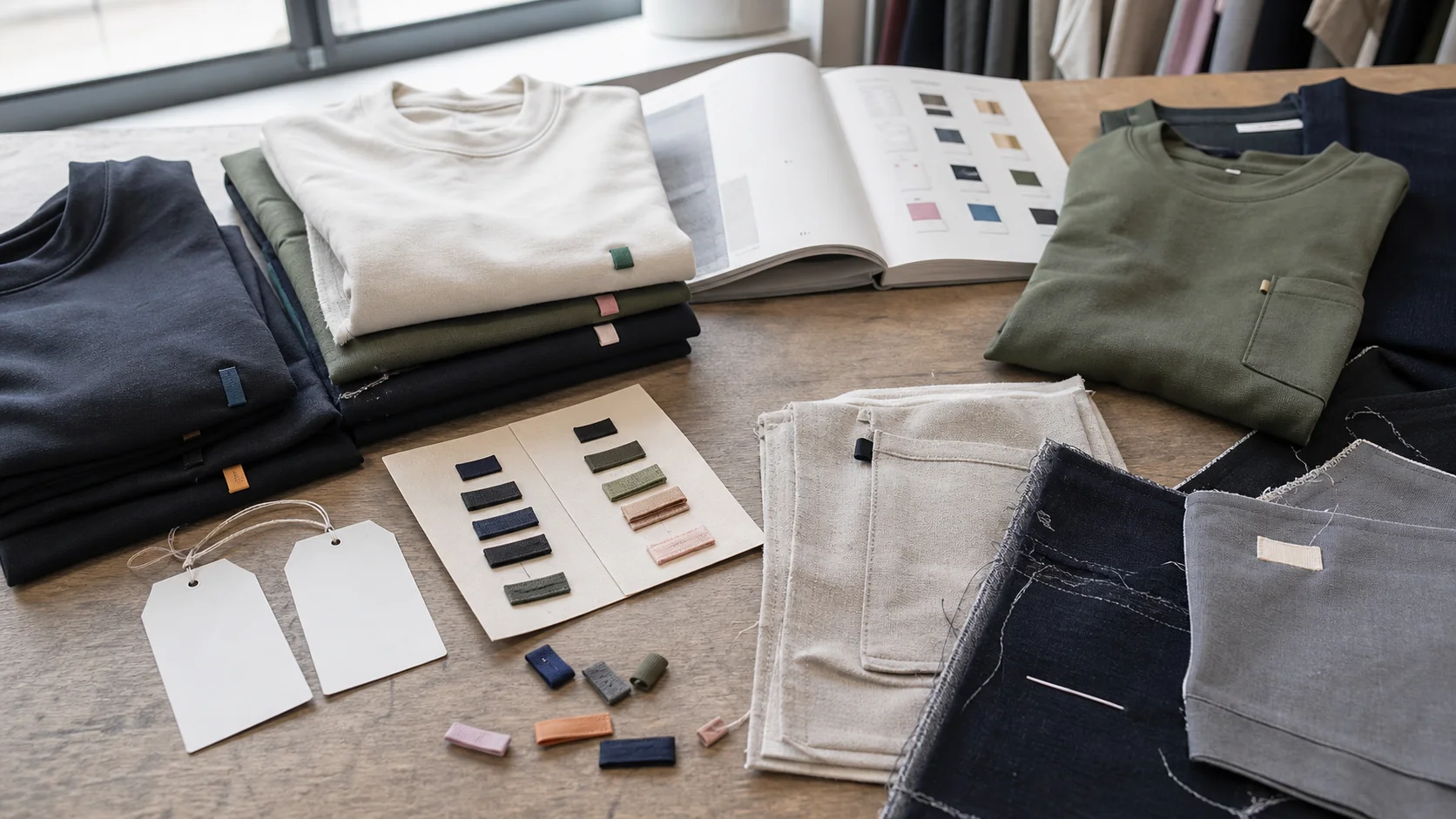
A retail operations-focused outline for evaluating MOQ, pricing, sampling, and production controls for micro embroidery tabs used on apparel and accessory...
Micro embroidery tabs look small on the garment, but they can complicate sourcing fast. For retail operations teams, the real question is not whether the trim looks premium. It is whether the supplier can hold stitch quality, keep pricing stable at the required order size, and meet pack-out expectations without slowing production. A proper micro embroidery tab MOQ pricing review should cover artwork complexity, stitch count, backing choice, label construction, approval steps, and the way minimums change when the decoration is added to an existing program.
In retail programs, micro embroidery tabs are usually used as a subtle brand marker on caps, tees, outerwear, bags, and accessories. They can be sewn into a side seam, applied as a patch, or inserted as a small woven or fabric tab with embroidered branding. Since the unit is small, many teams assume it should be inexpensive. That is not always true. Small pieces can carry more labor per unit than larger decorations because the setup time, thread changes, digitizing, and handling cost do not scale down neatly.
Micro Embroidery Tab MOQ Pricing Review - Decoration & Printing manufacturing guide
A micro embroidery tab is a small branded piece attached to a product as decoration or identification. It may be stitched directly onto a garment edge, folded into a seam, or applied as a small patch. The embroidery itself is usually limited in size, but the term “micro” does not automatically mean “simple.” Small artwork often needs tight digitizing to keep letters readable and borders clean. Thin strokes, tiny icons, and low-height lettering can collapse if the construction is not planned correctly.
Retail teams often use micro embroidery tabs when they want a premium look without a large chest logo or heavy print. That makes the decoration valuable for collections that rely on understated branding. The sourcing problem is that the production team must balance a small visible area with practical factory requirements. If the tab is too small for the stitch density, the result can blur. If the backing is too stiff, it can distort the fabric. If the order size is too low, the decoration cost can be disproportionate to the product cost.
MOQ pricing for micro embroidery tabs is shaped by more than decoration alone. The final price depends on the base material, embroidery method, design complexity, machine setup, and whether the supplier is producing the tab as a standalone component or attaching it to a finished garment. Retail operations teams should treat the tab as a mini-production program, not a simple add-on.
Embroidery requires digitizing, which converts artwork into machine instructions. Even a small tab needs a custom file. Suppliers often spread digitizing costs across the order, which is why low MOQs can look expensive on a per-piece basis. If the design changes after approval, re-digitizing may be charged again. This is one of the easiest ways to lose margin on a small trim program.
More stitches mean more machine time. Micro embroidery can become expensive if the brand insists on dense fills, multi-color threads, or tiny text that needs extra passes for clarity. A simple one-color wordmark is usually cheaper than a multi-color icon with outlined edges. In many cases, a cleaner design with fewer stitches produces a better-looking result at a lower cost. That tradeoff is often worth accepting.
The base material matters. Cotton twill, polyester tape, woven fabric, recycled polyester, and synthetic leather each create different cost and handling profiles. A cut-and-fold tab may cost less than a shaped patch with laser-cut edges. If the tab needs merrowed borders, heat cut edges, or specialty backing, the price rises. The same artwork on two different substrates can land at very different costs.
Costs increase when the tab must be sewn into a product at a specific stage. A loose trim supplied in bulk is simpler than a tab that must be positioned precisely on a seam allowance. Retail teams should ask whether the supplier is quoting decoration only, decoration plus trim assembly, or full garment attachment. These are not the same scope, and comparing them directly can create false savings.
Each thread color adds handling and setup. Metallic threads, specialty matte threads, and brand-matched shades can carry a premium. Standard polyester embroidery thread is usually the most economical. Exact color matching can also create lead-time dependence if the supplier has to source thread before production starts.
If each tab must be bagged, barcode-labeled, sorted by size, or packed per store allocation, the labor cost rises. Retail operations teams often overlook pack requirements until late in the process. A decoration quote that looks competitive on the factory floor may become expensive once compliance pack-out is included.
There is no universal MOQ for micro embroidery tabs, but retail buyers can use practical ranges to judge whether a quote is realistic. The numbers below are typical sourcing benchmarks, not guarantees. Final pricing depends heavily on supplier capability, country of origin, and the exact construction requested.
Program type Typical MOQ range Typical pricing driver Buying judgment Simple micro embroidery tab, one color 500 to 3,000 pcs Setup spread over volume Good for seasonal basics if artwork is clean Multi-color micro embroidery tab 1,000 to 5,000 pcs Thread changes and digitizing complexity Worth it only if the color detail is visible at size Tab plus garment attachment 1,000 to 10,000 pcs Sewing labor and handling Ask for step-by-step scope before comparing quotes Specialty substrate or backing 3,000 pcs and up Material sourcing and process control Better for controlled programs than test buys Low-MOQ pilot run 100 to 500 pcs High fixed cost per piece Useful for market testing, not ideal for marginOn price, small embroidered tabs can vary widely. For reference, low-volume decorated tabs may price anywhere from a few cents to over a dollar per piece depending on construction, while attached or specialty versions can run higher. That spread is normal. The important part is understanding what is actually included in the quote. A quote that looks cheap may exclude digitizing, sampling, packaging, inspection, or the final application to the garment.
For retail operations, the best comparison method is to normalize every quote against the same scope. Ask each supplier to separate development cost, decoration cost, attachment cost, and packaging cost. Without that breakdown, unit pricing is hard to interpret and easy to misread.
Micro embroidery tabs should not go straight from artwork to bulk order without a sample checkpoint. Small decorations are sensitive to proportion. A design that looks good on screen may fail at actual size. Retail operations teams should plan the approval process carefully and build in enough time for correction.
The first sample should confirm legibility, border shape, backing feel, and color alignment. If the tab includes tiny lettering, ask for a magnified photo or close inspection under normal retail lighting. Some issues are only visible at arm’s length. Others only appear after washing or laundering tests. For products with strict consumer expectations, wash performance should be part of the approval scope.
Sample timing depends on supplier workload, artwork complexity, and thread or substrate availability. A simple strike-off may be ready quickly, while specialty materials can extend lead time. Retail planners should avoid locking launch dates before sample approval is complete. The trim is small, but the approval loop can still slow the whole production chain.
Practical sourcing rule: if the sample is not legible at true size, do not approve it just because the artwork file looks correct. Micro embroidery is judged on the finished piece, not the mockup.
Buying teams save time and money when the technical package is specific. “Micro embroidered tab” is too vague for production. The supplier needs measurable requirements. The more precise the brief, the less likely the factory is to interpret the decoration in a way that increases cost or causes disputes later.
Fabric and trim specs matter because they affect both appearance and performance. A soft garment may need a lighter tab so the decoration does not feel stiff against the skin. A bag or cap may support a thicker construction. If the tab is exposed to abrasion, the thread and backing need better durability. If the decoration sits in a high-movement zone, over-dense stitching can cause puckering.
Retail teams should also decide whether the tab is intended to be a branding detail or a compliance identifier. Those two uses can require different standards. A brand tab needs visual consistency. A functional label may need durability and readability. Mixing the two can create confusion in production and in the final product review.
Micro embroidery tabs are small enough that defects can hide until final inspection. That makes the risk profile different from larger decoration programs. Buyers should watch for issues that are easy to miss during sampling but costly in bulk.
Inspection plans should include an AQL or equivalent checking method suited to the program risk. For low-cost trims, some teams inspect only finished garments, but that can be too late. It is often smarter to inspect decorated tabs before attachment or before final packing. A decoration defect caught early is easier to correct than one discovered after full assembly.
If the order is seasonal and time-sensitive, build in a contingency window. Micro embroidery can stall if machines need re-threading, if a backing material arrives late, or if the first bulk run shows a readability issue. The smaller the decoration, the more careful the factory must be. Speed without control is usually a false saving.
Retail operations teams should not evaluate micro embroidery tab pricing in isolation. The decoration needs to be weighed against the product line, margin target, launch calendar, and inventory risk. A slightly higher unit cost may be acceptable if it reduces rework or keeps the product on schedule. A cheap quote that causes delays can cost more than the decoration itself.
These questions force the quote into a usable format. They also reveal whether the supplier understands retail program discipline. A solid vendor should be able to explain how MOQ changes when the design complexity changes. They should also be able to flag when a requested finish is not realistic at the target price point.
For teams building recurring programs, consistency matters more than chasing the lowest first order. If the tab becomes part of a core assortment, the supplier needs to hold color, size, and stitch behavior across repeats. That often rewards a slightly more capable vendor over a cheaper one that struggles with repeatability.
For broader production support and decoration planning, see fabrikn.com/services/. If you are comparing options for development or production support, a direct inquiry through fabrikn.com/contact-us/ can help clarify scope early. Company background and capabilities are outlined at fabrikn.com/about-us/.
The biggest mistake in a micro embroidery tab MOQ pricing review is assuming that the lowest MOQ is the safest choice. Low MOQ can be useful for market testing, retailer exclusives, or new brand launches. It is not usually the best route for a scaled retail program. The per-unit price almost always improves as the order size grows, but only if the supplier can keep the same decoration standard.
Retail teams should think in terms of total landed cost and program risk. A low-MOQ run may protect the buyer from overstock, but it can inflate unit cost enough to compress margin. A larger MOQ may improve cost efficiency, but it increases inventory exposure if the product underperforms. The right answer depends on sell-through confidence, assortment breadth, and how reusable the decoration is across styles.
There is also a quality tradeoff. Some factories are strong on sample work but less consistent on bulk repeatability at smaller sizes. Others handle volume well but struggle with delicate micro detail. That is why inspection data, not just price, should guide vendor choice. In decoration sourcing, repeatability is usually worth paying for.
Best practice: compare suppliers on the same finished size, same stitch scope, same backing, same packaging, and same delivery window. If those variables are different, the price comparison is not reliable.
A micro embroidery tab looks simple on a line sheet, but it carries the same sourcing discipline as a larger decoration program. MOQ pricing is shaped by setup, stitch count, substrate choice, attachment method, and the amount of handling required to deliver a clean retail-ready piece. For retail operations teams, the smartest approach is to define the construction tightly, approve a physical sample before bulk, and compare suppliers on fully loaded scope rather than headline price.
When the artwork is restrained and the specs are clear, micro embroidery tabs can deliver a polished brand detail without excessive cost. When the design is crowded or the brief is vague, the decoration can become disproportionately expensive and hard to control. The practical answer is to keep the tab small, the instructions precise, and the approval process disciplined.
Get a free quote from Fabrikn — your trusted B2B clothing manufacturer with 10+ years of experience. MOQ as low as 200 pieces.
Get a Free Quote →Typical MOQs often start around 500 to 3,000 pieces for simple programs. More complex designs, specialty substrates, or attached applications may need 1,000 to 5,000 pieces or more. Low-pilot runs are possible, but unit cost is usually higher.
Small size does not reduce setup time, digitizing, thread handling, or quality control. Tiny lettering and multi-color designs can also increase machine time. If attachment and packaging are included, the price rises further.
Approve the finished size, artwork, thread colors, backing, edge finish, placement, and packaging format. A physical sample is important because micro embroidery can look different on screen than in production.
Lead time depends on sample approval, material availability, and order size. Simple programs can move quickly after approval, while specialty materials or multiple revisions can extend the schedule. Plan extra time for development.
Unreadable lettering, puckering, loose threads, frayed edges, inconsistent size, and color variation are the most common issues. These are easier to catch if tabs are inspected before final garment packing.
Not necessarily. Low MOQ helps reduce inventory risk, but it often raises unit cost. For repeat programs, a higher MOQ may be better if it improves cost, consistency, and supply reliability.