
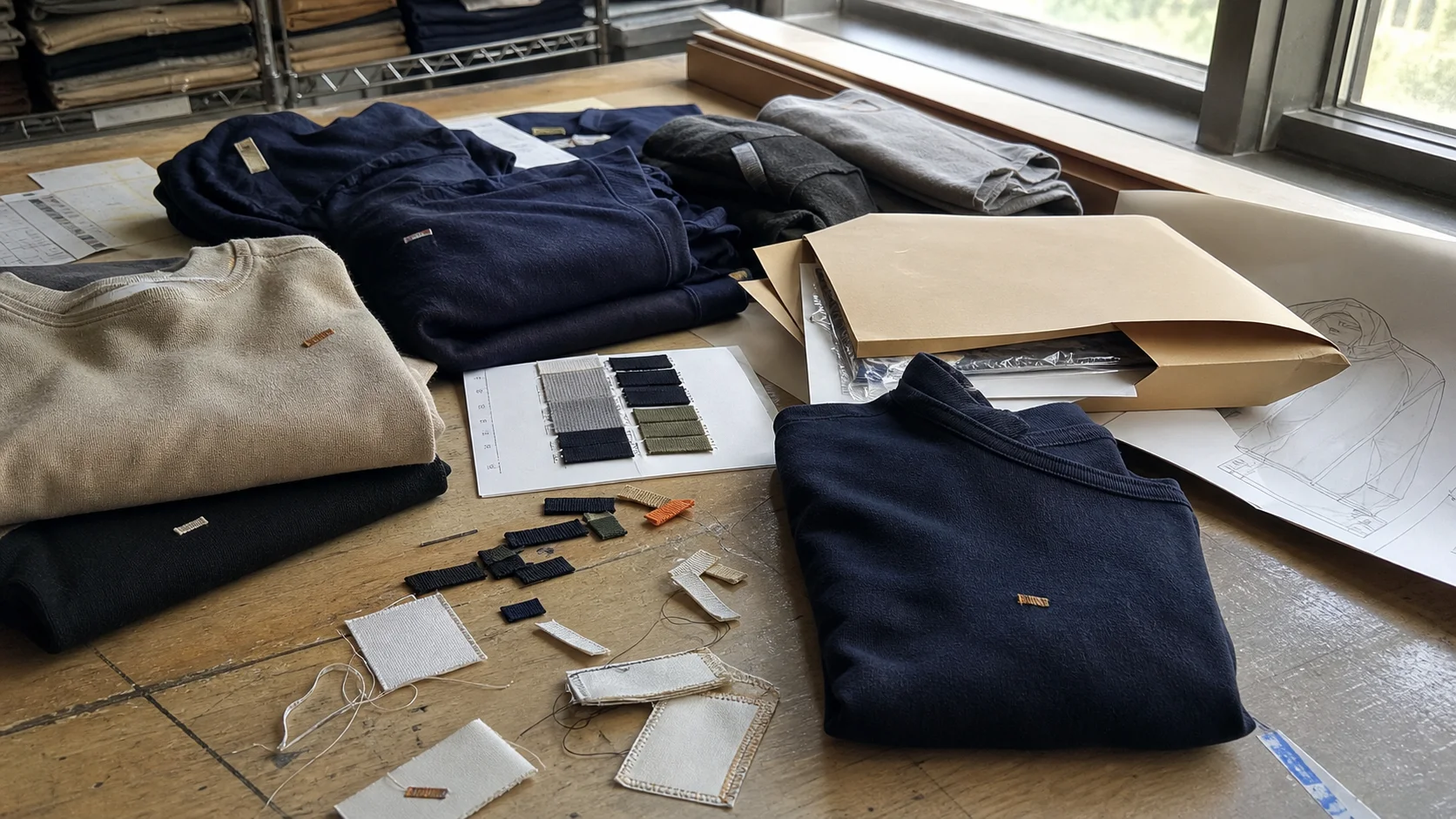
A facilities-manager-focused outline for reviewing micro embroidery tab order fit blocks before approving uniform decoration, with emphasis on legibility,...
Micro Embroidery Tab Order Fit Block Review - Fabrikn production reference
For facilities managers sourcing decorated uniforms, a micro embroidery tab order can look simple on a purchase sheet and become difficult in production. Small logo tabs, sleeve tabs, pocket tabs, name tabs, and compliance tabs sit in tight spaces where stitch density, fabric behavior, placement tolerance, and garment fit all meet. A proper fit block review is the safeguard that keeps a small decoration from disrupting comfort, durability, laundering performance, and brand consistency.
This guide reviews how to assess micro embroidery tab orders for facilities teams buying workwear, maintenance uniforms, security apparel, housekeeping garments, technical service shirts, and other staff-issued apparel. The focus is practical: what to approve, what to specify, where orders fail, and which tradeoffs matter before bulk production begins.
A micro embroidery tab order fit block review is the evaluation of small embroidered tabs against the approved garment pattern, size set, construction, and intended use. The review checks whether the decoration works on the actual fit block rather than only on a flat artwork file or a loose fabric swatch.
A fit block is the base pattern or standard garment shape used across sizes. In uniform sourcing, the block controls shoulder width, chest ease, sleeve position, pocket location, placket width, hem shape, and other measurements that affect daily wear. When a tab is added, especially a small embroidered tab, it can interfere with seams, pocket openings, sleeve movement, waistbands, ID badge clips, radio loops, and laundering performance.
Micro embroidery generally refers to very small stitched artwork, lettering, symbols, or brand marks. It may be used on a woven or cut-and-sewn tab that is attached to a garment edge, pocket seam, sleeve seam, placket, side seam, collar, or hem. The tab may be decorative, functional, identification-based, or compliance-related.
The fit block review answers several buying questions:
The review is especially important when the tab is small. Small details leave little room for thread spread, cutting variation, seam allowance variation, and operator handling. A logo that looks clean at 40 mm wide on screen may become crowded at 18 mm wide on a folded tab.
Facilities managers usually buy uniforms for function first. Garments must be easy to issue, durable, washable, consistent by department, and acceptable to staff who wear them for long shifts. Decoration is part of that system. It helps identify teams, reinforce brand standards, and support visitor-facing professionalism. Poorly executed tabs can do the opposite.
A small tab placed in the wrong location can catch on equipment, irritate skin, curl after washing, or make a shirt look uneven. If the tab includes department codes or small lettering, low legibility can create confusion during rollout. If the embroidery is too dense, it can cause puckering that makes otherwise acceptable garments look defective.
Facilities teams also face replacement ordering. A hospital, university, hotel, warehouse, airport service provider, or property group may need repeat orders over several seasons. The first order must be documented well enough for future production to match. A fit block review creates that reference point.
For buyers comparing decoration options, it may help to review broader production capabilities before locking a method. Fabrikn’s services page is a useful internal starting point when mapping decoration, garment development, and production needs into one sourcing brief.
Purchasing judgment: micro embroidery tabs are best used when the mark is simple, the placement is protected, and the garment construction can hold the detail consistently. They are not the right choice for every small logo or every uniform fabric.
A fit block review should not be treated as a branding-only exercise. Facilities managers should ask for the tab to be reviewed on the actual garment block, not on a generic shirt, jacket, or trouser. If the order covers both men’s and women’s fits, each block should be checked. If the order includes extended sizes, the tab placement should be graded or controlled so it does not drift into awkward positions.
Key fit block points include chest, shoulder, sleeve, pocket, waist, and hem relationships. On a work shirt, a tab near the chest pocket may look balanced on size medium but too close to the armhole on small sizes or too high on larger sizes if placement is not defined correctly. On a sleeve tab, the decoration may rotate backward or forward depending on sleeve pitch and wearer movement. On trousers, a waistband or side seam tab can rub under belts or tool pouches.
The supplier should define whether placement is measured from fixed points such as center front, shoulder seam, pocket edge, sleeve hem, side seam, or bottom hem. For repeat orders, “same as sample” is not enough. Measurement points and tolerances should be written into the tech pack or order confirmation.
Fit Block Area Tab Review Question Common Risk Chest pocket Does the tab avoid pocket opening and pen slots? Tab interferes with access or sits crooked after washing. Sleeve seam Does the tab remain visible during normal arm movement? Logo rotates out of view or rubs against the arm. Side seam Does the tab avoid belts, harnesses, and tool pouches? Tab catches or frays during use. Hem Does the tab hang flat on tucked and untucked wear? Tab curls, flips, or creates a cheap appearance. Collar or placket Does the tab create irritation or stiffness? Wearers complain or reject the garment.Micro embroidery has limits. The biggest issue is legibility. Small letters, tight spacing, thin outlines, and multi-color details can collapse when translated into thread. Thread has thickness. Needles displace yarns. Fabric moves. A buyer should not assume that a miniature version of a large logo will work.
For very small tabs, simplified artwork is usually safer. This may mean using initials, a symbol, a single-color mark, or a reduced-detail version of the logo. Satin stitches can work for short strokes, but overly narrow satin columns may break or look uneven. Fill stitches can become dense and stiff when packed into a small area. Fine outlines may disappear, especially on textured tab fabrics.
Stitch density is another risk. Too much density can pucker the tab, distort the edges, or make the tab feel hard. Too little density can expose the ground fabric and make the logo look incomplete. The digitized embroidery file should be tested on the actual tab material, backing, and thread, not just on a standard test cloth.
Color contrast also matters. Facilities uniforms often use dark navy, charcoal, black, khaki, white, or high-visibility colors. A tonal tab may look premium in a showroom but be hard to see in real lighting. A high-contrast tab is easier to read but may look more promotional. For staff uniforms, visibility and consistency usually deserve more weight than subtle branding.
Polyester embroidery thread is common for uniforms because it generally performs better in repeated washing and exposure than rayon. Thread size should suit the artwork scale. Fine thread can improve small detail, but it may affect cost, availability, and production speed. Needle size must match the fabric and thread to reduce cutting, snagging, or visible holes.
Metallic thread, novelty thread, and very fine decorative effects should be treated cautiously for facilities apparel. They may not tolerate industrial laundering, abrasion, or daily use. If the garments will be washed by a laundry service, request wash testing before approving the decoration.
Backing selection affects both appearance and comfort. Cutaway backing can stabilize stretch or soft fabrics but may feel bulky on small tabs. Tearaway backing is cleaner for some stable wovens but may not control distortion as well. Heat-away or specialty stabilizers may be used in specific cases, but they should be tested for residue and wash behavior.
When the tab is attached to a garment after embroidery, the back side may be hidden inside the fold or seam. That can improve comfort. When the embroidery back remains exposed, loose threads and backing edges become inspection points.
The tab is a trim component, and it should be specified like one. Facilities buyers should avoid vague descriptions such as “small logo tab” without material, dimensions, construction, color, and attachment details. A clear trim spec reduces disputes and improves repeatability.
Common tab materials include woven cotton twill, polyester twill, poly-cotton blends, grosgrain tape, canvas, herringbone tape, and custom woven base tape. The right choice depends on garment fabric, laundering requirements, and desired hand feel. A heavy canvas tab on a lightweight polo may pull or curl. A soft tape on a rugged work jacket may fray too quickly.
Specify the tab width, finished length, folded length if applicable, seam allowance, edge finish, and attachment stitch. If the tab is folded into a seam, confirm how much of the tab remains visible after sewing. A 30 mm tab with 8 mm captured in the seam may leave only 22 mm visible. That visible area must still fit the embroidery with enough margin.
Specification Item What to Define Buyer Note Tab base fabric Fiber content, weave, weight, color standard Ask for lab dip or approved physical swatch for repeat orders. Finished dimensions Width, visible length, fold allowance Small dimension changes can affect logo readability. Embroidery thread Fiber type, color reference, finish Polyester is usually safer for wash durability. Backing Type, weight, removal method Check stiffness and exposed edges. Attachment Seam insertion, topstitch, bartack, edge stitch Attachment method affects strength and appearance.Trim color should be controlled with a physical reference where possible. Digital screens are not reliable for navy, black, grey, beige, or safety colors. If the tab sits near a garment panel, the color relationship must be checked under practical light conditions, not only under office lighting.
Placement should be judged on a worn garment, not only on a flat sample. Facilities staff bend, reach, lift, carry, clean, inspect, repair, and move through public areas. Tabs placed at stress points can twist or abrade. Tabs placed where equipment sits can become uncomfortable.
For shirts and polos, chest pocket and sleeve placements are common. Chest placements must respect pocket function, badge lanyards, radios, and safety vests. Sleeve placements must respect arm rotation and sleeve length. A tab near the sleeve hem may disappear under gloves or outerwear. A tab too close to the underarm may rub or become invisible.
For jackets, tabs often sit at the hem, pocket edge, sleeve, or chest seam. Outerwear has more structure, so it can support a tab better, but thicker seams can make placement harder. If the tab is inserted into a seam with multiple layers, factories may need stronger needles, adjusted presser foot settings, and tighter process control.
For trousers, tab placement needs special caution. Side seam tabs can interfere with utility belts, keys, tool loops, and seated comfort. Waistband tabs can be hidden by belts or create pressure. Back pocket tabs may wear quickly if staff carry wallets, devices, or tools.
Typical placement tolerances for small tabs may range from plus or minus 3 mm to plus or minus 6 mm depending on garment type, fabric stability, sewing method, and factory capability. Tighter tolerances can increase cost or slow production. Wider tolerances may be acceptable on rugged workwear but not on premium front-of-house uniforms.
A realistic tolerance is better than an unrealistic one that production cannot meet. For micro embroidery, the buyer should also define acceptable skew or rotation. A tab can be placed in the correct location and still look poor if it tilts noticeably.
Sample approval should move in stages. Skipping steps may save a few days at the start and cost weeks if bulk stock arrives with crooked tabs or illegible embroidery. Facilities managers often work with budget cycles and rollout dates, so approval discipline matters.
A practical sample sequence includes artwork confirmation, digitizing proof, strike-off, trim sample, fit sample, size set review, pre-production sample, and bulk approval. Not every order needs every stage at maximum formality, but high-volume or repeat uniform programs should not rely on artwork approval alone.
Photos are useful for speed, but they are not a full substitute for physical approval when the tab affects touch, stiffness, or wearer comfort. If timing forces photo approval, request close-ups with a ruler, front and back views, worn-garment photos, and lighting that shows puckering or distortion.
For buyers preparing a specification package, Fabrikn’s contact page can be used to start a sourcing discussion with artwork, garment type, order quantity, target delivery date, and known compliance requirements.
Minimum order quantities vary by garment, decoration method, trim sourcing, and factory setup. For facilities managers, the important point is to separate the garment MOQ from the tab or embroidery MOQ. A stock garment with custom tabs may have a lower garment barrier but still require a custom trim or decoration minimum. A fully custom garment may have higher MOQs but better control over placement and construction.
As cautious planning ranges, small decorated uniform orders may start around 100 to 300 pieces when using available garments and straightforward embroidery. More customized apparel programs often begin around 300 to 500 pieces per style or color. Custom tabs, special dyed trims, or multiple size and color splits can push practical MOQs to 500 to 1,000 pieces or more, depending on supplier structure.
Micro embroidery itself may have setup charges or minimum stitch-run requirements. If each department requires a different tab, the order may become a collection of small runs, each with separate setup, sampling, and inspection needs. Consolidating designs can reduce cost and risk.
Order Scenario Typical MOQ Planning Range Lead-Time Dependency Stock garment with simple tab embroidery 100 to 300 pieces Garment stock, thread availability, decoration capacity Custom tab on existing garment block 300 to 500 pieces Trim sourcing, sampling, placement approval Custom uniform with tab integrated into seam 500 to 1,000 pieces or more Pattern work, size set, production line setup Multiple departments with unique tabs Depends on split per design Separate digitizing, setup, approvals, sortingLead time depends on more than stitching time. Artwork revisions, digitizing, trim sourcing, lab dips, fit sample approval, size set review, production queue, inspection, packing, and freight all matter. A simple reorder may move quickly if materials are in stock and the approved file is unchanged. A new custom program can require several weeks before bulk production even starts.
As a planning guide, allow one to two weeks for artwork and digitizing if revisions are needed, one to three weeks for physical sampling depending on material availability, and several additional weeks for bulk production and delivery. International sourcing, custom dyed trims, compliance testing, or peak-season capacity can extend timelines.
Inspection for micro embroidery tabs should be specific. General garment inspection may catch major defects but miss small decoration problems that become obvious when uniforms are issued. A quality checklist should include tab placement, embroidery clarity, thread color, loose threads, puckering, backing, attachment strength, skew, and washing behavior if testing is part of the program.
Common inspection defects include crooked tabs, inconsistent visible length, frayed tab edges, skipped stitches, thread nests, misregistered colors, needle damage, puckering, incorrect thread color, poor trimming, exposed backing, and weak attachment stitching. On dark garments, lint and loose backing fibers may also show around the decoration.
Measurement should be taken from defined reference points. Inspectors should not judge by eye alone. For example, a chest tab may be measured from the pocket top edge and side edge. A sleeve tab may be measured from the sleeve hem and sleeve seam. The approved tolerance must be realistic and documented.
Facilities uniforms are usually washed often. Some are washed at home, while others go through commercial laundry. The tab should be checked after laundering for shrinkage, curling, color bleed, thread fading, edge fray, and stiffness. If garments will be exposed to bleach, sanitizing chemicals, oils, solvents, or outdoor conditions, the trim and thread selection must account for that.
A small wash test can prevent a costly rollout problem. Test at least a few garments with the actual tab and embroidery. If the uniform program is large, testing across sizes and colors is safer. A tab that behaves well on a dark woven shirt may not behave the same way on a lighter knit polo.
Facilities orders often involve many sizes, departments, roles, and locations. Micro tab variations increase sorting risk. If housekeeping, maintenance, security, engineering, and front-desk teams each have different tabs, packing must be controlled with clear SKU labeling. The supplier should provide cartons and polybags labeled by style, size, color, and decoration version.
Ask whether replacements can be ordered later in small quantities. If replacement MOQs are high, the facilities team may need extra inventory by size and department. The cost of overstock must be weighed against the disruption of unavailable uniforms.
A micro embroidery tab can be a polished uniform detail when the artwork is simple, the tab material is stable, and placement is controlled. It can also become an unnecessary complication if the logo is too detailed, the order is split into too many versions, or the garment fabric cannot support the decoration cleanly.
The best purchasing decision starts with the use case. For front-of-house uniforms where brand detail matters, a small embroidered tab may justify the extra sampling and inspection. For heavy maintenance garments, a woven label, heat transfer, direct embroidery, or larger patch may be more durable and easier to read. For high-turnover roles, simplicity may be more valuable than a premium trim detail.
Cost should be reviewed as total program cost, not unit decoration cost only. A tab may add costs through digitizing, trim sourcing, sampling, sewing operations, inspection time, replacement stock, and sorting. If the tab helps standardize uniforms across departments, the cost may be justified. If it creates multiple low-volume variants, it may complicate procurement.
Buyers should also consider brand hierarchy. A main chest logo, name badge, department color, and micro tab can compete visually. Too many identifiers make a uniform look busy. A restrained tab works best when it has a clear purpose: brand accent, department marker, compliance cue, or premium finishing detail.
Direct sourcing advice: do not approve bulk production until the tab is reviewed on the actual fit block, in at least one worn sample, with placement measurements recorded. The smaller the embroidery, the less room there is for assumptions.
For organizations evaluating supplier fit, it is also worth reviewing company background and production approach. Fabrikn’s about us page provides context for buyers comparing partners for apparel development and decorated uniform sourcing.
A clear specification package makes the order easier to quote, sample, produce, and inspect. Facilities managers do not need to write a technical manual from scratch, but they should provide enough detail to prevent interpretation gaps.
The strongest programs keep a sealed approved sample or detailed sample record. If the physical sample cannot be retained by every stakeholder, use high-resolution photos with rulers, color references, and written measurements. A production file should include the final embroidery file version, thread references, tab material reference, placement diagram, and approval date.
Before issuing the purchase order, facilities managers should confirm that the supplier has quoted the same specification that was approved. Small changes in tab size, thread type, backing, or placement can alter the result. If the quote says “custom tab embroidery” but does not mention material, dimensions, or placement tolerance, ask for clarification before approval.
The purchase order should reference the approved sample, decoration file, garment style, size breakdown, delivery schedule, packing instructions, and inspection standard. If the order is for multiple facilities or departments, define how substitutions are handled. Do not assume a supplier can replace a missing department tab with a similar version unless that is approved in writing.
A fit block review is not bureaucracy. It is risk control. Micro embroidery tabs are small, but the operational consequences of poor execution can be large: delayed rollout, inconsistent staff appearance, wearer complaints, rejected units, and difficult reorders. A careful review at the start gives procurement, operations, and the supplier a shared standard.
Get a free quote from Fabrikn — your trusted B2B clothing manufacturer with 10+ years of experience. MOQ as low as 200 pieces.
Get a Free Quote →A micro embroidery tab is a small fabric tab with embroidered artwork, lettering, or a symbol attached to a uniform. It may appear on a pocket, sleeve, side seam, hem, placket, or other garment area. Facilities teams use it for branding, department identification, or detail finishing.
A small tab can affect placement, comfort, movement, and garment appearance. The fit block review confirms that the tab works on the actual garment shape and size range, not only on artwork or a flat fabric sample.
Typical planning ranges may start around 100 to 300 pieces for stock garments with simple embroidery, 300 to 500 pieces for custom tabs on existing blocks, and 500 to 1,000 pieces or more for fully custom uniforms. Actual MOQ depends on garment type, trim sourcing, decoration setup, size split, and supplier capacity.
Sampling may take one to three weeks after artwork is confirmed, depending on digitizing, tab material availability, factory workload, and shipping. Custom dyed trims, multiple revisions, or full fit samples can extend the timeline.
Simple artwork works best. Short initials, clean symbols, bold shapes, and limited colors are safer than small text, thin lines, gradients, or complex logos. The design should be tested as a physical strike-off at the final size.
Photo approval can help when timing is tight, but physical approval is safer for checking stiffness, backing, tab thickness, and true color. If photo approval is used, request ruler shots, front and back views, close-ups, and worn-garment photos.
Polyester embroidery thread is commonly preferred for uniforms because it usually handles repeated washing better than rayon. The final choice should consider laundry method, chemical exposure, color requirements, and artwork scale.
The main risks are illegible embroidery, puckering, crooked placement, inconsistent tab length, frayed edges, loose threads, exposed backing, weak attachment, color mismatch, and poor performance after laundering.
They can be used, but they require careful stabilization and testing. Stretch fabrics can distort under embroidery and washing. A strike-off and attached sample should be reviewed before bulk approval.
The purchase order should reference the approved garment style, fit block, size breakdown, tab material, embroidery file, thread colors, placement measurements, tolerance, approved sample, packing instructions, inspection requirements, and delivery schedule.