
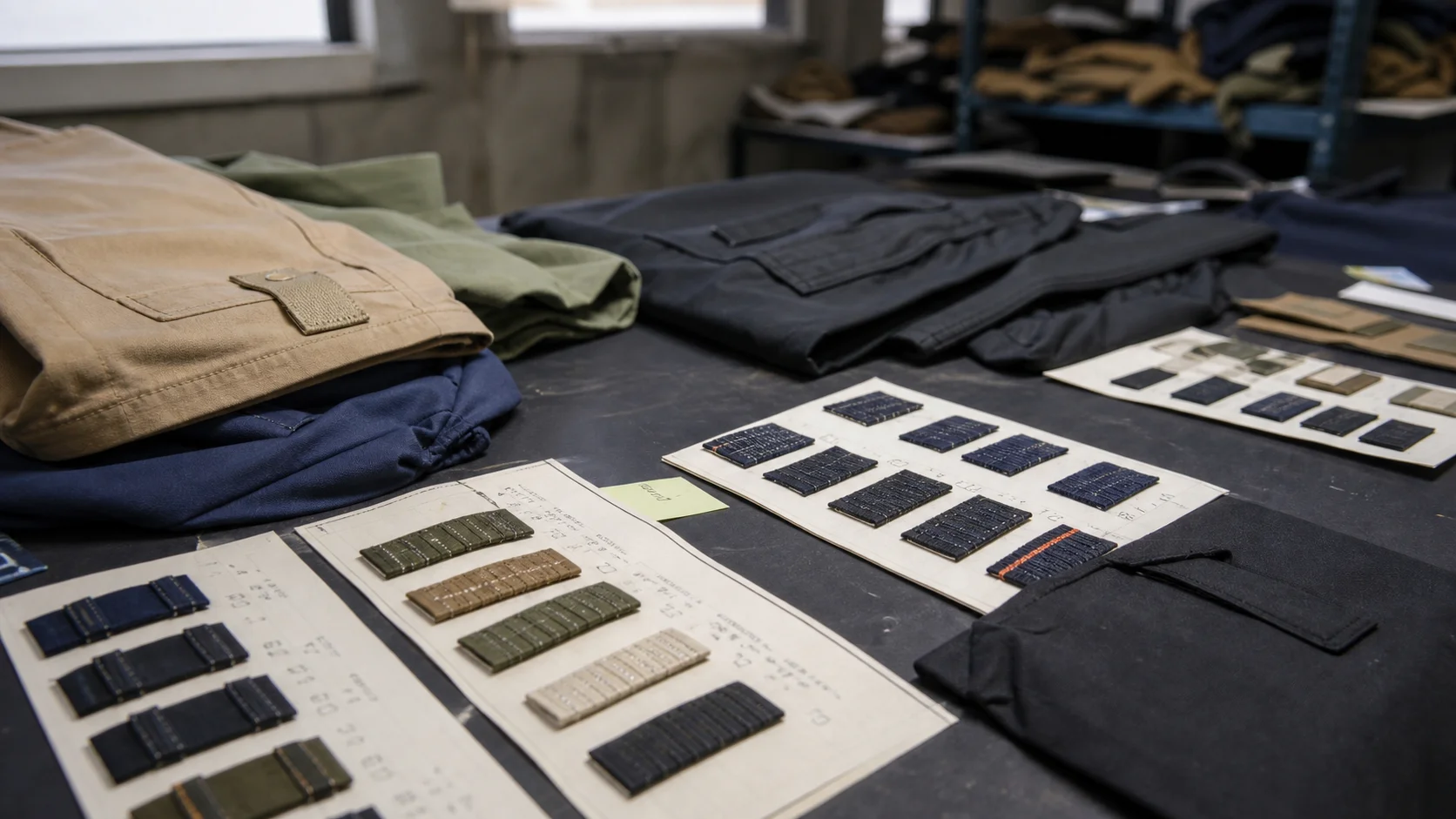
A durability-focused SEO outline for construction safety buyers evaluating micro embroidery tab prints on workwear, high-vis garments, PPE-adjacent...
Micro Embroidery Tabs Durability Review for Safety Teams - Decoration & Printing manufacturing guide
Category: Decoration & Printing
Micro embroidery tabs are small woven or fabric tabs carrying a compact logo, safety mark, size cue, department code, or identification detail. In construction safety apparel, they are commonly attached to vests, jackets, work shirts, cargo trousers, flame-resistant outerwear, tool pouches, and sometimes removable accessories. They look minor on a specification sheet, but they can become a repeat quality issue if the decoration is poorly matched to washing, abrasion, reflective tape placement, or jobsite handling.
For safety teams, the main question is not whether a micro embroidery tab looks sharp on a pre-production sample. The better question is whether it remains legible, secure, and non-irritating after repeated laundering, sun exposure, dust, sweat, harness friction, and contact with rough surfaces. A tab that curls, bleeds, frays, puckers, or loses contrast can make a uniform program look cheap. In regulated or semi-regulated environments, unclear markings may also create confusion between crews, subcontractors, visitor groups, or access levels.
The short buying judgment is this: micro embroidery tabs are usually stronger than small printed tabs for abrasion resistance and premium appearance, but they need disciplined artwork simplification, controlled stitch density, stable backing, and careful placement. Printed micro tabs can be cost-effective for very fine detail or color gradients, yet they are more exposed to cracking, fading, and surface wear unless the ink system and base fabric are tested properly. For construction safety teams ordering repeat uniform programs, embroidery is often the safer default for small brand tabs, while print is better only when the graphic detail cannot be stitched cleanly.
Durability is not a single test result. For micro tabs, it is the combined performance of thread, base fabric, backing, edge finish, attachment seam, artwork scale, and final garment care conditions.
Buyers should treat micro embroidery tab print durability review as part of the overall decoration approval process, not as an afterthought. The review should cover fabric and trim specs, decoration method, sample approval, wash testing, rub testing, seam pull strength, colorfastness, and final inspection. If the program includes high-visibility garments, tab placement must also avoid interference with reflective tape, certified label information, and visibility zones.
A micro embroidery tab is a small branding or identification element, usually smaller than a conventional chest patch. Typical dimensions range from 15 mm to 50 mm wide, depending on the garment type and logo complexity. Some are folded woven tabs sewn into a seam. Others are flat fabric tabs stitched onto the garment surface. A few combine a printed base with embroidered detail, which is why buyers often use the phrase “micro embroidery tab print durability” when reviewing mixed decoration constructions.
Common tab positions include side seams, lower front hems, chest pocket edges, sleeve openings, collar seams, waistband areas, cargo pocket flaps, and back neck positions. On safety vests and jackets, tabs are sometimes placed near pockets or lower hems to avoid reflective tape. That location can be practical, but it also exposes the tab to tool belts, harness straps, glove contact, kneeling, bending, and site dirt.
The tab may serve one of several functions:
Micro tabs are attractive because they are subtle, repeatable, and less expensive than large embroidered panels. They also reduce the risk of heavy decoration distorting lightweight mesh or breathable high-visibility fabric. That said, small size creates a real production constraint. Tiny lettering, thin outlines, and complex icons often fail when translated into embroidery. A design that works at 80 mm may not work at 22 mm.
Construction safety teams purchase apparel for hard use. Garments may be washed in domestic machines, industrial laundries, or informal site conditions. They can be exposed to concrete dust, oils, metal edges, timber, sunlight, rain, sweat, and repeated mechanical friction. A micro tab must survive this environment without becoming the weak visual point of the garment.
Durability also affects perception. A safety vest with intact reflective tape but a curled or frayed brand tab may still function, yet the wearer and buyer see a quality problem. On large rollouts, small defects multiply quickly. If 5% of tabs begin lifting after several washes, the complaint rate can be high enough to disrupt reorders.
Safety teams should evaluate durability in four practical ways:
A tab is not usually a safety compliance component by itself. Still, it sits on a safety garment and must not compromise the garment. If the tab covers reflective material, hides certification labels, creates a snag hazard, or causes discomfort under harnesses, it becomes a procurement problem. Buyers should require placement drawings and full-size samples before bulk production.
Micro embroidery and printed tabs both have valid uses. The right choice depends on artwork detail, garment fabric, intended life cycle, washing method, and budget. The mistake is treating them as interchangeable because both are small.
Embroidery generally performs well against abrasion because the color is carried by the thread rather than a surface ink layer. Good polyester thread can withstand repeated laundering, light chemical exposure, and moderate UV exposure better than many low-cost print systems. Embroidery also creates a dimensional, premium look that suits durable workwear.
For safety teams, embroidery is often suitable for simple logos, initials, small icons, and color-coded tabs. It is less suitable for tiny legal text, gradients, photographic elements, or very thin lines. Dense stitching on a small tab can make the tab stiff. On lightweight mesh vests, stiffness can cause puckering or discomfort.
Printing can reproduce fine detail that embroidery cannot handle at micro scale. Heat transfer, screen print, silicone print, and digital transfer can all be used depending on the tab substrate. Printed tabs are usually flatter and lighter than embroidered tabs, which may be useful on thin garments.
The durability risk is surface dependency. If the print film or ink does not bond well to the tab fabric, it can crack, peel, fade, or rub off. This is especially relevant when tabs are placed near pockets, hems, or tool contact areas. Print durability must be tested against the actual fabric, not a similar fabric from a supplier drawer.
Some programs use a printed background with embroidered letters or a printed logo with an embroidered border. This can improve appearance, but it also adds failure points. The print may fade while the embroidery remains strong, creating uneven aging. The embroidered border may also stress the printed film if stitch density is too high.
Decoration Option Best Use Main Durability Risk Buying Judgment Micro embroidery Simple logos, icons, short text, premium workwear Fraying, puckering, thread snagging, poor small-letter clarity Strong choice for repeat safety uniform programs when artwork is simplified Printed tab Fine detail, small text, gradients, flat lightweight tabs Cracking, peeling, fading, poor ink bond Useful when detail matters more than raised texture, but testing is essential Hybrid print and embroidery Layered branding, contrast borders, premium visual detail Uneven aging between print and thread Acceptable for controlled programs, not ideal for the lowest-risk construction useThe durability of a micro embroidery tab starts with the substrate. A beautiful stitch file cannot rescue a weak base fabric. For construction apparel, the tab material should be chosen for abrasion resistance, dimensional stability, wash behavior, and compatibility with the garment body.
Common tab substrates include polyester twill, nylon twill, cotton twill, woven label tape, canvas, grosgrain, and coated synthetic fabric. Polyester twill is often a balanced option because it washes well, holds color, and supports embroidery. Nylon can be strong but may react differently to heat, which matters when transfers, heat pressing, or high-temperature laundering are involved. Cotton has a natural look but can shrink, fade, and absorb soil more readily.
For high-visibility garments, the tab base color should be reviewed against the garment color. A dark tab on fluorescent yellow or orange can look sharp, but it may create a visual interruption if placed poorly. The tab should not reduce the effective visible area of a garment where visibility standards are relevant. Buyers should ask the garment supplier to confirm placement against applicable design rules for the target market.
Polyester embroidery thread is usually the practical default for workwear. It resists washing, sunlight, and abrasion better than rayon in many industrial-use contexts. Rayon has a soft sheen and is common in fashion decoration, but it is not usually the first choice for construction safety apparel that will see repeated laundering and outdoor wear.
Thread size matters. Standard embroidery thread can become bulky on a tiny tab. Finer thread may improve detail but can reduce surface robustness if poorly specified. The stitch file should be digitized for the actual tab size, not scaled down from a larger logo. Scaling down without redigitizing often causes thread crowding, needle breaks, rough edges, and unreadable letters.
Backing stabilizes the embroidery during stitching and helps prevent distortion. Tear-away backing is common, but it may leave rough remnants if not removed cleanly. Cut-away backing offers more stability but can add stiffness. Heat-seal backing may help edge control on some tabs, though heat compatibility must be verified.
For safety apparel, backing should not create scratchy edges or hard points against the wearer. This is important when tabs sit near the neck, side seam, or waistband. A tab that passes visual inspection but irritates skin under sweat conditions will still create complaints.
A reliable durability review uses both lab-style checks and practical garment-level review. Formal test methods vary by market, buyer, and product category. Safety teams do not need to over-engineer every small tab order, but repeat programs should have clear pass/fail criteria.
Useful test categories include:
Wash testing should be performed on a finished garment or a garment panel with the final tab attached. Testing loose tabs alone is not enough. The seam, placement, garment fabric, and laundering movement all affect the result. A tab sewn onto mesh behaves differently from a tab sewn onto heavyweight cotton duck.
Buyers should request before-and-after photos under consistent lighting. They should also request notes on curling, edge fray, thread fuzzing, shrinkage, print cracking, color bleeding, and seam damage. A simple rating scale can be enough for many programs: Grade 5 for no change, Grade 4 for slight acceptable change, Grade 3 for noticeable but functional change, Grade 2 for unacceptable appearance, and Grade 1 for failure.
The most common failure pattern for micro embroidery tabs is not dramatic breakage. It is gradual appearance decline. The tab may begin to curl at the edge. Threads may fuzz. Small letters may become less crisp. A printed background may fade faster than the embroidered border. These issues are often visible before the main garment fails.
Construction safety apparel may be washed more aggressively than corporate uniforms. Soil removal can involve stronger detergents, warm water, pre-soaking, and repeated drying. High heat can shrink natural fibers, weaken some adhesives, and distort heat-applied print films. If the tab uses both embroidery and print, the wash program must suit both components.
Typical approval targets for standard workwear tabs are 10 to 25 domestic wash cycles for initial validation. For long-term uniform programs, 50-cycle testing gives better confidence. Industrial laundry programs may need buyer-specific testing because chemistry, temperature, and mechanical action vary widely.
A tab near a pocket or lower hem can rub against gloves, tapes, tools, scaffolding, and material edges. Embroidery usually handles light abrasion well, but raised stitches can snag. Satin stitches on narrow letters are more vulnerable than filled areas with balanced stitch direction. Printed tabs may look clean at first but lose surface detail when repeatedly rubbed.
Placement can solve many abrasion problems. A tab placed under a tool belt line is asking for damage. A tab placed near a harness contact point may fail faster and irritate the wearer. For safety vests, tabs should be placed where they do not compete with reflective tape and where they avoid heavy fold zones.
Outdoor crews expose garments to UV, rain, dust, and temperature swings. Polyester thread is usually a reasonable choice for sunlight resistance, but not all thread qualities are equal. Low-grade dyed thread may fade unevenly. Printed tabs need UV-resistant inks or transfer films if they are expected to remain readable outdoors.
Weather exposure also affects edge finish. Folded woven tabs often resist fraying better than raw-edge fabric tabs. Merrowed or heat-sealed edges can help, depending on tab size and substrate. On very small tabs, bulky edge finishing can overwhelm the design, so the buyer must balance durability with appearance.
A strong purchase order should not say only “add small embroidered tab.” That leaves too much room for interpretation. The specification should define size, artwork, thread, base fabric, backing, edge finish, placement, attachment seam, color tolerance, wash requirement, and inspection method.
Artwork should be simplified before sampling. Very small letters below roughly 4 mm in height may lose clarity in embroidery, depending on font and thread. Thin outlines, sharp corners, tight gaps, and multi-color shading should be reviewed carefully. For micro scale, a clean block font often performs better than a detailed brand typeface.
Color matching also needs discipline. Embroidery thread, print ink, tab fabric, and garment fabric reflect light differently. A Pantone reference helps, but it does not guarantee identical appearance across materials. Buyers should approve a physical standard under normal daylight and indoor lighting.
Micro tabs look simple, but they can slow production when artwork, placement, or durability requirements are unclear. A practical sourcing process reduces delays by locking the tab early, before bulk garment cutting and sewing.
The buyer should approve both the loose tab and the sewn application. A loose tab may look acceptable on a table but twist or pucker when sewn onto mesh or lightweight fabric. Final placement should be measured from stable garment points such as seam edges, pocket edges, or hem folds.
MOQ depends on supplier setup, tab construction, artwork complexity, and whether the garment order is produced at the same facility. As a practical guide, simple micro embroidered tabs may start around 100 to 300 pieces for sampling or small runs, while more efficient bulk pricing often begins around 500 to 1,000 pieces. Custom woven or printed base tabs may require 500 to 2,000 pieces, especially if special yarn, color dyeing, mold charges, or dedicated print setup is involved.
For garment programs, the final MOQ is usually driven by the garment fabric and sewing line, not the tab alone. A supplier may accept 300 custom tabs but still require 500 or 1,000 garments per color/style for efficient production. Buyers planning multi-style safety programs should ask whether one shared tab can be used across vests, jackets, and trousers to improve purchasing efficiency.
Typical lead time for a loose tab sample may be 5 to 10 working days after artwork confirmation. A sewn garment sample may take 10 to 20 working days depending on garment complexity and fabric availability. Bulk tab production may add 7 to 20 working days, while full garment production commonly depends on fabric booking, trims, cutting, sewing capacity, inspection, and freight mode.
Lead time increases when buyers request special reflective-compatible placement, flame-resistant materials, industrial laundry testing, multiple colorways, or revised digitizing. The most common delay is artwork rework after the first sample shows that micro lettering is too small. Buyers can avoid this by requesting a stitch simulation and a realistic size mockup before the first physical sample.
For broader manufacturing coordination, buyers can review production capabilities through Fabrikn’s services and use early technical discussion to align decoration, fabric, and order planning. When specifications are already developed, the contact page is the practical next step for sharing artwork, garment type, target quantity, and performance expectations.
Inspection should cover more than whether the tab is present. Small tabs are prone to inconsistency because operators handle them quickly and positioning tolerances are tight. A one-centimeter placement error may look minor on a large back print, but it can look obvious on a pocket tab.
AQL inspection should include a defined check for decoration quality. For safety apparel, buyers often use general garment AQL levels for major and minor defects, but micro tab criteria should be added to the inspection checklist. A missing tab, wrong placement, severe color mismatch, or illegible required mark should usually be treated as a major defect. Minor thread tails or slight position variance may be minor if they fall within approved tolerance.
The sealed sample is the buyer’s strongest inspection tool. It should include the approved tab, garment fabric, stitch quality, position, and care label instructions. Photos are useful, but they do not replace a physical standard when thread sheen, stiffness, and edge quality matter.
For construction safety teams, the best decoration method is the one that survives the real use case with the fewest complaints. Micro embroidery tabs are a good choice when the design is simple, the program repeats across seasons, and the buyer wants a durable premium trim. Printed micro tabs are a good choice when very fine detail is essential and the tab location is protected from heavy abrasion. Hybrid tabs should be reserved for programs with enough volume and testing time to manage the extra variables.
The strongest purchasing approach is to limit complexity. Use fewer colors, bigger letters, stable base fabric, polyester thread, and a placement that avoids high-friction zones. A simplified tab may look less dramatic in a presentation deck, but it will usually look better after 25 washes than a crowded miniature logo.
Buyers should also consider whether the tab is necessary on every garment. A tab on a jacket sleeve may make sense for a branded supervisor program. A tab on a low-cost disposable vest may not justify the setup and inspection burden. For large safety rollouts, it may be better to invest decoration budget in compliant reflective layout, stronger fabric, reinforced pockets, or clearer size labeling.
Cost tradeoffs are straightforward. Embroidered tabs usually cost more than basic printed marks, but they can reduce replacement complaints when placed correctly. Printed tabs can be cheaper at volume and better for detail, but only if the ink or transfer system is proven against wash and abrasion. The cheapest tab is not cheap if it causes rework, late shipment, or visible failure during the first month of use.
Procurement teams should ask suppliers for the following before approval:
Buyers comparing supplier capability should look for clear technical communication, not just low decoration pricing. A supplier that flags unreadable artwork before sampling is doing the buyer a favor. A supplier that accepts every tiny logo without comment may deliver a sample that looks crowded, stiff, or inconsistent. Fabrikn’s background and sourcing orientation can be reviewed on the about us page for buyers assessing fit before opening a specification discussion.
Before placing a bulk order for micro embroidery tabs on construction safety apparel, safety teams should confirm the following points:
Micro embroidery tabs can be durable and professional on construction safety garments, but only when treated as engineered trims rather than decorative afterthoughts. The best results come from practical artwork, stable materials, cautious testing, and inspection criteria that match the working environment. For repeat safety programs, that discipline is usually worth the time because it reduces avoidable defects and protects the appearance of the uniform program over its service life.
Get a free quote from Fabrikn — your trusted B2B clothing manufacturer with 10+ years of experience. MOQ as low as 200 pieces.
Get a Free Quote →Yes, they can be durable enough when made with stable base fabric, colorfast polyester thread, proper backing, and secure stitching. The tab should be tested on the final garment fabric because placement, washing, and abrasion can change performance.
Embroidery is often more abrasion-resistant because the color is in the thread rather than a surface print layer. Print may be better for tiny details, gradients, or very small text, but it needs stronger wash and rub validation.
Small sample or pilot runs may start around 100 to 300 pieces, while bulk efficiency often begins around 500 to 1,000 pieces. Custom woven or printed base tabs may require 500 to 2,000 pieces depending on materials, colors, and setup.
For basic workwear, 10 to 25 domestic wash cycles can provide an initial durability view. For repeat uniform programs or harsher laundering, 50-cycle testing is more useful. Industrial laundry programs should be tested against the actual laundry process where possible.
The most common risks are unreadable small lettering, edge fraying, curling, stitch crowding, thread fuzzing, and weak attachment seams. Poor placement can also create abrasion damage or interfere with reflective tape.
They can be used, but placement must be reviewed carefully. The tab should not cover reflective tape, reduce required visible areas, hide compliance labels, or sit in a high-friction zone where it will fail quickly.
Simple logos, short initials, bold icons, and block lettering work best. Thin lines, tiny text, gradients, and complex outlines should be simplified or moved to a printed solution if clarity is more important than raised texture.
The specification should include tab size, base material, thread type, backing, edge finish, artwork file, color reference, placement diagram, attachment method, wash requirement, rub test expectation, and inspection criteria.