
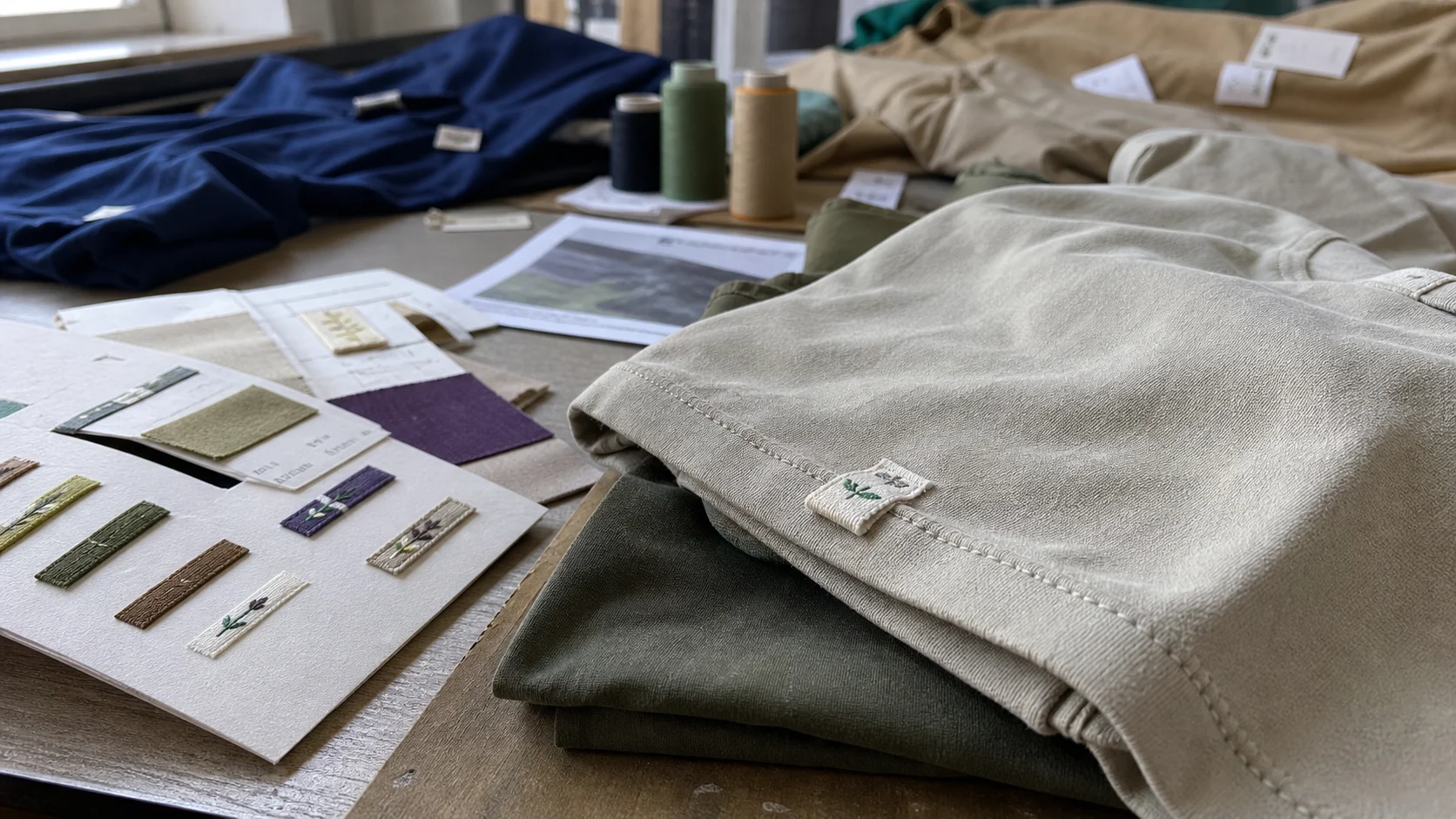
A distributor-focused quality control outline for custom micro embroidery tabs, covering stitch clarity, tab construction, placement, durability testing,...
Micro Embroidery Tab QC Checklist for Buyers - Fabrikn production reference
Custom micro embroidery tabs look simple on a finished garment, but they are one of the easiest decoration details to get wrong in bulk production. For distributor buyers, a small tab can carry a brand mark, size identifier, campaign message, care cue, collection code, or premium detail. When the embroidery is tiny, the production tolerance is also tiny. A slight thread shift, poor edge sealing, wrong backing, or uneven tab placement can turn a polished garment into a reject.
This checklist is written for distributor buyers sourcing custom micro embroidery tabs across apparel categories such as T-shirts, hoodies, workwear, caps, knitwear, bags, uniforms, and promotional merchandise. It focuses on practical quality control points: artwork preparation, stitch density, fabric selection, tab construction, attachment accuracy, color approval, bulk inspection, and packaging risks.
Micro embroidery tab QC should not be treated as a final inspection task only. The best results come from controlling the process before bulk production starts. Buyers should lock the artwork, approve an actual stitched sample, define measurable tolerances, and make sure the supplier understands how the tab will be attached to the garment. Small decoration parts leave very little room for guesswork.
A micro embroidery tab is a small fabric or woven base label decorated with miniature embroidery and then attached to a garment or accessory. It may be folded over a seam, inserted into a side seam, stitched onto a cuff, applied near a hem, sewn onto a cap panel, or placed on the edge of a pocket. The tab is usually small, often between 10 mm and 40 mm wide, although exact size depends on the design and end use.
The term “micro embroidery” refers to very small embroidered lettering, symbols, icons, or logos. It does not mean the same thing as standard left-chest embroidery scaled down. Small embroidery requires careful digitizing, correct thread selection, controlled stitch density, and enough fabric stability to keep details readable.
For distributor buyers, the tab usually serves one of three purposes:
Micro embroidery tabs can be produced as standalone trims and sewn into garments later, or they can be embroidered directly onto small fabric pieces before garment assembly. The QC approach changes depending on whether the buyer is inspecting loose tabs, finished garments, or both.
Distributors often manage multiple customer orders, variable logo files, tight delivery windows, and mixed garment styles. A micro tab defect may appear minor, but customers usually inspect decoration details closely because those details carry their brand. If the tab is crooked, unreadable, or inconsistent across sizes, the issue becomes visible immediately.
Micro embroidery has a narrower approval window than many standard decoration methods. Screen printing can tolerate some fine-line variation, and woven labels can handle small text if properly woven. Embroidery, by contrast, creates design detail with thread thickness, stitch direction, and tension. At very small scale, a letter may fill in, a dot may disappear, and a curved shape may become blocky.
Quality control matters because the defect often cannot be repaired cleanly after sewing. Removing a tab from a finished garment may leave needle holes, broken seam threads, fabric distortion, or shade marks. Rework is slower and more expensive than catching the issue at sample or inline inspection stage.
Purchasing judgment: If the artwork depends on tiny text below practical embroidery limits, do not approve bulk production based only on a digital mockup. Require a physical stitched sample at actual size.
Distributor buyers should also consider customer expectations. A premium apparel customer may reject slight placement variation. A budget promotional campaign may accept minor variation if the logo is readable and the tab is securely attached. QC standards should match the order value, brand sensitivity, and resale risk.
Micro embroidery tabs are used across many apparel categories, but each application has different risk points. The same tab that works well on a heavyweight hoodie may not perform well on a lightweight performance T-shirt. Fabric movement, seam construction, washing behavior, and visual contrast all affect final quality.
Side seam tabs require alignment through garment assembly. If the tab is inserted during sewing, operators need a clear notch or positioning guide. Hem tabs are more visible, so angle and distance from the edge must be controlled. Pocket tabs need secure stitching because they may be pulled during use. Cap tabs face curved surfaces and thicker seams, which can make attachment uneven.
For stretchy fabrics, the tab may ripple after washing if the fabric base and garment body behave differently. For heavy fabrics, the tab edge may not sit flat unless the base material is compatible with the garment. For performance garments, buyers should check whether the tab backing irritates the wearer or affects stretch recovery.
A clean spec sheet prevents many production disputes. The buyer should not rely on a mockup image alone. A micro embroidery tab requires a written specification that defines material, dimensions, artwork, placement, attachment method, color, tolerance, packaging, and inspection requirements.
Where possible, attach a technical drawing rather than only a lifestyle image. A drawing should show the exact tab position on each garment type and size range. If the order includes multiple garment styles, confirm whether the same tab size and placement works on all styles.
Buyers working on broader apparel programs can align tab QC with overall sourcing requirements through a structured development process. For support on production planning and decoration execution, buyers can review Fabrikn’s services.
Artwork is one of the main reasons micro embroidery tabs fail. A logo that looks sharp on screen may not stitch clearly at 15 mm wide. Before approving the order, buyers should check whether the design is suitable for embroidery at actual size.
Digitizing converts artwork into stitch instructions. For micro embroidery, good digitizing is not just file conversion. It controls stitch direction, underlay, density, pull compensation, trims, tie-ins, and sequencing.
Purchasing judgment matters here. If the logo loses too much detail at the requested size, choose a larger tab, simplify the mark, switch to woven label production, or use a printed tab. Forcing embroidery to reproduce artwork beyond its physical limits usually leads to rejects.
The tab base must support tiny stitches without puckering, fraying, shrinking, or distorting. It also needs to match the garment’s intended look and use. A high-shine polyester tab may look out of place on washed cotton workwear. A raw cotton tab may shrink or curl after laundering if not tested.
Polyester embroidery thread is widely used because it offers good wash resistance, colorfastness, and durability. Rayon has a soft sheen but may be less robust in some laundering or industrial use conditions. For workwear, kidswear, hospitality uniforms, and frequently washed items, buyers usually lean toward polyester thread unless a specific finish is required.
Thread color should be approved against a physical shade reference. Digital color matching is not enough. Specify whether the reference is Pantone, thread card number, or approved physical sample. If exact brand color is critical, request lab dips or thread shade cards before sampling.
Backing supports embroidery during stitching. The wrong backing can make the tab stiff, itchy, bulky, or unstable. Tear-away backing may be suitable for stable materials, while cut-away backing may be needed for stretch or soft substrates. Wash-away films can help with surface texture but must be fully removable and compatible with the fabric.
Check the back of the tab during sample approval. Long thread tails, rough backing edges, excessive stiffness, or adhesive residue can create complaints even when the front looks acceptable.
A disciplined sample approval process protects the buyer before money is tied up in bulk production. Micro embroidery tabs should move through approval stages in a clear order. Skipping steps may save a few days early but can create larger delays later.
The pre-production sample should become the benchmark for bulk inspection. Buyers should keep one approved sample and require the factory to keep one matching reference. If the supplier changes thread, backing, base fabric, machine setup, or attachment operator method, a revised sample may be needed.
For new programs or complex decoration packages, early communication with the manufacturer reduces risk. Buyers can use Fabrikn’s contact page to discuss project requirements, timelines, and decoration planning.
Bulk QC should cover both loose tab production and garment attachment. Many buyers inspect only the finished garment, but defects may start earlier at the tab production stage. If tabs are made separately and then supplied to a cut-and-sew line, inspect the trims before sewing begins.
Inline inspection is valuable when the tab is inserted during sewing. Once the seam is closed, a missing or misaligned tab becomes harder to repair. For side seam tabs, an inspector should check the first pieces from each operator or line before the team continues.
Tolerances should be realistic for the product type. If a buyer sets a tolerance that is too tight for the construction method, the order may become slow and expensive. If the tolerance is too loose, the finished goods may look inconsistent. The goal is to define what customers will accept and what the supplier can repeatedly produce.
These are not universal standards. They are starting points for buyer-supplier discussion. A 12 mm tab on a luxury polo may require a stricter tolerance than a 35 mm tab on a utility tote. Buyers should define major, minor, and critical defects before inspection.
Not every defect has the same impact. A tiny loose thread on the back of a hidden seam tab may be minor. An unreadable logo on a customer-facing hem tab is more serious. Distributor buyers should classify defects based on visibility, brand impact, durability, and safety.
Purchasing tradeoff: For a low-cost promotional order, accepting minor cosmetic variation may be reasonable if the tab is secure and the logo is recognizable. For a retail or corporate uniform program, placement inconsistency and color mismatch can damage brand perception. The inspection standard should be set before production, not argued after goods are packed.
MOQ for custom micro embroidery tabs depends on the supplier’s setup, material sourcing, embroidery complexity, and whether tabs are produced as loose trims or attached to garments. Typical loose custom tab MOQ may start around 500 to 1,000 pieces for simple designs, while more efficient pricing often appears at 2,000 to 5,000 pieces. Some apparel factories may align MOQ with garment production minimums rather than tab minimums.
For fully custom garment programs, MOQ may be driven by fabric dyeing, garment style, size breakdown, or decoration setup. A distributor ordering blanks with applied custom tabs may face different minimums from a buyer producing a private-label garment from scratch.
As a cautious planning range, a simple micro embroidery tab strike-off may take several business days after artwork confirmation. Bulk tab production may require one to three weeks depending on quantity, design, and supplier capacity. When attached to garments, the overall timeline follows the garment production schedule, which may range from a few weeks for stocked blanks to longer periods for custom cut-and-sew programs.
Cost is influenced by stitch count, color changes, tab base material, cutting method, backing, attachment labor, inspection requirements, and order quantity. A very small tab is not automatically cheap. Machine setup, handling, trimming, folding, and precise sewing can be labor-intensive relative to the size of the part.
Micro embroidery tabs reward careful planning. Buyers who approve only a digital mockup are taking an avoidable risk. The decoration is small, but the QC process should be structured.
Embroidery is best when the design has simple shapes, limited colors, and enough scale for thread to form clean detail. If the design has tiny text, gradients, or very fine lines, compare embroidery against woven, printed, silicone, TPU, or heat transfer options. The best purchasing decision may be to change the decoration method rather than force a poor embroidery result.
A stitch-out on a random fabric does not prove the tab will work on the final base material. A tab sample without garment attachment does not prove placement and seam quality. For important orders, approve the decoration and the application together.
Loose tab inspection is faster than finished garment rework. If tabs are defective before attachment, stop them before they enter production. This is especially important for side seam tabs, pocket tabs, and folded tabs sewn into construction seams.
Define what counts as major, minor, and critical. Use the approved pre-production sample as the visual standard. Include measurement tolerances on the purchase order or technical pack. Verbal standards are difficult to enforce when the order is late.
Small trims can be lost, damaged, or rejected during production. Buyers often plan a small overage, depending on order value and supplier policy. Exact allowance should be agreed in advance. If the tab is custom and the garment production cannot proceed without it, running short can delay the entire shipment.
A distributor handling a one-time event order may prioritize delivery and basic appearance. A distributor supplying a retail chain, corporate uniform buyer, or repeat branded merchandise program should invest more in sampling, wash testing, and inline inspection. Higher QC cost can be justified when replacement risk is high.
Buyers evaluating manufacturing partners should look for clear communication, realistic sampling feedback, and the ability to manage decoration details across garment production. More background on Fabrikn’s sourcing approach is available on the about us page.
Before approving shipment, distributor buyers should review the following points against the approved sample and purchase order:
The strongest QC system for custom micro embroidery tabs is built before production starts: workable artwork, accurate digitizing, stable materials, approved physical samples, measurable tolerances, and inspection at the right production stages. Buyers who treat the tab as a technical trim, not just a small decoration, reduce rework, customer claims, and shipment delays.
Get a free quote from Fabrikn — your trusted B2B clothing manufacturer with 10+ years of experience. MOQ as low as 200 pieces.
Get a Free Quote →Many embroidery setups need text around 4 mm to 5 mm high for reliable readability, but the practical limit depends on font, thread, fabric, density, and digitizing quality. Buyers should approve a physical stitch-out at actual size before bulk production.
Typical loose tab MOQ may start around 500 to 1,000 pieces for simple designs, with better pricing often at 2,000 to 5,000 pieces. For garment programs, the MOQ may be driven by garment production minimums, fabric sourcing, or decoration setup requirements.
Both stages matter. Inspect loose tabs before sewing to catch logo, size, color, edge, and backing defects. Then inspect finished garments for placement, angle, seam security, puckering, and overall appearance.
Polyester thread is often preferred for durability, wash resistance, and colorfastness, especially for uniforms, workwear, kidswear, and frequently washed garments. Rayon can provide a softer sheen, but buyers should confirm performance requirements before choosing it.
Common defects include unreadable small text, wrong thread color, excessive stitch density, puckering, frayed edges, crooked placement, loose attachment stitching, backing residue, and inconsistent folding.
Sometimes, but not always. Complex artwork may need simplification, a larger tab, fewer colors, or a different decoration method such as woven label, printing, or heat transfer. A physical sample is the safest way to confirm feasibility.
For many promotional garments, plus or minus 3 mm to 5 mm may be commercially acceptable. Premium retail, uniforms, or highly visible placements may require tighter tolerance. The tolerance should be agreed before production and checked against an approved sample.
Start with a clear technical spec, approve an actual stitched sample, test attachment on the real garment, define defect classifications, inspect loose tabs before sewing, and use a pre-production sample as the final reference for bulk QC.