
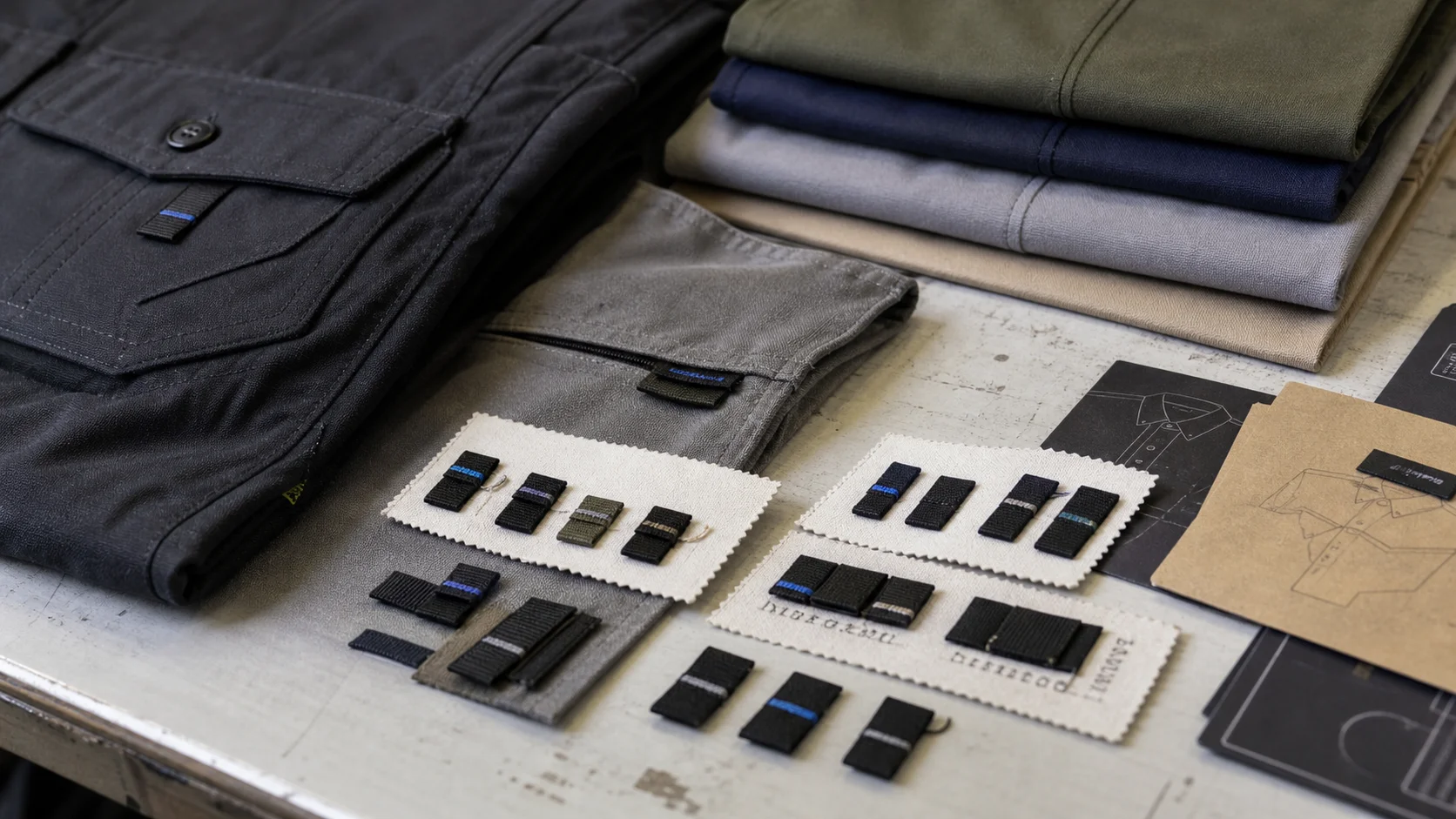
A practical quality control checklist for micro embroidered tabs on security uniforms, covering stitch count, edge finish, backing adhesion, legibility,...
Micro embroidery tabs look simple until they start failing in the field. A small logo, rank marker, or ID tab can carry the weight of a brand standard, uniform compliance rule, or site-specific identification system. For security contractors, that small patch is not decorative filler. It is a controlled component that has to be readable, durable, consistent, and acceptable across repeated wash and wear cycles.
This checklist is built for sourcing, inspection, and production approval. It focuses on the practical issues that usually cause rejection: poor stitch definition, unstable borders, loose backing, inconsistent sizing, weak adhesion, color drift, and placement errors. It also covers sample approval steps, typical MOQ ranges, and inspection risks that matter when tabs are produced for uniforms, tactical apparel, or managed service programs.
Micro Embroidery Tab QC Checklist for Security Contractors - Decoration & Printing manufacturing guide
Micro embroidery tabs are small embroidered identifiers used on garments, caps, outerwear, bags, or accessories. In security programs, they often carry a company name, site code, rank, department label, or role identifier. The term “micro” usually refers to smaller dimensions and tighter detail than a standard patch, which means the design has to be simplified and stitched with controlled density.
These tabs can be:
Security contractors usually need tabs that are legible from a short distance, compliant with uniform standards, and stable through wash and abrasion. The product spec should treat the tab as a controlled uniform component, not a casual decoration.
Security uniforms are used in environments where identification and consistency matter. A tab that curls, frays, peels, or loses contrast creates a presentation problem and can become a compliance issue. In managed uniform programs, the cost of a bad batch is not limited to replacement. It also includes rework, delayed deployment, and extra inspection time at receiving.
QC matters most because these products often sit at the intersection of several demands:
For that reason, sourcing teams should inspect micro embroidery tabs as a functional identification item. If the tab fails, the garment may still wear correctly, but the uniform program still fails.
Uniform decoration for security work should be judged by legibility, retention, and repeatability first. Visual appeal is secondary to the control points that keep the tab readable and attached over time.
A good QC process starts before the first sample is stitched. If the purchase order is vague, inspection becomes guesswork. The spec should define the design, size tolerance, thread behavior, backing type, edge finish, and placement rules.
MOQ depends on construction, number of colors, and whether the design is custom cut. For small embroidery tabs, common ranges are:
Very low quantities are possible in some setups, but unit cost tends to rise sharply. Small programs sometimes make sense for testing a new site or a pilot security contract. For repeat orders, standardization usually lowers both cost and defect risk.
For tighter programs, keep written approval of size, thread color, backing, and placement. Verbal approval is weak evidence when the wrong tab arrives later.
A usable QC system works in stages. Each stage catches different problems, and skipping a stage usually shifts the cost downstream.
Micro embroidery is sensitive to over-detailing. Fine lines, tiny gaps, and compact letterforms can fill in or collapse. The design should be simplified before production rather than “fixed” on the machine.
Thread and base cloth matter more than many buyers expect. A low-grade backing or unstable fabric can make the patch twist after the first wash. The result looks like a stitching issue, but the root cause is often material selection.
At this stage, inspect under normal light and close inspection. A patch that looks acceptable from a distance can still fail if the border is weak or the letters are closing in. Close review is essential for small-size embroidery because the margin for error is narrow.
In-line checks are the best place to catch drift. Once the machine settings move or a new operator loads the wrong backing, the defect can multiply quickly. A small run can still produce a large rejection rate if no one is watching for drift.
Final inspection should be tied to a practical acceptance standard. For many programs, the major risk is not one obvious defect but a pattern of minor inconsistency that shows up across the lot.
Micro embroidery tabs fail in predictable ways. A QC checklist should be designed around those failure points rather than generic patch inspection.
When text is too small or too dense, the letters close up. This is common with narrow fonts, stacked lines, and logos that are scaled down without redesign.
Thin base material, poor edge sealing, or weak border construction can cause the tab to curl after washing. This is especially visible on small rectangular tabs.
Thread dye lots can vary slightly. For security contractor programs, color shifts are noticeable when tabs are repeated across a uniform fleet.
Heat-seal adhesive, hook backing, or sew-on reinforcement can fail if the substrate, temperature, or stitching is wrong. Adhesive-backed tabs need careful validation because field conditions are rarely controlled.
Even a well-made tab can be rejected if it lands in the wrong position on the garment. Placement standards should be measured from a fixed point, not estimated by eye.
A practical inspection standard should be simple enough for warehouse or receiving staff to apply. The goal is not to create a lab document. The goal is to reject bad product before it is distributed.
Exact tolerance should match the product and decoration method. A tiny tab with a lot of detail deserves tighter control than a plain name bar. Buyers should not assume one tolerance fits every micro embroidered item.
It is worth noting that inspection should be paired with a realistic use case. A patch that survives handling in a warehouse still needs to survive actual wear on a uniform. For programs with repeated laundering, a wash test is not optional.
The approval path for micro embroidery tabs should be written into the order flow. Unclear sampling rules create delays and increase the chance of an argument over what was “approved.”
For high-volume security contractor programs, a pre-shipment sample or top carton review is often the best compromise. It gives one last chance to catch packing errors, label problems, or lot variation.
Lead time is rarely just a machine schedule. Material availability and sample approval speed often determine whether the order ships on time. If the program needs custom thread colors or special backing, add buffer time.
Security contractors usually want a tab that looks sharp, lasts, and stays easy to read. Those goals can conflict. A higher stitch density may improve coverage but also stiffen the tab. A thinner base fabric may feel cleaner but can fray more easily. The right answer depends on use conditions.
Buyers should choose based on the uniform system, not the patch alone. If the jacket fabric is textured, heat seal may not perform well. If the program needs role changes, removable tabs may be the better option even if the cost is a little higher.
Before placing an order, ask direct questions that reveal whether the supplier understands small-format embroidery and uniform use. If the answers are vague, the risk usually shows up in the first sample or the first bulk shipment.
For broader uniform programs, it helps to align the tab order with the rest of the sourcing plan. Teams working with a single vendor for decoration and trim coordination often reduce handoff errors. Useful starting points include the services page, the about page, and the contact page when you need a production conversation rather than a catalog search.
The best repeat-order programs are the ones with the least room for interpretation. If the first order is approved with a clear spec, the next orders become faster and more consistent. That matters for security contractors who need controlled replenishment across multiple sites.
Repeat orders should also note any changes to uniform fabric or garment supplier. A tab that worked on one jacket style may perform differently on another due to surface texture, stitch density, or application method. That is a common place where otherwise good programs lose consistency.
Small decoration items are easy to under-specify. That usually looks efficient at ordering time and expensive at receiving time. A tight spec reduces both the rejection rate and the administrative load.
This summary works best when it is attached to the purchase order and shared with the supplier before production begins. If the supplier knows the inspection logic, fewer surprises reach the warehouse.
Get a free quote from Fabrikn — your trusted B2B clothing manufacturer with 10+ years of experience. MOQ as low as 200 pieces.
Get a Free Quote →The biggest risk is losing legibility at small size. Dense stitching, thin lettering, or overcomplicated artwork can make the tab hard to read before the product even leaves production. Edge quality and backing failure are close behind.
Many suppliers quote around 100 to 300 pieces for simple repeat designs and 300 to 500 pieces for more complex or custom-shaped tabs. Special backings, multiple colorways, or mixed-size programs can push the MOQ higher.
That depends on the garment and how the uniforms are used. Sew-on is usually safer for long-term durability. Heat-seal can save labor, but it depends on the fabric surface, application temperature, and wash conditions. Some programs use both for extra retention.
Check finished size, stitch clarity, thread color, border finish, backing type, and overall legibility. The sample should also be reviewed on the actual garment if placement and attachment are part of the spec.
Tolerance should match the size and complexity of the design. Small tabs often need tighter control than larger patches. A practical standard usually covers dimensions, alignment, edge quality, thread consistency, and visible defect limits.
For repeat uniform programs, yes. Wash testing helps confirm that the patch keeps its shape, color, and attachment after real use. It is especially useful for heat-seal or adhesive-backed tabs.
The PO should include artwork version, finished size, color references, backing type, border style, placement instructions, packaging requirements, and the approved sample reference. Missing details are a common source of avoidable defects.
For security contractor sourcing, the safest approach is to treat micro embroidery tabs as a controlled uniform component. Tight spec discipline, clear sample approval, and stage-by-stage inspection will catch most of the problems before they turn into field complaints.