
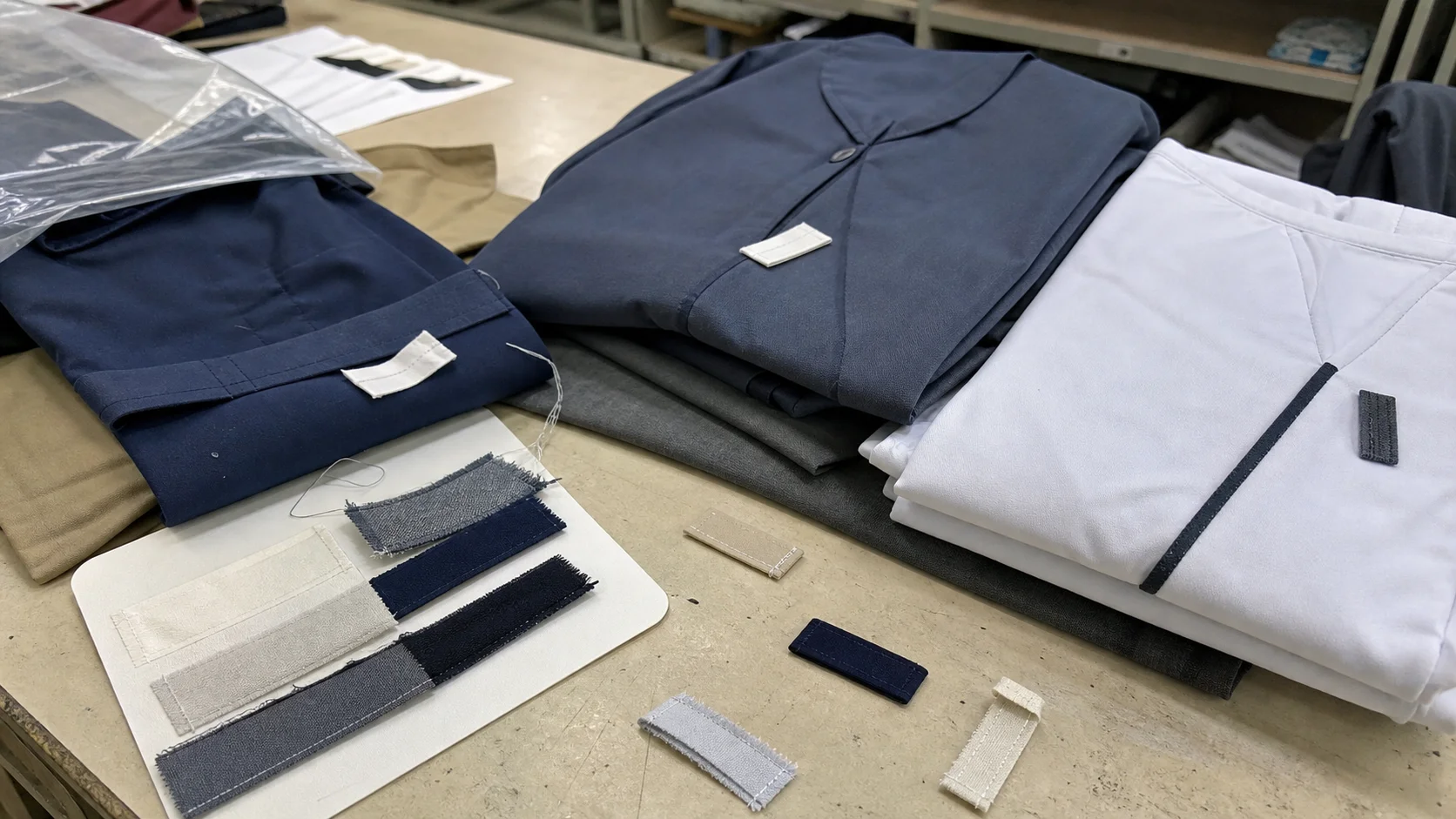
A risk review for hotel procurement teams planning repeat orders of micro embroidery tabs, covering artwork control, stitch consistency, lead times, QC,...
Micro Embroidery Tab Reorders for Hotels - Decoration & Printing manufacturing guide
Micro embroidery tabs look like a minor decoration item until a hotel reorder goes wrong. A small woven or fabric tab with stitched initials, a room-category mark, a service-line identifier, or a discreet brand detail can affect how linens, amenities, robes, spa garments, housekeeping uniforms, and guest-facing apparel are sorted, issued, and perceived. For hotel procurement teams, the risk is rarely the embroidery itself. The bigger risk is inconsistency between the original production run and the reorder.
Hotels often reorder in waves. Opening stock may be bought in one large batch, followed by replacement orders every quarter, season, or budget cycle. A tab that looked acceptable during the first bulk shipment can become a problem six months later if the thread shade shifts, the tab base fabric changes, the stitch density is reduced, or the placement tolerance becomes loose. Guests may not notice one tab in isolation, but they notice when two robes in the same room carry visibly different trim details.
Micro embroidery tabs are common in hotel programs because they are subtle, durable, and more refined than large logo placements. They also help back-of-house teams distinguish products without making everything feel over-branded. A small embroidered tab can identify king sheets from queen sheets, standard towels from suite towels, spa robes from pool robes, or housekeeping uniforms from restaurant uniforms. The tab becomes a quiet operating tool as much as a decoration component.
The procurement challenge is that micro details demand tighter control than their size suggests. A 1 mm border shift on a large chest embroidery may be acceptable. The same 1 mm shift on a 12 mm tab can look off-center. A slight thread tension issue may disappear on a large towel logo, but it can distort a tiny letter on a narrow tab. The smaller the decoration area, the less room there is for production tolerance.
For decoration and printing teams, micro embroidery tabs sit between branding, trimming, and production engineering. They require a confirmed artwork file, digitized stitch file, tab material specification, thread reference, attachment method, wash-performance target, and reorder archive. Procurement teams that treat the tab as a generic accessory usually face the highest reorder risk.
Teams planning a new hotel textile or apparel program can review decoration options through Fabrikn’s services before locking the trim package. Early review matters because tab size, fabric weight, thread type, and attachment method should be matched to the base product, not decided after bulk fabric has already been cut.
Micro embroidery tab reorder risk usually comes from missing documentation, unapproved substitutions, and weak sample discipline. The first order may pass because everyone is focused on launch quality. The reorder can fail because the original tab was never fully specified, the previous supplier used a different subcontractor, or the buyer only references a photo instead of a full technical record.
A photo is not a specification. It can help confirm general appearance, but it cannot define thread denier, stitch density, backing, tab fabric composition, fold type, cut size, finished size, or color standard. Hotel procurement teams should assume that every unrecorded detail may change during a reorder, especially when the order quantity is smaller than the opening batch.
Reorder risk also rises when the original program used a special trim run. A supplier may have produced 50,000 tabs for the launch, then face a reorder request for only 3,000 pieces. If the original tab base fabric, thread, or backing required a large minimum, the factory may look for alternatives to make the reorder economical. That is where visual mismatch starts.
Another common risk is artwork interpretation. Micro embroidery does not reproduce artwork the same way as print. Thin lines, small serif fonts, tight curves, and gradients are difficult to stitch cleanly at tab scale. A digitized file that worked on one machine may need adjustment on another, and even small changes can alter the character shape. Procurement teams should not approve a reorder based only on the original vector logo unless the digitized embroidery file is also controlled.
Hotel product categories add another layer of complexity. Towels and bathrobes go through heavy laundering. Uniforms may use industrial wash programs. Bed linens need a clean hand feel and cannot carry irritating trim edges. Spa garments may involve softer, more absorbent materials. A tab that survives on a decorative pouch may not survive repeated tunnel washing on terry towels.
Purchasing judgment: if the tab is used for operational sorting or visible brand consistency, treat it as a controlled component. If the tab is purely decorative and hidden from guests, a wider tolerance may be acceptable, but the hotel should still protect wash durability and attachment strength.
A complete micro embroidery tab specification should describe the finished component, not only the logo. The buyer should be able to send the spec to a qualified supplier and receive a close match without relying on memory or old email threads. This is especially important when procurement staff changes or when the hotel group consolidates purchasing across properties.
Thread color should be tied to a recognized standard or a physical approved sample. Pantone references can help, but embroidery thread does not always match print colors exactly because sheen, fiber content, and light reflection change the appearance. For hotel reorders, a retained physical standard is often more useful than a screen image.
Base material is another frequent source of mismatch. A polyester satin tab may look premium on a robe, but it may slip, curl, or shine too much against matte cotton terry. Cotton tape can feel natural, but it may shrink, fade, or fray if the edge finish is poor. Nylon can be durable, yet it may feel too technical for luxury room textiles. The correct choice depends on the product, wash process, brand position, and budget.
Stitch density should be controlled carefully. Too little density can make the micro artwork look thin or broken. Too much density can make the tab stiff, cause puckering, or create needle damage. Small tabs do not have much surface area to absorb embroidery stress. The best production route is usually a balanced digitizing setup with simplified artwork, suitable underlay, and realistic minimum letter height.
For micro text, procurement teams should challenge the artwork before production. Letters below roughly 4 mm in height can be difficult to embroider cleanly, depending on font, thread, and fabric. Thin script fonts, tight spacing, and complex crests are high-risk choices. A slightly simplified mark can look better in real hotel use than a technically “accurate” logo that becomes unreadable after washing.
MOQ planning is one of the main reasons hotel tab reorders become difficult. The hotel may need replacement stock quickly, but the trim supplier may have minimums that are higher than the hotel’s short-term demand. Procurement teams should separate the MOQ for the finished product from the MOQ for the embroidered tab component. They are not always the same.
Component or Order Type Typical MOQ Range Procurement Note Micro embroidered tab only 1,000 to 5,000 pieces Lower quantities may be possible with surcharge, especially if base tape and thread are standard. Custom base tape or special tab fabric 3,000 to 10,000 pieces MOQ rises if dyeing, weaving, or custom edge construction is required. Hotel robe reorder with tab 100 to 500 pieces per style/color MOQ depends on fabric availability, size ratio, and whether trims are already stocked. Towel or linen reorder with tab 300 to 1,000 pieces per item Bulk fabric or terry MOQ can drive the real minimum, not the tab itself. Uniform reorder with tab 50 to 300 pieces per style Smaller runs are more feasible if fabric, thread, buttons, labels, and tabs are carryover items.These ranges are typical planning references, not fixed rules. A supplier with stock fabric and in-house embroidery may support smaller runs. A program using custom-dyed tab material and special thread may need higher commitments. The safest purchasing approach is to ask for both bulk MOQ and reorder MOQ before approving the first order.
Lead time also depends on more than embroidery time. A small tab may take only minutes to stitch once the setup is ready, but the schedule can be delayed by artwork confirmation, digitizing, thread sourcing, base tape dyeing, sample shipping, internal hotel approval, bulk product production, and final inspection. Procurement teams should build a reorder calendar around the slowest input, not the smallest component.
Step Typical Time Range Risk if Rushed Artwork and spec review 1 to 3 working days Unclear scale, wrong color reference, missing placement detail. Digitizing or file retrieval 1 to 5 working days Different stitch file used from the original order. Strike-off or tab sample 3 to 10 working days Bulk proceeds without checking centering, density, and hand feel. Hotel approval 2 to 7 working days Approval delays compress production and inspection time. Bulk tab production 5 to 15 working days Thread lot or base fabric substitution if material is not reserved. Finished goods production 2 to 8 weeks Depends on product type, fabric availability, cut quantity, and workshop capacity.Sample approval should be formal, even for repeat orders. A sensible sequence is digital artwork confirmation, embroidery strike-off, physical tab approval, pre-production sample on the actual base product, then bulk production approval. For a reorder using the same approved component and same supplier, the process can be shortened, but it should not be eliminated.
The pre-production sample is important because a tab can look correct as a loose component and still fail on the final product. Placement may distort when attached to thick terry. A folded tab may become too bulky in a seam. A heat-cut edge may feel sharp near the neck. A topstitched tab may twist after laundering if the base fabric shrinks differently from the robe or towel.
Hotels with multiple properties should consider ordering a buffer stock of tabs or finished products, especially when the tab is a custom component. A trim buffer can reduce reorder pressure, but it needs clear storage control. Tabs should be protected from sunlight, humidity, dust, and mixed-lot confusion. Procurement should label bags or cartons with item code, order number, color reference, production date, and approved sample version.
Inspection for micro embroidery tabs should focus on appearance, durability, placement, and consistency across the shipment. AQL inspection can catch many defects, but buyers should define tab-specific checkpoints before inspection begins. If the checklist only says “logo correct,” it will miss the problems that matter most on small embroidered trims.
For hotel textiles, wash testing is not optional if the tab is exposed to industrial laundering. A basic review may include colorfastness to washing, dimensional stability, thread integrity, and edge behavior after repeated cycles. The number of cycles should match the value and expected life of the product. A luxury robe or towel program deserves more testing than a short-life promotional item.
Attachment strength also needs attention. A seam-inserted tab is usually cleaner and more durable than a loosely topstitched decorative tab, but it must be planned before sewing. Topstitching is more flexible for late-stage decoration and smaller reorders, yet it can look less integrated and may catch during use or laundry. Bartacks can strengthen a tab, but they may look too utilitarian for premium guest-facing products.
Inspection teams should compare bulk goods against an approved physical standard, not only a PDF. The standard should include a loose tab and a finished product sample if possible. For reorders, inspectors should also compare the new batch against retained stock from the previous shipment. This is the simplest way to catch visual drift before goods enter hotel circulation.
Carton-level mixing is another practical issue. If one reorder includes multiple room categories, department colors, or property-specific tabs, packing must be controlled. A perfect tab on the wrong item is still a procurement failure. Carton labels, polybag stickers, SKU codes, and packing lists should align with the hotel’s internal receiving process.
Not every supplier is suitable for micro embroidery tab programs. A factory can be competent at bulk garments or linens and still weak at small trim control. Procurement teams should assess whether the supplier has a repeatable process for artwork archiving, thread management, trim sampling, and reorder comparison.
The strongest suppliers will ask practical questions before quoting. They will request the finished tab size, artwork scale, base product, wash requirement, previous sample if available, and intended reorder pattern. A supplier that quotes only from a logo image may still produce the item, but the risk of mismatch is higher.
Price matters, but the cheapest tab option can become expensive if it causes sorting errors, rejected stock, or visible inconsistency across hotel rooms. Micro embroidery tabs are low-cost components relative to the finished goods, so the purchasing decision should give weight to repeatability. Saving a small amount on the tab is poor value if the hotel then has to discount, rework, or segregate finished goods.
There is also a tradeoff between supplier consolidation and specialist trim control. A single finished-goods supplier can simplify communication and responsibility. A specialist decoration or trim partner may provide better tab quality, cleaner digitizing, and stronger component consistency. The right choice depends on order scale, risk tolerance, and how complex the hotel’s product range is.
For hotel groups managing multiple textile and apparel categories, it can be useful to align early with a sourcing partner that understands both decoration and production. Procurement teams can start that discussion through Fabrikn’s contact page, especially when a reorder program needs spec cleanup before the next buying cycle.
These questions are not paperwork for its own sake. They reduce the chance of a reorder being approved by a buyer, rejected by operations, and disputed with the supplier after delivery. A small tab can create a large amount of friction when roles are unclear.
Micro embroidery tab cost is shaped by size, stitch count, thread type, base material, edge finish, quantity, and attachment method. A tiny tab is not always cheaper than a larger label because setup, handling, cutting, folding, inspection, and sewing time still apply. Labor can outweigh material cost, especially for small reorders.
Stitch count is a major driver. A dense logo with small lettering may take longer to stitch and may require more careful trimming. Metallic thread or specialty thread can raise cost and increase breakage risk. Multiple colors increase setup time and create more chances for sequence errors. A single-color embroidery on a stable base fabric is usually the safest route for repeat hotel reorders.
Edge finish also affects both cost and performance. Heat-cut polyester edges are efficient, but they can feel sharp if placed near skin. Folded edges feel softer and more finished, but they add bulk and sewing time. Woven-edge tape can look clean, but it may require higher MOQ. Ultrasonic cutting can produce neat edges on synthetic materials, though it may not suit every fabric.
Attachment method should be chosen early. Seam-inserted tabs look intentional and withstand laundry well when engineered properly. They require coordination during garment or linen sewing. Top-applied tabs allow more flexibility and can be added later, but placement variation is more likely. For premium hotel goods, late decoration flexibility should not override guest comfort and durability.
The best tradeoff is often a simplified, durable tab with controlled materials and a retained reorder stock. A complicated micro logo may look impressive in a presentation but fail under real laundry conditions. Procurement teams should judge the tab based on how it will perform after 20, 50, or 100 wash cycles, not only how it looks in the first sample photo.
Good documentation is the cheapest insurance for reorder consistency. A hotel procurement team should keep a trim file for every controlled micro embroidery tab. This file should be accessible to purchasing, quality, operations, and the supplier. It should not sit only in one buyer’s inbox.
The trim file should include approved artwork, digitized stitch file, tab construction drawing, thread references, base material details, approved sample photos, physical sample location, wash-test notes, supplier quotation, MOQ agreement, and reorder history. If a substitution is approved, the file should record what changed and why.
Reorder history is valuable because it shows whether the program is stable. If every reorder requires a new strike-off because materials keep changing, the hotel should reconsider the specification or supplier route. If reorders are predictable, procurement can plan inventory more confidently and reduce urgent buying.
Hotels with brand standards should include micro embroidery tabs in the approved decoration manual. Many manuals cover logo size and placement for guest-facing items but overlook small operational tabs. That gap creates room for local interpretation. A consistent standard helps properties buy replacement goods without drifting away from the brand system.
Procurement teams interested in how sourcing structure affects decoration consistency can review Fabrikn’s background to understand the value of connecting product development, supplier coordination, and quality review in one process.
Before approving a reorder, hotel procurement teams should run a short risk review. The review should be simple enough to use every time and specific enough to catch the common failure points.
Checkpoint Acceptable Condition Buyer Action if Not Confirmed Approved sample Physical tab and finished product sample available. Request new strike-off before bulk approval. Artwork file Correct digitized embroidery file identified. Do not rely only on vector artwork or photo reference. Material match Base tape, thread, backing, and edge finish match prior order. Require substitution sample and written approval. MOQ clarity MOQ confirmed for both tabs and finished goods. Review buffer stock or combined property demand. Placement Measurement and tolerance confirmed in the tech pack. Add placement diagram before production starts. Wash performance Testing requirement matches hotel laundry conditions. Run sample wash before bulk shipment. Packing control SKU, property, department, and size labeling are clear. Approve packing plan before final inspection.This checklist is especially useful when the reorder is urgent. Pressure tends to remove steps, and removed steps are where mismatches enter. A short risk review keeps the team disciplined without slowing the order unnecessarily.
The final purchasing decision should balance urgency, cost, and brand consistency. If a hotel needs emergency replacement stock for back-of-house use, it may accept a close substitute with documented approval. If the item is guest-facing and used across premium rooms, the better decision is usually to wait for the correct tab or order a larger batch that secures the original materials.
Micro embroidery tab reorders are manageable when the component is treated with the same seriousness as fabric, fit, and finished-goods quality. The tab may be small, but it carries brand detail, operational function, and quality perception. For hotel procurement teams, the safest route is clear specification, controlled sampling, realistic MOQ planning, and inspection that checks the details guests and staff will actually see.
Get a free quote from Fabrikn — your trusted B2B clothing manufacturer with 10+ years of experience. MOQ as low as 200 pieces.
Get a Free Quote →A micro embroidery tab is a small fabric or tape component decorated with stitched artwork, initials, category marks, or branding. Hotels use these tabs on robes, towels, linens, uniforms, spa garments, and amenity items for subtle identification or brand detail.
Reorders are risky because small changes in thread shade, stitch density, base material, edge finish, or placement can be highly visible on a tiny tab. Risk increases when the original sample, digitized stitch file, or material specification is missing.
Typical tab-only MOQs often fall around 1,000 to 5,000 pieces, while custom tape or special materials may require 3,000 to 10,000 pieces. Finished-goods MOQs vary by product type, fabric availability, size range, and supplier setup.
Approval without a physical sample is risky, especially for guest-facing goods. A digital image cannot reliably confirm thread sheen, fabric hand feel, edge softness, stitch quality, or exact color match. A strike-off or pre-production sample is the safer route.
A strong specification should include finished size, visible face area, base material, thread reference, digitized embroidery file, stitch density, backing, edge finish, fold type, attachment method, placement measurement, and approved tolerance.
Hotels can reduce reorder problems by keeping approved physical samples, controlling digitized files, documenting materials, confirming reorder MOQs upfront, reserving surplus tabs where practical, and comparing every reorder against previous production before shipment.
Embroidery is durable and premium-looking, but it has limits with tiny text and complex artwork. Print can reproduce fine detail more easily, yet it may not offer the same texture or wash durability. The right option depends on artwork scale, product use, laundry conditions, and brand expectations.