
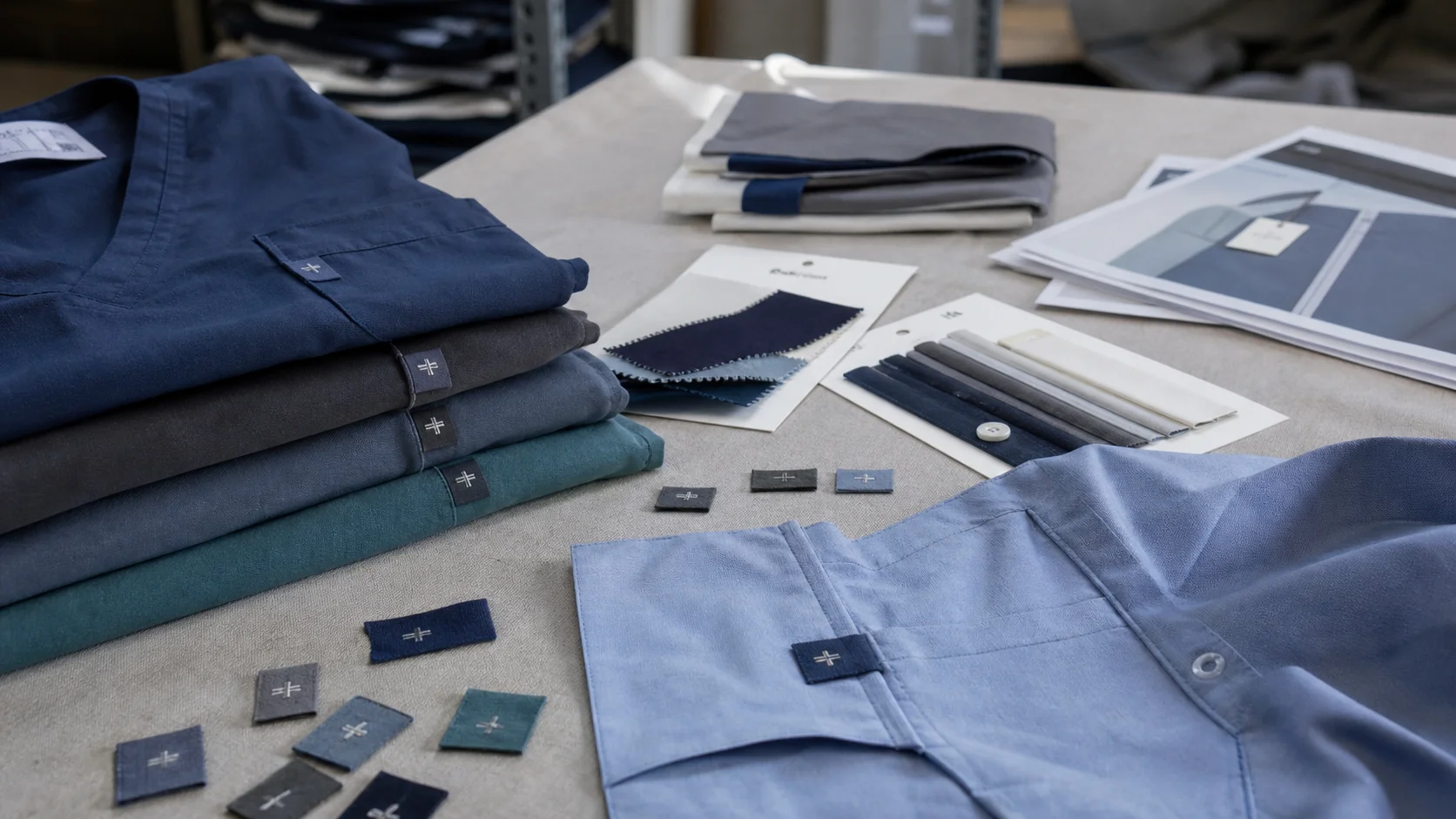
A practical scorecard for pharmacy operations teams evaluating factories that produce micro embroidery tabs, with criteria for stitch quality, hygiene,...
Pharmacy operations teams usually want decorated textiles that are durable, discreet, and consistent across locations. A micro embroidery tab is a small branding detail, but it still carries the same procurement risk as any other controlled purchase: color mismatch, weak stitching, delayed approvals, and quality drift between lots. A supplier scorecard gives the team a disciplined way to compare factories on the facts that matter, not on polished sales language.
For decoration programs tied to uniforms, lab coats, tote bags, or pouch accessories, the right supplier should prove control over stitch density, thread selection, backing material, sample sign-off, and repeatability. It also helps to work from a clear sourcing brief before you request pricing through fabrikn.com services or ask for a quote via contact us. If the supplier cannot answer the basics cleanly, the purchase should stay on hold.
This scorecard is designed for pharmacy operations teams evaluating a micro embroidery tab factory supplier scorecard for pharmacy operations teams in the Decoration & Printing category. It focuses on practical sourcing judgment: what to measure, what to verify, where the hidden cost sits, and which tradeoffs are worth accepting.
Micro Embroidery Tab Supplier Scorecard for Pharmacies - Decoration & Printing manufacturing guide
A micro embroidery tab is a small branded panel, patch, or trim element that uses fine stitch work to display a logo, department marker, size indicator, or compliance-related label. In pharmacy settings, the tab is usually small enough to stay subtle while still carrying identity. It may be attached to garments, bags, aprons, or soft accessories used by staff and support teams.
The term “micro” matters because tiny graphics are harder to sew cleanly than standard embroidery. Small text can close up. Thin lines can blur. Tight corners can distort if the factory uses the wrong needle, thread, stabilizer, or digitizing settings. A supplier that is strong on large logo embroidery is not automatically good at micro work. That distinction should be explicit in the scorecard.
Pharmacy buyers tend to value consistency over decorative complexity. A micro tab should look neat at arm’s length, survive repeated laundering or wipe-downs, and stay legible after use. If the application requires frequent cleaning, the tab design should be simplified before production starts.
Pharmacy operations teams usually buy for multiple branches, multiple job functions, and more than one garment type. That creates pressure to standardize. A scorecard helps the team compare suppliers using the same lens, which reduces bias from sample presentation, aggressive pricing, or promises that are hard to verify.
The scorecard also protects against a common failure pattern. A supplier may quote well on the first order, pass the sample stage, then lose control on repeat production when the factory changes thread dye lot, backing stock, or subcontracted finishing. Micro embroidery is sensitive to those changes. The cost of a remake often exceeds the savings from a cheaper quote.
A small embellishment becomes an expensive problem when the factory cannot repeat the first approved sample.
For pharmacy operations, the commercial question is not only “What does it cost?” The better question is “What does it cost to keep the brand consistent across every site with acceptable lead time and low rework risk?” That is what the scorecard should answer.
A strong supplier scorecard should measure both technical ability and operating discipline. The table below gives a practical structure that can be adapted to your own weighting.
Criterion What to Check Suggested Weight Embroidery capability Fine detail handling, stitch control, digitizing skill, sample consistency 20% Material control Thread quality, backing choice, trim stability, colorfastness 15% Sampling discipline Clear approval steps, revision tracking, sample turnaround time 15% Production reliability On-time delivery, batch repeatability, defect handling 15% MOQ flexibility Minimum order quantity, pilot order support, replenishment terms 10% Documentation Spec sheets, size approvals, color references, carton labels, traceability 10% Commercial terms Pricing structure, payment terms, tooling charges, freight clarity 10% Communication Response time, issue escalation, clarity of answers, English or local market support 5%The exact weighting should match the risk profile of the order. A large multi-site pharmacy rollout may place more value on on-time delivery and documentation. A small pilot may care more about sampling speed and MOQ. The scorecard is useful only if it reflects the actual buying context.
Those questions sound basic, but they separate a decoration vendor from a controlled production partner. In pharmacy sourcing, that difference matters.
Micro embroidery quality starts with the base materials. A factory should not quote from a logo file alone. It needs a complete spec that covers substrate, stabilizer, thread, attachment method, and finish. Missing details often appear later as disputes over “equivalent” materials.
Most micro embroidery tabs use polyester thread because it is more durable and generally more color stable than cotton in repeated laundering or cleaning. The supplier should confirm thread brand or at least thread grade, available color matching, and whether the color reference is matched to a physical Pantone or lab dip standard. For pharmacy programs, a small difference in tone can make a uniform set look inconsistent across stores.
Backing choice affects stitch definition and edge cleanliness. A lightweight backing may keep the tab soft, but it can also let stitches sink or distort during sewing. A heavier backing improves shape retention, though it may add stiffness. The right option depends on where the tab sits and how often it is washed. For wearable items that contact skin, the buyer should check for abrasion risk and comfort. For outerwear or utility items, shape retention may matter more than softness.
Micro embroidery can be sewn onto twill, felt, polyester woven base cloth, or other stable substrates. A stable weave is usually safer than a loose, stretchy base because fine details hold better. If the design is very small, avoid fuzzy or uneven surfaces. They can swallow detail and reduce legibility.
The attachment method should be selected for the end use. Sew-on tabs are usually more stable for repeated laundering. Heat seal or adhesive-backed options can work for short-cycle use, but the buyer should test adhesion under realistic conditions. Pharmacy operations teams should resist assuming that a decorative bond will survive cleaning chemicals unless the supplier has tested it.
Specs do not need to be complex, but they do need to be complete. A supplier that asks the right questions up front is usually safer than one that accepts a vague brief and promises to “make it work.”
Micro embroidery should never move to bulk production without a controlled sample approval process. This is the point where many procurement teams lose time later. If the sample is approved casually, the factory can argue that the bulk run matched the approved reference, even when the result is clearly off.
For small text or dense logos, a single sample may not be enough. The buyer may need one sample focused on stitch clarity and another focused on color and material behavior. That is a practical tradeoff, not overengineering. The cost of one extra sample is usually lower than the cost of rework on a full production order.
Sample turnaround time should be measured in the scorecard. A supplier that can deliver a first sample quickly but cannot manage revision rounds is not necessarily ready for production. Speed without control is a weak signal.
Approval should lock the exact artwork version, size, thread reference, and attachment method. If any of those move, the sample is no longer a valid control point.
Micro embroidery has a short list of failure modes, and most of them are visible if the buyer knows what to inspect. The factory should demonstrate controls, not merely say that quality is checked “at every stage.” That phrase is too vague to rely on.
Inspection should cover both appearance and durability. A tab can look good in a photo and still fail after handling or cleaning. For pharmacy use, especially on uniforms or staff accessories, the buyer should ask what happens after repeated wash tests or wipe-down cycles. If the supplier cannot provide a reasonable test method, the risk stays with the buyer.
For multi-branch pharmacy networks, incoming inspection on the buyer side should be simple and repeatable. Use the same check points every time: size, color, clarity, attachment quality, and packaging count. A standard receiving sheet keeps the process realistic for operations teams that are managing many product categories at once.
Lead time is usually the first place where a supplier overpromises. Micro embroidery may look simple, but the schedule depends on artwork complexity, digitizing, sample iterations, thread availability, and factory loading. Buyers should treat quoted lead times as conditional until the artwork and sample are approved.
For many factories, the MOQ for micro embroidered tabs can sit somewhere in the range of 300 to 1,000 pieces per design or per colorway. Some suppliers will go lower for pilot programs, but the unit price usually rises. Large consolidated orders often reduce cost, yet they increase the risk of overbuying if pharmacy branding changes later. The right MOQ is the one that matches rollout certainty, not the one with the lowest quoted unit cost.
Commercial terms should also be explicit. Ask whether the quote includes digitizing, setup, packaging, and freight. A low headline price can become expensive once every extra line item is added. That is a common procurement trap in decoration work.
Payment terms matter, but only in the context of control. A small deposit may be normal for custom decoration. A large upfront payment without sample approval or clear inspection rights is a weak position for the buyer. Pharmacy teams should align payment milestones with real production gates.
The scorecard should be simple enough to use on every quote request. A useful structure is a 1-to-5 scale for each criterion, with written evidence required for any score above 3. That keeps the exercise grounded in facts rather than impressions.
A supplier should not score high just because the sample looks attractive. If the factory cannot describe thread sourcing, sampling control, or inspection procedure, the visual sample is not enough to justify a premium. On the other hand, a slightly less polished sample from a factory that has strong process control can be the safer purchase.
For pharmacy programs, it is sensible to reject any supplier that scores below baseline on production reliability or documentation, even if price is attractive. A decorative tab is low-value only until it causes repeat rework, branch inconsistency, or procurement delay. The cheapest supplier is often the most expensive one after failure costs are counted.
If the sourcing team wants a broader supplier comparison across categories and decoration methods, reviewing the company background on about us can help frame what type of factory relationship is being evaluated. That does not replace diligence, but it gives context for the commercial conversation.
Several warning signs appear repeatedly in custom decoration sourcing. Any one of them may be manageable. Two or three together usually justify moving on.
One especially common problem is overconfidence around small logos. A supplier may say the design is “easy” and then miss the key issue: the smaller the tab, the less room there is to hide poor digitizing. If the factory minimizes the complexity too quickly, that is a reason to slow down, not speed up.
Use the checklist below before awarding a micro embroidery tab order for pharmacy operations.
That checklist is intentionally practical. It avoids unnecessary procurement theater and focuses on what prevents disputes. For decoration and printing programs in pharmacies, clarity is more valuable than a long spec sheet with gaps in the wrong places.
A strong supplier does not just deliver a neat sample. It explains how the sample was made, what changes were made during digitizing, what tolerance applies to size and placement, and how the same result will be repeated in bulk. It also gives a clean answer when asked what could delay the order.
That level of discipline is what pharmacy operations teams should reward. The best vendor is not always the one with the lowest quote or the fastest promise. It is the supplier that reduces uncertainty, keeps documentation tight, and treats the micro embroidery tab as a controlled production item rather than a casual accessory.
When the sourcing team needs support moving from brief to quote, it is reasonable to start with a structured inquiry through contact us. The more exact the brief, the more useful the supplier response will be.
Get a free quote from Fabrikn — your trusted B2B clothing manufacturer with 10+ years of experience. MOQ as low as 200 pieces.
Get a Free Quote →It gives pharmacy operations teams a consistent way to compare suppliers on quality, reliability, sampling control, documentation, and commercial terms. The goal is to reduce risk, not just to compare price.
Typical MOQ ranges often fall between 300 and 1,000 pieces per design or colorway, though this varies by factory and complexity. Lower quantities may be possible, but the unit cost and setup charges usually rise.
Small text and fine lines are less forgiving. Stitch density, thread tension, digitizing, and backing choice have a bigger impact on legibility and finish. A design that works at larger size may fail when scaled down.
The buyer should approve the final artwork version, finished size, thread colors, backing, attachment method, and a physical sample or strike-off. Bulk production should not begin until the reference sample is fixed.
Thread breakage, unreadable small text, color inconsistency, edge fraying, puckering, and poor wash or wipe durability are the main risks. Repeated cleaning and daily handling expose weak construction quickly.
No, but the low quote should be tested carefully. If pricing is far below the market without a clear explanation, there is usually a tradeoff in material quality, sampling control, or delivery reliability.
At minimum, the supplier should provide a spec sheet, approved sample reference, quotation with all charges listed, production timeline, and inspection terms. Batch traceability is a strong plus for repeat orders.
Yes, if the thread, backing, and attachment method are chosen for that use. The buyer should ask the factory how the decoration performs under realistic washing or cleaning conditions before approving the design.
For pharmacy operations teams, a micro embroidery tab is a small item with outsized procurement consequences. A proper supplier scorecard makes those consequences visible before the order is placed, which is where the risk should be managed.