
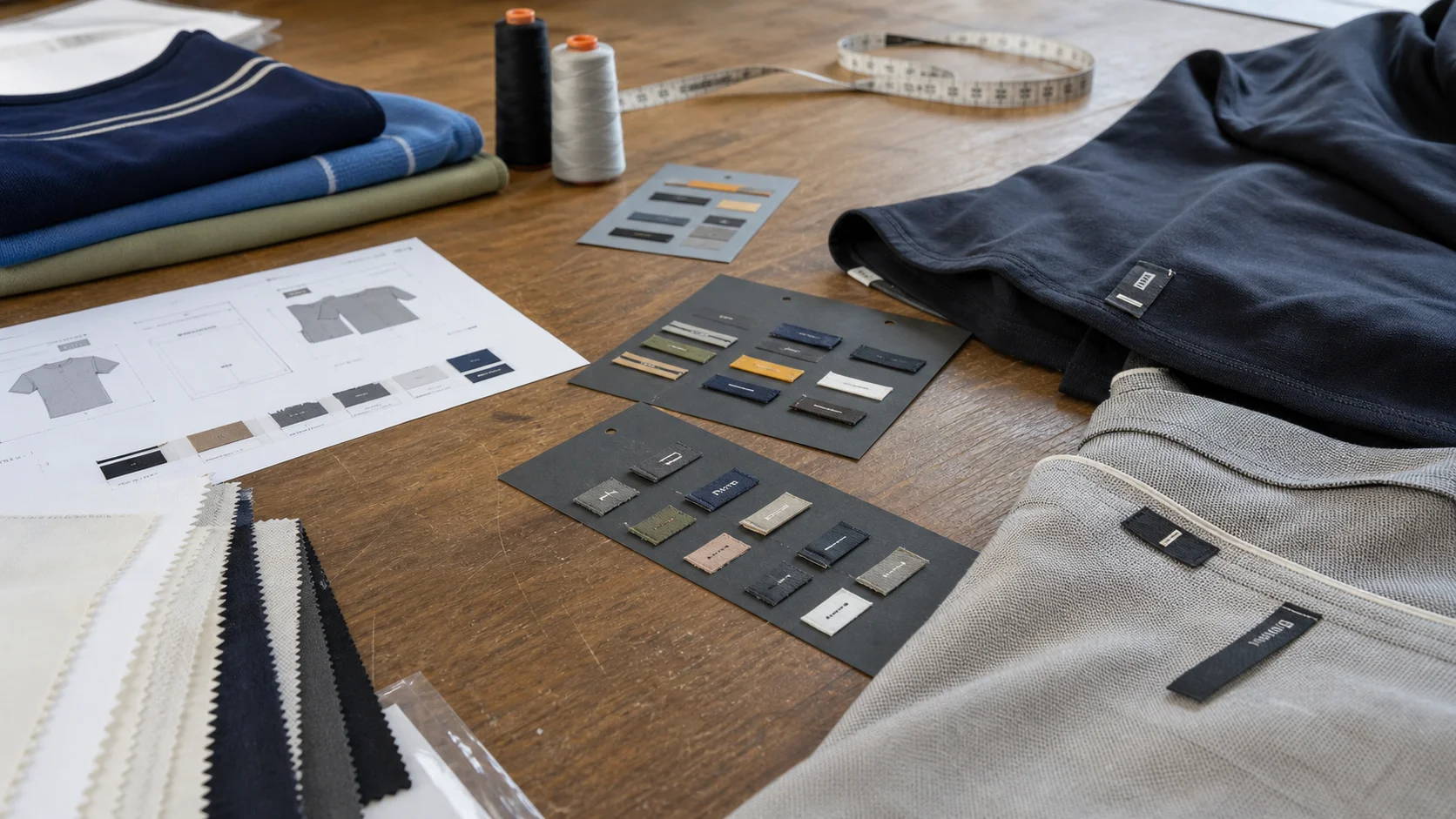
A distributor-focused outline for inspecting micro embroidery tabs with AQL criteria, covering stitch clarity, backing, trim, labeling, packing, and...
Micro Embroidery Tabs AQL Checklist for Buyers - Fabrikn production reference
Micro embroidery tabs look small on a garment, but they can create large sourcing problems when the inspection standard is vague. Distributor buyers often place these tabs on caps, polos, hoodies, knitwear, workwear, bags, children’s apparel, and promotional merchandise. The decoration may be only a few centimeters wide, yet it carries brand identity, retail presentation, and compliance risk.
For distributor buyers sourcing from a micro embroidery tab supplier, the most useful tool is a practical AQL inspection checklist. It should define what must be checked, what defect level applies, how many pieces to inspect, and which issues trigger rejection before bulk goods ship. A clear checklist also reduces arguments between the buyer, supplier, factory, and third-party inspector.
This guide is written for B2B apparel buyers, distributors, and sourcing teams that need a workable inspection framework for micro embroidered tabs. It covers AQL planning, embroidery quality points, fabric and trim specifications, sample approval steps, MOQ expectations, lead-time dependencies, packaging checks, and common risks that are easy to miss until the goods arrive.
Micro embroidery tabs are small decorative or branding components, often sewn into a seam, folded over a garment edge, heat-applied, or attached as a patch. They may use woven base fabric, twill, felt, canvas, recycled polyester, cotton tape, synthetic leather, or other narrow trim materials. The embroidered area can include a logo, initials, icon, size mark, slogan, or collection identifier.
The difficulty is scale. A small tab leaves little margin for error. A thread shift of 0.5 mm may distort a letter. A slight trim cutting error can make the folded edge uneven. Dense stitching can pucker the base fabric. Poor color matching can make the decoration look like a substitute component rather than a brand-approved trim.
AQL inspection gives buyers a structured way to decide whether a shipment is acceptable based on a defined sampling plan. It does not guarantee every defective piece is removed. It does create an agreed commercial standard that helps prevent bulk shipments with excessive quality variation.
For micro embroidery tabs, the inspection decision should not be based only on whether the logo is recognizable. Buyers should judge brand accuracy, construction durability, placement consistency, and presentation at retail distance.
Distributor buyers face an extra issue: the goods often move quickly to resellers, uniform programs, e-commerce packs, or promotional campaigns. Once decorated items are delivered downstream, replacement can be more expensive than the tab itself. That is why the checklist needs to be built before production, not after defects are found.
A supplier cannot quote or inspect micro embroidery tabs properly without a complete specification. A buyer should avoid sending only a logo file and target price. That usually leads to assumptions, and assumptions create inspection disputes.
Buyers should also confirm whether the micro embroidery tab supplier is producing the tab only, attaching it to the garment, or coordinating with a garment factory. These are different scopes. A tab supplier may control embroidery and cutting but not final sewing placement. A garment factory may sew the tab correctly but have no control over embroidery accuracy. Inspection responsibility should match production responsibility.
For buyers that need broader sourcing support across decoration methods, product development, or production coordination, it is sensible to review available manufacturing services at fabrikn.com/services/. A decoration detail like a micro tab often needs to fit into a wider garment quality plan.
MOQ for micro embroidery tabs varies by supplier, construction, thread colors, base material, and whether the order is a standalone trim order or part of a garment production package. Buyers should treat any MOQ quote as conditional until artwork and material are approved.
Order Type Typical MOQ Range Buyer Notes Simple embroidered tab on stock base fabric 500 to 2,000 pieces Best for test orders, promotional runs, and distributor sampling programs. Custom color base fabric or dyed tape 2,000 to 5,000 pieces MOQ depends heavily on dye lot and trim mill requirements. High-detail micro logo with multiple thread colors 1,000 to 5,000 pieces Sampling time may increase due to digitizing and repeated strike-offs. Tabs attached to finished garments Usually aligned with garment MOQ, often 300 to 1,000 pieces per style/color Placement inspection must be included in garment final inspection. Retail-ready branded trims with custom packaging 3,000 to 10,000 pieces Carton labels, barcodes, and packing accuracy become more important.A low MOQ can be useful for market testing, but it may come with tradeoffs. Suppliers may use stock fabric, limited thread options, or manual cutting. Larger MOQ orders may support better material control and more stable unit cost, but they increase exposure if the sample approval is weak. Buyers should not chase the lowest MOQ if the brand logo requires tight color, size, and edge control.
The sample approval process for micro embroidery tabs should be stricter than many buyers expect. Small decorative trims are often approved by photo, but photo approval can miss puckering, edge thickness, hand feel, backing stiffness, and sheen mismatch. Physical samples are strongly preferred for brand-critical trims.
Distributors should keep one approved sample in the buying office and require the supplier to keep a matching sealed sample. If a third-party inspection is arranged, the inspector should receive the approved sample or high-quality reference images with clear measurements. Without a controlled reference, inspection becomes subjective.
Buyers planning a new trim program can use fabrikn.com/contact-us/ to discuss production scope, supplier coordination, and inspection expectations before bulk orders are locked.
AQL stands for Acceptable Quality Limit. In apparel and trim inspection, buyers often use ISO 2859-1 style sampling tables, commonly with General Inspection Level II for normal inspections. The AQL value sets the maximum number of defects allowed in a sample before the lot fails.
For micro embroidery tabs, buyers commonly separate defects into critical, major, and minor categories. Critical defects have no tolerance because they create safety, legal, or brand misuse risk. Major defects affect appearance, function, durability, or saleability. Minor defects are small workmanship issues that do not seriously affect the item’s commercial use.
Defect Class Common AQL Setting Typical Application Critical 0.0 Safety risk, wrong brand, restricted substance concern, sharp component, severe contamination. Major 1.5 or 2.5 Wrong size, obvious logo distortion, poor attachment, visible color mismatch, severe puckering. Minor 4.0 Slight thread tail, small edge roughness, minor shade variation within approved range.For premium retail, children’s apparel, licensed brands, or corporate uniform programs, buyers should consider tighter major defect limits. For low-cost promotional products, a buyer may accept a slightly wider tolerance, but brand errors should still be treated firmly. A misspelled logo, wrong trademark, or incorrect tab orientation is not a small workmanship matter.
Some buyers inspect micro embroidery tabs as trims before they are sewn into garments. Others inspect the final garment only. The better approach depends on risk. If the tab is produced separately and then sent to a garment factory, trim inspection before attachment can prevent wasted sewing time. If the tab is produced and attached in one facility, final inspection should include both tab quality and placement.
The checklist below can be adapted for distributor buyers ordering micro embroidery tabs from a supplier. It is designed to be practical rather than theoretical. The buyer should attach it to the purchase order, supplier manual, or quality agreement.
Inspection Area What to Check Risk if Missed Suggested Defect Level Artwork accuracy Logo shape, letters, icon, spacing, scale, and orientation match approved sample. Brand rejection, license issue, customer complaint. Major or Critical Color matching Thread and base fabric match approved color reference under suitable light. Visible mismatch across styles or repeat orders. Major Embroidery clarity Letters are readable, lines are clean, no stitch crowding or lost detail. Logo looks cheap or unreadable. Major Stitch quality No broken stitches, skipped stitches, loose threads, bird nesting, or excessive thread tails. Unraveling, poor appearance, durability failure. Major or Minor Tab dimensions Width, height, fold depth, edge margin, and thickness within tolerance. Attachment difficulty, inconsistent finished garment look. Major Edge finish Cut edges are clean; no fraying, scorching, uneven fold, or sharp synthetic edge. Retail appearance issue, comfort complaint. Major or Minor Backing and hand feel Backing is secure and not too stiff, scratchy, bulky, or visible from front. Discomfort, seam bulk, poor drape. Major Placement on garment Tab position, angle, seam insertion depth, and visibility match approved sample. Uneven branding across the order. Major Attachment strength Tab is securely sewn, bonded, or heat-applied according to specification. Tab detaches during use or washing. Major Cleanliness No oil stains, dust, loose fibers, machine marks, adhesive residue, or color transfer. Failed inspection, poor customer presentation. Major or Minor Quantity and assortment Correct count by style, color, logo version, size group, and purchase order. Short shipment or mixed branding. Major Packing Correct bundle size, bag labels, carton marks, moisture protection, and separation by SKU. Warehouse receiving errors, picking mistakes. Major or MinorAQL inspection should include both visual review and measured checks. For very small tabs, inspectors should use a ruler, caliper, approved reference sample, color standard, and adequate lighting. Magnification can help confirm thread problems, but buyers should avoid creating unrealistic standards that would fail good commercial production for microscopic issues invisible in normal use.
The base material matters as much as the embroidery. A strong embroidery supplier may still struggle if the buyer chooses the wrong base fabric for a micro-scale logo. Dense stitching on a light fabric can pucker. Thin fabric may curl. Thick felt may make tiny letters sink into the surface. Synthetic tape may cut cleanly but feel hard at the seam.
Thread selection affects both appearance and durability. Polyester embroidery thread is common because it offers good strength and colorfastness. Rayon has a soft sheen, but may not be the best choice for hard-wearing uniforms or frequent washing unless the performance is confirmed. Metallic thread can look attractive, but it increases the chance of breakage and may require a looser design.
Buyers should request thread color references using Pantone, supplier thread cards, or physical swatches. Pantone matching is useful for communication, but thread reflects light differently from printed ink. A physical thread match is more reliable than a screen image. For repeat programs, the buyer should ask whether the supplier will reserve thread lot consistency or approve each lot separately.
These are typical working ranges, not universal rules. A luxury brand, licensed logo, or technical uniform may require tighter control. A rustic casual tab may tolerate more natural edge variation. The purchasing judgment is simple: do not demand a tolerance the supplier cannot measure and maintain in bulk.
Defect classification is where many inspections become inconsistent. One inspector may call a thread tail minor. Another may call it major if it affects the logo. Buyers should define defect levels before production and include examples where possible.
Buyers should be careful with “normal viewing distance.” For a micro logo tab, normal retail viewing may be close. A tab on a cuff, chest pocket, cap side, or bag handle is often inspected by end customers at hand distance. If the decoration is a brand signature, the buyer should apply a stricter appearance standard than for a hidden internal size tab.
Measurement control should include both the tab itself and its position on the final product. A perfect tab can still fail if sewn at a poor angle or hidden too deeply in the seam.
Measurement Point How to Check Typical Buyer Tolerance Tab width Measure finished visible width edge to edge. Plus or minus 1 mm, depending on design. Tab height Measure visible height after fold or attachment. Plus or minus 1 mm to 1.5 mm. Logo center Compare logo center to tab center line. Plus or minus 0.5 mm to 1 mm. Fold symmetry Check front and back fold balance. Buyer-defined based on construction. Placement on garment Measure from seam, hem, pocket edge, or approved reference point. Often plus or minus 3 mm to 5 mm for garments. Angle Check tab alignment against seam or garment edge. No visible tilt at normal inspection distance.Distributor buyers should decide whether placement tolerance changes by product type. A tab on a rib cuff may shift slightly due to stretch. A tab on a woven pocket should be more consistent. A tab inserted into a side seam may depend on sewing operator control and seam allowance. The inspection checklist should reflect the real construction, not a generic decoration standard.
Packaging errors are common with small trims because many logo versions, colors, and sizes can look similar. A micro tab for navy garments may be almost identical to one for black garments. A left-facing icon may be confused with a right-facing icon. If the goods are packed as loose trims for later garment production, warehouse mistakes can spread through the whole order.
The inspection should include carton selection from different parts of the shipment. Pulling samples only from the easiest cartons near the front of the warehouse is weak practice. A proper inspection should select cartons randomly across the available lot, subject to the agreed sampling plan.
Lead time for micro embroidery tabs depends on more than machine capacity. Artwork digitizing, thread sourcing, base material availability, sample revisions, buyer approval speed, bulk cutting, packing, and final garment attachment all affect the schedule.
Stage Typical Timing Main Dependency Artwork review and digitizing 2 to 5 working days Logo complexity and file quality. First embroidery sample 3 to 7 working days Thread and base material availability. Revision sample 3 to 7 working days per round Buyer feedback clarity and technical feasibility. Bulk tab production 7 to 20 working days Order volume, color count, cutting method, and machine loading. Attachment to garments Aligned with garment sewing schedule Garment production flow and operator training. Final inspection and release 1 to 3 working days Shipment readiness, sample availability, and defect results.A realistic schedule includes time for at least one sample correction. Buyers who approve a micro embroidery tab by photo in a rush may save a few days and lose much more time later if bulk goods fail. The best purchasing decision is to protect the sample stage, especially for new suppliers, new artwork, or new materials.
Lead time can also change during peak seasons. Before holidays, trade shows, school uniform programs, and promotional campaign deadlines, embroidery capacity tightens. Buyers should confirm whether the quoted lead time starts from purchase order date, deposit date, artwork approval date, material arrival date, or pre-production sample approval date. These are not the same.
A good micro embroidery tab supplier is not simply the cheapest supplier with embroidery machines. Distributor buyers should judge whether the supplier understands small-scale logo execution, material compatibility, repeat color control, and inspection documentation.
The right supplier depends on the buyer’s product segment. A low-cost promotional order may prioritize speed and acceptable logo readability. A premium apparel line may need better thread matching, clean edges, softer backing, and tighter sampling discipline. A uniform distributor may need durability, wash resistance, and repeat-order consistency more than decorative complexity.
Buyers should be cautious with suppliers that promise every detail without technical review. Micro embroidery has limits. Very thin lines, tiny serif lettering, gradients, photographic logos, and narrow negative spaces may not translate cleanly into thread. A capable supplier will suggest artwork adjustments before bulk production.
For buyers evaluating a broader manufacturing partner, company background and operating approach can be reviewed at fabrikn.com/about-us/. Supplier fit is not only about one trim order; it is about whether the production setup can support repeatable commercial quality.
Before approving shipment, buyers should confirm that the inspection report covers the right points. A report that only says “embroidery checked” is not enough. It should show sampled quantity, defect counts, photos, measurements, carton selection, PO details, and approval references.
When a shipment fails, the buyer should avoid vague instructions such as “improve quality.” The supplier needs specific corrective actions: remove pieces with tilted tabs, recut oversize tabs, replace wrong thread color, retrain operators on placement, repack mixed SKUs, or remake the affected lot. The reinspection should focus on the failed points and still confirm that no new defects were created during sorting or repair.
There is always a balance between cost, speed, and precision. Very tight embroidery and measurement tolerances raise supplier workload and may increase rejection rates. Low-cost tabs may be acceptable for simple promotional use, but they may not support premium brand presentation. Fast approval can help meet a delivery date, but it can also transfer unresolved risk into bulk production.
The strongest buying position is to decide what matters most before asking for a quote. If the tab is a signature brand feature, invest in sampling, physical approvals, and stricter AQL controls. If the tab is a secondary decoration on a budget item, focus on correct logo, clean attachment, and packing accuracy. Not every order needs luxury-level inspection, but every order needs a written standard.
Distributor buyers should also consider repeatability. A supplier that can make one attractive sample may still struggle across 20,000 pieces, five colorways, and three shipment windows. AQL inspection helps catch this gap, but the supplier’s internal quality control should prevent it first. Bulk quality comes from clear specifications, stable materials, trained operators, and disciplined packing.
Micro embroidery tabs are small components with outsized influence on garment presentation. For distributor buyers, the safest approach is to treat them as controlled branded trims rather than simple accessories. The AQL checklist should cover artwork accuracy, stitch quality, material selection, sizing, placement, attachment, packing, and defect classification.
A practical micro embroidery tab supplier AQL inspection checklist protects both buyer and supplier. It gives the supplier a clear production target and gives the buyer a fair basis for accepting or rejecting goods. The checklist does not need to be complicated, but it must be specific. Small tabs leave little room for vague standards.
The final purchasing judgment is straightforward: approve the right sample, define measurable tolerances, use realistic AQL levels, and inspect before the goods move too far downstream. That discipline reduces returns, protects brand consistency, and keeps distributor orders commercially manageable.
Get a free quote from Fabrikn — your trusted B2B clothing manufacturer with 10+ years of experience. MOQ as low as 200 pieces.
Get a Free Quote →Many buyers use Critical 0.0, Major 1.5 or 2.5, and Minor 4.0. Premium, licensed, children’s, or uniform programs may need stricter major defect control. The final AQL should match brand risk, order value, and customer expectations.
Yes, if the tabs are produced separately and then sent to a garment factory. Early trim inspection can prevent defective tabs from being sewn into finished goods. If the supplier produces and attaches the tab in one production flow, final garment inspection should include tab quality and placement.
Common defects include unreadable small letters, thread color mismatch, stitch breaks, puckering, uneven cutting, wrong fold depth, rough edges, loose backing, incorrect placement, and mixed logo versions in packing.
Typical MOQ ranges from about 500 to 2,000 pieces for simple tabs using stock materials. Custom base fabric, special colors, complex logos, or retail packaging can push MOQ to 2,000 to 10,000 pieces or more.
Only within technical limits. Very small letters, fine serifs, tight spacing, gradients, and narrow negative spaces may not translate cleanly into embroidery. Buyers should approve a physical strike-off before bulk production.
The tech pack should include artwork, dimensions, tolerances, base material, thread colors, stitch requirements, backing, edge finish, fold type, attachment method, packaging, AQL level, and defect classifications.
Artwork digitizing and first samples often take 5 to 12 working days in total, depending on complexity and material availability. Each revision round can add several working days. Bulk timing starts only after the buyer approves the production-ready sample.
Photo approval may be acceptable for low-risk repeat orders, but physical sample approval is safer for new artwork, premium branding, unfamiliar suppliers, or tabs that require strict hand feel, edge, color, and backing control.
The biggest risk is approving vague standards. If the buyer does not define logo clarity, tolerances, defect levels, and packing rules, the supplier and inspector may apply different judgments. That usually leads to disputes and shipment delays.
Buyers should require specific corrective action, sorting, repair, remake, or repacking based on the failed defect type. A reinspection should verify the corrected issues and confirm that no new problems were introduced during handling.