
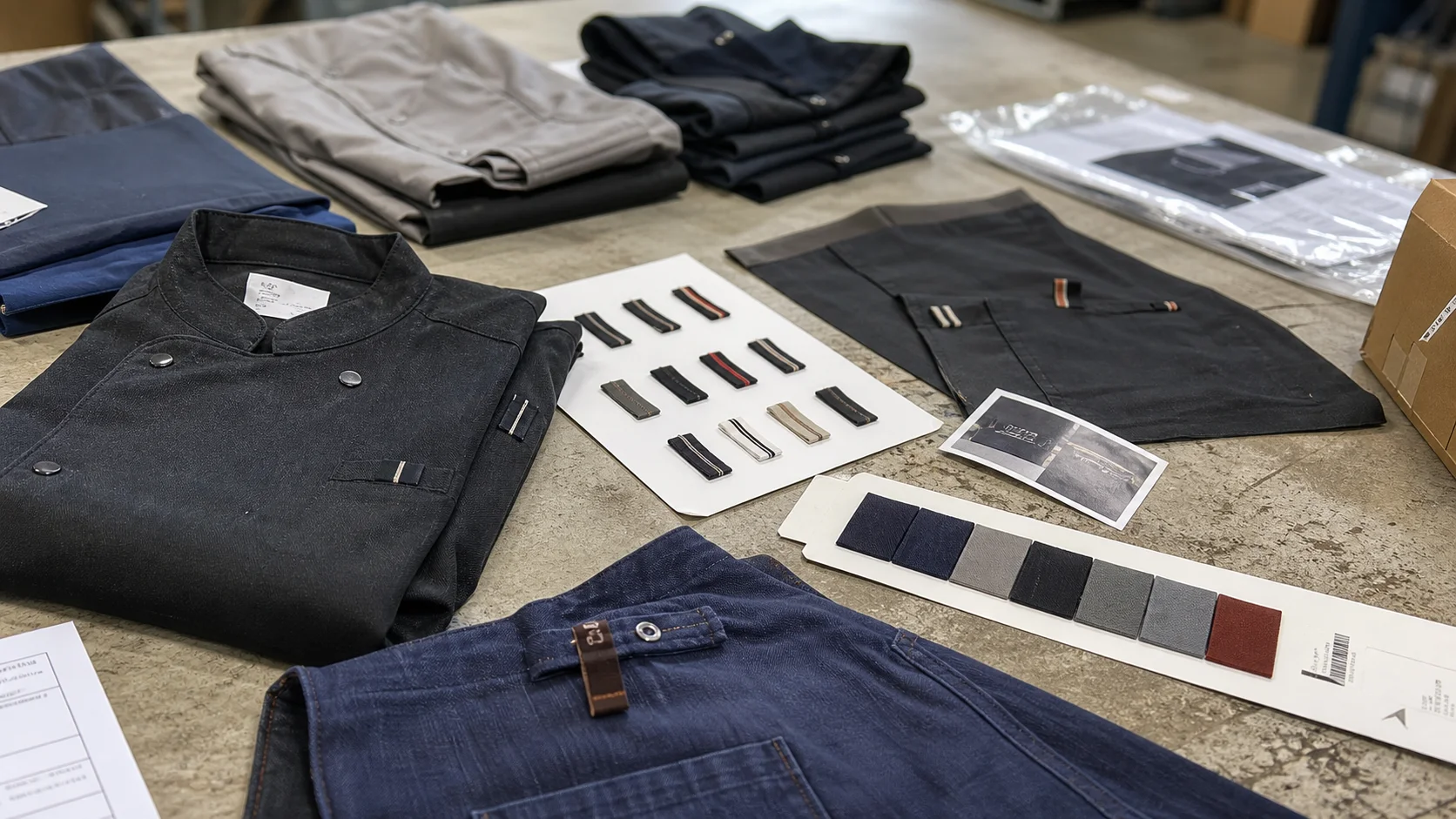
A buyer-focused outline for auditing wholesale micro embroidery tab colorfastness before restaurant uniform rollouts, covering wash tests, dye transfer,...
Micro Embroidery Tabs Colorfastness Audit for Buyers - Decoration & Printing manufacturing guide
Restaurant groups buy uniforms under conditions that expose weak decoration quickly: repeated commercial laundering, food stains, sanitizer contact, perspiration, steam, abrasion from aprons, and daily handling by staff. A small embroidered tab may look like a minor branding detail, but it can become a visible quality problem when the thread bleeds, dulls, crocking transfers onto light garments, or the base tab fabric fades before the garment reaches the end of its service life.
This guide explains how buyers can structure a wholesale micro embroidery tab colorfastness audit for restaurant groups. It focuses on practical sourcing controls: what to specify, what to test, how to approve samples, what minimum order quantities usually look like, and where inspection risks tend to appear. The goal is not to over-engineer a small label. The goal is to prevent a small component from damaging a full uniform rollout.
Colorfastness is the ability of a dyed or colored material to resist fading, bleeding, rubbing off, or staining adjacent materials. For restaurant uniforms, colorfastness is not just a lab concern. It is a service-life concern. A tab can be tiny, but it sits on a garment that may be washed dozens of times under aggressive conditions.
Restaurant groups often standardize shirts, aprons, chef coats, polos, overshirts, or caps across multiple locations. If the embroidered tab fails, the failure is multiplied across stores. A red thread that bleeds onto a white apron is not a small defect once hundreds or thousands of units are in circulation.
The most common colorfastness problems in micro embroidery tabs include:
For buyers, the risk is highest when a restaurant group uses high-contrast branding, such as black tabs on white chef coats, red embroidery on cream aprons, or navy logo tabs on pale gray shirts. The risk also increases when garments are laundered through outsourced industrial laundries rather than gentle in-house washing.
A micro embroidery tab should be treated as a trim component with performance requirements, not only as a branding detail.
A micro embroidery tab is a small folded, flat, or edge-sewn label-like trim with embroidered branding, iconography, lettering, or color coding. It may be inserted into a side seam, attached to a pocket edge, sewn onto an apron strap, placed near a hem, or fixed to a sleeve or cap panel.
In restaurant uniforms, these tabs are used for subtle brand recognition. They are popular because they look more premium than a printed neck label and less visually dominant than a large chest logo. For multi-unit food service brands, the tab can also help distinguish roles, departments, or uniform collections.
Typical micro tab formats include:
Size varies by design, but many tabs fall between 15 mm and 45 mm wide, with height between 8 mm and 25 mm when visible. Micro embroidery can be difficult because small lettering, thin strokes, and tight spacing leave little room for thread movement or stitch density error.
The smaller the tab, the more disciplined the artwork needs to be. A supplier may be able to digitize a small logo, but that does not mean it will remain legible after wash testing. Buyers should not judge micro embroidery only from a fresh pre-production sample under office lighting. It must be reviewed after laundering and rubbing exposure.
A wholesale micro embroidery tab colorfastness audit should examine the tab as a full component. Buyers sometimes test only the embroidery thread, then overlook the dyed tab fabric, backing material, fusible layer, sewing thread, or garment fabric interaction. That approach leaves gaps.
A practical audit should cover five areas:
The audit should be tied to the garment’s intended use. A tab for a black host polo has different risk than a tab for a white chef coat. A fashion-style café apron washed at home has different demands than a high-turnover restaurant apron laundered commercially three times per week.
Buyers should classify the risk level before finalizing the test plan. A low-risk tab may need basic wash and crocking checks. A high-risk tab may need stricter colorfastness requirements, controlled thread sourcing, and pre-bulk lab testing.
Risk Level Typical Situation Recommended Buyer Control Low Tonal embroidery on dark tab attached to dark garment Basic wash test, dry and wet crocking check, visual shade approval Medium Contrast thread on medium-colored tab attached to colored garment Lab colorfastness testing, wash-after-sample approval, bulk shade cards High Dark or red tab attached to white, cream, or light uniform fabric Full colorfastness audit, pre-production wash testing, incoming trim inspection Critical Commercial laundry program, sanitizer exposure, national rollout Defined test standards, controlled approved thread, production lot testing, retained samplesA weak specification creates room for interpretation. That is where many trim failures start. If the purchase order only says “small embroidered logo tab,” the supplier may choose thread, backing, base fabric, and dye route based on price or availability. Some choices may look acceptable at sample stage but fail in use.
Before sampling, buyers should define the following:
Buyers should also specify whether color matching is based on Pantone, physical swatch, thread card, lab dip, or approved counter sample. Pantone references are useful for communication, but thread and dyed fabric rarely match a coated paper chip exactly. A physical approved sample is more reliable for production comparison.
When the tab is part of a broader uniform program, align the trim specification with the main garment specification. If the garment is expected to withstand industrial laundering, the tab cannot be specified to a promotional-grade standard.
For buyers developing broader restaurant apparel programs, working with a manufacturing partner that understands both garment construction and decoration is useful. Fabrikn outlines its apparel production capabilities on its services page, which can help buyers frame decoration requirements alongside garment sourcing.
Micro embroidery tabs combine multiple materials in a small area. Each material has its own risk profile. The buyer’s job is to remove the obvious weak points before bulk production begins.
Common base fabrics include polyester twill, cotton twill, poly-cotton twill, woven label ground fabric, nylon, canvas, and satin-like synthetics. Polyester is often preferred for color retention and dimensional stability. Cotton can offer a softer, more natural look, but it may shrink, fade, or absorb stains more readily.
For restaurant groups, a polyester or poly-cotton base is often safer than untreated cotton when frequent laundering is expected. Cotton can still be used, but the buyer should request wash testing and shrinkage review before committing to bulk.
Important base fabric specifications include:
Embroidery thread is usually polyester, rayon, cotton, or metallic. For restaurant uniforms, polyester embroidery thread is commonly the stronger commercial choice because it typically resists washing, abrasion, and chemical exposure better than rayon. Rayon can deliver a softer sheen, but it may be less stable under harsh laundering.
Thread selection should consider:
Red, black, navy, burgundy, and deep green threads deserve extra attention when placed near light fabrics. Bright fluorescent colors and specialty threads may also carry higher fading risk. If the brand color is critical, buyers should ask for thread supplier details and retained thread cones or lot references for repeat orders.
Backing helps stabilize embroidery, especially on small tabs. It can also create problems if it shrinks, stiffens, discolors, or remains visible at the tab edge. For a micro tab, the backing should support clean stitching without making the tab bulky.
Typical backing choices include tear-away, cut-away, heat-away, water-soluble, and fusible stabilizers. The right choice depends on the base fabric and construction. A supplier should not choose backing only for embroidery convenience. It must survive the garment’s wash requirements and not affect hand feel or appearance.
The thread used to attach the tab to the garment can also fail. It may fade differently from the embroidery thread, break after laundering, or create seam puckering. Attachment thread should be compatible with the garment body and the tab. For most restaurant uniforms, polyester sewing thread is a practical default.
Attachment position matters. Tabs placed on pocket corners, apron waist areas, sleeve hems, and side seams receive more abrasion than tabs placed in low-contact zones. Buyers should assess colorfastness and durability based on where the tab is used, not only what it is made from.
A buyer does not need to become a lab technician, but the purchase team should know which tests matter. A supplier’s statement that “the color is good” is not enough for a restaurant group order.
Common colorfastness checks include:
Recognized test methods may include ISO, AATCC, or equivalent local standards depending on the market. Buyers should avoid vague wording such as “must not fade.” Better wording is “minimum Grade 4 color change and Grade 4 staining after specified wash test,” adjusted according to the product type and risk level.
Restaurant groups should be cautious with chlorine exposure. Many uniform programs specify no chlorine bleach, but actual restaurant environments may include bleach-based cleaning products, sanitizer splashes, or laundry practices that are not tightly controlled. If bleach exposure is likely, buyers should discuss realistic limitations with the supplier. Not every embroidery thread or dyed tab can resist chlorine well.
Test Area Why It Matters Buyer Judgment Wash fastness Shows fading and staining after laundering Essential for all restaurant uniform tabs Wet crocking Shows transfer when damp tab rubs against fabric Critical for aprons, chef coats, and light garments Perspiration Shows color stability near skin contact Important for polos, caps, and shirts Heat resistance Shows reaction to pressing and drying Important if garment is tunnel finished or heat pressed Light fastness Shows fading from sunlight exposure Useful for outdoor and delivery uniformsA disciplined sample process reduces the chance of bulk surprises. For micro embroidery tabs, buyers should approve both appearance and performance. A beautiful sample that fails after three washes is not approved for restaurant use.
A practical sample workflow may include the following steps:
Do not approve the tab in isolation if the garment fabric is light. A dark tab may pass a standalone wash test but still stain the garment at the attachment seam. For white chef coats, cream aprons, pale gray overshirts, or light chambray uniforms, test the tab sewn onto the actual garment fabric.
Buyers should also request photographs under consistent lighting, but photos should not replace physical samples for color approval. Camera settings and screen displays can hide shade differences. For bulk orders, physical sample approval remains the safer route.
MOQ for micro embroidery tabs depends on the supplier setup, artwork complexity, material availability, and whether the tab is produced as a standalone trim or attached during garment production. Buyers should treat any MOQ number as conditional until artwork, thread, fabric, and finishing requirements are confirmed.
Typical wholesale ranges may look like this:
Smaller quantities may be possible, but unit cost usually rises because digitizing, machine setup, cutting, and inspection time are spread across fewer pieces. For a restaurant group testing a new uniform program, it can be sensible to run a controlled pilot before committing to a large rollout. The tradeoff is that pilot tabs should use the same materials and production route intended for bulk, or the pilot result will not predict bulk performance.
Lead time is also variable. A simple approved tab using stocked materials may move quickly. A custom-dyed, wash-tested, multi-color embroidery tab will take longer. Buyers should allow time for:
For planning purposes, a straightforward custom tab may require one to three weeks before bulk production, depending on supplier capacity and approval speed. A more controlled program with lab testing, custom materials, and garment-level validation may require three to six weeks before full production begins. Bulk garment lead time is separate and depends on fabric availability, cutting, sewing capacity, decoration workload, and inspection requirements.
Restaurant groups with opening deadlines should not leave trim development until the end. A delayed tab can delay the full garment shipment if it is sewn into seams during assembly.
Inspection should not only count units and check logo placement. A micro tab requires close review because defects are small but highly visible once noticed. Restaurant staff and customers often see tabs at close range, especially on aprons, pockets, and sleeves.
Common inspection risks include:
For bulk restaurant orders, inspection should include both incoming trim inspection and finished garment inspection. Incoming inspection catches tab problems before sewing. Finished garment inspection confirms placement, attachment security, and fabric interaction.
A buyer can set acceptable tolerance for tab placement, but tolerance should be realistic. A micro tab placed 3 mm off-center may be noticeable if it sits on a small pocket edge. On the other hand, demanding extreme tolerance on a flexible knit garment may raise cost and rejection rates. Good purchasing judgment balances brand requirements with production reality.
For colorfastness risks, buyers should request random wash checks from bulk or pilot production. Testing only the pre-production sample does not catch all problems, especially if the supplier changes thread lots or tab fabric lots.
Restaurant groups have operational realities that differ from retail apparel. Uniforms may be issued to staff, washed at home, cleaned by a commercial laundry, stored in humid back rooms, or exposed to cleaning chemicals. Buyers should specify based on actual use, not ideal use.
Commercial laundries may use higher temperatures, stronger detergents, mechanical action, and faster drying than household machines. If the uniform program relies on industrial laundering, the audit should be stricter. A tab that performs well after gentle home washing may not survive commercial cycles.
Restaurant uniforms encounter oil, sauce, wine, coffee, sanitizer, degreaser, and bleach residue. Colorfastness testing does not cover every real-world stain, but buyers should identify likely exposures. For example, a white chef coat with a black embroidered tab near the chest may face hot water, alkaline detergent, and stain treatment. That combination increases risk.
Front-of-house, back-of-house, bar, delivery, and management uniforms do not experience the same conditions. A subtle tab on a host blazer may need stronger shade consistency than wash durability. A tab on a kitchen apron needs stronger laundering and abrasion resistance. Buyers can avoid unnecessary cost by matching the specification to the role.
Restaurant groups care about consistency across locations. If replacement uniforms are ordered quarterly, the tab shade should remain consistent. Buyers should ask how the supplier controls repeat orders, thread lots, fabric lots, and retained approval samples.
For buyers comparing suppliers or building a repeat uniform program, it helps to understand the manufacturer’s broader sourcing approach and quality position. Fabrikn provides company background on its about page, which can be useful when evaluating whether a partner is set up for repeat B2B apparel programs.
The right questions reveal whether a supplier understands the audit requirement or is simply quoting the lowest decoration cost. Buyers should ask specific, production-oriented questions before approving a wholesale order.
Buyers should pay attention to vague answers. If a supplier cannot identify thread composition, cannot explain backing choice, or does not understand wet crocking risk, the quote may be incomplete. The lowest quote can become expensive if the order needs rework or replacement.
Not every micro embroidery tab needs premium testing and high-cost materials. Over-specifying a low-risk tab wastes budget. Under-specifying a high-risk tab creates failure risk. The buyer’s job is to decide where the extra control is justified.
Upgrade the specification when:
A practical upgrade path may include polyester embroidery thread, colorfast base fabric, physical shade approval, wash-tested placement sample, retained production sample, and random bulk wash checks. This is not excessive for a restaurant group placing a repeatable uniform order.
Keep the specification simpler when the tab is tonal, placed on a dark garment, used for a short-term promotional uniform, or ordered in a small pilot quantity. Even then, buyers should still approve a washed sample before scaling.
Price tradeoffs are real. Better thread, controlled fabric lots, extra sampling, lab testing, and tighter inspection add cost. The question is whether the added cost is lower than the cost of field failure. For restaurant groups, replacement logistics, staff dissatisfaction, brand inconsistency, and urgent remakes often cost more than preventive testing.
The following checklist can be used before placing a wholesale micro embroidery tab order for restaurant uniforms:
Buyers who need support turning a restaurant uniform concept into production-ready specifications can contact Fabrikn through its contact page. The most productive inquiry includes garment type, estimated quantity, artwork, target delivery window, fabric preferences, and laundry expectations.
A micro embroidery tab is a small detail with outsized quality risk when it is used across a restaurant group. The safest buying approach is to treat it as a performance trim. Define the materials, confirm the decoration method, test the tab after washing, review it on the actual garment fabric, and inspect bulk production against a sealed approval sample.
For low-risk uniforms, a basic wash check and careful sample approval may be enough. For light garments, commercial laundry programs, national rollouts, and high-contrast branding, buyers should require stronger colorfastness controls before bulk production. The cost of testing and controlled sourcing is usually easier to manage than a uniform recall caused by bleeding tabs or faded branding.
Get a free quote from Fabrikn — your trusted B2B clothing manufacturer with 10+ years of experience. MOQ as low as 200 pieces.
Get a Free Quote →A micro embroidery tab is a small fabric trim with embroidered branding, lettering, or iconography. It is often sewn into a side seam, pocket edge, apron strap, sleeve, or hem as a subtle brand detail.
Restaurant uniforms are washed often and exposed to food, heat, moisture, sanitizer, and abrasion. Poor colorfastness can cause fading, bleeding, or staining on the main garment, especially when dark tabs are attached to light fabrics.
Polyester embroidery thread is often the practical choice for restaurant uniforms because it generally offers better resistance to washing, abrasion, and chemical exposure than rayon. Final selection should still be tested against the intended laundering method.
Typical custom tab MOQs may range from about 500 to 2,000 pieces per design when ordered as standalone trims. When tabs are attached during garment production, MOQ often follows the garment order, commonly around 100 to 500 pieces for smaller custom runs and higher for larger factory programs.
Both are useful, but high-risk orders should test the tab attached to the actual garment fabric. This is especially important for white, cream, pale gray, or pastel restaurant uniforms where staining would be highly visible.
Wash fastness and wet crocking are usually the most important for restaurant uniform tabs. Perspiration, heat, light, and water fastness may also matter depending on the garment type, placement, and laundering process.
Buyers should be cautious with absolute guarantees. A better approach is to define test methods, target grades, laundering conditions, and acceptance standards. Real-world exposure to bleach, harsh chemicals, or incorrect laundering can exceed normal test assumptions.
A practical workflow includes artwork review, digitizing proof, first strike-off, wash-tested sample, garment placement sample, pre-production sample, and sealed approval sample. Small low-risk orders may use a shorter process, but high-risk restaurant programs should not skip wash validation.
Common defects include shade mismatch, thread bleeding, poor logo alignment, illegible small lettering, loose threads, uneven edges, puckering, wrong placement, and staining after washing or pressing.
Upgrade the specification when the tab is dark or red on a light garment, the uniforms will be commercially laundered, the order covers multiple locations, or the brand requires consistent repeat orders. These conditions justify stronger testing and tighter trim control.