
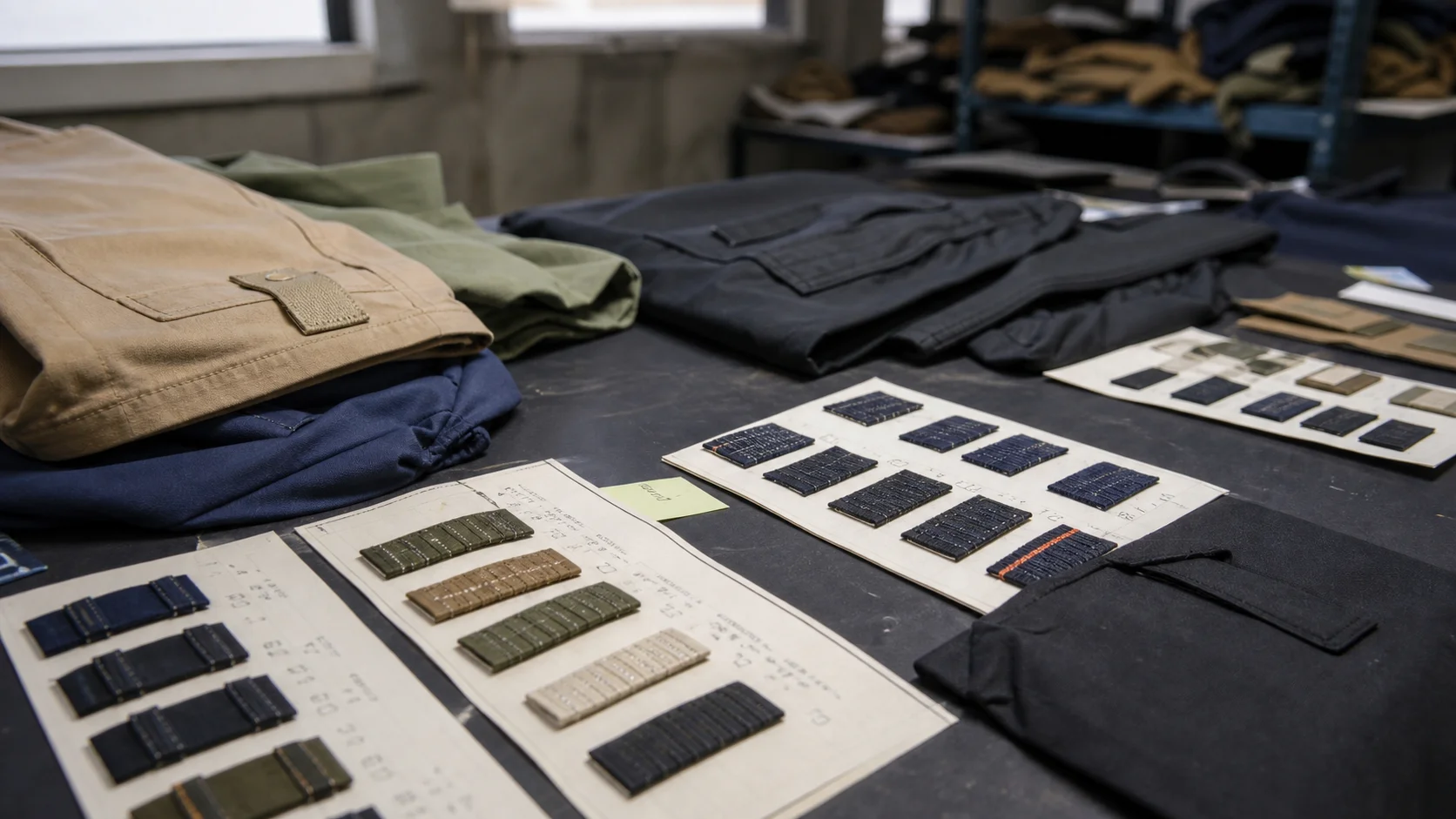
A 2500-word SEO outline reviewing how micro embroidery tabs and printed tab details hold up on event staffing apparel through washing, abrasion, handling,...
Micro Embroidery Tabs Durability Review for Event Teams - Fabrikn production reference
Category: Decoration & Printing
Event staffing uniforms work harder than most buyers expect. A tab on a polo sleeve, apron edge, cap side, vest chest, or lanyard attachment may look like a small branding detail, but it is handled, washed, rubbed, packed, and reissued repeatedly. For event teams, that small tab often carries a role identifier, sponsor mark, department code, or brand accent. If the tab curls, frays, fades, or detaches after a few uses, the whole uniform looks poorly controlled.
Micro embroidery tabs are popular because they give a more permanent appearance than many printed labels. They can add texture without covering a large area of the garment. For teams that need premium presentation at conferences, hospitality activations, trade shows, sports events, festivals, and corporate launches, the format is attractive: small, visible, and relatively easy to standardize across multiple garment types.
The buying question is not whether micro embroidery looks good on a sales sample. The better question is whether the tab survives the real use pattern of event staffing teams. Staff may wear the same item for one long activation, or garments may rotate across seasonal teams for months. Laundering may be done by individuals, hotel services, local contractors, or a central uniform provider. Each route creates different durability risks.
A practical durability review should look at the whole system: base tab fabric, embroidery thread, stitch density, backing, edge finishing, attachment method, garment fabric, wash process, packing method, and inspection criteria. One weak point can undo the rest. A strong embroidered face is not enough if the tab edge sheds threads or the seam attachment pulls out under repeated movement.
For event uniform buyers, micro embroidery tab durability is less about decoration alone and more about whether branding remains neat after transport, wear, wash, and reissue.
A micro embroidery tab is a small textile label or fabric extension decorated with embroidered artwork. It may be sewn into a seam, stitched onto the garment surface, folded over a hem, or attached as a separate patch-like detail. Sizes vary, but common event uniform tabs range from around 15 mm to 60 mm wide, depending on placement and artwork complexity.
The word “micro” usually refers to the small format of the tab and the fine scale of the embroidery. It does not mean every small logo can be embroidered clearly. Tiny lettering, thin outlines, gradients, QR codes, and complex sponsor marks are common sources of disappointment. Embroidery is made from thread, not ink. The artwork must be simplified enough for stitches to form clean shapes.
Typical micro embroidery tabs for event teams include:
A tab can be made from cotton twill, polyester twill, canvas, felt, woven label tape, grosgrain, satin, recycled polyester, nylon, or blended fabric. Polyester-based options are often preferred for event uniforms because they tend to dry quickly, hold color better, and resist shrinkage more predictably than many natural-fiber alternatives. Cotton may look softer and more traditional, but it can shrink, wrinkle, and fade faster under heavy washing unless properly specified.
Micro embroidery tabs are normally produced through a sample approval process before bulk manufacturing. Buyers should ask for both an artwork proof and a physical strike-off. A digital mockup cannot show thread thickness, puckering, backing shadow, edge behavior, or how the tab sits on the actual garment fabric.
Durability starts with the base material. A tab fabric that is too thin may pucker under embroidery tension. A tab fabric that is too stiff may curl at the corners or feel uncomfortable on lightweight uniforms. Event garments often need a balance between appearance and mobility, especially for staff who stand, walk, lift, bend, scan tickets, serve guests, or handle equipment for long shifts.
Embroidery thread is commonly polyester or rayon. Polyester thread is generally the safer choice for event staffing teams because it performs better against abrasion, laundering, perspiration, sunlight exposure, and cleaning chemicals. Rayon can deliver a softer sheen, but it is usually less robust in repeated commercial use.
For event uniform procurement, ask the supplier to confirm thread type, colorfastness expectations, and whether the thread is suitable for industrial or repeated washing. For outdoor events, lightfastness matters. Bright reds, oranges, neons, and certain blues can shift faster under UV exposure if lower-grade thread is used.
Higher stitch density can make a tab feel substantial, but too much density on a small tab can cause stiffness, puckering, needle damage, and distorted artwork. Too little density can make the design look sparse or allow the tab base color to show through. The correct density depends on thread size, artwork shape, base fabric, and backing.
Small text is the main risk. Letter heights below roughly 4 mm to 5 mm can become difficult to read, especially on textured base fabric. Very thin strokes may break visually. Buyers should not accept artwork that looks sharp only on a digital screen. The physical tab is the standard.
Backing supports the fabric during embroidery and helps prevent distortion. Tear-away, cut-away, and heat-soluble backings each have uses, but the wrong backing can cause problems. A rough cut-away backing can irritate skin if the tab sits near the neck or inner arm. An unstable backing can allow the tab to ripple after washing.
For tabs sewn onto outer surfaces, backing comfort may be less important than shape retention. For sleeve, collar, or apron tabs that touch skin, the reverse side should be reviewed carefully. The buyer should inspect both the front and back of the approved sample, not only the decorated face.
Edges often fail before the embroidery does. A tab can use merrowed edges, laser-cut sealed edges, folded edges, heat-cut synthetic edges, or sewn hems. Each has tradeoffs.
For repeated wash and reissue programs, sealed or stitched edges are usually worth the extra cost. A cheap raw edge can reduce unit cost but increases the chance of visible wear after only a few cycles.
The tab must stay attached to the garment. This sounds obvious, but attachment is one of the most common weak points. A durable embroidered tab can still fail if it is attached with a short seam bite, weak thread, poor backtacking, or inconsistent operator handling.
For sewn-in seam tabs, check whether the tab is caught securely in the seam allowance. For surface-applied tabs, check stitch type, thread match, backtack security, and whether the tab corners lift. Tabs placed on stretch garments need special attention. If the garment stretches but the tab does not, stress concentrates around the stitch line.
The keyword phrase “event staffing teams micro embroidery tab print durability review” points to a real sourcing comparison: should a buyer use embroidery or print for small tabs? The answer depends on artwork, budget, timeline, and use conditions.
Micro embroidery is usually stronger for simple logos, initials, icons, and role labels with limited colors. It provides texture and does not rely on a surface ink film in the same way as screen print or heat transfer. It can perform well when washed repeatedly, provided the base tab and attachment are correct.
Printed tabs can be better for fine detail, gradients, small multi-color sponsor logos, photographic marks, and tiny text. Screen print, silicone print, heat transfer, sublimation, and digital print each have different durability profiles. Sublimation can be very durable on white polyester base materials, but it is not suitable for all tab fabrics or dark backgrounds. Heat transfers can deliver sharp detail, but poor adhesive selection or high abrasion can lead to cracking, peeling, or edge lift.
Decoration Method Best For Main Durability Risk Purchasing Judgment Micro embroidery Simple logos, icons, initials, role words Puckering, thread snagging, unreadable small text Best premium option when artwork is simplified Screen print Flat graphics and medium-volume repeat runs Cracking or fading after washing and abrasion Good for clean artwork if ink and curing are controlled Heat transfer Sharp detail, names, short runs, variable data Peeling, edge lift, cracking under stretch Useful for speed, less ideal for rough reissue programs Sublimation Polyester tabs with full-color graphics Color shift, limited to suitable polyester bases Strong option for white or light synthetic tabs Woven label Tiny text and repeat brand labels Edge curl, fray, limited raised texture Often better than embroidery for very small letteringFor event teams, embroidery wins when the tab needs to look premium and survive multiple handling cycles. Print wins when the artwork is too detailed for thread. A mixed approach is sometimes sensible: use embroidered tabs for the main uniform identity and printed or woven labels for sponsor-heavy information.
Good durability starts with written specifications. “Small embroidered tab” is not enough for a purchase order. It leaves too much room for interpretation. A sourcing team should define size, base fabric, color, thread, backing, edge finish, attachment method, placement tolerance, wash expectation, and packaging method.
Useful specification points include:
For buyers building a full uniform package, decoration specs should be aligned with garment construction. A lightweight polo may not support the same tab as a softshell jacket. A tab that looks balanced on an apron may appear too bulky on a performance tee. Consistency across categories is important, but forcing one trim construction onto every garment can create unnecessary quality issues.
Teams planning multiple event uniforms can review broader production options through Fabrikn’s services to compare decoration, garment construction, and trim planning at the sourcing stage.
A physical sample should go through practical testing before bulk approval. Laboratory testing can be useful for larger programs, but many event buyers also need quick, realistic checks that reveal obvious risks before production starts.
A cautious sample process usually follows this sequence:
Skipping the attached sample is risky. A loose tab strike-off may look fine, while the same tab may pucker on a lightweight polo or pull unevenly on a stretch fabric. The attachment step is where many real durability issues appear.
For domestic-use event uniforms, run at least three to five wash-and-dry cycles on the sample if timing allows. For reissue programs, test more cycles or use a harsher internal benchmark. The exact number depends on the contract and garment lifespan, but one untouched salesman sample is not enough.
After washing, look for:
Event uniforms spend time in cartons, garment bags, lockers, vans, backstage areas, and staff rooms. Decoration can be damaged before the event even starts. Rub the tab lightly against similar fabric, backpack straps, lanyard hardware, radio clips, and badge reels if those items are part of the uniform system.
This is not a formal lab test, but it reveals practical problems. Metallic threads may snag. Raised embroidery may catch on hook-and-loop closures. Heat-sealed edges may scratch skin. Dense embroidery may create a hard spot under a jacket strap.
Different event roles expose micro embroidery tabs to different stress points. A registration team may mostly face rubbing from lanyards and desk edges. A catering or hospitality team may deal with food stains, apron washing, and steam. Security teams may wear outerwear, radios, harnesses, and utility belts. Brand ambassadors may change garments often and pack samples tightly between locations.
For indoor conferences, appearance consistency may matter more than extreme durability. For outdoor festivals, UV exposure, rain, mud, sunscreen, and repeated washing become more important. For sports events, sweat, abrasion, and quick laundering cycles can push decoration harder than expected.
Common failure risks include:
Placement should be chosen with movement in mind. Tabs near cuffs, underarms, waistbands, and bag strap zones face more friction. Sleeve tabs can look sharp, but they must be kept clear of high-stretch or high-rub areas. Apron tabs should avoid heavy fold lines and tie contact points. Cap tabs must account for curved panels and seam intersections.
MOQ depends on the supplier, tab construction, garment program size, and whether the tab is produced as a standalone trim or part of a complete garment order. For micro embroidery tabs, typical MOQ ranges may start around 100 to 300 pieces for simple domestic or small-batch programs, while export-oriented or custom trim production often becomes more efficient around 500 to 1,000 pieces. Highly customized base fabric, dyed-to-match tape, special thread, or multi-style garment programs may push practical MOQ higher.
Buyers should treat very low MOQ offers carefully. Low minimums can be useful for pilot events, but they may come with limited fabric choices, higher unit costs, manual variability, or fewer testing options. For one-time events, that may be acceptable. For a recurring staffing program, it is usually better to standardize the trim and hold a controlled specification.
Order Type Typical MOQ Range Practical Notes Pilot event or small team 100–300 pieces Higher unit cost; limited customization may apply Mid-size event uniform run 300–1,000 pieces Better balance of cost, sampling, and quality control Multi-event staffing program 1,000+ pieces More room for custom trim, dye matching, and inspection control Complex custom tab construction 500–2,000+ pieces MOQ depends on base material, edge finish, and decoration processLead times also vary. A simple tab strike-off may take several working days after artwork confirmation. A full pre-production garment sample can take longer because fabric, trims, cutting, sewing, and decoration all need to align. Bulk production may range from a few weeks for simple repeat programs to longer schedules for custom garment manufacturing, imported fabrics, dyed trims, or peak-season capacity.
Lead-time dependencies include:
Event buyers often work backward from the event date, but production should be planned backward from the required delivery-to-site date. Garments may need time for sorting, staff allocation, name labeling, steaming, repacking, and regional distribution. A durable tab is not useful if late approval forces rushed production and weak inspection.
For buyers still defining quantities, specs, and delivery windows, it is sensible to discuss the program early through Fabrikn’s contact page rather than waiting until final artwork and staff counts are already locked.
Inspection should not treat tabs as a minor detail. Small defects are highly visible when uniforms are worn in groups. A single crooked or frayed tab may not matter in isolation, but inconsistent branding across a team can make the uniform package look unmanaged.
If tabs are produced separately before garment sewing, inspect a sample of the trim before attachment. This catches problems early and avoids wasting finished garments.
During sewing, inspect placement and attachment before bulk completion. Placement issues can multiply quickly if operators use inconsistent guides.
Final inspection should include both appearance and practical handling. AQL standards may be used for larger orders, but even smaller event runs need a structured checklist.
A common inspection mistake is reviewing only the front chest logo and ignoring secondary trims. For event staffing teams, secondary trims often carry the role clarity that operations teams rely on. If a sleeve tab says “CREW” or “HOST,” it must be readable and consistent.
Micro embroidery tabs are a good choice when the event uniform needs a premium, durable, tactile branding detail and the artwork is simple enough for thread. They are less suitable when the design requires tiny sponsor text, color gradients, photographic detail, or frequent last-minute artwork changes.
The strongest purchasing route is to approve a real tab on the actual garment material, then test it under the expected use conditions. Do not rely only on a loose embroidery sample. Do not approve micro text that is barely readable before washing. Do not place tabs in high-abrasion zones unless there is a practical reason and the attachment has been tested.
Cost tradeoffs are straightforward. Better thread, stable backing, sealed edges, and stronger attachment add cost, but they protect the uniform’s usable life. Cheap tabs can make sense for one-night promotional events where garments are not reissued. For multi-day, multi-location, or recurring staffing programs, low-cost decoration can become expensive if replacements, complaints, or inconsistent team presentation follow.
For most event staffing teams, the best specification is a polyester or stable synthetic-blend tab, polyester embroidery thread, simplified artwork, sealed or stitched edges, secure sewing, and approved wash testing. If the artwork is too detailed, a woven label or sublimated polyester tab may be the better technical choice.
Buyers should also consider brand hierarchy. Not every logo needs embroidery. A main brand mark may deserve an embroidered tab, while sponsor names, staff names, or event-specific data may be better handled through print, badges, or removable identifiers. This keeps the permanent uniform clean and reduces rework when sponsors or roles change.
Fabrikn’s broader manufacturing background can be reviewed on the About Us page for buyers comparing uniform development, sourcing support, and decoration planning.
Micro embroidery tabs can be durable enough for event staffing teams when they are specified and tested as functional trims, not just decorative extras. The best results come from stable tab fabric, polyester thread, clean digitizing, controlled stitch density, secure edge finishing, and correct attachment to the garment.
Printed tabs still have a place. They are often better for detailed sponsor artwork, complex colors, and last-minute event customization. The practical buyer’s decision is not embroidery versus print in general. It is which method protects the brand presentation for the actual event use case.
For repeat event staffing programs, micro embroidery tabs are usually worth considering. For disposable or single-use promotions, a lower-cost print option may be enough. For premium event uniforms that must look consistent after washing, packing, and reissue, embroidery has a clear advantage when the artwork is suitable.
Get a free quote from Fabrikn — your trusted B2B clothing manufacturer with 10+ years of experience. MOQ as low as 200 pieces.
Get a Free Quote →Yes, they can be durable when made with stable base fabric, polyester embroidery thread, proper backing, secure edges, and strong attachment. Durability depends on the full trim construction, not only the embroidery.
Embroidery is usually better for simple logos, initials, and role labels that need a premium textured look. Print is often better for tiny text, gradients, sponsor marks, and complex full-color artwork.
Typical MOQ ranges may start around 100 to 300 pieces for small programs and often become more cost-efficient from 500 to 1,000 pieces. Custom fabric, dye matching, or complex trims can require higher minimums.
Buyers should approve a physical strike-off, attach it to the actual garment fabric, run wash tests, check abrasion risks, inspect edge fray, and review attachment strength before approving bulk production.
Polyester embroidery thread is usually the safest choice for event uniforms because it handles washing, abrasion, perspiration, and sunlight exposure better than many rayon alternatives.
Only to a point. Lettering below roughly 4 mm to 5 mm can become difficult to read, depending on font, fabric, stitch density, and thread. A woven label or print may be better for very small text.
Good placements include sleeve edges, apron corners, cap sides, chest accents, and outerwear panels, provided they avoid high-rub zones. Tabs should not be placed where straps, cuffs, belts, or heavy movement will damage them.
Common issues include crooked placement, frayed edges, loose threads, unreadable artwork, puckering, rough backing, color mismatch, corner lifting, and inconsistent seam capture.
They can be suitable if thread colorfastness, UV exposure, rain, washing, and abrasion are considered. Outdoor programs should avoid weak thread, raw edges, and placements that rub against bags or equipment.
For repeat teams, invest in a tested embroidered tab with stable fabric, sealed edges, polyester thread, and secure attachment. The slightly higher trim cost is usually justified by better appearance retention and fewer replacement issues.