
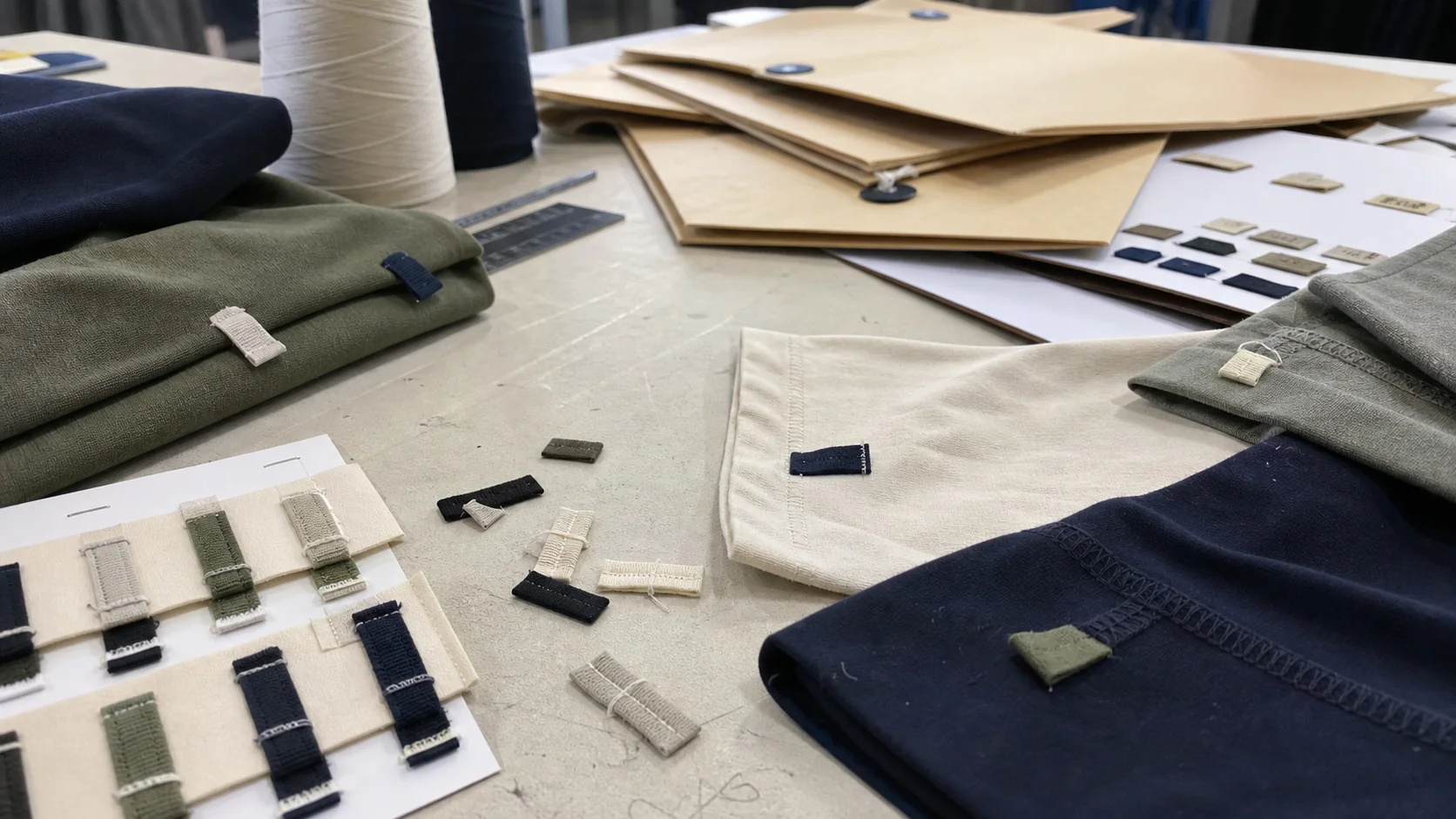
A distributor-focused production control outline for sourcing micro embroidery tabs, covering artwork engineering, thread density, backing, tolerances,...
Micro Embroidery Tabs: Buyer Production Control Brief - Fabrikn production reference
Micro embroidery tabs look simple on a buyer’s line sheet, but they are not simple in production. A small woven or fabric tab with tight embroidery can carry a brand mark, size code, product series, care cue, promotional icon, or compliance-related identification. For distributor buyers, the risk is that a low-cost decoration component becomes the reason a shipment is delayed, rejected, or downgraded by the final customer.
This brief is written for buyers sourcing from a micro embroidery tab factory, especially distributors handling multi-client decoration programs. The focus is production control: how to define the product, qualify the supplier, approve samples, control bulk output, inspect defects, and manage the tradeoffs between cost, speed, and consistency.
Micro embroidery tabs sit inside the broader Decoration & Printing category, but they should not be managed like ordinary embroidery on garments. Their size is smaller, the tolerance is tighter, and the visual defects are more obvious because the buyer is often looking at a logo or symbol at very close range. A 1 mm shift that is acceptable on a large chest logo may ruin a 15 mm tab.
Distributor buyers also face a practical problem: the end customer may approve a digital mockup without understanding thread behavior, needle limitations, fabric shrinkage, backing visibility, or edge finishing. The factory may quote quickly, but bulk success depends on disciplined pre-production control.
For sourcing support across apparel manufacturing and decoration planning, buyers can review Fabrikn’s broader production services at https://fabrikn.com/services/. For supplier briefing, quotation alignment, or project-specific discussion, the contact page at https://fabrikn.com/contact-us/ is the more direct route.
A micro embroidery tab is a small component. That is exactly why it needs tighter control. The unit cost may be low, but the inspection pressure is high. The tab may be sewn into a seam, applied to a hem, folded over a pocket edge, attached to headwear, or used as a decorative identifier on bags, uniforms, kidswear, sportswear, or promotional apparel.
The factory must control the relationship between four elements: the base material, the embroidery stitch file, the backing system, and the cutting or folding method. If one part is wrong, the tab may twist, curl, fray, shrink, distort, or lose definition.
Buyers should separate micro embroidery tabs from larger embroidered patches, woven labels, printed heat transfers, and direct garment embroidery. A tab is usually smaller than a patch, thicker than a printed label, more tactile than a woven label, and more technically constrained than a large embroidery placement.
Purchasing judgment: treat micro embroidery tabs as a precision trim item, not as a generic decoration add-on. The supplier must prove repeatability before bulk approval.
Common use cases include side seam tabs, neck tape markers, sleeve badges, hem flags, cap tabs, bag tabs, fold-end logo tabs, zipper-pull decorative tabs, promotional badges, and limited-run branded inserts. Each application changes the construction. A tab sewn into a side seam needs a clean allowance and stable fold. A badge-style tab needs a presentable border. A zipper-pull tab may need stronger base fabric and denser stitching.
Micro embroidery also raises legibility concerns. Small lettering can collapse. Fine outlines can disappear. Thread colors can bleed visually into the ground fabric. Metallic thread can break more often than standard polyester thread. High-density stitch areas can make the tab stiff or wavy. These are not rare problems; they are normal production risks when small decoration is pushed too far.
A good quotation starts with a complete product definition. Many distributor quote requests are too light: “small embroidered logo tab, 2 cm, black base, white logo.” That is not enough for reliable costing or production control.
The buyer should prepare a technical brief that defines the tab as a trim component, not just an artwork request. The factory needs to know size, shape, fold type, edge finish, base fabric, thread count, backing, attachment method, packaging, quantity split, colorways, and approval requirements.
Buyers should not rely only on finished images. The factory needs the dimensions of the fold and seam insertion area. If a tab is 20 mm wide and 15 mm visible after sewing, the total flat piece may need to be 20 mm by 30 mm, 20 mm by 35 mm, or another size depending on fold construction and attachment method.
Small tabs often fail because the buyer approves only the front face, then the sewing factory struggles with the seam allowance. A tab that looks correct loose on a table may be too thick for a side seam. It may also twist after washing if the base fabric and backing are not compatible.
Not every embroidery supplier is suitable for micro tabs. A factory that can run large chest embroidery may still struggle with 10 mm icons or 2 mm lettering. Distributor buyers should check capability before chasing the lowest unit price.
The first question is machine capability. Multi-head embroidery machines are common, but micro work depends on needle condition, thread tension control, hooping or frame stability, backing choice, and operator skill. If the supplier produces tabs as a regular trim category, it should understand small-format digitizing, cutting accuracy, and tab packing discipline.
The second question is component handling. Micro tabs are small and easy to mix, miscount, or damage during cutting and packing. If one carton includes several near-identical colorways, the risk of assortment error increases. The factory needs clear internal controls for lot separation.
Buyers should also ask whether the embroidery tab factory handles cutting in-house or outsources it. Outsourcing is not automatically a problem, but it adds a control point. If embroidery is done in one place and laser cutting or heat cutting is done elsewhere, the buyer needs to know who owns final inspection.
A practical supplier will push back on artwork that cannot be embroidered cleanly at the requested size. This pushback is valuable. A supplier that accepts every design without warning may be protecting the quotation rather than the buyer’s shipment.
For buyers evaluating manufacturing partners, the company background and operating scope can be reviewed at https://fabrikn.com/about-us/. The key point is not just who can make the item, but who can manage the production control behind it.
The base fabric determines how the embroidery sits. For micro tabs, the ground material must be stable enough to hold stitches without puckering, but not so heavy that the finished tab becomes bulky. The best choice depends on the end use.
Polyester twill is common because it is stable, cost-effective, and compatible with heat cutting. Cotton twill gives a softer and more natural hand feel, but it may fray more and can shrink if not controlled. Felt gives a badge-like appearance and good stitch support, but it may not suit premium apparel or wash-heavy products. Satin gives shine and a smoother surface, but it can show needle marks and snag more easily.
Backing selection is often under-specified. Tear-away backing can work for simple designs, but it may not support very small details. Cut-away backing offers stronger support but can leave visible residue or stiffness. Heat-seal backing can reduce fraying and support the tab during cutting, yet it may change hand feel. No-show mesh may be useful where backing visibility matters, though it may cost more.
Thread selection is equally important. Polyester embroidery thread is usually preferred for durability and wash resistance. Rayon gives a softer shine but may be less robust in demanding wash or abrasion conditions. Metallic thread creates a premium effect but breaks more often, slows production, and increases defect risk. Matte thread can look modern and subtle, but color matching may be more limited than standard thread ranges.
Buyers should define thread colors using a physical thread card or approved sample rather than only digital Pantone references. Pantone is useful for communication, but embroidery thread is not ink. Thread has sheen, direction, and shadow. Two thread colors that match a screen image may look different under store lighting.
Digitizing is the conversion of artwork into an embroidery stitch file. For micro embroidery tabs, digitizing is not a routine administrative step. It is one of the main quality drivers.
Small logos often need simplification. Fine gradients, tiny text, thin serifs, detailed icons, and hairline outlines rarely translate cleanly. The buyer should decide early whether brand accuracy or embroidery clarity is more important. In many cases, a simplified embroidery version of the logo is the better commercial choice.
A distributor buyer should request an embroidery proof, but should not treat the proof as a guarantee. A digital stitch simulation can show sequence, direction, and color blocking, but it cannot fully show thread tension, fabric movement, thread shine, or edge distortion. A physical strike-off is still necessary for final approval.
Size control is a common dispute. Buyers may approve a 20 mm artwork, but the factory may need to compensate for fabric pull. Pull compensation is normal in embroidery. The problem occurs when no one agrees on whether the measured size refers to artwork dimensions, stitched dimensions, visible dimensions, or finished cut dimensions.
Distributor buyers should specify tolerances clearly. For micro tabs, common practical tolerances may be around plus or minus 1 mm for finished size, depending on construction and material. More demanding tolerances can be requested, but they may increase rejection risk and cost. For very small logos, even a 0.5 mm shift can be visually noticeable, so buyers should define critical points separately from general size tolerance.
Sampling should be managed in stages. A rushed approval process is one of the fastest ways to create bulk problems. Distributor buyers should avoid approving bulk production from a digital mockup alone unless the design is extremely simple and repeat history exists.
The standard process should include artwork confirmation, digitizing review, first strike-off, revised strike-off if needed, pre-production sample, and sealed approval sample. For small orders, the buyer may combine some steps, but the risk must be understood.
Lead time for sampling depends on artwork complexity, fabric availability, thread matching, workload, and whether special cutting or folding is required. Typical sampling may take 5 to 10 working days for straightforward tabs after artwork confirmation. More complex designs, custom materials, special backing, or multiple revisions can push sampling to 2 to 3 weeks.
Buyers should not approve a sample that is “almost right” unless the defect is clearly documented and corrected in writing. If the sample has a slightly off-center logo and the factory says bulk will be better, that is not enough. Bulk production follows approved standards. A buyer should approve only what is acceptable, or approve with a written correction list and require a pre-production confirmation before full run.
Purchasing judgment: if the factory cannot produce a clean sample after two reasonable correction rounds, the design may be unsuitable, the digitizing may be weak, or the supplier may not be the right fit.
MOQ varies widely by factory, material, colorway, and finishing method. For micro embroidery tabs, typical MOQ may range from 300 to 1,000 pieces per design for basic production, with better pricing often starting around 2,000 to 5,000 pieces. For special materials, multiple thread colors, custom cutting dies, or complicated folding, MOQ may rise.
Distributor buyers should be careful with MOQ language. A supplier may quote “500 pieces MOQ,” but that may mean 500 pieces per design, per colorway, per size, or per embroidery file. If the buyer has five logo colors and two base fabrics, the real production split may be too fragmented for the quoted price.
Setup cost is also important. Digitizing charges, sample charges, cutting mold costs, color card charges, and courier charges may be separate. Some factories waive setup after bulk order confirmation; others charge upfront. Neither approach is automatically better. The buyer should compare total landed cost, not just unit price.
Bulk lead time commonly ranges from 10 to 25 working days after sample approval for standard materials and reasonable quantities. Larger programs, seasonal factory load, custom fabric procurement, special trims, color matching delays, and outsourced cutting can extend the schedule. Shipping time, export documentation, and buyer inspection windows must be added separately.
Distributors should plan extra time for assortment checking. A program with 20 small tab designs may take longer to pack and verify than one large run of a single design. The factory’s production speed is only one part of the timeline. Sorting, counting, bagging, labeling, and carton marking can become bottlenecks.
Bulk production should not start until the factory has the approved sample, approved artwork file, approved material references, and written order breakdown. A clean production file reduces disputes. It also gives the factory’s internal teams one reference point.
Distributor buyers should request a pre-production confirmation before full bulk output. This can be a small first-run sample from the actual production setup. The purpose is to confirm that the machine settings, thread colors, backing, base fabric, cutting, and folding match the approved standard.
Thread tension and needle condition need monitoring. Poor tension can create loops, thread breaks, loose stitching, or uneven surfaces. A dull needle can damage fabric or create rough stitch edges. The smaller the tab, the less room there is to hide these issues.
Cutting control is just as important as embroidery. Laser cutting can give a clean edge but may leave discoloration or burnt smell if settings are poor. Heat cutting can seal polyester edges but may create hard edges. Die cutting can be consistent if tooling is good, but dull dies cause rough edges. Scissor trimming should be avoided for bulk precision unless the design is extremely simple and volume is low.
Folded tabs need folding jigs or clear production aids. Manual folding without a guide can produce inconsistent visible size. If tabs are sewn into garments later, inconsistent fold depth can create uneven appearance on the finished product.
Inspection for micro embroidery tabs should cover appearance, measurement, construction, durability, packing, and assortment. A buyer cannot inspect only the logo face and assume the shipment is acceptable.
Common defects include off-center embroidery, misaligned borders, broken threads, loose threads, thread loops, missing stitches, poor color match, dirty marks, oil stains, puckering, curled edges, frayed edges, burnt edges, inconsistent cutting, visible backing, rough reverse side, wrong fold depth, mixed colorways, and incorrect quantities.
The acceptable level depends on the product position. A premium apparel program needs stricter visual standards than a low-cost giveaway. Still, even promotional orders need basic control because tabs often carry the buyer’s or end customer’s brand identity.
AQL inspection can be used, but buyers should define critical defects separately. Wrong logo, wrong color, wrong size, wrong customer code, and mixed assortment should usually be treated as major or critical depending on the contract. Minor loose thread may be trimable if it does not affect appearance. Burnt edges, severe puckering, or unreadable logo should not be accepted as minor just because the tab is small.
Durability testing should be considered if the tab will be washed, abraded, stretched, or exposed to heat. Basic tests may include wash testing, rubbing, seam insertion trial, heat application check, and edge fray check. If the tab is used on children’s products, uniforms, safety-related apparel, or regulated goods, the buyer should confirm relevant compliance requirements separately.
Packing deserves more attention than it usually receives. Micro tabs are small, and small items are easy to lose, mix, or miscount. Distributor buyers often supply tabs onward to garment factories, embellishment shops, brand clients, or fulfillment centers. Poor packing creates downstream cost.
The packing method should match the buyer’s workflow. Loose bulk packing may be cheapest, but it can create counting problems. Bundles of 50 or 100 pieces are easier to control. Individual bags may be required for high-value or multi-SKU orders, though they add labor and packaging cost.
Buyers should ask whether the quoted quantity includes production wastage or exact shipped count. Some factories produce extra to cover defects but ship only the ordered quantity. Others may ship slight overage. The distributor should define whether overage is billable, free, or not accepted.
For garment factory handover, tabs should be packed to support line feeding. A factory sewing 2,000 garments does not want a mixed carton with several loose tab designs. If tabs are intended for specific garment styles, the packing label should match the garment purchase order or style number.
Shipping method depends on urgency and value. Small tab orders often ship by courier or air because the weight is low. Larger distributor replenishment programs may ship by sea or consolidated freight. Lead time planning should include final inspection, packing, documentation, pickup, customs, and delivery to the final production point.
Distributor buyers need clear judgment because micro embroidery tabs can trigger emotional decisions. The end customer may focus on logo perfection, while the factory may focus on production tolerance. The buyer sits between both.
The best approach is to define the non-negotiables before production. Wrong logo, wrong thread color, wrong base fabric, wrong size, unreadable text, unstable edge, and mixed assortment should not be treated as small issues if they affect brand identity or usability.
Rework may be reasonable for loose threads, minor trimming, sorting mistakes, or packaging errors. Rework is usually not practical for poor digitizing, wrong embroidery placement, or dense puckering across a bulk lot. Once embroidery is stitched into a small tab, correction options are limited.
Purchasing judgment: reject root-cause production defects early. Accept cosmetic variation only when it is within approved tolerance and does not affect brand, sewing, durability, or customer presentation.
Cost pressure is real. A cheaper factory may be acceptable for simple one-color tabs with standard materials and generous tolerance. A more controlled supplier is worth the premium for tiny logos, premium apparel, multiple colorways, tight delivery windows, or distributor programs where sorting accuracy matters.
Buyers should not demand luxury standards at commodity pricing without adjusting the design or order plan. If the budget is tight, simplify the logo, reduce thread colors, increase tab size, use standard polyester twill, accept a standard edge finish, and consolidate SKUs. If the brand requirement is strict, pay for better sampling, stronger inspection, and more disciplined packing.
A micro embroidery tab factory should be selected for control, not just machine access. The buyer needs proof that the supplier can handle small details, stable backing, clean cutting, accurate folding, and disciplined packing. A good factory will help prevent an unworkable design from reaching bulk production.
For distributor buyers, the biggest risks are unclear specification, weak sample approval, unrealistic artwork, fragmented MOQ, color mismatch, inconsistent cutting, and mixed packing. Each of these risks can be reduced with a tighter production brief and a sealed physical standard.
The most practical purchasing route is straightforward: define the tab fully, confirm factory capability, approve a physical strike-off, lock the production file, check first bulk output, inspect before shipment, and pack by SKU. That process may feel heavy for a small trim, but it is cheaper than sorting or replacing thousands of defective branded components after delivery.
Buyers planning decoration and trim programs can use Fabrikn’s apparel production services as a starting point for broader sourcing coordination. For project-specific briefs, quotation discussions, or production control planning, use Fabrikn’s contact page.
Get a free quote from Fabrikn — your trusted B2B clothing manufacturer with 10+ years of experience. MOQ as low as 200 pieces.
Get a Free Quote →A micro embroidery tab is a small fabric or trim component decorated with embroidery. It may be sewn into a garment seam, attached as a badge, folded over an edge, or supplied as a branded trim for apparel, bags, caps, uniforms, and promotional products.
Typical MOQ may range from 300 to 1,000 pieces per design for simple standard tabs. Multi-color, custom-shaped, specialty material, or distributor SKU programs may require 1,000 to 5,000 pieces per design or more. Always confirm whether MOQ applies per design, per colorway, or per size.
Sampling often takes 5 to 10 working days after artwork and specifications are confirmed. Complex designs, special materials, thread matching, outsourced cutting, or multiple correction rounds can extend sampling to 2 to 3 weeks.
Sometimes, but there are limits. Very small lettering, thin serifs, tight spacing, and detailed icons may collapse after stitching. A simplified embroidery version of the artwork is often better than forcing the original artwork into a micro size.
Polyester twill is a common choice because it is stable, cost-effective, and suitable for heat cutting. Cotton twill offers a softer natural look but may fray or shrink more. Felt, satin, and canvas can work for specific applications, but each has tradeoffs in bulk, durability, and appearance.
The main risks include off-center embroidery, unreadable logos, thread color mismatch, puckering, frayed or burnt edges, visible backing, inconsistent fold depth, loose threads, mixed SKUs, and incorrect quantities.
Physical approval is strongly preferred. A digital proof cannot fully show thread behavior, fabric movement, stitch density, color shine, or cutting quality. For distributor orders, a physical strike-off and sealed pre-production sample reduce bulk risk.
Many buyers use around plus or minus 1 mm for finished size on small tabs, depending on construction. Critical points such as logo placement, legibility, color, and seam allowance may need stricter control. The tolerance should be written before bulk production starts.
Some defects can be reworked, such as loose thread trimming, sorting mistakes, or packing label errors. Major defects such as wrong artwork, poor digitizing, severe puckering, incorrect fabric, or wrong embroidery placement are usually difficult or uneconomical to correct.
Prioritize small-format embroidery capability, physical sampling discipline, material control, cutting accuracy, SKU-level packing, and honest feedback on artwork feasibility. The lowest unit price is not the best choice if the factory cannot maintain consistency across bulk production.