
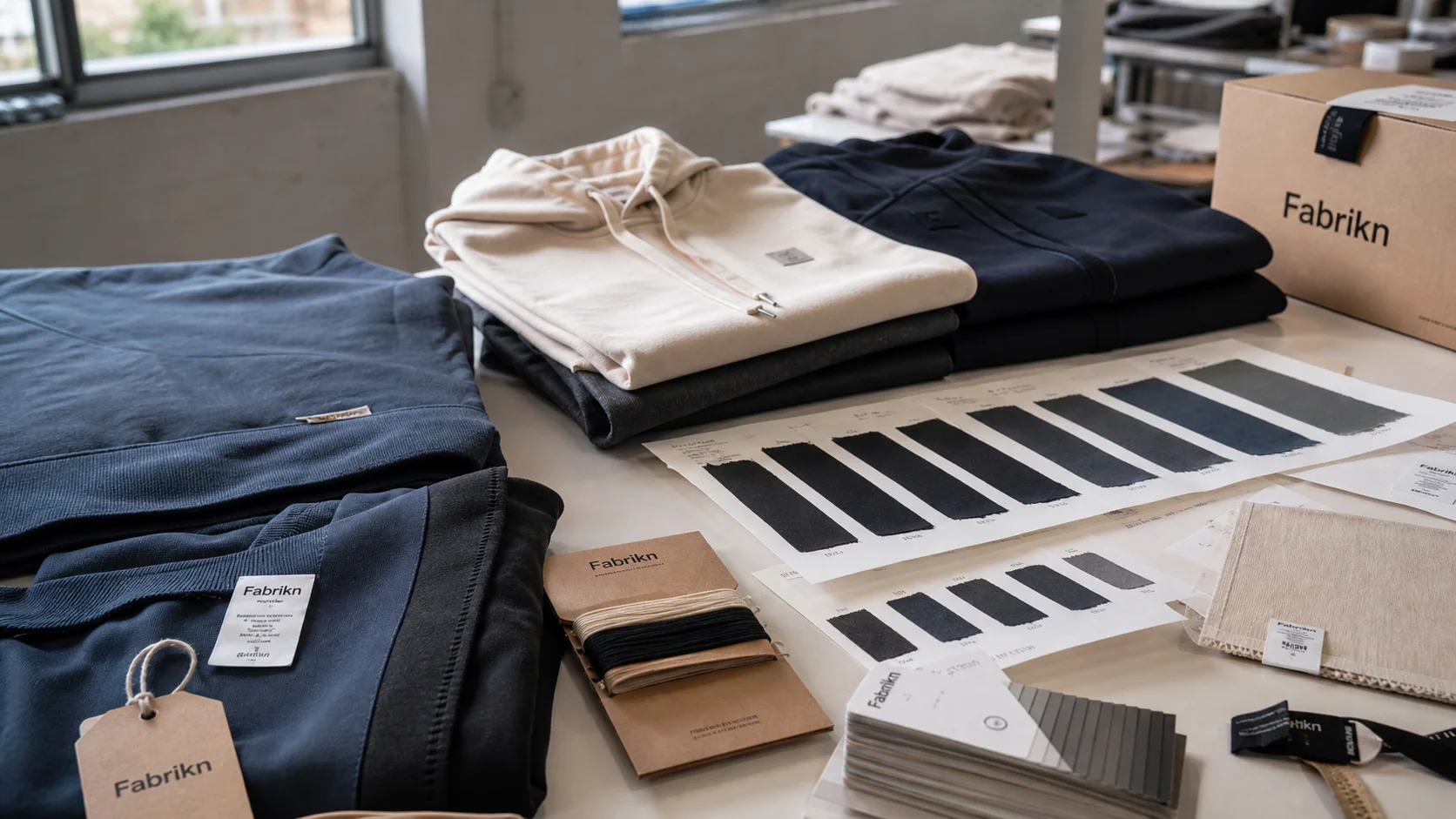
Minimum Order Quantity Negotiation for China Sourcing compared by sample evidence, fabric or trim specs, MOQ, AQL terms, cost lines, delivery timing, and...
Fast answer: Minimum Order Quantity Negotiation for China Sourcing: Tech Pack, Sample Gate, MOQ, and QC Terms should be judged by production evidence, not by a generic sourcing promise. The buyer needs sample proof, cost breakdowns, QC checkpoints, and delivery buffers in writing.
Ask for recent sample photos, measurement tolerances, fabric or print test assumptions, decoration test notes, packing examples, and a named inspection checkpoint. These details show whether the team can repeat an approved sample at bulk volume.
Separate garment cost, decoration, labels, packaging, sampling, testing, freight, and rush charges. Clear cost lines make it easier to reduce colorways, adjust size depth, or reserve more time for sampling.
For apparel brands, retailers, startups, and private label businesses, sourcing from China can offer major advantages in cost, manufacturing capability, and product variety. But one challenge comes up again and again: minimum order quantity, or MOQ. Negotiating MOQ effectively can determine whether a new product launch is profitable, whether a pilot run is possible, and whether your supply chain stays flexible enough to grow with demand.
If you are searching for minimum order quantity negotiation tips China buyers can actually use, this guide will help you understand what suppliers are thinking, how to prepare a strong negotiation strategy, and how to build a business relationship that gives you more room to grow. Whether you are sourcing T-shirts, hoodies, activewear, workwear, or custom apparel, the right MOQ negotiation approach can save money, reduce risk, and improve your ability to test the market.
MOQ is the smallest quantity a supplier is willing to produce for a specific item, material, color, print, or custom specification. In China sourcing, MOQ often reflects the manufacturer’s cost structure, production efficiency, material purchasing requirements, and setup time.
For example, a factory may have one MOQ for fabric dyeing, another for embroidery, and another for packaging. That means the final order threshold is not always a single number. Instead, it can be a combination of production requirements across different components of the product.
In apparel manufacturing, MOQ can vary widely depending on:
Understanding this helps buyers negotiate more strategically. Instead of asking a supplier to “lower the MOQ,” it is often better to ask which elements are driving the MOQ and whether those elements can be adjusted.
MOQ affects more than just the number of units you have to buy. It influences cash flow, inventory risk, warehouse space, product testing, and your overall buying strategy. For B2B buyers, especially those launching new lines or entering new markets, a high MOQ can create a barrier to growth.
Here are a few reasons MOQ matters so much:
At the same time, suppliers are not being difficult when they set MOQs. They are balancing raw material sourcing, labor efficiency, production scheduling, and profit margins. Successful MOQ negotiation is not about forcing a supplier to accept an unprofitable order. It is about finding a structure that works for both sides.
Good negotiation starts long before you ask for a lower quantity. The more prepared you are, the easier it is to present a compelling case and the more likely the supplier is to work with you.
Suppliers respond better when they understand that you have a clear business plan. If you can explain your target market, expected sell-through, reorder potential, and growth strategy, the MOQ conversation becomes more credible.
For example, if you are launching a new athleisure line and plan to reorder every 60 days if the product performs well, say so. A supplier is often more willing to reduce the initial MOQ if they see a path to repeat business.
Before negotiating, try to identify what is driving the MOQ. Is it the fabric minimum from the mill? The printing setup cost? The dyeing process? Special trims or packaging? When you know the reason, you can propose a better solution.
For instance, if one custom label is increasing MOQ, you may be able to simplify the label design or use a shared label approach for the pilot order.
A well-structured order forecast can be more persuasive than a generic request for “small quantities.” Include estimated monthly demand, size breakdowns, color preferences, and reorder expectations. This shows you are serious and helps the supplier evaluate the opportunity.
It is smart to gather quotes from several factories or trading partners. Not only does this give you leverage, but it also helps you understand the market range for MOQ. You may discover that one supplier has a lower MOQ because they specialize in startup-friendly production, while another requires a larger volume but offers better pricing at scale.
If your budget or launch schedule is tight, decide which elements are essential and which can be flexible. For example, you might need a specific fit and fabric, but you may be willing to change packaging, neck label style, or color count to reduce MOQ.
Once you understand the supplier’s position and your own business needs, you can begin negotiating with more confidence. Below are practical minimum order quantity negotiation tips China sourcing teams use to improve outcomes.
Many buyers make the mistake of asking only for a lower total order quantity. A better approach is to break the order into components. Ask about minimums for fabric, dye lot, trims, prints, labels, and packaging separately.
This can reveal where the real bottleneck is. Sometimes a supplier cannot lower the overall MOQ much, but they can reduce one restricted component enough to make the order viable.
If a supplier is hesitant to lower MOQ, propose a pilot order followed by a larger reorder if sales are strong. This reduces the supplier’s risk while giving you a lower entry point.
Example: instead of ordering 3,000 units immediately, ask whether you can start with 500 or 800 units for sampling the market, with a contract commitment for a larger second order if performance meets a target.
If your issue is not total volume but SKU complexity, consider consolidating the order. For example, a factory may accept lower quantity per color if you increase the total quantity across all colors or sizes.
This works especially well when the supplier cares about production efficiency more than one specific SKU count. A broader order with fewer changes on the line may be easier for them to accept.
The more complex the product, the higher the MOQ tends to be. If you need a lower MOQ, simplify where possible:
Small design adjustments can significantly lower production requirements and make suppliers more flexible.
Suppliers value long-term business. If you can commit to a forecasted annual volume, they may agree to a lower initial MOQ. This is particularly effective when you are building a relationship with a factory that wants stable, repeat orders.
Rather than asking for a one-time exception, present a business case: “We are launching with a smaller test order, but if the product performs well, we expect to place monthly replenishment orders.” That signal can be powerful.
Sometimes a supplier can reduce MOQ if the buyer accepts a slightly higher unit price. This trade-off may be worthwhile if you want to lower inventory risk or test a new market. In many cases, paying a bit more per unit is better than committing to excess stock.
However, make sure the numbers still work. Lower MOQ with a much higher cost can undermine your margins. The goal is balance, not compromise for its own sake.
Some suppliers are open to starting with samples or a small trial run before agreeing to a larger production order. This is useful when you need to validate quality, fit, or customer demand before scaling up.
Ask whether the supplier can apply sample development knowledge to a low-volume pilot production order. In some cases, the sample process can also help the factory estimate the final MOQ more accurately.
MOQ negotiations are easier when the supplier trusts you. Be professional, clear, and responsive. Avoid aggressive bargaining as your first move. A respectful tone and a solid understanding of the production process can make a real difference.
Suppliers are more likely to make exceptions for buyers who communicate well, pay on time, and show potential for repeat business.
Factories may be more flexible during slower production periods. If you are not in a rush, timing your order strategically can improve your chances of securing a lower MOQ or better terms.
Ask the supplier whether their production schedule allows for smaller trial orders during off-peak times.
Once you agree on MOQ, pricing, lead times, and specifications, document the terms clearly. This avoids misunderstandings later, especially if the order involves multiple colors, sizes, or packaging options.
Written agreements help both sides stay aligned and reduce the risk of disputes during production.
Even experienced buyers sometimes make mistakes that weaken their negotiating position. Avoid these common issues when discussing MOQ with China suppliers.
Price matters, but MOQ can have a bigger impact on total business risk. A low unit price is not helpful if the order is too large for your budget or sales capacity.
If a factory’s minimum is 1,000 units, asking for 50 units without any flexibility may not be productive. It is better to ask what portion of the MOQ is fixed and whether there are alternatives.
Every change in color, print, or trim can add setup time and cost. If you do not account for this, you may misunderstand why the MOQ is set where it is.
A product may have multiple MOQ layers, including fabric, accessories, and finished goods. If you only focus on the final garment count, you may miss opportunities to negotiate more efficiently.
Suppliers are more willing to cooperate when they can see a clear future value. If you plan to reorder, explain that. If you have an expanding market or multiple product categories, share that too.
Lowering quantity should not mean compromising on product quality. If the supplier offers a lower MOQ but cannot maintain standards, the savings may be lost through returns, complaints, or brand damage.
MOQ negotiation is not a one-time event. It is part of a longer supplier relationship strategy. The better relationship you build, the more flexibility you are likely to gain over time.
Here are a few ways to strengthen supplier trust:
Factories appreciate buyers who are organized and predictable. If you establish yourself as a reliable customer, future MOQ discussions often become easier.
It also helps to learn more about the manufacturer’s capabilities and values. If you want to understand how a supplier approaches production, quality, and long-term collaboration, visit our about us page to learn more about Fabrikn’s approach to apparel manufacturing. You can also explore our services to see how we support brands with custom clothing production and sourcing.
Sometimes the best negotiation outcome is not a lower MOQ. In certain cases, accepting a higher quantity may actually be the smarter business decision.
You may want to accept a higher MOQ if:
In other words, if the order supports your margin and growth strategy, a larger MOQ can be an opportunity rather than a burden. The key is to evaluate the total picture: inventory risk, cost savings, and expected demand.
At Fabrikn, we understand that MOQ is a major factor in B2B clothing manufacturing decisions. Many brands need a practical way to balance product testing, cost control, and future growth. That is why we work with clients to assess production requirements early and identify realistic order strategies.
If you are exploring a new apparel concept, launching a private label collection, or scaling an existing range, our team can help you think through quantity planning, material options, and manufacturing feasibility. For brands that want to start a conversation about product development or sourcing, please visit our contact page.
MOQ negotiation works best when both sides understand the business goals behind the order. The more transparent you are about timelines, target customers, and growth plans, the easier it becomes to find a production path that works for everyone.
Negotiating MOQ in China sourcing is not just about asking for smaller numbers. It is about understanding supplier economics, simplifying product requirements, using phased order strategies, and showing long-term value. When done well, MOQ negotiation can help apparel businesses reduce risk, improve flexibility, and grow more strategically.
The best minimum order quantity negotiation tips China buyers can follow all have one thing in common: preparation. Know your product, know your supplier’s constraints, and communicate your goals clearly. Whether you are sourcing a small pilot run or planning a larger production launch, a thoughtful negotiation approach can lead to better results for your business.
If you want to build a smarter sourcing strategy, use MOQ as a conversation tool rather than a barrier. With the right mindset and the right manufacturing partner, you can turn order minimums into manageable, scalable opportunities.
Get a free quote from Fabrikn — your trusted B2B clothing manufacturer with 10+ years of experience. MOQ as low as 200 pieces.
Get a Free Quote →MOQ varies widely by product type, fabric, customization level, and factory size. Basic garments may have lower MOQs, while custom or complex items often require higher quantities.
Yes, in many cases you can. Suppliers may lower MOQ if you simplify the product, accept a higher unit price, commit to future orders, or phase the order in stages.
The best approach is to explain your business plan, share expected reorder potential, and ask about the specific cost drivers behind the MOQ. This is more effective than making a vague request for a smaller order.
Usually, larger quantities can reduce unit cost, but not always enough to justify the extra inventory risk. The right decision depends on demand, cash flow, and product lifecycle.
Fabrikn helps B2B apparel buyers evaluate manufacturing requirements, product development options, and sourcing strategies so they can make better quantity decisions. To discuss your project, visit our contact page.