
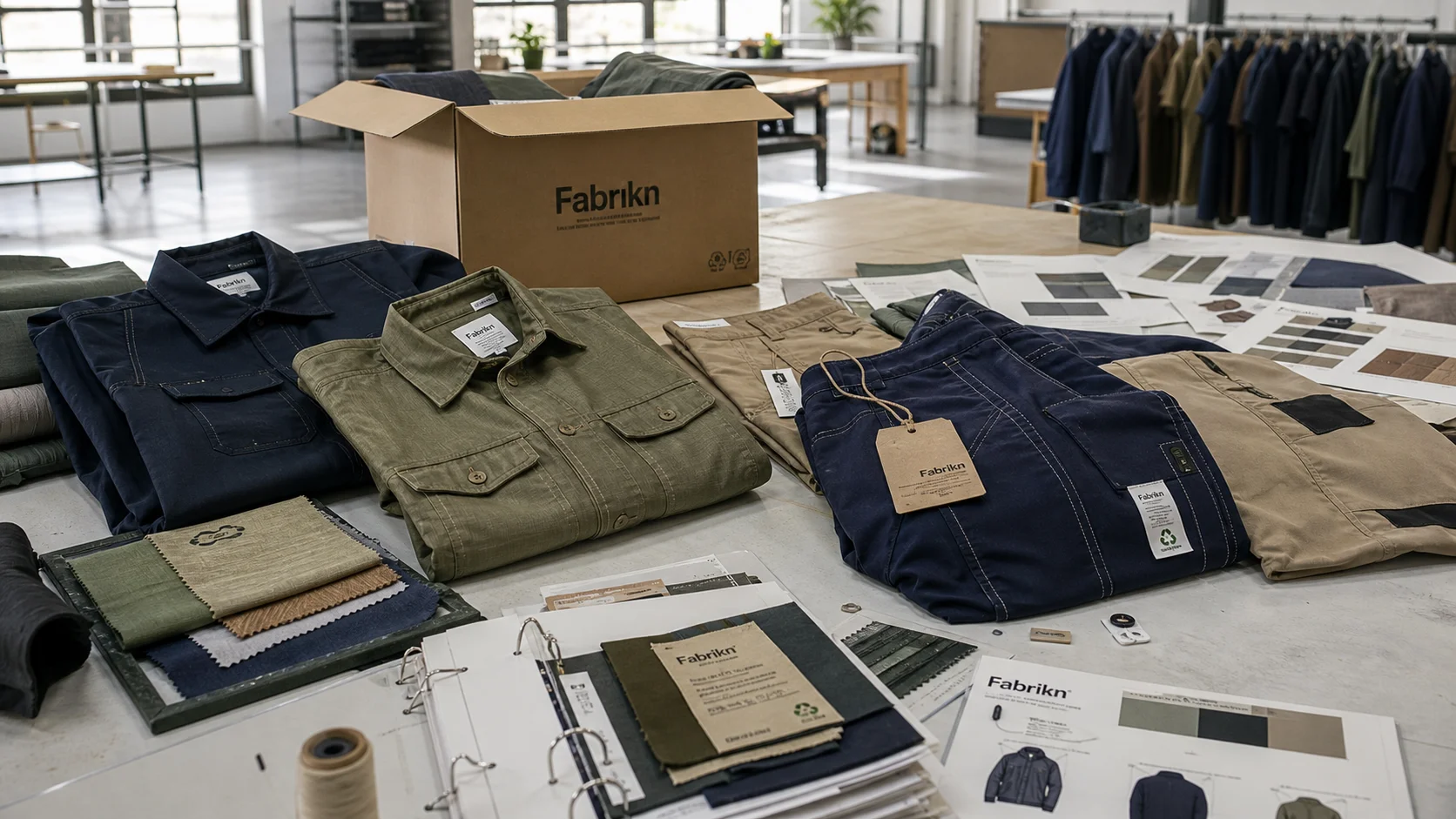
A buyer-focused outline for fitness clubs evaluating mono-material workwear uniforms through wash testing, durability review, comfort checks, and...
Mono-Material Uniform Wash Tests for Gym Buyers - Fabrikn production reference
Category: Sustainable Fashion
Fitness club uniforms are washed hard, worn frequently, and seen by members every day. That makes them a useful test case for sustainable fashion claims. A polo shirt, trainer T-shirt, reception jacket, or cleaning-team apron may look simple on a purchase sheet, but poor fabric choices show quickly after repeated laundering. Shrinkage, twisting, color fading, seam puckering, print cracking, and odor retention all become visible inside the club.
Mono-material uniform design aims to reduce that risk while improving end-of-life recyclability. In practical sourcing terms, mono-material usually means the garment shell, and ideally the key trims, are made from one dominant fiber type. A common example is a 100% recycled polyester performance polo with polyester sewing thread, polyester care label, and polyester rib. Another example is a 100% cotton reception shirt with cotton-rich labels and minimal non-compatible trims.
The appeal is clear. Mixed fiber uniforms such as polyester-cotton blends can perform well, but they are more difficult to recycle mechanically or chemically without separation. Mono-material construction gives sustainability teams a cleaner claim and gives procurement teams a more controlled wash-test profile. The tradeoff is that buyers must be more disciplined with specifications. A uniform described as “recyclable” can lose credibility if it uses incompatible trims, heavy coatings, mixed-fiber rib, or decorative patches that cannot be removed.
For fitness club buyers, the best purchasing judgment is not to treat mono-material as a marketing label. Treat it as a technical sourcing requirement. The wash test should confirm that the uniform survives the club’s real laundering conditions while staying within an acceptable appearance standard. If the garment cannot pass 20 to 30 realistic wash cycles during development, it is unlikely to perform well across multiple branches, staff roles, and laundry routines.
A mono-material uniform is only useful if it can perform as a uniform first. Recyclability matters, but gym buyers still need garments that hold shape, color, hand feel, and brand presentation after repeated washing.
A wash test is not just a fabric lab report. It is a buyer-side risk check that compares the supplier’s claim against actual use. Fitness uniforms are often laundered more aggressively than office wear because they absorb sweat, deodorant, body oils, cleaning chemicals, and general club dust. Staff may wash garments at home, while larger operators may use commercial laundries. Both systems create different risks.
The wash test should prove five things. First, the garment must keep its dimensions within tolerance. Second, the shade should remain consistent enough that old and new uniforms can be worn together without obvious mismatch. Third, seams, hems, collars, cuffs, and plackets should not distort. Fourth, prints, embroidery, heat transfers, or woven badges should remain legible and secure. Fifth, the garment should dry and wear comfortably enough for active staff.
Most buyers should request both fabric-level and garment-level wash data. Fabric tests help compare suppliers before sampling. Garment tests reveal problems created by cutting, sewing, trims, logo application, and finishing. A fabric may pass shrinkage standards, while the finished polo fails because the rib collar shrinks differently from the body. A T-shirt may pass colorfastness testing, while the logo transfer cracks because the application temperature or adhesive film was unsuitable.
For clubs buying across multiple sites, wash tests also protect brand consistency. A chain ordering uniforms for front desk, trainers, sales staff, and maintenance teams cannot afford inconsistent fading after the first month. Staff uniforms affect member perception. A sustainable garment that looks tired too quickly creates replacement waste and higher cost per wear.
Fitness club workwear is not one garment category. Each staff role creates a different performance requirement. A buyer reviewing mono-material uniforms should avoid approving one fabric across every job function without role-based testing.
Trainer tops face the heaviest sweat exposure. They need stretch recovery, moisture management, colorfastness to perspiration, and resistance to odor retention. A 100% polyester jersey or interlock can work well, especially where recycled polyester is specified. The risk is cling, static, shine, pilling, and poor odor release if the fabric quality or finishing is weak.
For this category, wash testing should include repeated laundering at 30°C and 40°C, plus drying assessment. Buyers should check whether the garment dries quickly without becoming boardy or retaining detergent residue. If anti-odor or wicking finishes are claimed, ask whether the finish is durable through a defined number of washes. Some finishes perform well initially but fade after repeated laundering.
Reception uniforms carry the brand image. They may not face the same sweat load as trainer tops, but they need a sharper appearance. Collars, plackets, cuffs, and hems should be tested carefully. A mono-material polyester polo can maintain color and dry quickly, but low-grade collars may ripple. A cotton mono-material shirt can look more premium, but shrinkage and creasing need tighter control.
The main purchasing tradeoff is presentation versus maintenance. Cotton may support a softer, less synthetic hand feel, but it usually needs more ironing and dries slower. Polyester offers easier care and better color retention in many cases, but buyers must specify fabric weight, surface texture, and anti-pilling requirements to avoid a cheap look.
Cleaning teams need tougher uniforms. Their garments may contact disinfectants, cleaning sprays, floor-care chemicals, and bleach residues. Mono-material polyester can resist some staining and dry quickly, but chemical discoloration can still occur. Cotton may absorb more moisture and stains. Workwear for these teams should be tested against the actual detergent and cleaning environment where possible.
Maintenance trousers, overshirts, and aprons often require abrasion resistance. If the buyer wants mono-material construction, avoid adding mixed-fiber reinforcement panels unless they are removable or clearly justified. Pocket bags, binding, zippers, snaps, and reflective trims can compromise the mono-material claim. Where safety or durability requires non-matching trims, the specification should state the exception instead of hiding it.
Lightweight jackets, gilets, and warm-up layers are harder to keep truly mono-material. Shell fabric, lining, padding, zippers, cords, elastic, thread, labels, and logo applications all need review. A 100% polyester shell with polyester lining and polyester thread is possible, but zipper teeth, pullers, stoppers, and elastic components may introduce non-compatible materials.
For buyers, the practical choice is to define levels. A “mono-material main body” claim is easier than a “fully mono-material garment” claim. If the sustainability brief requires recyclability, trims should be removable or compatible with the planned recycling route.
Good wash results start with precise specifications. Vague terms such as “recycled fabric,” “quick dry,” or “sustainable polo” are not enough for procurement. Buyers should write specifications that factories can price, sample, test, and reproduce.
For polyester uniforms, buyers should specify whether the fiber is virgin polyester, recycled polyester, or a mix. If recycled polyester is required, request the certification scope and transaction documentation relevant to the order. Do not rely on a hangtag claim alone. The fabric should also state knit or woven structure, gsm, yarn count where applicable, finish, color standard, and shrinkage target.
For cotton mono-material uniforms, specify pre-shrunk or sanforized fabric where appropriate. Cotton can be a good choice for low-activity roles, but gym buyers should not underestimate home laundering variation. Staff may wash warm, tumble dry, or mix uniforms with towels. Cotton garments that look excellent in the sample room may become inconsistent after real use if shrinkage is not controlled.
Trims often weaken mono-material claims. Sewing thread is commonly polyester, even on cotton garments. Labels may be satin polyester, woven polyester, cotton, nylon, or printed heat-transfer film. Buttons may be plastic, metal, corozo, or polyester. Zippers may include polyester tape, plastic teeth, metal sliders, and elastane-containing pulls. Each trim needs a clear decision.
Fabrikn’s apparel manufacturing services page is a useful starting point for buyers who need help turning sustainability targets into production-ready garment specifications.
A practical wash test should be strict enough to reveal problems, but not so extreme that it rejects workable garments unnecessarily. The method should reflect how the uniforms will actually be used. A boutique studio with staff washing uniforms at home has different risk from a national gym chain using an industrial laundry provider.
Before washing begins, record the garment condition. Measure body length, chest width, shoulder width, sleeve length, collar size, hem width, inseam, waist, and any key fit points. Photograph the garment under consistent lighting. Record the shade standard, logo placement, label condition, fabric hand feel, and any visible defects.
Each sample should be clearly identified by fabric lot, color, size, supplier, date, logo method, and wash recipe. Without this documentation, a failed wash test becomes difficult to interpret. Buyers may know that one sample performed poorly, but not whether the issue came from fabric, sewing, logo application, or finishing.
For most fitness club buyers, 20 wash cycles is a sensible development benchmark for tops and polos. For large rollouts, high-sweat roles, or commercial laundry use, 30 to 50 cycles may be justified. The buyer should not expect every sample round to go through 50 cycles, because that adds time and cost. A staged method is more efficient: screen fabrics first, then run extended tests only on finalist garments.
Wash temperature should match the intended care label. Many activewear garments are labeled for 30°C or 40°C washing. Cleaning uniforms may require warmer wash conditions depending on hygiene policy. If staff are likely to tumble dry despite a line-dry instruction, buyers should test a limited tumble-dry scenario and decide whether the care label is realistic.
Buyers should define tolerances before testing. A common target for knitted performance tops is shrinkage within roughly 3% after standard laundering, though tighter or looser tolerances may apply depending on fabric and fit. Woven cotton shirts may need careful pre-shrink control if the buyer expects consistent sizing. Color change should be assessed against an agreed grey scale or buyer-approved visual standard. Pilling should be evaluated after both washing and wear simulation where possible.
Odor is harder to measure than shrinkage, but it matters in gyms. Polyester can hold odor if yarn, fabric construction, detergent, or finishing is poorly matched. A buyer can request odor-control testing, but real-use wear trials by staff are often more revealing. For a controlled development process, test garments should be worn during actual shifts or workout instruction, then washed according to the proposed care label.
A disciplined sample process prevents avoidable bulk problems. The best sequence is not to approve a sales sample, place a large order, and then hope the fabric behaves. Gym buyers should separate concept approval from technical approval.
The buyer should define staff roles, garment types, gender or unisex fit requirements, size range, expected wash frequency, laundry method, logo needs, and sustainability claim. The brief should state whether the target is 100% mono-material, mono-material main body, recycled-content fabric, removable trims, or another measurable standard.
The supplier should submit fabric swatches with gsm, composition, construction, color options, finishing, shrinkage expectation, and available certification details. Trim proposals should be listed separately. Buyers should reject unclear trim descriptions at this stage because they become more expensive to fix later.
The proto sample checks style, fit direction, fabric hand feel, construction method, and branding options. It does not need to be perfect, but it should be close enough to reveal whether the concept is viable. Wash testing can begin on proto samples, but buyers should avoid making final decisions until pre-production samples are reviewed.
Fitness clubs often include staff with varied body types and movement requirements. A uniform that fits standing still may restrict stretching, cleaning, lifting, or training demonstrations. Size-set samples should be worn, moved in, washed, and reviewed. For active roles, shoulder mobility, body length, sleeve opening, and hem recovery are important.
Branding should be tested as part of the garment, not separately. Embroidery may pucker lightweight polyester. Heat transfers may peel if fabric texture, temperature, pressure, or adhesive compatibility is wrong. Screen prints may crack on stretch fabrics. Woven patches may introduce mixed materials and create recycling complications.
The pre-production sample should use bulk-intended fabric, trims, logo method, labels, thread, and packing. This is the sample that should go through the most serious wash review. If it passes, the buyer can approve production with clearer risk control. If it fails, the supplier should identify whether the root cause is fabric, pattern, sewing, trim, or finishing.
Once approved, the buyer should keep a sealed sample. The factory should keep a matching reference. This sample becomes the comparison point for bulk inspection. Without a sealed standard, disputes over shade, hand feel, logo finish, and measurements become more subjective.
Mono-material uniforms can be cost-effective, but buyers should understand minimum order quantities and timing. MOQ depends on fabric availability, dyeing method, color, trims, logo application, size range, and whether the order uses stock fabric or custom development.
These ranges are not fixed rules. A supplier with available fabric may accept lower quantities, while a custom color or certified recycled yarn program may require more. Buyers should be careful with very low MOQs for custom mono-material garments. They may be possible, but unit cost, color control, and trim consistency can suffer.
Lead times also vary. A stock-fabric uniform with standard logos may take roughly 3 to 6 weeks after final approval. A custom fabric program may take 8 to 14 weeks or longer, especially when lab dips, strike-offs, wash tests, certification paperwork, and shipping are included. Peak production seasons, fabric mill capacity, holiday closures, and delayed approvals can extend timelines.
The purchasing decision often comes down to speed versus control. Stock polyester uniforms can be faster and cheaper, but the buyer may have less influence over yarn source, exact shade, and trim compatibility. Custom mono-material uniforms give stronger brand and sustainability control, but require higher MOQ, longer lead time, and more disciplined approval.
Buyers planning a multi-site launch should start with a pilot order. A pilot of 100 to 300 garments can reveal staff acceptance, fit problems, washing behavior, and operational issues before the full rollout. If the pilot uses the same fabric and trims planned for bulk, the learning is useful. If it uses substitute materials, it may only validate the design concept, not the final product.
Inspection is where many uniform programs discover that the approved sample and bulk shipment are not identical. Mono-material claims add another layer of checking. The inspector should not only review measurements and workmanship; the inspection should also verify fabric labels, trim consistency, logo placement, shade, and packing against the approved standard.
Gym buyers should request inspection before final payment or shipment where order size justifies it. For smaller orders, a structured supplier QC report with photos, measurements, and wash-test confirmation may be enough, but it is less independent. For chain-wide rollouts, third-party inspection is usually worth the cost.
Inspection should include random carton selection, measurement checks by size, workmanship review, shade comparison, logo review, trim verification, packaging check, and carton marking review. If the uniform is sold internally as a sustainable program, supporting documents should also be checked. A certificate without order-level traceability may not satisfy internal ESG reporting.
Care labels deserve more attention than they usually receive. If the wash test passed at 30°C line dry, but the label allows 60°C tumble dry, the buyer has accepted a false risk profile. If staff need hygienic washing at 40°C and the garment only survives cold wash, the product may not fit the operation.
The care label should be based on test results and real club behavior. Fitness staff may not follow delicate instructions. A uniform program that depends on delicate washing, no spin, no tumble dry, and careful reshaping is unlikely to work across a large workforce. Sustainable procurement should reduce waste, not create fragile uniforms that fail in daily use.
Before confirming a purchase order, buyers should ask direct questions. A capable supplier should be able to answer clearly, or at least identify what needs to be tested. Vague answers are a warning sign.
Buyers who need help shaping these questions into a manufacturing brief can review Fabrikn’s about us page to understand how production support and sourcing communication are positioned.
Mono-material uniforms are a strong option when the buyer wants a clearer sustainability story, easier material tracking, and better potential for recycling. They work especially well for polyester performance tops, polos, aprons, and some lightweight layers. They can also work for cotton shirts where the club accepts more ironing and slower drying.
The approach is less straightforward when garments require stretch, insulation, heavy-duty closures, waterproof coatings, or safety trims. A strict mono-material rule can make the garment less comfortable or less durable if applied without judgment. In those cases, a buyer may choose a mono-material main fabric with documented trim exceptions. That is often more honest than forcing a weak design for the sake of a cleaner claim.
The best choice depends on cost per wear. A slightly more expensive mono-material polo that lasts 80 staff washes may be better than a cheaper blended polo that looks poor after 20 washes. On the other hand, a high-cost custom recycled uniform with long lead times may not suit a small independent gym that needs quick replenishment and flexible sizing.
For multi-site fitness clubs, the recommended path is controlled development: define the claim, select two or three fabric candidates, run garment-level wash tests, complete staff wear trials, inspect a pilot order, then scale. This process takes longer than buying catalog uniforms, but it reduces replacement waste and brand inconsistency.
Fitness club buyers should not view wash testing as a delay. It is a cost-control tool. Uniform failures usually become expensive after rollout, when staff already have garments, managers need replacements, and the brand team is unhappy with appearance. A proper mono-material wash test catches the most common problems while there is still time to change fabric, trim, logo method, or care instructions.
For buyers preparing a sustainable uniform program, the next practical step is to create a style-by-style specification and sampling calendar. Include target fabric, mono-material scope, logo method, sample deadlines, wash-test cycles, inspection requirements, and reorder plan. If supplier coordination is needed, Fabrikn can be contacted through the contact us page.
Get a free quote from Fabrikn — your trusted B2B clothing manufacturer with 10+ years of experience. MOQ as low as 200 pieces.
Get a Free Quote →Mono-material means the garment is made from one dominant material type, such as 100% polyester or 100% cotton. For a stronger claim, buyers should also review thread, labels, rib, zippers, buttons, and logo materials. Some garments are only mono-material in the main fabric, which should be stated clearly.
For early screening, 5 wash cycles can reveal obvious problems. For serious uniform approval, 20 cycles is a practical benchmark for many gym tops and polos. For large rollouts, commercial laundry, or high-sweat roles, 30 to 50 cycles may be justified.
Polyester usually dries faster, holds color well, and suits active roles. Cotton often feels more natural and may look more premium in front-of-house settings, but it can shrink, crease, and dry slowly. The better choice depends on staff role, laundry method, brand image, and wash-test results.
Yes, recycled polyester uniforms can be mono-material if the main fabric and compatible trims are polyester-based. Buyers should request order-relevant recycled-content documentation and should verify that trims do not undermine the claim.
Stock fabric uniforms may start around 100 to 300 pieces per style and color. Custom color or custom recycled polyester programs often require 500 to 3,000 pieces depending on fabric, trim, and mill requirements. Jackets and complex garments may have higher MOQs because trims drive minimums.
The most common failures are shrinkage, twisting, collar ripple, shade fading, pilling, logo cracking, heat-transfer peeling, seam puckering, and odor retention. These issues are easier to solve during sampling than after bulk production.
Yes, if the club uses commercial laundry or plans to do so. Commercial washing, drying, and chemicals can be harsher than home laundering. The care label and wash test should reflect the real cleaning method.
Not automatically. A mono-material garment that fails quickly creates waste. A sustainable uniform should combine responsible material selection, durable wash performance, realistic care instructions, and a clear end-of-life plan.