
A product-specific SEO outline for security contractors ordering mono material workwear uniforms, focused on colorfastness audits, sustainable fabric...
Workwear Uniform Colorfastness Audit for Buyers - Fabrikn production reference
Security contractors buying mono material workwear uniforms have a narrower margin for error than many apparel buyers. A faded black patrol shirt, a bleeding navy cargo trouser, or a high-visibility trim that stains the base fabric does not only look poor. It can weaken brand consistency, create contract disputes, trigger replacement claims, and expose gaps in the sourcing process.
Colorfastness is one of the most practical quality risks in sustainable workwear procurement because it sits at the intersection of dye chemistry, fabric selection, laundering behavior, supplier control, and inspection discipline. For buyers placing repeated uniform orders, especially with one main fabric type across shirts, trousers, jackets, or coveralls, a structured audit is more reliable than relying on supplier assurances or a clean-looking pre-production sample.
This guide is written for B2B buyers, procurement teams, security companies, and sourcing managers who need to audit colorfastness before committing to bulk mono material workwear uniform orders. It focuses on purchasing judgment: what to specify, what to test, what to inspect, when to reject, and where tradeoffs usually appear.
Security uniforms are judged in daily use. Guards may work long shifts, move between indoor and outdoor sites, sit in vehicles, carry equipment belts, and wash garments frequently. A uniform that passes a showroom check may still fail after repeated laundering, perspiration, abrasion, rain exposure, or sunlight.
Colorfastness issues are especially visible in security workwear because many programs use dark shades: black, navy, charcoal, bottle green, or deep grey. These colors are practical for appearance and authority, but they can reveal dye migration, shade loss, crocking, and uneven batch variation. White or light blue shirts create another risk: dark trousers, jackets, belts, or trims can transfer color onto them during storage, wear, or washing.
For buyers, poor colorfastness usually creates four problems:
Colorfastness should not be treated as a laboratory detail after the order is placed. It should be part of the purchase specification, supplier assessment, sample approval, and final inspection plan. Buyers who wait until shipment inspection often find that the only available options are discount negotiation, delayed shipment, or partial acceptance.
A practical rule for uniform buyers: if color is part of the service identity, colorfastness is part of the product performance specification.
Mono material workwear usually means the garment is designed around one dominant fiber family, such as 100% polyester, 100% recycled polyester, 100% cotton, or one consistent polyester-cotton blend across the program. In sustainable fashion discussions, mono material can support easier sorting, recycling, and product lifecycle planning, especially compared with garments that combine many incompatible layers, coatings, laminates, and trims.
For security contractors, mono material uniforms can simplify purchasing. The same fabric base may be used across shirts, trousers, outer vests, or lightweight jackets. This can help with shade consistency, fabric testing, stock planning, and repeat orders. It can also reduce development complexity when compared with mixing multiple fabric constructions from different mills.
The tradeoff is that mono material does not automatically mean low risk. A single fabric type can still show major variation if dye lots change, if finishing conditions are inconsistent, or if trims are not tested against the main fabric. A 100% recycled polyester uniform may behave differently from virgin polyester in dye uptake and shade consistency. A 100% cotton twill may feel durable but may fade faster under industrial laundering if dyeing and finishing are not controlled.
Buyers should clarify what “mono material” means in the supplier’s offer. It may refer to fiber content only, not sewing thread, zipper tape, reflective tape, buttons, hook-and-loop, interlining, or labels. In real uniform performance, trims can cause colorfastness claims even when the main fabric passes the lab test.
A colorfastness audit should start before the purchase order is signed. The buyer needs to define the intended use, laundering method, color standard, test methods, pass criteria, sample process, and inspection checkpoints. Without this scope, the supplier may test only the easiest fabric property or provide a generic report from a previous order.
Security contractor uniforms usually need a clearer audit scope than fashion garments because the garments are work tools. They may be washed weekly or more often. They may be exposed to sweat, rain, sun, body armor, seat belts, radios, and utility belts. Those conditions create rubbing, moisture, and heat, which are exactly the conditions that reveal weak dye fixation.
These answers shape the test plan. A black polyester polo for indoor reception security has a different risk profile from a navy cotton-rich cargo trouser used for outdoor patrols in hot weather. The audit should match the actual use case, not a generic product category.
At minimum, buyers should request a technical pack, fabric specification sheet, color standard, lab dip records, bulk dye lot records, trim specification sheet, garment measurement chart, care label proposal, and third-party or accredited lab colorfastness test reports. If the order uses recycled material, request recycled content certification or transaction documentation that matches the production material.
For buyers building a uniform program from scratch, a supplier with structured development support is usually safer than a factory that only quotes from a picture. Fabrikn’s services page outlines sourcing and production support areas that are relevant when buyers need specification control rather than one-off purchasing.
Colorfastness performance begins with specification discipline. If the purchase order only says “black workwear uniform, 100% polyester, good quality,” the buyer has left too much room for interpretation. A workable specification should identify the fabric construction, weight, fiber content, dye type where relevant, finishing, color tolerance, trims, sewing thread, and care instructions.
The main fabric specification should include fiber content, yarn type where useful, fabric construction, weight, width, finish, shrinkage tolerance, and color reference. For example, a 100% polyester pique polo fabric will not behave like a woven polyester twill trouser fabric. A cotton twill dyed in reactive black will not perform the same as one dyed with lower-cost direct dyes.
Typical workwear fabric weights vary by garment type. Security shirts and polos often fall around 160 to 220 gsm for knit or lightweight woven options. Trousers may range from 200 to 280 gsm depending on climate and durability targets. Jackets and outer layers can move higher, especially where wind resistance or abrasion resistance is required. These are typical ranges, not rules. Climate, end-client expectations, and laundering method should drive the final choice.
Buyers should also specify whether fabric must be piece-dyed, yarn-dyed, solution-dyed, or otherwise controlled. Solution-dyed polyester can offer strong colorfastness and lower dyeing impact in some applications, but it may require higher minimums, fewer shade options, and longer planning. Piece-dyed fabric gives more shade flexibility, but bulk shade variation and fastness must be audited more closely.
Trims are a common source of claims. A main fabric may pass colorfastness testing, while zipper tape bleeds, black hook-and-loop stains a shirt, or contrast piping loses color faster than the base fabric. Security uniforms often include epaulettes, pocket flaps, reflective details, badges, badge holders, elastic, webbing, drawcords, buttons, snaps, zipper tapes, and inner labels.
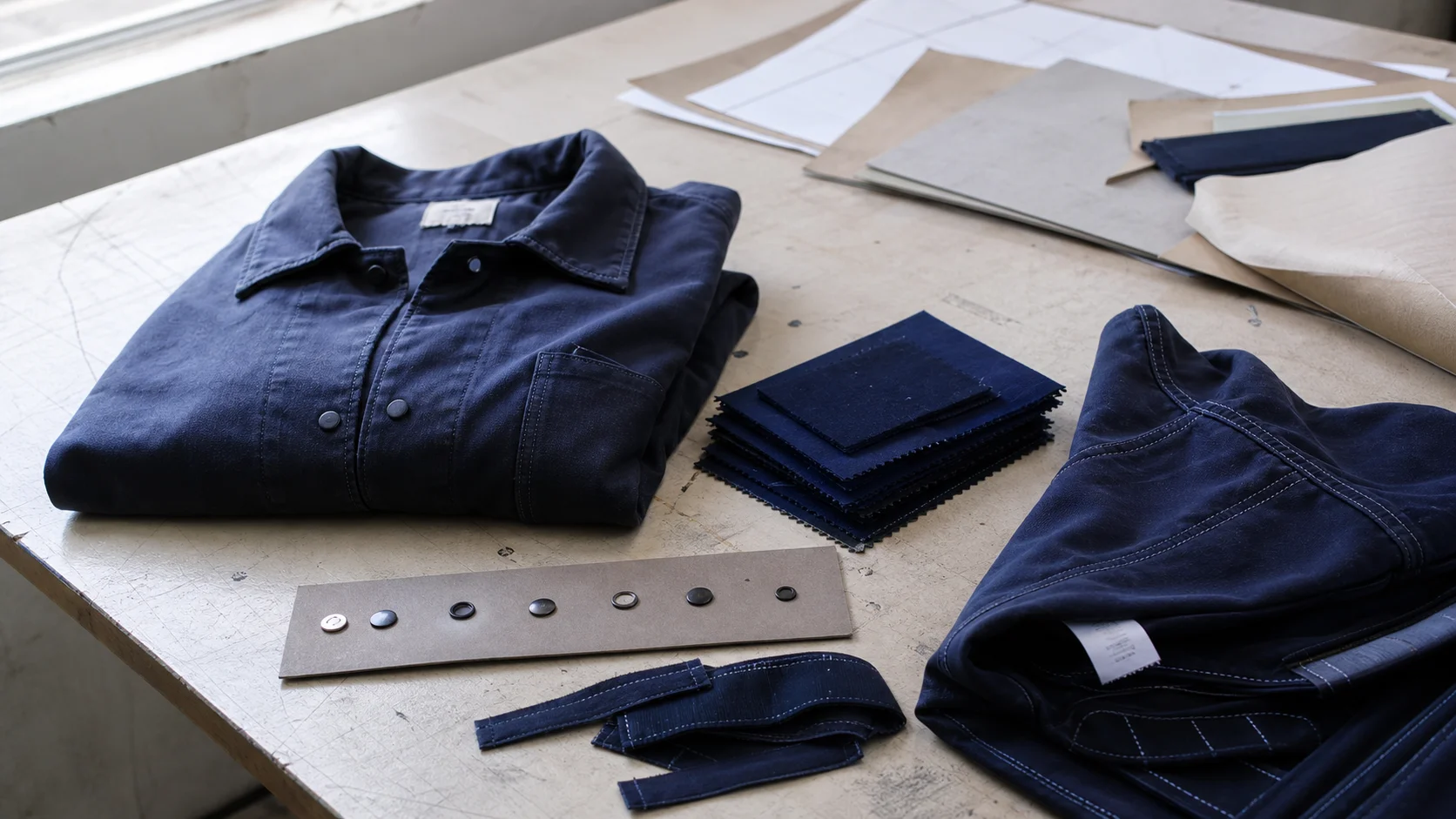
Buyers should require trim cards for approval. Each trim should be attached to the approved fabric or displayed beside it under standard lighting. A trim card without colorfastness risk review is only a visual document, not a quality control tool.
Colorfastness is not one test. A garment can pass washing but fail rubbing. It can pass dry rubbing but fail wet rubbing. It can pass lab washing but fade under perspiration and sunlight. Buyers should specify the tests most relevant to the uniform’s use.
Common standards include ISO, AATCC, and other regional methods. The exact standard should match the buyer’s market and contract requirements. A practical specification should state both the test method and the acceptable grade. Many colorfastness tests use grey scale ratings from 1 to 5, where 5 is best. Buyers often target grade 4 or above for many uniform applications, though wet rubbing on dark shades may be more difficult and should be negotiated carefully.
The buyer should not accept a lab report unless it clearly identifies the fabric, color, composition, test method, rating, date, and sample source. Reports from old production, different shades, or similar fabrics are useful background but not proof for a new order.
Black and navy are common in security uniforms, and they deserve extra attention. Dark shades carry heavier dye loads, so wet rubbing and washing performance can be harder to control. Cotton and cotton-rich fabrics may show progressive fading after repeated laundering, even if initial testing looks acceptable. Polyester may hold color better in washing, but poor dyeing or heat setting can still cause migration or shade variation.
If the security contractor expects a deep black shade, buyers should ask whether the supplier can maintain the shade after five, ten, or more wash cycles. A single wash test may not reflect the real wear cycle. For large programs, repeated wash testing on pre-production garments is worth the time.
Sampling is where many colorfastness risks can be caught early. The key is to avoid approving a garment sample that looks correct but is not made from the same bulk fabric, dye process, trims, and finishing route planned for production.
The lab dip is the first formal shade approval. Buyers should review lab dips under a light box or controlled lighting where possible, not only under office light. Shade should be compared against the approved color standard. If the color is brand-critical, define the tolerance using an accepted color measurement system or agreed visual tolerance.
For dark workwear shades, buyers should avoid approving a lab dip based only on visual depth. Ask whether the lab dip has been tested for washing and rubbing, especially if the fabric is cotton or cotton-rich. A beautiful black that bleeds is not a good uniform color.
If the garment includes contrast panels, reflective tape, prints, embroidery, or logos, buyers should review a strike-off or fabric layout. This confirms how the color behaves beside trims and branding elements. Mono material programs still need this step when multiple trims or finishes are included.
The proto sample checks styling, construction, fit direction, and basic appearance. It is not always made in final bulk fabric. Buyers should not treat proto approval as colorfastness approval unless the supplier confirms that the fabric, dyeing, and finishing are production-representative.
Fit samples and size sets are mainly for measurement and wearability, but color review should still happen. If the size set includes fabric from different cutting lots, shade variation may appear. Security uniform programs often include a wide size range, so buyers should check whether larger and smaller sizes come from the same dye lot or different lots.
The pre-production sample is the key control point. It should be made using approved bulk fabric, approved trims, approved labels, correct sewing thread, correct logo application, and final care label instructions. Buyers should require pre-production sample approval before bulk cutting.
This sample should be washed according to the intended care method. If the garment is expected to survive commercial laundering, do not approve based only on a gentle home wash. If guards will frequently wash garments at home, include practical domestic wash testing as well.
After approval, seal a final sample and use it as the reference for production and inspection. The sealed sample should include the correct color, trims, labels, branding, and packaging. If possible, keep one sample with the buyer, one with the supplier, and one with the inspection team.
Buyers who need help building a sample approval route can review Fabrikn’s about us page to understand the type of sourcing structure and production coordination that should support uniform development.
Colorfastness requirements affect MOQ, lead time, and cost. Buyers should expect this and plan accordingly. A supplier may quote faster and cheaper if using available stock fabric, but stock fabric may not match the required shade, recycled content claim, or colorfastness target. Custom dyeing gives better control but usually increases minimums and development time.
MOQ varies by country, mill, fabric type, dyeing route, and garment complexity. The following ranges are typical planning references, not guaranteed thresholds:
Order Type Typical MOQ Range Colorfastness Impact Buyer Tradeoff Stock fabric uniform order 100 to 500 pieces per style/color may be possible Limited control over dye process and shade repeatability Faster and lower risk for small trials, weaker for long-term programs. Custom dyed fabric order 500 to 2,000 pieces per style/color is common Better shade control if lab dip and bulk testing are managed Better for branded uniforms, but needs planning time. Custom recycled polyester order 1,000 to 3,000 pieces or higher may be requested Certification, yarn sourcing, and dye consistency must be checked Good sustainability value, but not ideal for urgent small orders. Solution-dyed polyester program Often higher, depending on yarn and shade availability Can deliver strong color performance and reduced dyeing impact Best for repeat programs with stable colors, less flexible for seasonal changes.Lead time depends on more than sewing capacity. For colorfastness-controlled uniform orders, buyers should account for lab dips, fabric booking, dyeing, finishing, testing, sample making, sample approval, trim sourcing, bulk cutting, sewing, inspection, packing, and shipping.
A simple repeat order using approved fabric and trims may move quickly if stock is available. A new custom shade with recycled material and third-party testing will take longer. If lab tests fail, lead time extends because the supplier may need to adjust dyeing, redo finishing, or source another fabric. Buyers should build this into the purchase calendar instead of compressing testing at the end.
Buyers should be cautious with suppliers who promise very short delivery on custom dyed uniforms without discussing lab dips, testing, and shade approval. Speed may be possible, but skipped controls often return as claims.
Bulk inspection should verify more than measurements and stitching. Colorfastness itself is best confirmed by lab testing before shipment, but inspection can catch visible warning signs. Inspectors should compare bulk garments to the sealed sample, review shade consistency across sizes and cartons, check trims, examine contrast areas, and look for staining from packing or storage.
AQL inspection can identify visible defects, but it is not a replacement for lab testing. A garment that looks acceptable at final inspection may still fail after two washes. Buyers should link inspection release to both visual inspection and approved test results.
Borderline colorfastness results require commercial judgment. Rejecting the entire order may be justified for severe bleeding, visible shade mismatch, or failed contract-critical performance. In other cases, buyers may accept with conditions, such as restricted laundering instructions, price adjustment, partial shipment, or supplier-funded replacement reserve.
Acceptance should not be casual. If a dark trouser has weak wet rubbing, guards may stain light shirts, office furniture, or vehicle seats. If a shirt fades after a few washes, the team appearance will deteriorate quickly. A small lab grade difference can become a large field complaint when the order is deployed across many staff.
Colorfastness is directly linked to sustainability. A uniform that fades early has a shorter usable life. Early replacement increases material use, transport, packaging, and disposal. From a sustainable fashion perspective, durability and appearance retention are not secondary features. They are part of responsible product design.
Mono material strategies can support circularity, but only if the uniform is also durable enough to stay in use. A garment designed for recycling but replaced too quickly may not deliver the intended environmental benefit. Buyers should balance recyclability, color performance, repairability, and operational lifespan.
Recycled polyester can be a strong option for security uniforms, especially polos, softshell-style layers, and lightweight jackets. It can reduce reliance on virgin inputs, depending on the supply chain and certification. Colorfastness can be good when yarn quality, dyeing, and finishing are controlled.
The buyer should ask for proof of recycled content and test the actual production fabric. Do not rely on a hangtag claim or catalogue statement. If a supplier changes yarn source between repeat orders, shade and performance may shift. Repeat-order control is especially important for security contractors that add new staff throughout the year.
Lower-impact dyeing can include solution-dyed fibers, improved dye fixation, controlled water use, certified chemicals, and wastewater management. Buyers should avoid vague claims such as “eco dyed” unless the supplier can provide a clear explanation and documents. Sustainable sourcing requires evidence, not marketing language.
Stronger colorfastness can also reduce laundering waste. If garments retain appearance at lower wash temperatures and avoid re-dyeing or early replacement, the program becomes more practical. Care label accuracy matters here. A care label that protects color but is unrealistic for guards will not work in the field.
Security contractors building a long-term uniform program can use Fabrikn’s contact page to start a sourcing discussion around fabric selection, testing scope, and production planning.
A disciplined checklist helps prevent rushed approvals. The goal is not to make procurement complicated. The goal is to make risk visible before the factory cuts bulk fabric.
Not every specification needs to be premium. Security contractors often work with tight budgets, and uniform programs must balance cost, availability, and performance. Still, colorfastness has several areas where compromise is usually expensive later.
Do not compromise on testing the actual color. A report for grey fabric does not prove black fabric performance. Do not compromise on trim review. Many claims start at zippers, labels, tapes, and logos. Do not approve bulk cutting without a production-representative pre-production sample. Once fabric is cut, negotiation power drops.
Buyers can compromise more safely on features that do not affect field performance. A slightly simpler pocket construction, fewer decorative panels, or a standard trim can reduce cost without increasing colorfastness risk. In many workwear orders, simpler is more reliable. Extra contrast details may look good in a design presentation but create more test points, more shade matching work, and more failure opportunities.
The strongest sourcing decision is often to standardize. A stable fabric, stable shade, stable trim set, and repeatable testing protocol will outperform constant redesign. For security contractors with frequent hiring, this also makes replenishment easier. Replacement garments should match existing uniforms closely enough that new staff do not look like they belong to another contract.
A supplier should know from the first inquiry that colorfastness is part of the order requirement. This changes the conversation. Instead of asking only for unit price, the buyer asks for fabric route, test capability, dye lot control, sample timeline, and failure response.
The answers will show whether the supplier understands workwear uniform risk or is simply quoting a garment. A capable supplier may push back on unrealistic targets, especially for very dark cotton shades or urgent low-MOQ orders. That pushback can be useful if it is specific and supported by alternatives.
A mono material workwear uniform order can be a sensible choice for security contractors that need durability, consistency, and a clearer sustainability direction. The sourcing advantage only holds if colorfastness is audited properly. A uniform that fades, bleeds, or stains other garments will not be saved by a good fiber claim.
Buyers should build the audit around actual use: dark colors, frequent washing, perspiration, rubbing from belts and equipment, sunlight exposure, and repeat-order needs. The right process includes clear fabric and trim specifications, lab dip approval, production-representative samples, relevant lab testing, sealed sample control, and shipment inspection.
The best purchasing decision is not always the cheapest garment. It is the uniform program that maintains a professional appearance over its intended service life, supports responsible material use, and avoids preventable replacement claims. Colorfastness is where that decision often proves itself.
Get a free quote from Fabrikn — your trusted B2B clothing manufacturer with 10+ years of experience. MOQ as low as 200 pieces.
Get a Free Quote →A colorfastness audit is a structured review of how well uniform fabrics, trims, logos, and finished garments resist fading, bleeding, staining, and dye transfer. For workwear buyers, it usually includes specification review, lab dip approval, sample washing, lab testing, trim checks, and final inspection against the approved sample.
Security uniforms need to look consistent and professional across teams. Poor colorfastness can cause black or navy garments to fade quickly, stain lighter shirts, transfer dye to equipment, or create visible shade differences between staff. These problems can lead to replacement costs and client complaints.
Buyers commonly request tests for washing, dry and wet rubbing, perspiration, water, and light exposure. The exact test methods should match the buyer’s market and use case. Dark uniforms, outdoor roles, and frequent laundering usually require a stronger test plan.
Many uniform buyers target grade 4 or better on common grey scale assessments, though wet rubbing for very dark shades may be harder and sometimes lands around grade 3 to 4 depending on fabric and dye route. The required grade should be agreed before production, not after inspection.
Mono material can simplify fabric control and repeat ordering, but it does not automatically improve colorfastness. Dyeing method, fiber quality, finishing, trims, laundering conditions, and batch control still determine performance. Buyers should test the actual fabric and shade planned for production.
Small stock-fabric orders may start around 100 to 500 pieces per style and color, depending on supplier availability. Custom dyed orders often sit around 500 to 2,000 pieces or more. Recycled polyester or solution-dyed programs may require higher minimums, especially when custom colors are needed.
Yes, recycled polyester uniforms can perform well when yarn sourcing, dyeing, and finishing are controlled. Buyers should request recycled content documentation and colorfastness reports for the actual production fabric. Certification claims should not replace testing.
Testing should happen before bulk cutting when possible, using production-representative fabric. Finished garments may also need testing when trims, prints, embroidery, or heat transfers could affect performance. Shipment release should depend on approved test results for critical orders.
Common risks include shade mismatch between panels, dye lot variation across sizes, trim bleeding, wet rubbing failure, heat marks on dark polyester, staining from damp packing, and logo instability after washing. Inspectors should compare bulk goods against the sealed sample and review relevant test reports.
It depends on the failed test, garment use, color, and contract risk. A borderline wet rubbing result on black trousers may be serious if guards wear light shirts or sit in client vehicles. Buyers should make acceptance decisions based on field risk, not only the lab number.