
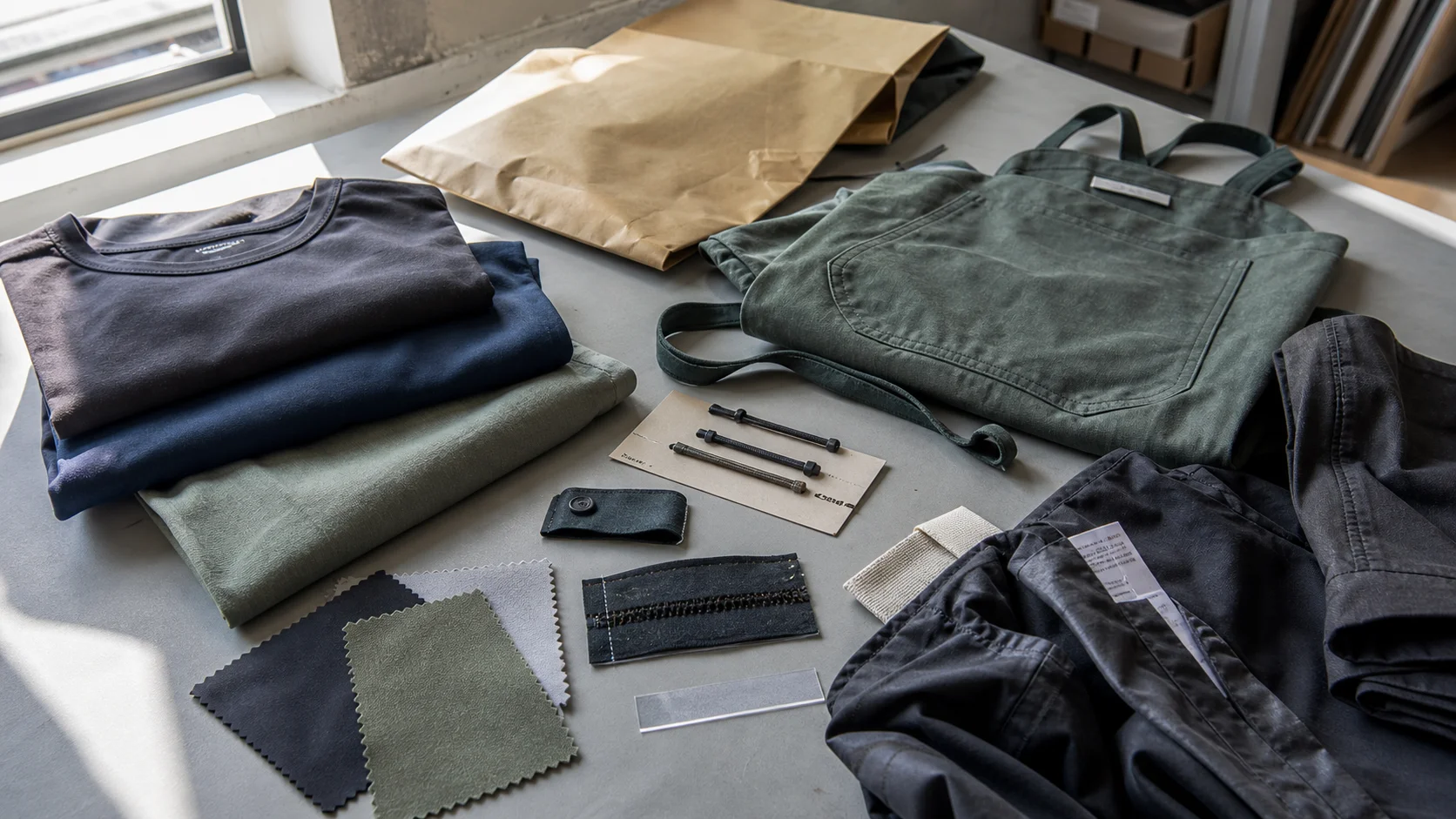
A practical scorecard for gym program buyers comparing mono-material workwear uniforms on recyclability, laundering performance, decoration compatibility,...
Gym programs are under growing pressure to cut waste, simplify sorting, and prove that sustainability claims hold up in real use. A mono-material workwear uniform program is one of the more practical ways to move in that direction. The concept is straightforward: reduce the garment system to a single primary fiber family so the uniform is easier to recycle at end of life, easier to spec consistently, and easier to audit across seasons.
For gym buyers, the challenge is not the idea. It is execution. Uniforms need to survive frequent washing, sweat exposure, abrasion, and branding changes. They also need to stay within budget, arrive on time, and pass fit approval without dragging the program into endless revisions. A supplier scorecard gives buyers a disciplined way to compare vendors and keep the discussion anchored in measurable criteria rather than broad sustainability language.
This article sets out a practical scorecard for mono-material workwear uniform supplier selection, with specific notes on fabric, trims, testing, sampling, lead times, and inspection risk. It is written for gym program buyers who need a purchasing tool, not a branding pitch.
Mono-Material Workwear Uniform Scorecard for Gym Buyers - Sustainable Fashion manufacturing guide
Mono-material means the garment is designed around one main fiber family, such as 100% polyester, 100% cotton, or 100% nylon. In a strict recycling sense, the fewer mixed materials in the garment, the easier it is to sort and process at end of life. In workwear, the most realistic options tend to be polyester and cotton, with polyester often favored for its durability, moisture management, and color retention.
The term is used loosely in the market, so buyers should define it carefully. A supplier may describe a uniform as mono-material while still using mixed-content labels, polyester thread, foam inserts, or elastication that complicates recyclability. A useful procurement standard is to specify the primary body fabric, then require the supplier to disclose every major component: thread, trims, labels, closures, heat-transfer graphics, reinforcement patches, and accessories.
For gym programs, the best version of mono-material is not the one that sounds most rigid. It is the one that can be produced reliably, worn hard, washed often, and sorted sensibly after use. A slightly imperfect but durable mono-material garment is usually better than a fragile, theoretically pure spec that fails in the field.
Gym uniforms sit in a demanding category. Staff move constantly, garments are exposed to perspiration and frequent laundering, and appearance matters because the uniform reflects the brand directly on the floor. That creates a narrow design window. The fabric must be resilient enough for daily wear and polished enough to stay presentable.
Mono-material construction helps in four ways:
There are tradeoffs. A pure fiber system can limit stretch, handfeel, or shrink control. Cotton can be comfortable but slower drying and more prone to dimensional change. Polyester is durable but can raise concerns around heat build-up and pilling if the quality is poor. Buyers should treat mono-material as a program decision, not a slogan. The right choice depends on wear conditions, laundering frequency, and the brand’s durability expectations.
For suppliers that support broader workwear development, a service page like https://fabrikn.com/services/ is useful for understanding the development and production scope before asking for a quotation. Company background also matters when the buyer needs to assess whether the factory can handle repeat orders and compliance paperwork, which is why the supplier profile on https://fabrikn.com/about-us/ can be part of the review pack.
A scorecard works best when it separates product performance from commercial discipline. The categories below are designed for gym buyers evaluating mono-material workwear uniform suppliers. The weights can be adjusted, but the structure should stay stable across bids.
Category Weight What to Check Material integrity 25% Fiber declaration, fabric consistency, shrinkage control, colorfastness, pilling resistance Construction quality 20% Stitch density, seam strength, reinforcement points, label placement, finish cleanliness Sampling and approval discipline 15% Proto accuracy, size set availability, revision response time, approval traceability Commercial fit 15% MOQ, price tiers, payment terms, production flexibility, reorder stability Lead-time reliability 10% Fabric booking, trim sourcing, capacity planning, shipping readiness Compliance and testing 10% Lab test access, restricted substances controls, audit readiness, documentation After-sales support 5% Claims handling, replacement policy, reorder support, communication speedThis is the core of the scorecard. The supplier should be able to state the exact fiber content, fabric construction, weight, finish, and acceptable tolerance. For gym uniforms, common fabric weights vary by garment type: lightweight tees often sit around 150 to 180 gsm, polos around 180 to 220 gsm, and trousers or overshirts can sit higher depending on the intended use.
Buyers should ask for the following in writing:
A supplier that cannot provide a controlled spec on these points is a risk, even if the sample looks acceptable. Mono-material sourcing only works when the base cloth is consistent enough to reorder without surprises.
Uniforms used in gyms are worn and washed aggressively. Weak seams, poor topstitching, and careless bar-tacks show up fast. Construction should be judged on durability and repeatability, not visual neatness alone.
Key checks include seam alignment, stitch density, reinforcement at stress points, collar and placket stability, hem recovery, and resistance to torque after laundering. If the design includes pockets, zips, or gussets, the buyer should verify that these elements do not introduce mixed-material complexity that conflicts with the mono-material brief.
The sample process tells you how the factory works under pressure. A good supplier treats sampling as a controlled development process. A weak supplier treats it like guesswork.
The ideal sequence is usually:
Each stage should be logged. Buyers should not allow bulk production to start from a verbal approval or a screenshot in chat. A formal sign-off process protects both sides and reduces dispute risk later.
MOQ is often the first commercial test. For custom workwear, MOQ can range widely depending on fabric, color, and decoration method. A practical range for many programs is 100 to 500 pieces per style and color, though smaller development runs may be possible if the supplier is willing to absorb setup costs. Custom-dyed or custom-knitted fabrics can raise the threshold significantly.
Pricing should be judged against the whole program, not only the unit rate. A slightly higher price may be justified if the supplier reduces defect risk, protects reorder consistency, and supports better packaging or labeling control. The cheapest quotation often becomes expensive when remakes, delays, and freight changes are included.
Lead time is not a single number. It depends on fabric availability, lab-dip approval, trim sourcing, sample revisions, production queue, finishing, packing, and export booking. A factory that quotes a short lead time without specifying dependencies is not necessarily efficient. It may simply be under-disclosing risk.
For gym uniforms, a realistic planning window often runs from several weeks for repeat orders to longer for new development, especially if fabric has to be knit or dyed to order. Buyers should ask the supplier to separate:
That separation reveals whether the supplier is actually capable of meeting a launch date or simply quoting the shortest possible number.
Mono-material claims should be backed by documentation. The supplier should be able to provide fabric composition records, testing reports where available, and evidence of restricted substance control. For gym programs, the buyer may also want wash performance testing and colorfastness data, since uniforms that fail in laundering create avoidable replacement costs.
Testing priorities typically include:
If a supplier cannot describe where testing occurs, who pays for it, and what the acceptance threshold is, the buyer should treat that as a warning. Compliance language is not enough by itself.
Uniform programs continue after the first shipment. Sizes need topping up, staff turnover creates reorder pressure, and branding updates happen. The supplier’s response speed matters as much as the first sample. Buyers should score how easily the factory handles repeat orders, batch matching, claims, and spare units.
A supplier with a disciplined contact path is easier to manage over time. If the buyer wants to move from inquiry to quotation or request a development review, the contact route on https://fabrikn.com/contact-us/ should be simple and visible.
For mono-material workwear, fabric specification is where most programs succeed or fail. The buyer should lock the body fabric before discussing decoration details. Decoration should follow function, not the other way around.
Buyers should be careful with “mono-material” claims that hide functional compromises. Stretch is one example. A garment can stay within a mono-material framework and still offer comfort through knit structure, but some product types will need a different design approach if elastane is excluded. If stretch recovery is essential, the buyer must decide whether the sustainability objective outweighs the performance benefit of a small blend. That decision should be explicit, not accidental.
Trim decisions have a direct impact on the integrity of the program. Zips, buttons, interlinings, labels, and badges should be specified clearly. If the aim is to keep the product as recyclable as possible, trims should be minimized and standardized. Heat-transfer labels may be more compatible than sewn-in multi-layer labels in some cases, but they must still be tested for wash durability.
Embroidery can be durable, yet it may affect softness and add thread complexity. Screen print can be economical for larger runs, but print durability must be checked against wash cycles. Buyers should ask for the supplier’s preferred branding method and then challenge it against the garment end use. The right solution is the one that survives the laundry, not the one that looks best in a showroom.
The most useful supplier is not the one that agrees with every brief detail. It is the one that identifies where the brief will create wear risk, then proposes a controlled alternative with clear tradeoffs.
Gym uniforms must fit different body types without creating friction in movement. A weak fit becomes a daily complaint. A strong fit range supports staff confidence and reduces replacement demand.
Buyers should request a size set early, especially if the program includes multiple garment types. A single base pattern can look acceptable in one size and fail in another. Sleeve balance, torso length, crotch rise, and hem sweep all need review. If staff move, lift, bend, and stretch in the uniform, fit should be tested in motion rather than only on a hanger.
The sample sign-off process should include measurement tables with accepted tolerances. Any deviation beyond the agreed limits should trigger correction before bulk. If the supplier resists this discipline, the buyer should expect measurement drift in production.
For larger programs, it is sensible to reserve the first bulk lot for closer inspection before committing to reorder scale. That approach reduces exposure if the initial production run reveals a trim issue or color variation. It is a conservative buying choice, but in uniform programs conservatism is usually cheaper than correction.
MOQ should be matched to the buying cycle. A gym chain with frequent turnover may need a more flexible supplier than a boutique operation with limited annual demand. When comparing vendors, the buyer should calculate the MOQ by style, color, and size curve. A low headline MOQ can become less useful if the supplier requires a much higher fabric minimum or charges heavily for the first sample set.
Lead times are also influenced by the source of the fabric. Stock fabric shortens the path, while custom fabric adds risk at every stage. Knit development, dye approvals, and finishing can all extend the schedule. Buyers should ask whether the quotation is based on stock-supported material or new mill development. Those are not equivalent scenarios.
If the launch date is fixed, the buyer should build a contingency buffer. Uniform launches often get delayed by content approval, logo changes, or missing size approvals rather than sewing capacity itself. A cautious buyer plans for that and does not anchor the whole timeline to a single optimistic promise.
Inspection failure is expensive because it often appears late, after fabric has been cut and labor has been spent. For mono-material workwear, the most common risks are not exotic. They are repeatability issues.
Typical risks include:
Quality control should not wait until final inspection. Buyers should confirm whether the supplier uses inline checks, pre-shipment inspection, and corrective action reports. If third-party inspection is part of the program, define the AQL level in advance and make sure the supplier understands the acceptance criteria.
One further point matters in sustainable sourcing: mono-material claims can be weakened by rushed substitutions. A supplier may switch thread type, trim composition, or fabric source to protect schedule. Any substitution should require written approval. Without that control, the sustainability claim becomes hard to defend.
The scorecard should not be treated as a paper exercise. It should drive a decision memo that states why one supplier won and what risks remain. A strong purchasing decision usually comes from balancing three questions:
If two suppliers are close on price, the better choice is often the one with stronger testing discipline and clearer reorder control. Gym programs are repeat businesses. A slightly higher unit cost may be the cheaper route if it prevents disputes, restarts, or broken size continuity in later seasons.
Buyers should also think in terms of program lifecycle. A supplier that can produce the first order is useful. A supplier that can hold the spec steady across multiple reorder windows is more valuable. That is especially true when staff uniforms are visible to members every day and the brand cannot afford mismatched batches.
Before awarding a mono-material workwear uniform program, ask these questions and insist on written answers:
Good suppliers answer these questions directly. Weak suppliers answer around them. The difference matters because the program risk sits inside the details.
Get a free quote from Fabrikn — your trusted B2B clothing manufacturer with 10+ years of experience. MOQ as low as 200 pieces.
Get a Free Quote →A mono-material workwear uniform is a garment designed around one main fiber family, such as 100% polyester or 100% cotton, with the goal of improving consistency and simplifying end-of-life sorting. The buyer still needs to review trims, labels, thread, and decoration methods because those can complicate recyclability.
MOQ varies by supplier, garment complexity, and fabric source. A practical market range is often 100 to 500 pieces per style and color for custom workwear, although development runs and stock-fabric programs may differ. Buyers should also check whether the mill or trim supplier has a separate minimum that affects the real order size.
There is no single best option. Polyester is often preferred for durability, color retention, and easy care. Cotton is comfortable and breathable but can shrink and dry more slowly. Nylon can work well for technical layers. The right choice depends on the role, wash frequency, and the brand’s durability targets.
The fabric spec, lab-dip or color approval, sample measurements, branding method, size range, and final trim details should all be approved before bulk starts. Buyers should also confirm whether the supplier has aligned the production version with the approved sample and whether any substitutions have been introduced.
The main risks are shade variation, shrinkage, seam failure, pilling, print or label degradation, and inconsistent grading across sizes. These issues are common enough that buyers should ask for test data and inspect the first production run carefully.
Ask for full composition disclosure, testing records, and any traceability documents the supplier can provide. A mono-material claim should be supported by clear written specifications. If the garment includes mixed trims or decorative elements, the buyer should understand how that affects the claim before approving the program.
For a supplier discussion, development request, or program review, the most practical starting point is the contact page at https://fabrikn.com/contact-us/. Buyers who need broader production support can also review the available capabilities on https://fabrikn.com/services/.