
A product-specific vendor audit outline for sourcing mono-material workwear uniforms for cleaning crews, focused on fiber choices, trims, durability,...
Mono-Material Workwear Audit Brief for Buyers - Sustainable Fashion manufacturing guide
For cleaning crew uniforms, mono-material workwear is moving from a sustainability talking point to a sourcing requirement. Buyers are being asked to reduce textile waste, improve recyclability, and simplify end-of-life handling without compromising durability, laundering performance, wearer comfort, or brand presentation. That is a useful goal, but it also creates a new audit burden. A vendor may say a uniform is “recyclable” because the main fabric is polyester, while the trims, pocket bags, sewing thread, reflective tape, interlinings, and labels are not compatible with the same recycling stream.
This brief is written for buyers, sourcing managers, procurement teams, and sustainability leads evaluating mono-material workwear uniform vendors for cleaning crews. The focus is practical: what to ask, what to verify, what to test, and where claims commonly break down. It is not enough to request a recycled polyester polo or a single-fiber trouser. A real mono-material program needs a disciplined specification, clear vendor documentation, sample approval controls, and inspection criteria that match the laundering and movement demands of commercial cleaning work.
Cleaning crew uniforms sit in a demanding category. Garments face frequent industrial or semi-industrial washing, chemical exposure from detergents and cleaning agents, repeated bending and reaching, sweat, abrasion from equipment belts, and public-facing appearance standards. A mono-material strategy must account for all of that. The right vendor is not simply the lowest-cost supplier that can print a sustainability claim on a quote sheet. The right vendor can prove fiber consistency, control trims, document inputs, maintain color continuity, and support buyer-side audit requirements.
In workwear sourcing, mono-material usually means the garment is designed predominantly from one fiber type so it can be more easily sorted, processed, and recycled. For cleaning crew uniforms, the most common mono-material route is polyester-based: polyester fabric, polyester sewing thread, polyester labels where possible, polyester rib, polyester binding, and compatible trims. Some buyers explore cotton-based mono-material uniforms, but cotton workwear brings different durability, shrinkage, drying, and stain-release concerns, especially for crews that wash uniforms frequently.
A strict mono-material specification is not the same as “single main fabric.” A polo made from 100% polyester body fabric but finished with nylon buttons, cotton care labels, elastane rib, mixed-fiber embroidery backing, and PVC badges is not fully mono-material. It may still be a better garment than a heavily blended alternative, but the buyer should not treat it as audit-ready without qualification.
Purchasing judgment: ask vendors to define the percentage threshold behind their mono-material claim. “100% polyester main fabric” and “mono-material garment system” are not interchangeable statements.
The cleanest approach is to specify a target such as “minimum 95% polyester by garment weight, with all major components polyester-compatible unless functionally impossible.” Some recycling programs require stricter input standards. Others tolerate small non-compatible items if they can be removed before processing. The buyer should align the uniform specification with the intended end-of-life route rather than using “mono-material” as a loose marketing phrase.
Cleaning crew uniforms are not fashion basics with a logo. They are operational garments. The audit must consider wearer movement, stain exposure, laundering frequency, and replacement cycles. A hotel housekeeping tunic, janitorial polo, facility services trouser, and contract cleaning apron may all sit under the same uniform program, but their wear conditions differ. A vendor that can produce a recycled polyester T-shirt may not be ready to manage a multi-style cleaning crew uniform set.
Common cleaning crew uniform items include polos, tunics, overshirts, trousers, cargo pants, aprons, tabards, lightweight jackets, caps, and sometimes high-visibility panels. Each item introduces different mono-material risks. Trousers may need stretch, reinforcement, snap closures, or pocketing. Tunics may need concealed plackets and piping. Aprons may need ties, buckles, or water-resistant finishes. Jackets may need zippers, elastic cuffs, and interlinings.
The practical question is not whether mono-material is possible. It often is, at least for selected styles. The better question is which styles can be converted with low operational risk and which should remain in a controlled mixed-material specification until the vendor can prove performance.
For buyers building a sustainable uniform program, a phased rollout is often safer than forcing every garment into a mono-material standard from the first purchase order. Start with high-volume, lower-complexity items, validate performance, then expand the standard across the range.
Before requesting quotes, buyers should define the commercial and sustainability objective. A vague brief will produce vague answers. The vendor needs to know whether the priority is recyclability, recycled content, lower material complexity, lower carbon impact, simplified repair, industrial laundering, or brand alignment. These objectives overlap, but they are not identical.
A 100% polyester uniform may be easier to recycle than a polyester-cotton blend, yet recycled polyester content can affect shade consistency, pilling, hand feel, and cost. A cotton mono-material garment may support natural fiber messaging, yet it may shrink more, dry slower, and show stains more clearly. A strict mono-material garment may require replacing familiar trims with less common alternatives, which can increase MOQ and lead time.
Buyers should write the brief around measurable priorities:
This is also the stage to decide whether the program needs external certification or internal verification only. Some buyers need transaction certificates, recycled content documentation, restricted substance declarations, or chain-of-custody paperwork. Others need a more basic but still credible vendor file. If your team needs structured supplier development support, review relevant sourcing capabilities through Fabrikn’s services before finalizing the audit format.
The vendor audit should begin with documents, but documents should not end the audit. Many suppliers can provide polished product sheets. Fewer can connect each claim to a bill of materials, purchase records, test results, and production controls. The buyer should request enough evidence to separate genuine mono-material capability from a standard uniform offer with sustainability language added later.
Document What It Should Show Buyer Risk If Missing Bill of Materials Fiber content and material type for fabric, trims, thread, labels, reinforcements, and packaging if relevant. Hidden mixed materials can undermine mono-material claims. Fabric Specification Sheet Composition, weight, construction, finish, width, shrinkage, colorfastness, and test standards. Buyer may approve a fabric that fails laundering or durability needs. Trim Card Physical samples and composition for buttons, zippers, snaps, cords, tape, rib, binding, and labels. Small trims can create recycling incompatibility and inspection disputes. Test Reports Wash shrinkage, pilling, tensile strength, tear strength, seam strength, colorfastness, and chemical safety. Performance claims remain unverified before bulk production. Recycled Content Evidence Supplier declarations, certificates where applicable, and batch traceability for recycled polyester or other inputs. Recycled content claims may not survive buyer or client review. Production Flow Cutting, bundling, sewing, finishing, packing, and segregation controls for approved materials. Approved samples may differ from bulk output due to substitution.Buyers should ask for documents before pricing is finalized. If the vendor cannot provide a trim composition list during sampling, it is unlikely to manage a disciplined mono-material program during bulk production. This is not a reason to reject every smaller supplier, but it is a reason to limit claim language and tighten inspection.
For cleaning crew polos and tops, common polyester fabrics include pique, interlock, jersey, birdseye mesh, and woven plain or twill structures. Typical weights may range from 140 to 220 gsm for polos and T-shirts, 150 to 240 gsm for tunics or overshirts, and 180 to 280 gsm for lightweight trousers. Heavier fabrics are not automatically better. A high gsm polo may feel durable but trap heat during active work. A light fabric may dry quickly but become transparent, snag-prone, or unstable after repeated washing.
For trousers, buyers often want stretch. That is where mono-material discipline becomes more difficult. Elastane improves movement but creates a mixed-fiber garment. Some vendors may suggest mechanical stretch polyester fabric, which uses yarn and construction rather than elastane to provide limited give. This can be a sensible compromise, but buyers should test real movement and recovery. Mechanical stretch is not the same as elastane stretch.
Recycled polyester is widely used in sustainable uniforms, but buyers should verify whether the content is pre-consumer, post-consumer, or blended. The percentage matters. A “recycled polyester uniform” may contain 30%, 50%, or 100% recycled polyester in the main fabric, with virgin polyester trims. Higher recycled content can support sustainability goals, but the buyer should watch for shade variation, pilling, yarn consistency, and minimum order constraints.
If the uniform program requires consistent corporate colors, lab dips and bulk shade control are critical. Recycled polyester lots may behave differently during dyeing, especially in darker shades or bright brand colors. This does not make recycled polyester unsuitable. It means the buyer should avoid approving color by screen image or general swatch only.
Sewing thread is easy to overlook and easy to specify. For polyester mono-material workwear, polyester thread should be standard. Ask whether thread is spun polyester, filament polyester, or textured polyester, and confirm suitability for seam strength and wash durability. Thread colorfastness should match the garment’s laundering conditions.
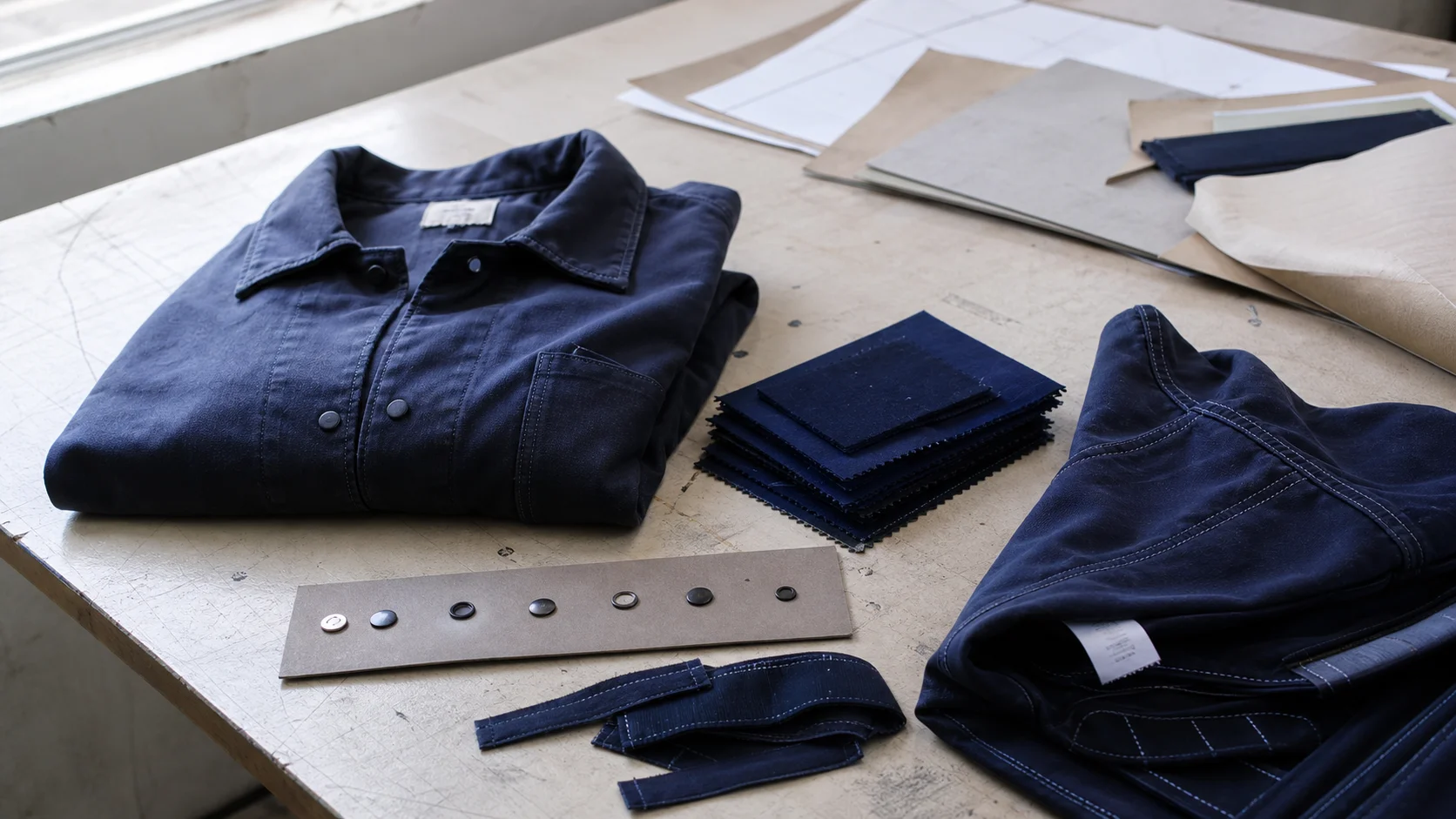
Plastic buttons may be made from polyester, nylon, resin, or other materials. Do not assume a plastic button is polyester-compatible. Zippers are more complicated because tape, teeth, sliders, and stops may use different materials. A polyester zipper tape with plastic teeth and a metal slider may be acceptable for operational use, but it weakens a strict mono-material claim. If recyclability is the priority, ask whether trims can be removed before recycling or replaced with compatible alternatives.
Care labels, size labels, neck labels, woven patches, heat transfers, embroidery backing, and printed logos can all disrupt a clean material stream. Heat transfers may use films and adhesives that are not aligned with the main fiber. Embroidery may require backing material that remains inside the garment. A woven polyester label is usually easier to align than a mixed-material patch.
Purchasing judgment: branding is one of the most common places where a clean mono-material specification gets compromised. Lock the logo method before approving the salesman sample, not after bulk fabric is booked.
Typical MOQs vary widely by vendor, fabric availability, dyeing route, trim sourcing, and customization level. For basic stock-color polyester polos with simple decoration, some vendors may support 100 to 300 pieces per style or even lower through stock programs. For custom color mono-material uniforms, a more realistic MOQ may be 500 to 1,000 pieces per color per style. For custom recycled polyester fabric, dyed-to-match trims, and controlled mono-material components, 1,000 to 3,000 pieces can be common. Complex trousers or jackets may require higher quantities because trims and fabric development are less flexible.
Buyers should treat very low MOQs with caution when the brief includes custom recycled fabric, matching trims, and audit-ready documentation. Low MOQ can be legitimate if the vendor is using existing materials. It becomes risky when the supplier promises full customization, low price, quick delivery, and strict mono-material compliance in the same offer. Something usually gives: fabric quality, documentation, shade control, or trim consistency.
Program Type Typical MOQ Range Best Use Case Main Tradeoff Stock polyester uniform with compatible trims 100 to 500 pieces Pilot programs and small teams Limited color, fit, and trim control Custom color polyester main fabric 500 to 1,500 pieces Corporate uniform rollout Lab dip and shade approval add time Recycled polyester mono-material package 1,000 to 3,000 pieces Sustainability-led procurement Higher documentation and material control burden Complex trousers or jackets 1,500 to 5,000 pieces Large facility service programs Trims, stretch, and performance requirements can conflict with mono-material goalsPricing should be assessed against total program cost, not garment unit price only. A cheaper uniform that pills, fades, shrinks, or fails seams after repeated wash cycles will increase replacement rates. A strict mono-material garment may cost more upfront but reduce sorting complexity and support sustainability reporting. The best purchasing decision depends on volume, wash cycle expectations, contract length, and the credibility of the end-of-life plan.
A disciplined sample process is essential. Buyers should not move directly from quote to bulk order based on a digital mockup. Mono-material workwear programs need physical verification at several stages, especially when custom fabrics, trims, or branding methods are involved.
The first sample confirms general style, fit direction, fabric hand feel, pocket layout, and branding position. At this stage, the buyer should ask the vendor to attach a provisional bill of materials. The goal is to detect obvious material conflicts early. If the polo body is polyester but the rib contains elastane, that needs to be discussed before the next round.
Cleaning crew uniforms need practical fit. Workers bend, lift, kneel, reach overhead, carry tools, and move through tight spaces. Fit samples should be evaluated on motion, not hanger appearance. Tops should not pull sharply across the shoulders. Trouser rises should support bending. Apron ties and tabs should be comfortable and durable.
Custom colors require lab dip approval under controlled lighting. Buyers should approve fabric, rib, buttons, zipper tape, binding, and thread together where visible. A mono-material program can still look poor if trims are technically compatible but visually mismatched. Cleaning crews are often public-facing, so shade consistency matters.
The pre-production sample should represent bulk production standards. It should use actual approved fabric, trims, thread, labels, and branding method. This is the stage to check the full material claim against the final bill of materials. If the vendor substitutes a zipper, label, or backing after this stage, it should trigger re-approval.
For larger programs, a wash and wear trial is worth the time. Even a small internal trial can reveal pilling, odor retention, snagging, seam stress, poor drying, logo cracking, or discomfort. A minimum evaluation after 5 to 10 wash cycles can catch early issues. For high-frequency laundering, buyers may request testing after 25 or 50 cycles depending on contract requirements.
Lead time depends on fabric status, trim availability, color approval, testing requirements, order size, and factory capacity. Buyers should separate sampling lead time from bulk production lead time. A vendor may quote 30 days for production, but that does not include lab dips, fabric booking, recycled content documentation, fit corrections, or testing.
For stock fabric and simple decoration, samples may take 7 to 15 days, with bulk production around 3 to 6 weeks after approval. For custom color fabric, lab dips may add 1 to 3 weeks, and bulk production may move to 6 to 10 weeks after final approval. For recycled polyester with custom trims and audit paperwork, 8 to 14 weeks is more realistic, especially for first orders. Repeat orders are usually faster if the vendor controls fabric and trim continuity.
Lead-time risk is highest when buyers approve the garment style but delay decisions on color, labels, packing, logo method, or size ratio. Mono-material sourcing makes this worse because the vendor may need specific compatible trims that are not held in general stock. A late logo change can force a new backing, film, or label material, which may reopen the material audit.
Stage Typical Timing Common Delay Cause Initial sample 7 to 15 days Unclear tech pack or missing measurements Lab dips 7 to 21 days Difficult brand colors or recycled yarn variation Pre-production sample 10 to 20 days Late trim confirmation or fit corrections Bulk production 4 to 10 weeks Fabric knitting, dyeing, trim sourcing, factory capacity Testing and inspection 5 to 15 days Retesting after failed wash, colorfastness, or seam resultsA sound purchase order should include approval gates. Do not start bulk cutting until the pre-production sample, trim card, lab dip, and material declaration are approved. If the supplier pressures the buyer to approve production while documents remain incomplete, the buyer should treat that as a commercial risk, not a harmless administrative gap.
A vendor audit for mono-material cleaning crew uniforms should test both knowledge and control. The goal is not to punish a supplier for every limitation. The goal is to understand whether the vendor can consistently produce what the buyer is asking for.
Buyers should avoid treating the audit as a paperwork exercise only. A factory can submit the right documents and still allow line-level substitution if material controls are weak. A practical audit asks what happens when the approved polyester button runs short, when the thread shade is unavailable, or when a subcontracted decoration unit uses a different backing. The answer reveals the supplier’s real control level.
Mono-material workwear inspection should include normal garment quality checks and sustainability-specific checks. Standard inspection covers measurements, workmanship, defects, stains, shade variation, labels, packing, and quantity. A mono-material audit adds verification of trim consistency, fiber declarations, branding materials, and any approved exceptions.
Cleaning crew uniforms have recurring QC risks:
Inspection plans should be based on order size and risk. For a repeat order using approved materials, a standard final random inspection may be enough. For a first mono-material order, buyers should consider fabric inspection before cutting, inline inspection during sewing, and final inspection before shipment. A failed final inspection is expensive if the fabric has already been cut and sewn.
Purchasing judgment: if the uniform will be washed every few days, do not rely on an unwashed showroom sample. Wash performance is not a secondary detail in cleaning crew workwear; it is the product.
Buyers can set acceptable quality limits, but they should also identify critical defects that trigger rejection. Wrong fiber trim, unapproved branding backing, severe shade mismatch, incorrect size labels, and poor seam strength should be treated seriously. Minor loose threads and removable marks are different from defects that compromise the sustainability claim or operational use.
Mono-material design only creates value if there is a realistic end-of-life route. Buyers should ask vendors what happens when uniforms are retired. Can garments be collected, sorted, repaired, downcycled, mechanically recycled, chemically recycled, or transferred to an approved textile recovery partner? The answer may vary by country and program scale.
A vendor may not operate a take-back program directly, and that is not automatically a deal-breaker. The stronger audit question is whether the garment has been designed to support future sorting and recycling. If every uniform uses mixed trims, unknown logo films, and incompatible reinforcements, the end-of-life claim is weak. If the vendor can provide material data and keep components aligned, the buyer has more options.
End-of-life planning should include identification. Uniforms may carry company logos, names, or security-sensitive branding. Buyers may need a process for de-branding before reuse or recycling. Heat transfers and embroidery can complicate that step. A removable badge system may be useful for some programs, but it can introduce non-compatible hardware. There is no perfect answer. The tradeoff should be documented and intentional.
Buyers should also separate recyclability from actual recycling. A garment can be technically recyclable and still end up discarded if collection, sorting, and processing are not organized. For procurement teams presenting sustainability results to clients, this distinction matters. Use careful language: “designed for improved recyclability” may be more accurate than “will be recycled” unless a take-back and processing route is confirmed.
A scorecard helps compare vendors beyond price. It should weight sustainability, workwear performance, documentation, and production reliability. A low-cost vendor with weak material control may be suitable for a basic uniform order, but not for an audit-ready mono-material program. A higher-cost vendor with stronger documentation may be a better choice for enterprise cleaning contracts where sustainability reporting is part of the buyer’s service promise.
Audit Area Strong Vendor Indicator Buyer Rating Mono-material understanding Can explain garment-level fiber compatibility, not just main fabric content. High priority Bill of materials Provides full BOM with fabric, trims, thread, labels, and branding materials. High priority Fabric performance Has test data for wash shrinkage, pilling, colorfastness, and seam strength. High priority Trim discipline Uses approved trim cards and controls substitutions. High priority MOQ flexibility Can support pilot quantities without overstating custom capability. Medium priority Lead-time reliability Separates sampling, lab dips, testing, production, and inspection timing. Medium priority End-of-life readiness Provides material data and supports sorting or take-back discussions. Medium priority Commercial transparency States tradeoffs clearly instead of promising every benefit at lowest cost. High priorityBuyers should rank vendors after receiving samples, documents, and pricing. A quote without a sample is not enough. A sample without a BOM is not enough. A BOM without test data is not enough for demanding cleaning crew workwear. The strongest approval file combines all three.
A practical audit brief should be short enough for vendors to answer, but detailed enough to prevent evasive responses. The buyer can structure it in sections: garment scope, sustainability objective, material specification, performance requirements, sample process, documentation, inspection, and commercial terms. Each section should include must-have requirements and preferred options.
List every garment style in the program. Include expected annual volume, size range, gender or fit requirements, colorways, logo placements, and use environment. A vendor quoting only the polo may not be able to supply the trouser, apron, or jacket at the same mono-material standard.
State whether the program requires mono-material construction, recycled content, reduced mixed-fiber complexity, or verified end-of-life support. If exceptions are allowed, define them. For example, a buyer may permit a non-polyester zipper slider if it is removable or if the garment still meets a defined minimum polyester weight percentage.
Cleaning uniforms should be tested for washing, colorfastness, pilling, seam strength, abrasion, and dimensional stability. If workers are exposed to bleach or strong cleaning agents, the buyer should discuss realistic exposure. No supplier should promise universal chemical resistance without a specific test method and chemical list.
Request fabric specs, trim cards, BOM, test reports, material declarations, and recycled content evidence where applicable. The buyer should ask vendors to mark which documents are available now, which are available after sampling, and which are not available. That transparency is useful.
Define inspection stages and defect classifications. Include sustainability-related defects such as unapproved mixed-fiber trims, wrong thread, incorrect labels, or undocumented logo backing. A final inspection checklist should match the approved pre-production sample and BOM.
Buyers need clear decision rules. A vendor can be promising but not ready. Another vendor can be technically capable but too expensive for the program. The best decision balances sustainability value, operational reliability, and commercial practicality.
Approve a vendor when the sample performs well, documents match the claim, trims are controlled, and lead times are realistic. Pause the vendor when the concept is good but BOM details, test reports, or trim compatibility remain unresolved. Reject or de-scope the vendor when mono-material claims are broad but unsupported, when sample quality is weak, or when the supplier repeatedly substitutes materials without approval.
This is where sourcing discipline protects both the sustainability claim and the operating budget. A cleaning contractor or facilities manager cannot afford uniforms that fail in use. A brand or procurement team cannot afford sustainability claims that collapse under review. The audit brief should make both risks visible before the purchase order is placed.
Mono-material workwear sourcing often requires coordination between buyer, vendor, fabric mill, trim supplier, decoration provider, and quality team. A sourcing partner can help structure the brief, compare supplier responses, and separate realistic claims from optimistic marketing. The buyer still needs to own the decision, but external support can reduce avoidable sampling loops and documentation gaps.
For teams building supplier criteria or comparing sustainable workwear options, Fabrikn’s company background is available at Fabrikn’s about page. If the program is ready for vendor discussion, sample planning, or production review, buyers can start a conversation through Fabrikn’s contact page.
A mono-material workwear uniform vendor audit brief for cleaning crews should be specific, testable, and commercially realistic. The buyer should verify the whole garment, not only the shell fabric. That means fabric composition, thread, trims, labels, branding, performance testing, shade control, laundering results, and end-of-life readiness all need attention.
The strongest sourcing route is often phased. Start with simple high-volume garments such as polos, T-shirts, aprons, or tabards. Test them through real laundering and wear conditions. Use the results to refine the specification before expanding into trousers, jackets, and more complex styles. This gives the buyer measurable progress without forcing risky claims across the full uniform range too early.
Mono-material workwear is not automatically cheaper, easier, or universally better. It can be a strong sustainability move when the vendor controls materials and the buyer audits the details. It can become greenwash when the claim stops at the main fabric. Procurement teams should ask direct questions, require physical proof, and document every approved exception. That is the difference between a sustainability label and a uniform program that can stand up to real buyer scrutiny.
Get a free quote from Fabrikn — your trusted B2B clothing manufacturer with 10+ years of experience. MOQ as low as 200 pieces.
Get a Free Quote →Mono-material workwear is designed mainly from one fiber type, such as polyester, to reduce material complexity and improve recyclability. In a strong specification, the buyer checks not only the main fabric but also sewing thread, trims, labels, branding materials, and reinforcements.
Polyester is often practical for cleaning crew uniforms because it dries quickly, resists shrinkage better than many cotton fabrics, and can support mono-material design. The tradeoff is that buyers must manage pilling, snagging, heat comfort, static, and recycled-content shade consistency.
It depends on the claim standard. If the garment uses polyester fabric but mixed-material zippers, buttons, or snaps, it may be better described as “designed with a mono-material main fabric” or “high polyester content.” A strict mono-material claim should be supported by a full bill of materials and approved exceptions.
Stock or semi-custom polyester uniforms may start around 100 to 500 pieces. Custom color or recycled polyester programs often require 500 to 3,000 pieces per style or color. Complex trousers and jackets can require higher MOQs because compatible trims and custom fabrics are harder to source in small quantities.
Buyers should prioritize wash shrinkage, colorfastness, pilling, seam strength, tear or tensile strength, logo durability, and dimensional stability. For cleaning crews, testing after repeated washing is especially important because uniforms may be laundered much more frequently than casual apparel.
Request supplier declarations, fabric specification sheets, batch information, and certification documents where applicable. The level of evidence should match the buyer’s reporting requirement. A general statement on a quotation is not enough for an audit-ready sustainability claim.
No. Mono-material design can improve recyclability, but actual recycling depends on collection, sorting, contamination, branding, trims, and access to a suitable recycler. Buyers should avoid promising recycling unless the end-of-life process is confirmed.
The biggest risk is hidden material mixing. A vendor may use the right main fabric but substitute thread, labels, zippers, rib, embroidery backing, or heat-transfer films that do not match the mono-material brief. A detailed BOM, trim card, and final inspection checklist reduce that risk.
Stretch improves movement, especially in trousers, but elastane creates a mixed-fiber garment. Buyers who want stronger mono-material alignment can consider mechanical stretch polyester, though it may not provide the same recovery or comfort as elastane blends. Fit testing is essential.
Reject or qualify the claim when the vendor only documents the main fabric, cannot identify trim composition, refuses to provide a BOM, or substitutes materials without approval. A supplier can still be used for standard uniforms, but not for a credible mono-material audit program.